Authors: Ye Yang, Liu Honglin
Since Satoshi Nakamoto released the first Bitcoin software in 2009, virtual currency has undergone great development and stood firm in the market, from a niche speculative project to a popular investment project. Today, virtual currency is favored due to its decentralization, anonymity, and globality, and more and more people are considering adding a portion of virtual currency investment to their asset allocation. However, these advantages of decentralization and anonymity will turn into disadvantages once it involves a certain issue, that is, inheritance.
Things before death - wallet and private key
The most important thing to inherit virtual assets such as cryptocurrency is to make arrangements early in life.
In the universally anonymous and decentralized world of virtual currencies, the wallet and its core private key are the proof of identity in this world. Conversely, as long as the wallet and private key are entrusted to others, the inheritance is directly completed.
A wallet is an application for managing virtual currency. The mainstream wallets are divided into PC wallets, browser extension wallets, mobile wallets, and hardware wallets. For PC wallets, browser extension wallets, and mobile wallets, it is necessary to clearly convey the application type of the wallet to the heirs. For hardware wallets, it is necessary to preserve the hardware device to ensure that it can be transferred to the heirs intact.
The private key is equivalent to the username and password for logging into the wallet in one. In actual use, the private key is converted into a mnemonic. When conveying it to the heir, the correctness of the mnemonic must be ensured. If it comes with a password, the method of using the password must also be conveyed.
So how should the wallet and private key be conveyed to the heirs? Inheritance is ultimately just insurance. Informing the heirs in advance may result in some avoidable losses and disputes.
1. Paper and Pen Delivery
You can record the wallet type (or wallet location if it is a hardware wallet), mnemonic phrase and other information on paper, and then put it in a safe, just like the paper wallets commonly used in the cryptocurrency circle. You can put the password of the safe in your will, or directly deposit the paper wallet in a bank safe to ensure that the heir can open the safe only after inheriting the estate.
2. Hardware preservation
You can also save the necessary information for inheritance on a USB or mobile hard drive, set up password protection, and save the hardware and password separately to ensure that the heirs can access the information in the hardware through the password after inheriting the estate.
3. Disable switch
You can also look for kill switch applications, such as the Sarcophagus project built on Ethereum and Arweave. Specifically, you can upload the necessary information for inheritance in the application, and the application will encrypt it and store it permanently on the network. At the same time, you need to set a file decryption time and specify your heir as the recipient. Before the decryption time arrives, you can choose to extend the storage time of the file or terminate the service, otherwise the file will be automatically decrypted to the recipient.
The above methods all have their own advantages and corresponding risks. Please choose the method that suits you to inherit your virtual assets.
What happens after death — centralized platform accounts
If you don’t leave your wallet and private key before you die, there is a high possibility that your virtual assets will not be inherited. After all, decentralization is the underlying characteristic of virtual currency. However, after so many years of development, centralized exchanges have also developed in the virtual currency world. Exchanges have sacrificed a certain degree of decentralization and anonymity in exchange for some security and convenience. If the deceased heir mainly uses a centralized exchange account to manage virtual assets, then as long as the heir knows the account name, he can file a complaint through the platform to inherit the virtual assets.
The inheritance process of each platform may not be consistent, and the required materials may also be different. This article only takes Binance as an example to introduce how to inherit the virtual currency in the deceased's account.
Previously, Binance’s inheritance appeal process was that after the heir registered his or her own account, he or she informed the customer service that he or she was the heir and needed to inherit the estate, and then he or she could directly enter the inheritance appeal page through the link of the AI customer service.
The required materials are not complicated. In addition to the inherited Binance account information, the heir also needs to provide the following three items:
1. Identity documents of the heir and the deceased;
2. Death certificate of the deceased;
3. Wills, notarized certificates of inheritance and other relevant legal documents proving the right of inheritance.
The above three materials need to be notarized or certified by a lawyer and accompanied by an English translation.
The third item is more troublesome, because when it comes to the stage of inheritance appeal, it is usually because there is no time to leave a will to deal with this virtual property. If there is no dispute about the inheritance, you can go to the notary office to apply for a notarized certificate of inheritance rights , which generally requires the death certificate of the heir, proof of kinship, personnel files of the heir, property certificates and other materials; if there is a dispute about the inheritance, you need to entrust a lawyer to conduct inheritance dispute litigation , and the final effective judgment is also a legal document that can prove the inheritance rights.
After submitting the above materials and passing Binance's review, you can inherit the virtual currency in the deceased's account in the heir account.

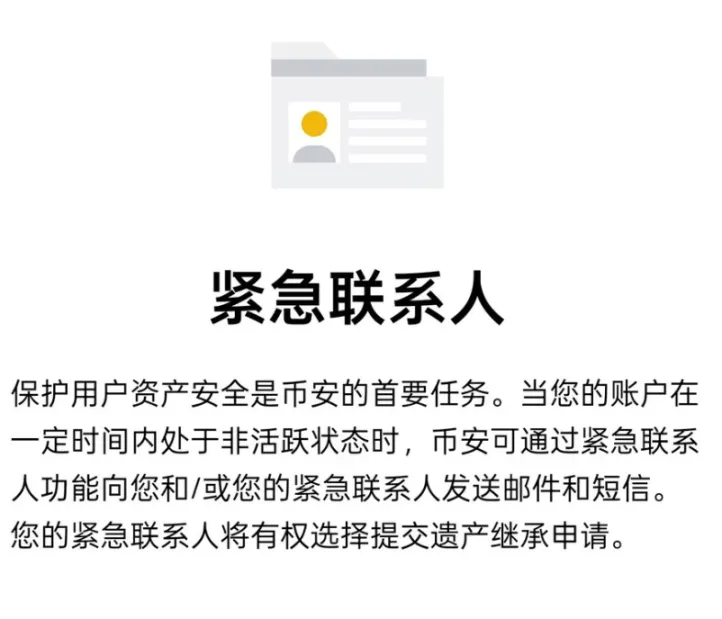
Recently, Binance launched the "Emergency Contacts and Heirs" feature in its APP platform update. In terms of specific operations, users can add emergency contacts in the "Account Security" settings of the Binance App. The path is: Home-Personal Information-Account Security-Emergency Contacts. When the account is inactive for a long time, Binance will automatically notify the emergency contact, and the emergency contact has the right to apply for inheritance.
Changpeng Zhao, the founder of Binance, commented on Twitter: “This is a topic that people don’t like to talk about, but humans have not yet achieved immortality. Every platform should have a ‘will function’ to ensure that when a user is gone, his assets can be distributed to a designated account in a specified proportion.”
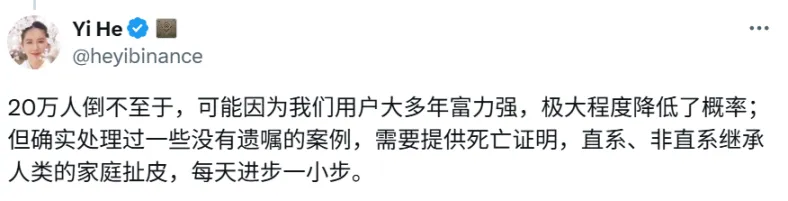
Binance co-founder He Yi responded in the Twitter comment section that Binance users are mostly old and strong, which greatly reduces the probability of accidental death, but they have indeed dealt with some cases without wills, requiring the provision of death certificates and dealing with disputes over direct and indirect inheritance.
Attorney Mankiw's Summary
Cryptocurrency is an asset with a high threshold for holding. You may have accumulated considerable virtual assets by avoiding market fluctuations, hacker fraud, legal risks, etc., but your family may know nothing about virtual currency. In extreme cases, the investor may die, and his family and heirs may not even know that the investor still holds a virtual property; or they may only know that the investor is playing with virtual currency, but have no idea what wallet or platform he uses; or they may get virtual currency based on clues left by investors, but step on landmines in the process of issuing coins, resulting in disputes.
Therefore, effective communication within the family is crucial. Attorney Mankiw recommends that you hold more family meetings in your daily life to explain to your family the operating principles, value, and how to manage these assets of virtual currency. Through education and communication, it is not only about leaving a virtual asset for your family, but also about leaving your investment philosophy and management skills, which is the key to ensuring the smooth inheritance of virtual assets.