

Jamie Dimon, the Wall Street mogul who once called Bitcoin a 'fraud', probably didn't expect that he would now open the door to cryptocurrencies himself.
According to Bloomberg on June 4, citing people familiar with the matter, JPMorgan Chase will begin providing financing services with shares of BlackRock's iShares Bitcoin Trust (IBIT) as collateral in the coming weeks. This policy will be open to all customer groups around the world, from individual retail investors to institutional investors.
This milestone move not only marks a major shift in traditional finance’s attitude toward crypto assets, but also indicates that the deep integration of digital assets into the mainstream financial system is accelerating.

New rules for loan collateral: Bitcoin ETFs are on par with traditional securities
It is worth noting that in addition to loan collateral, JPMorgan Chase will also begin to take cryptocurrency holdings into consideration when evaluating the net worth and liquid assets of some customers, putting them on the same footing as traditional securities such as stocks, cars or artworks to assess loan qualifications.
At the investor day event in May this year, Dimon publicly stated that he was "not optimistic about Bitcoin", but only reluctantly admitted that "customers have the right to buy." Therefore, this is not a simple business adjustment, but a meaningful turning point.

The move marks JPMorgan’s move toward a more formal and structured funding framework beyond its previous limited, case-by-case approval of crypto asset collateral.
Previously, other Wall Street financial institutions such as Morgan Stanley have also been exploring the wider integration of crypto products. For example, Bloomberg reported last month that Morgan Stanley plans to launch cryptocurrency trading on its E*Trade platform.
Attitude change + institutional demand
Dimon has long been critical of cryptocurrencies, particularly their use in illegal activities such as money laundering. However, his recent softening of his stance, especially his statement that “I’m not a fan of Bitcoin, but I defend your right to buy Bitcoin,” clearly demonstrates the pragmatic choice of banks in the face of market and regulatory pressure.
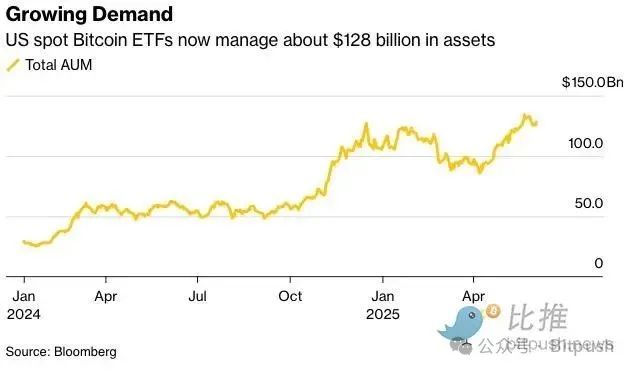
Wealth management companies are facing a large demand from clients for exposure to digital assets. Data shows that the total size of US spot Bitcoin ETFs has exceeded US$128 billion since its launch, and its average daily trading volume has crushed gold ETFs.
The public listing of crypto companies such as Circle on U.S. stock exchanges, coupled with investors' growing interest in cryptocurrencies ahead of a long search for regulatory clarity, has made it harder for banks to ignore this space. Earlier, a private banking consultant at JPMorgan Chase mentioned in an interview with CNBC: "Every day, high-net-worth clients ask: Why can't I allocate Bitcoin?"
"Official endorsement": Trump administration's "pro-crypto" policy
JPMorgan Chase launched JPM Coin as early as 2019 to test the blockchain, but has always kept a safe distance from Bitcoin. The background of this change is that the regulatory environment in the United States is becoming increasingly favorable. Since President Trump took office again in January 2025, his government has taken a clear "pro-crypto" stance.
Executive Order and Working Group: On January 23, 2025, Trump signed an executive order aimed at promoting the responsible growth of digital assets and blockchain technology, emphasizing the United States’ role as a global leader in innovation.
Crypto-friendly appointments: His government has also appointed crypto-friendly figures such as David Sacks to lead a crypto task force charged with creating a legal framework that supports industry growth and provides clarity for businesses.
Treasury Secretary's statement: Scott Bessent, the Treasury Secretary of the Trump administration, has been an active advocate of blockchain innovation, which is in stark contrast to the strict defense of the Biden era. During the tenure of former Treasury Secretary Janet Yellen, banks such as JPMorgan Chase received multiple regulatory warning letters for serving crypto companies.
From a more macro perspective, this "compromise" reflects the beginning of a new era: when asset management giants such as BlackRock and Fidelity have launched Bitcoin ETFs, and when the Trump administration has elevated crypto innovation to a national strategy, the resistance of traditional financial institutions has become inappropriate.