
Introduction
On January 3, 2009, the genesis block of Bitcoin was successfully mined, marking the first application of blockchain technology in the field of decentralized digital currency, and the Bitcoin network was officially launched. In the following decade, Bitcoin and the cryptocurrency market it led showed a significant long-term bullish trend. But this journey was by no means smooth, and its price trend showed violent and distinctive cyclical fluctuations, during which it experienced multiple transitions from a frenzy bull market to a deep bear market. These fluctuations are not random, but are closely linked to a series of core events that have a profound impact on the market structure.
Looking at the price trend of Bitcoin from 2009 to 2025 (data source: The Block), it can be clearly divided into six major development stages based on its price range and change trend. The landmark events of each stage and their profound impact on the industry ecology are as follows:
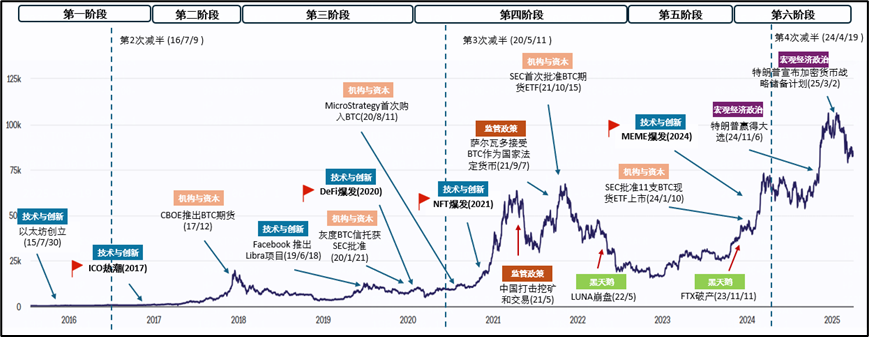
Looking at the price trend of Bitcoin from 2009 to 2024, it shows significant cyclicality. According to the price range and price change trend of Bitcoin, it can be divided into six major development stages. The landmark events of each stage and their profound impact on shaping the industry ecology are described as follows:
Phase 1 (2009-2016): Initial market exploration and technical foundation
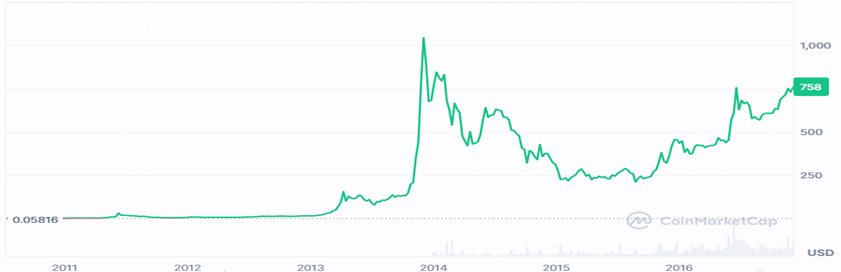
When Bitcoin was first born, it was just a niche toy in the geek circle and a testing ground for cryptography enthusiasts. From 2009 to early 2013, its price remained low. However, in 2013, the price of Bitcoin experienced its first violent fluctuation, soaring from about $20 at the beginning of the year to more than $1,100 at the end of the year, and then falling sharply. This roller coaster-like market brought Bitcoin to the global vision for the first time.
Source: CoinGecko
Why did the price of Bitcoin suddenly soar in 2013? The driving factors behind it are as follows:
1. The Cyprus banking crisis ignited safe-haven demand
In March 2013, the Cypriot government announced a tax on bank deposits in exchange for international aid. This radical measure triggered strong public protests, bank runs and market turmoil, profoundly exposing the fragility of the traditional financial system and the potential risks of government decision-making.
Against this backdrop, Bitcoin’s decentralized nature and its lack of control by a single government made it widely viewed as a potential safe-haven asset for the first time. Although Bitcoin’s circulation and application were still in their early stages, the Cyprus crisis clearly demonstrated the shortcomings of the traditional system. This event became a catalyst, allowing Bitcoin’s value proposition as an alternative asset, especially its potential safe-haven properties, to receive unprecedented market attention and initial recognition.
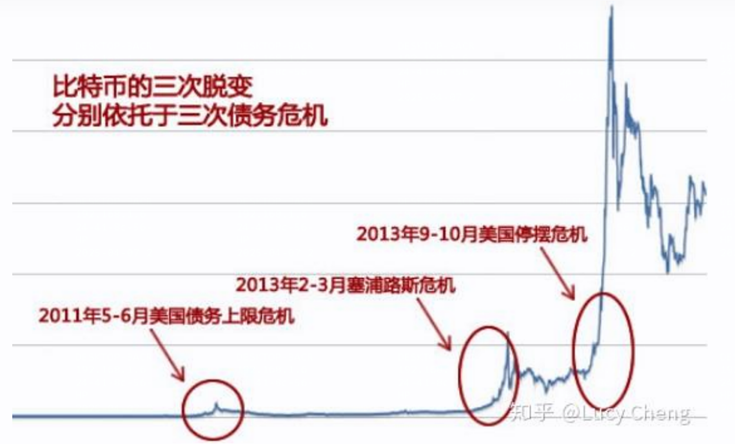
The Cyprus crisis was not an isolated case, as it occurred against the backdrop of the continued fermentation of the world’s sovereign debt crisis. At that time, many countries were deeply in debt, triggering widespread market concerns about the stability of legal currencies and a shaken confidence in legal currencies. This continued environment of uncertainty created a breeding ground for non-traditional assets such as Bitcoin.
In fact, looking back at 2013, the timing of several significant jumps in Bitcoin prices was often closely linked to key risk events in the debt crisis or the intensification of market panic. This shows that the general anxiety about the risks of the traditional financial system is a deep and persistent factor driving the surge in demand and price of Bitcoin that year.
2. Preliminary recognition of regulatory policies
Against the backdrop of the rapid rise in Bitcoin prices, the dynamics of regulatory policies are the vane of the industry's future development. On November 18, 2013, the relevant US government held a special hearing on the risks and threats of Bitcoin and other virtual currencies, publicly recognizing the legitimacy of Bitcoin for the first time.
The clarity of regulatory attitudes instantly ignited market enthusiasm. The day after the hearing (November 19), the price of BTC on Mt.Gox, the world's largest Bitcoin exchange at the time, soared by more than 114% in a single day from about $420 before the hearing, breaking through the $900 mark in one fell swoop, and hit a record high at the time shortly thereafter. This surge caused by regulatory policies clearly demonstrated the huge role that regulatory recognition plays in promoting market confidence and capital inflows.
3. Wide coverage by mainstream media
In 2013, Bitcoin completely "broke the circle" from the technology geek circle and became the focus of mainstream media around the world. Major media outlets rushed to report on the soaring price of Bitcoin, the stories of early investors getting rich, and its disruptive potential. This greatly stimulated the public's investment interest and speculative enthusiasm, and countless new investors poured into the market due to FOMO emotions, forming a strong buyer force.
However, in 2013, when the regulation was favorable and the market sentiment was high, why did the price of Bitcoin not continue to soar, but instead entered a downward cycle in 2014?
1. Regulatory risks emerge
During the window period when there was no strict regulatory framework, the dark web (such as Silk Road) flourished with Bitcoin. As a hotbed of illegal transactions that cannot be tracked, the rampant money laundering, drugs and contraband transactions on the dark web forced regulators to face up to the potential harm of cryptocurrencies. The landmark event was the FBI's seizure of the first generation of "Silk Road" in October 2013. This action not only dealt a heavy blow to the dark web ecosystem, but also sent a clear signal to the market: Bitcoin is not a lawless place.
2. China tightens regulation
On December 5 of the same year, the People's Bank of China issued the "Notice on Preventing Bitcoin Risks", prohibiting financial institutions from providing Bitcoin-related services. This suppressed the financial application of Bitcoin in China, causing a sharp drop in the price of Bitcoin in the short term.
3. Exchange trust crisis
On February 28, 2014, the Mt.Gox exchange announced bankruptcy and a large number of Bitcoins were lost, triggering widespread global concerns about the security and regulation of exchanges. Bitcoin prices fell further.
Phase characteristics: The decentralized nature of Bitcoin was significantly reflected in the first stage, just like the "peer-to-peer electronic cash system" defined in the Bitcoin white paper, and its anti-censorship and independent sovereignty were verified in the real world. At the same time, the early immature ecology also exposed its vulnerability to the lack of regulation.
Phase 2 (2016-2018): ICOMania and regulatory punch
Source: CoinGecko
Breakthrough in the Crypto Ecosystem
On July 20, 2015, the Ethereum mainnet was launched. The smart contracts and decentralized application framework introduced by it expanded blockchain technology from a single payment scenario to the entire ecosystem of finance, games, and social networking, marking the official start of the technological revolution of the value Internet.
While innovating technology, Bitcoin's internal mechanism began to exert its strength: the second block reward was halved on July 9, 2016. The expectation of scarcity and the incremental funds brought by the Ethereum ecosystem jointly pushed the market out of the trough at the end of 2016 and started a new round of recovery cycle.
With the maturity of Ethereum smart contract technology, the global ICO market showed explosive growth in 2017. By the end of November of that year, a total of 430 ICO projects had been born worldwide, with a total financing amount of US$4.6 billion. Taking the Chinese market as an example, the 2017 research brief of the National Institute of Finance of Tsinghua University shows that the scale of domestic ICO financing has reached 2.6 billion yuan in the first half of the year alone, with more than 100,000 investors participating, reflecting a significant increase in market participation.
The rise of this craze stems from two driving factors
- For project parties, ICO provides a financing channel that circumvents the strict review of traditional IPOs. Funds can be raised with only basic technical documents, while avoiding the problem of equity dilution;
- For ordinary investors, low-threshold participation in early projects and obtaining short-term premium returns after the listing of tokens constitute a strong speculative motivation.
However, market expansion is accompanied by the accumulation of systemic risks. ICO projects generally lack information disclosure mechanisms and qualification review standards, and there are no clear regulations on fundraising scale and circulation methods. In the absence of supervision, the scope of financing has expanded disorderly from the development of core blockchain technologies to the Internet of Things, gambling, social media and other fields. More seriously, the technical security risks of smart contracts continue to be exposed, further amplifying market risks.
Regulatory heavy-handedness and market turning point
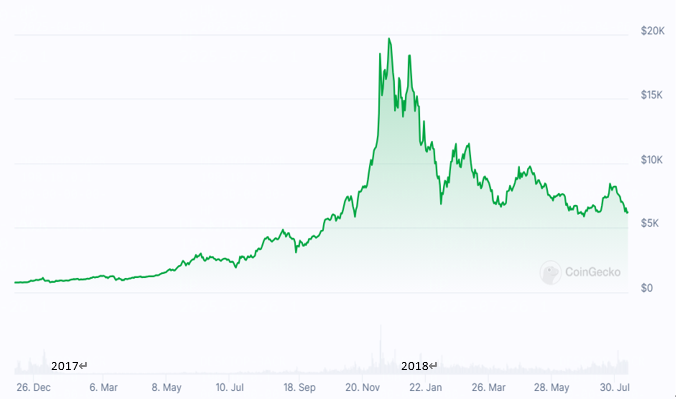
In response to the above chaos, on September 4, 2017, the People's Bank of China and seven ministries and commissions jointly issued the "Notice on Preventing the Risks of Token Issuance and Financing", which clearly defined ICO as illegal public financing. The ban requires domestic cryptocurrency exchanges to stop trading and close their platforms before September 15, which directly led to a cliff-like drop in the trading volume of the virtual currency market and a sharp drop in the price of Bitcoin. This regulatory action marks a paradigm shift in the global governance of decentralized financing.
Stage characteristics: In the second stage, we can see that Ethereum's technological innovation has driven the explosive growth of the market. However, the absence of macro-regulation has led to the accumulation of risks. This process reveals the two-way role of the macro-dynamic mechanism, that is, technology and innovation provide the momentum for market growth, while the reconstruction of the regulatory system guides the direction of market correction.
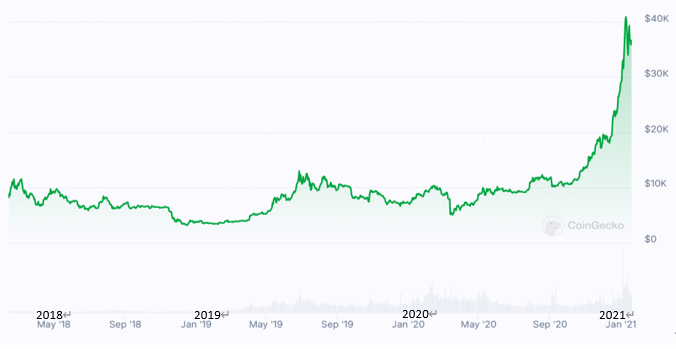
The third stage (2018-2020): Market clearing and institutional ice breaking
Source:CoinGecko
Deep callback and market clearing
After the ICO bubble burst in 2017, the Bitcoin market entered a deep callback cycle in 2018, accompanied by the bankruptcy and liquidation of a large number of projects, and prices continued to be under pressure. By the beginning of 2020, the price of Bitcoin remained in the range of $10,000. The core turning point of this stage was the entry of traditional capital and compliance institutions, which laid the foundation for a new round of bull market and finally triggered a wave of innovation in decentralized finance (DeFi) in the summer of 2020.
Entry of institutions
On June 18, 2019, Facebook officially released the Libra stablecoin white paper, attempting to build a global digital currency payment network. This disruptive challenge to the traditional financial system was eventually shelved due to the political siege of global regulators.

On January 21, 2020, Grayscale Bitcoin Trust completed its registration with the U.S. Securities and Exchange Commission (SEC), becoming the first cryptocurrency investment tool regulated by the SEC. The company's general manager Michael Sonnenshein emphasized: "Grayscale voluntarily accepted this appointment and will continue to work within the existing regulatory framework. Today's statement should send a signal to investors that our regulators are willing to participate in our products and the entire (cryptocurrency) industry." This move provides a compliant entry channel for institutional capital and significantly lowers the configuration threshold.
On August 11, 2020, MicroStrategy purchased 21,454 bitcoins for the first time at a price of $250 million. Today (2025), MicroStrategy has become one of the world's largest companies that publicly hold bitcoins. MicroStrategy's Bitcoin purchase strategy has completely changed the way companies think about financial management and transformed the entire industry's attitude towards digital assets.
Phase characteristics:The third stage is a critical period for market self-repair and transformation. In the bear market where the ICO bubble burst, inferior projects were washed out. The entry of real-world institutions has provided an institutional path for the crypto market, which has also paved the way for the next stage of market explosion.
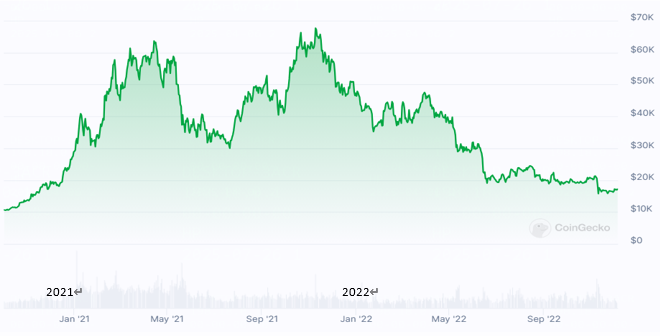
The fourth phase (2020-2022): Defiexpansion, NFToutbreak and regulatory differentiation
Source: CoinGecko
DeFiEcosystem grows exponentially
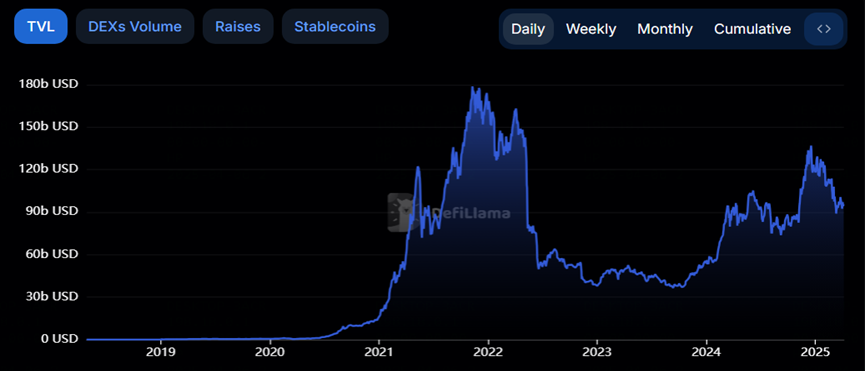
Based on the composability innovation of Ethereum smart contracts, decentralized finance (DeFi) started its explosive cycle in the summer of 2020. Core indicators show exponential growth. According to DeFi Llama statistics, the total value locked (TVL) of the industry soared from about US$15 billion at the beginning of 2021 to a peak of nearly US$180 billion at the end of the same year, an annual increase of 1,100%. Thousands of protocols that emerged in this process have reshaped the traditional financial logic. Representative projects with infrastructure significance include:
- Compound, a mortgage lending protocol
- Uniswap, an automated market maker
- USDT, a stable currency system
- ChainLink, a decentralized oracle
- Synthetic asset platform Synthetix
NFTmarket explosion
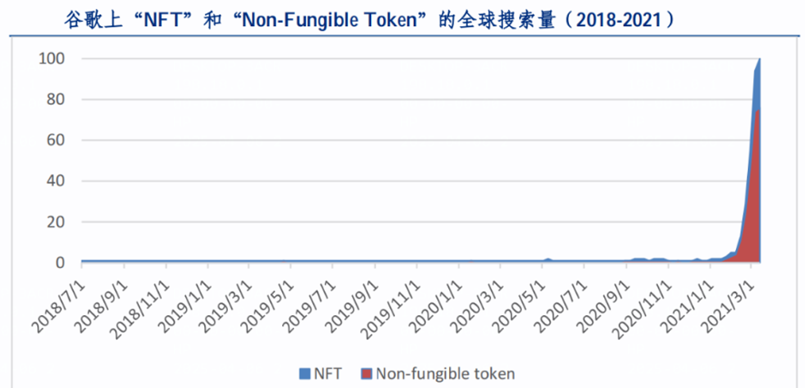
At the same time, the non-fungible token (NFT) market completed the transition from technical experiments to mainstream consumer scenarios. Its core breakthrough is to achieve the unique confirmation of digital content on the chain through the ERC-721/1155 standard, giving rise to trillion-level emerging markets such as artworks, collectibles, and virtual real estate. Typical cases include CryptoPunks, BAYC Bored Ape, and Decentraland, marking a fundamental shift in the ownership economic paradigm.
Global regulatory positions are significantly divided
In the fourth stage, the regulatory positions of various countries on cryptocurrencies are divided:
China
- May 2021: The Financial Stability and Development Committee of the State Council clearly requires "cracking down on Bitcoin mining and trading behaviors", and mining centers such as Inner Mongolia and Xinjiang have carried out clearance;
- September 2021: The central bank and ten other ministries and commissions issued the "Notice on Further Preventing and Dealing with Virtual Currency Trading Speculation Risks", defining virtual currency-related businesses as "illegal financial activities" and completely prohibiting the provision of domestic services.
El Salvador
On June 8, 2021, the Legislative Assembly of El Salvador voted to determine Bitcoin as an unrestricted legal tender, making the Republic of El Salvador the first country to officially adopt cryptocurrency.
United States
On October 15, 2021, the U.S. Securities and Exchange Commission (SEC) approved the listing of the ProShares Bitcoin Futures ETF (code: BITO) on the New York Stock Exchange. This move marks the first time that the traditional financial system has accepted cryptocurrency derivatives, opening up a standardized channel for institutional capital allocation.
Phase characteristics:Technological innovation has driven the market to unprecedented prosperity, but the pressure for regulatory adaptive reconstruction has increased significantly after the peak of the bull market, and the regulatory paths of various countries have shown significant differences.
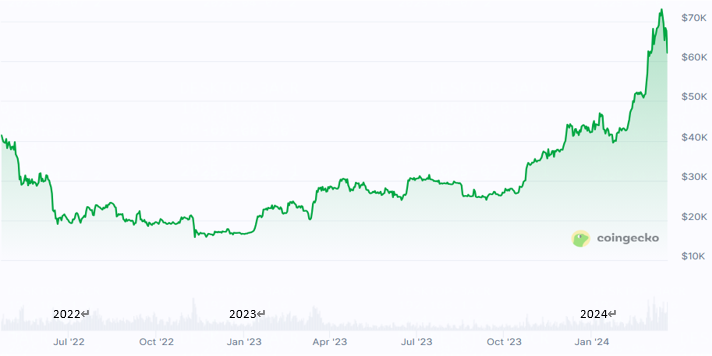
The fifth phase (2022-2024): Black Swan impact and governance restructuring
Source: CoinGecko
Serial Risk Events and Deep Downturn
Under the impact of serial risk events such as the collapse of LUNA, the bankruptcy of Celsius and the closure of FTX, the cryptocurrency market fell into a deep downturn in 2023. The price of Bitcoin has continued to decline since the end of 2022, and has fallen below $20,000 by the beginning of 2023.
In May 2022, the Terra ecosystem collapsed, causing its algorithmic stablecoin UST to be seriously decoupled, and the value of LUNA tokens was destroyed. The incident triggered a systematic reflection on the decentralized stablecoin economic model. Panic spread to the entire stablecoin market, and mainstream stablecoins such as USDT were once under pressure to run.
Celsius, a crypto lending institution, was one of the first crypto institutions to be implicated in the collapse of TerraUSD and Luna, and filed for bankruptcy in July 2022. This forced regulators to accelerate the formulation of regulatory requirements for lending platforms.
In November 2022, the FTX exchange went bankrupt, triggering a crisis of trust in the exchange and becoming a black swan that crushed market confidence. Since then, the market has put forward higher requirements for the transparency and trust of exchanges, which has promoted the reflection and improvement of the industry.
Phase characteristics: A series of black swan events exposed the industry's problems in risk management, transparency and governance, and the market entered a bear market, forcing the market to carry out painful but necessary clearing, and promoting the industry's reflection and upgrading of security, transparency and regulatory compliance.
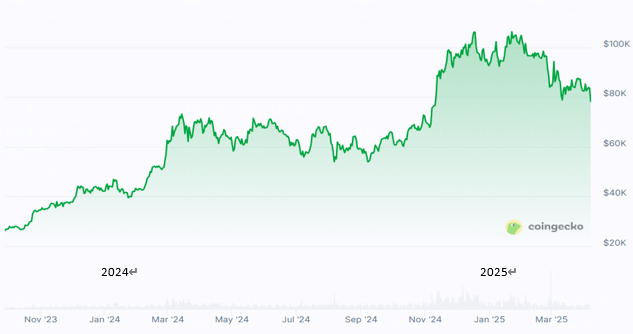
The sixth phase (2024-2025): Institutional breakthrough and macro narrative resonance
Source: CoinGecko
Market recovery and historic breakthrough
Driven by regulatory compliance and monetary policy shift, the cryptocurrency market achieved a historic breakthrough in 2024. Bitcoin price broke through the $100,000 mark for the first time, Ethereum significantly improved Layer2 scalability through the Cancun upgrade, and the Meme Coins sector simultaneously showed explosive growth.
In January 2024, the U.S. Securities and Exchange Commission (SEC) approved the listing of 11 BTC spot ETFs, and a large amount of funds from traditional institutions entered the crypto market, further promoting the compliance development of the crypto market. In May of the same year, the Ethereum spot ETF was approved.
In September 2024, the Federal Reserve cut interest rates by 50 basis points for the first time in four years. This move promoted the transfer of funds from traditional markets to high-risk assets, and a large amount of liquidity was injected into the crypto market.
In November 2024, Trump was elected as the President of the United States. His public support for cryptocurrency pushed the price of Bitcoin to exceed $100,000.
Phase characteristics:Institutional breakthroughs resonate with macro policies and political narratives, pushing the market into a new round of growth cycle led by institutions and more compliant.
Summary
In the several rounds of Bitcoin price growth cycles, we can get a glimpse of the operating rules of the cryptocurrency market. The cryptocurrency market follows the cyclical characteristics of "technological innovation outbreak à market speculation frenzy à regulatory intervention à deep market correction à underlying technology iteration". Among them, the factors affecting the market are diverse and mutually influential. The core factors include the following aspects:
- Technological innovation and ecological development: Ethereum smart contracts, DeFi protocols, NFTs and GameFi, and other continuously expanding application scenarios are one of the core driving forces for attracting funds and users. At the same time, Bitcoin's halving every four years has long supported the upward expectations of prices by reducing supply.
- Market sentiment and speculation drive: The emergence of a new round of narratives, the development of technology and ecology, accompanied by the rise in currency prices, amplified the FOMO emotions of users, triggered a speculative frenzy, and pushed up prices.
- Regulatory policies and compliance process: China halted ICOs, El Salvador listed BTC as legal tender, and the United States approved BTC futures ETFs and spot ETFs. Policy changes directly affected market confidence and capital flows. Strong regulation suppressed the market in the short term, but compliance ultimately cleared the way for large-scale institutional funds to enter the market, promoting market standardization and mainstreaming.
- Entry of institutions and capital: Grayscale Trust, MicroStrategy, spot ETFs and other channels have lowered the entry threshold for traditional capital, and their large-scale influx has provided stability endorsement and continuous liquidity for the market.
- Macroeconomic and political environment: Global monetary policy, geopolitical risks, major political events and leaders' policy tendencies significantly amplify market volatility, and cryptocurrencies are increasingly showing their potential as macro hedging tools.
- Black swan events and market corrections: The collapse of Mt.Gox, the collapse of LUNA, and the bankruptcy of FTX have triggered a crisis of trust and a bear market correction. However, the crisis has prompted the market to reflect, eliminate inferior projects, and promote the improvement of security, transparency and governance standards, laying the foundation for the next round of healthy development.
At the same time, we can find that:
- The cryptocurrency market follows a spiral cycle, and each cycle eliminates inferior projects and ecosystems and precipitates high-quality value.
- Breakthroughs in blockchain technology and ecological expansion are the core engines of long-term value growth in the cryptocurrency market.
- Regulatory policies are a double-edged sword for market development, and the final compliance process (such as spot ETFs) is the only way to attract institutional capital and achieve mainstreamization, marking a leap in market maturity.
- The impact of global macroeconomics, monetary policy and geopolitics on crypto market volatility is becoming increasingly significant, and its macro attributes as a new asset class are enhanced.
- Although black swan events cause short-term pain, they objectively accelerate the standardized development of the industry in terms of security, transparency and governance.
Standing at the starting point of the new cycle in 2025, the tokenization of real-world assets (RWA) has emerged as a bridge connecting traditional finance and the on-chain ecosystem, indicating that the market focus may shift from speculative frenzy to more substantial value creation. In the foreseeable future, the cryptocurrency market will enter a new era of dual-wheel growth driven by institutional innovation and continuous technological breakthroughs!