
Written by: Jaleel Jia Liu, BlockBeats
Although the entire crypto market seems to have returned to a "bear market," the enthusiasm for new sectors has not diminished much.
Especially in the derivatives sector, Perp DEX, many traders and community users are focusing more on high-frequency, structured, and points-based perpetual markets. This is why Perp DEX, which has not yet issued its own token, can still achieve amazing results in a sluggish environment.
This momentum will see a concentrated surge in December: two top-tier DEXs that haven't yet launched their own tokens will soon undergo TGE (Transactions Exclusive). Will they be able to replicate the frenzy surrounding Aster's launch, or even replicate that phenomenal market performance? Many users, including myself, are eagerly anticipating it.
BlockBeats has compiled a list of the top-perp DEXs by trading volume and the most talked-about topics, summarizing their key events and developments over the past two to three weeks to help everyone gain a deeper understanding of the PerpDEX sector.
edgeX: Seal Meme is here!
1. Community Memecoin Seal $MARU Arrives
The most talked-about thing about edgeX has to be the launch of its community memecoin, $MARU. This token, modeled after edgeX's seal mascot, attracted a lot of attention as soon as it was announced.
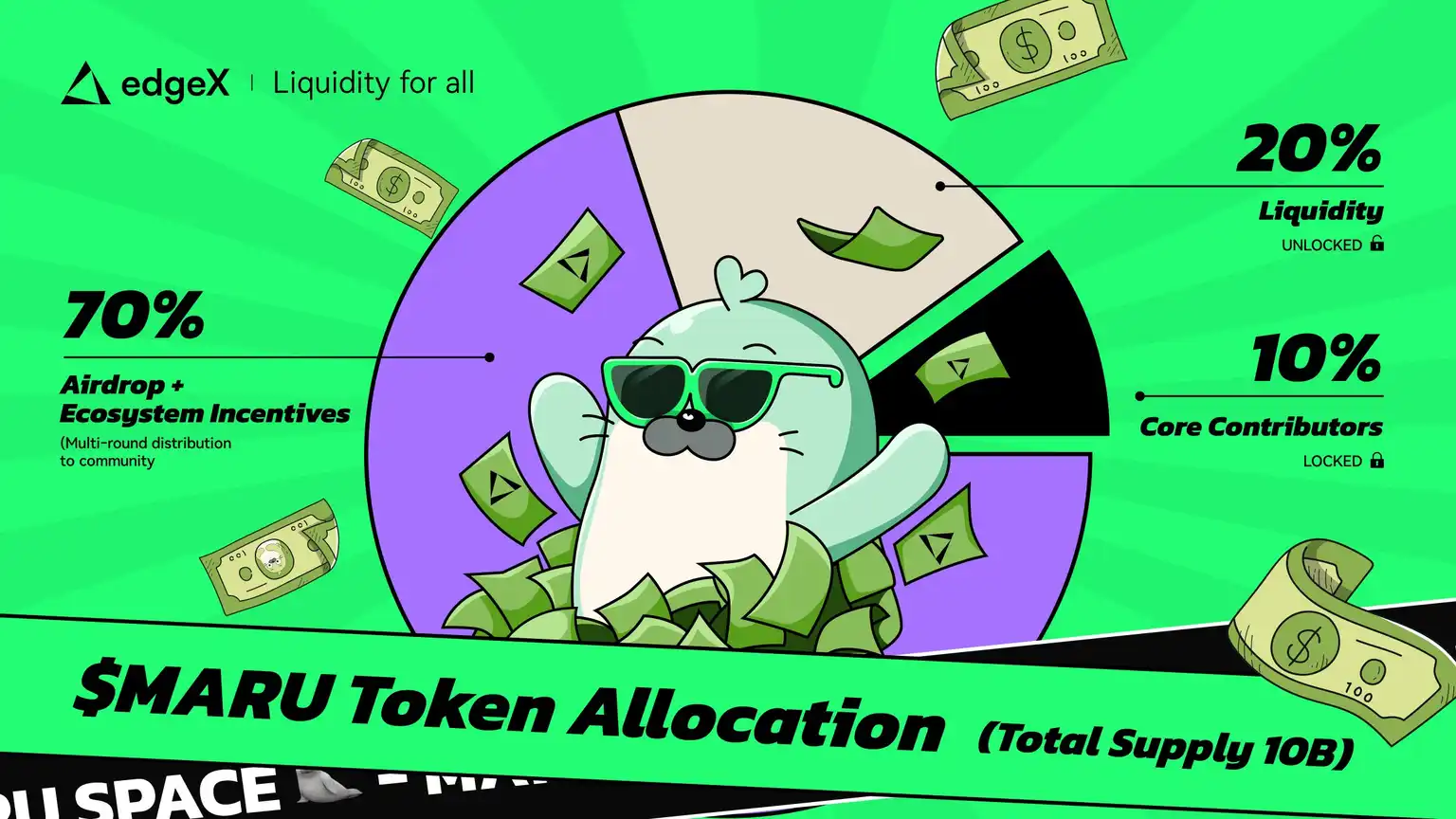
The total supply is 10 billion tokens, and the expected launch date is after the Open Season ends, which is after December 3rd. 70% of the total supply will be directly allocated to airdrops and ecosystem incentives, 20% will be used for the liquidity pool (unlocked upon launch for easy trading), and the remaining 10% will be reserved for core contributors (fully locked for long-term incentives).
How do you obtain $MARU? There are two main channels:
The first is Open Season Points, which is also the primary channel. These points will be converted into $MARU airdrops after December 3rd. It's important to note that the platform has minimum trading volume requirements, and wash trading will be identified and penalized. The weighting for earning points is as follows:
- Trading perpetual contracts: weighted at 60%, they constitute the majority of points;
- Referral bonus: 20% weighting;
- TVL/Liquidity Provision: Weighting 10%;
- Positions/Liquidation: Weighted at 10%;
Secondly, there's the creator activity, which can be simply understood as Kaito's way of earning rewards by creating content. There are many forms of tweets: create tweets, videos, memes, etc., and tag @edgeX_exchange. Original, high-quality content that has been officially selected (AI-generated content does not count; supports multiple languages including English, Chinese, Korean, and Japanese) will have the opportunity to share a prize pool of 500,000 USDT + 20 million MARU.
Some users have already seen the temporary rewards (such as 21,370 MARU + 464 USDT) on the dashboard. You can claim the USDT first, and the MARU will be distributed after the official launch.
2. EdgeX Messenger upgrade
Somewhat related to the previous point is the edgeX Messenger upgrade. Announced on November 13th, this plan aims to transform edgeX Messenger from a simple communication tool into a global DeFi collaboration hub.
Core focus: Providing a collaborative platform for traders and influencers; deep integration with the $MARU incentive mechanism. In short, the goal is to create a platform that integrates a trader community, content creation, and an incentive mechanism.
3. edgeXFlow Ecosystem Launch
On November 19th, edgeX made another big move: launching the edgeXFlow ecosystem.
In short, edgeXFlow is a new modular execution layer that operates in parallel with the existing StarkEx. Technical specifications: Execution latency: <10ms; Order processing capacity: 200,000 orders/second; ZK proof guarantees transparency, etc.
The first partner was Ave.ai, and the two jointly launched the XPIN trading campaign (November 19-26). The design of this campaign was quite interesting—it wasn't just a traditional PnL competition, but adopted a hybrid incentive model: tiered airdrop rewards based on trading volume; a leaderboard with 200 slots (expanding the scope of winners); and a 1.1x edgeX points bonus.
edgeX has ambitious goals, aiming to integrate 30 ecosystem partners by Q2 2026. It seems they intend to expand this infrastructure and establish it as an industry standard for modular execution layers.
4. Points Countdown
The Open Season is now in its final countdown! We're currently in weeks 20-24, with an estimated 2-4 weeks left until the end. In recent weeks, 300,000 points have been distributed weekly, covering 13,000-14,000 addresses.
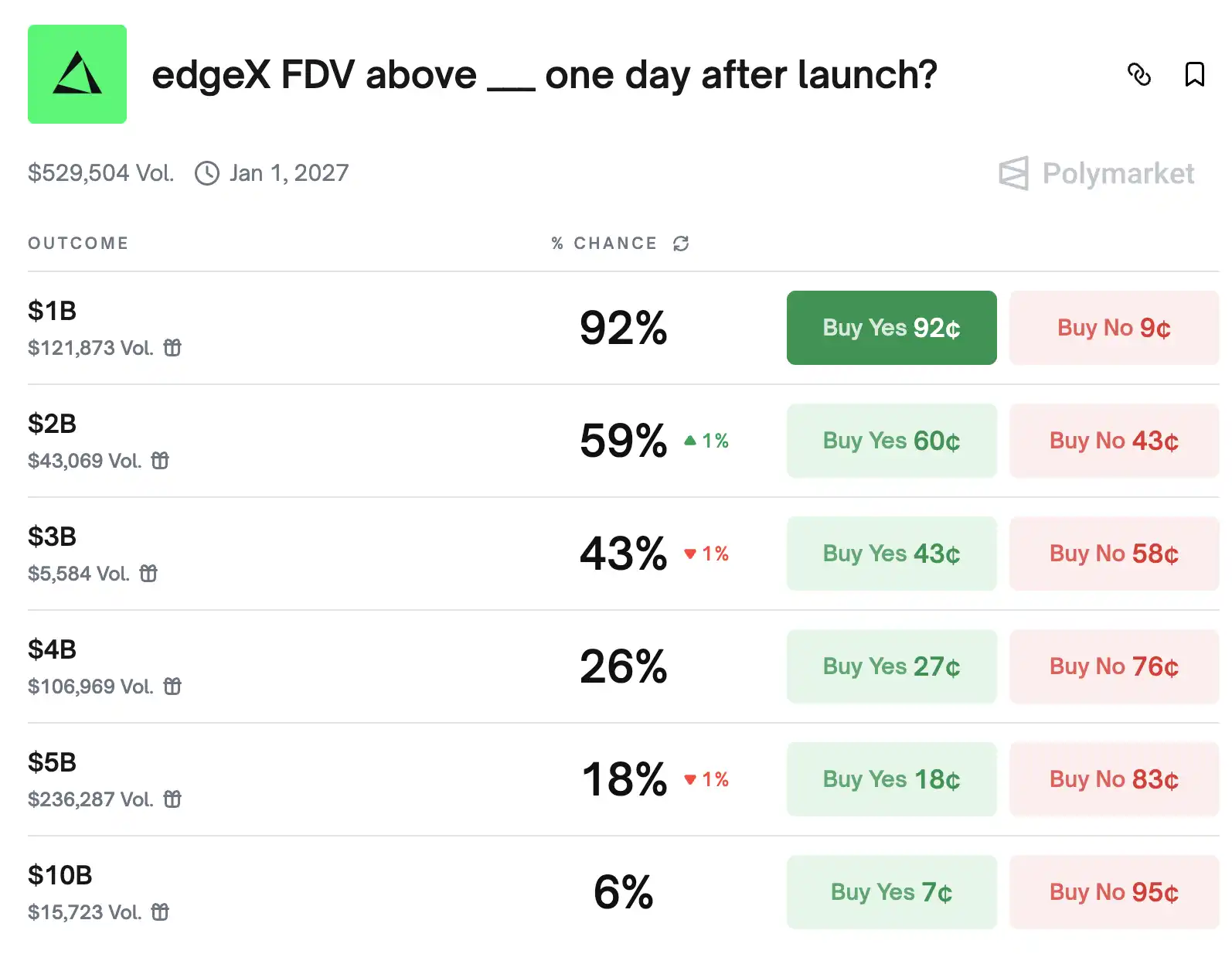
According to calculations by influential figures in the community, assuming edgeX's revenue is approximately 16% of Hyperliquid's, if the total FDV reaches around $2-7 billion during TGE, the value per point could be between $30 and $300. Of course, this is just an estimate, and the actual value will depend on market conditions. The current probability of edgeX's FDV on the first day of launch on Polymarket is as follows:
5. Established a strategic partnership with Polymarket
This is also quite a big piece of news. Yesterday, edgeX announced a strategic partnership with Polymarket: Polymarket's prediction scenarios will be seamlessly integrated into the edgeX mobile app; users can participate in event prediction with one click; and the two parties will jointly develop innovative leveraged prediction products.
Since the news was announced yesterday, there are no more details yet, but we can keep an eye on future developments. It is expected that the products that will be co-developed and incubated will be one of the key projects in the edgeXFlow ecosystem.
Lighter: Raised 68 million, valued at 1.5 billion.
1. Major Financing
On November 11th, Lighter announced the completion of a $68 million funding round, instantly becoming a DeFi unicorn. The lineup of investors in this round was quite impressive:
Financing details:
- Amount: US$68 million (equity + token subscription rights)
- Valuation: $1.5 billion (post-valuation)
- Lead investors: Founders Fund (Peter Thiel), Ribbit Capital
- Investors: Haun Ventures, Robinhood (a rare instance of a brokerage VC participating in the investment)
- Total funding: Approximately $90 million (including $21 million raised in 2024, led by Haun/Craft).
There are several noteworthy aspects to this round of financing:
First, the investor lineup is top-tier. Founders Fund is one of the top VCs in Silicon Valley, and Robinhood, as a brokerage firm, is directly investing in perp DEX, which is rare in the industry, indicating that traditional finance is increasingly recognizing decentralized derivatives.
Secondly, the founder has an impressive background. Novakovski is a legendary figure—he entered Harvard at 16, graduated at 18, and was personally recruited by Ken Griffin, the founder of Citadel. He later worked as an engineer and trader at several financial institutions for nearly 15 years. Joey Krug, a partner at Founders Fund, stated frankly that 85%-90% of the reasons for investing were due to founder Vladimir Novakovski and his team.
2. The only DEX with a daily trading volume exceeding 10 billion.
Lighter's recent growth data is quite explosive.
24-hour trading volume: approximately $7.9-11.2 billion (fluctuates depending on the time period, and was once the only DEX to break through $10 billion).
TVL: Approximately US$1.15 billion (a 2,000-fold increase in 6 months! From approximately US$500,000 at the end of March);
Positions held: Over $17 billion;
L2 Ranking: It has risen to the top ranks of the Ethereum L2 protocol and is considered the first native perp DEX on Ethereum;
However, some analysts have pointed out concerns: Lighter's trading volume/open interest ratio once reached 27 (the industry healthy value is usually ≤5), suggesting that some trading volume may have come from wash trading driven by points incentives. Wash trading before TGE is a characteristic of the industry. We may soon know Lighter's true trading volume after TGE. But considering the platform has just graduated from beta, its overall performance is still very impressive.
3. Oracle integration + RWA extension, targeting traditional financial assets.
Lighter recently announced a partnership with Chainlink to integrate real-time oracle data, officially expanding into the real-world asset (RWA) derivatives space.
Supported asset classes include: commodity futures contracts (gold, crude oil, etc.); stock index derivatives; foreign exchange trading pairs; and other real-world assets.
In addition, since RWA price sources are not available 24/7 (for example, gold and stocks only have prices during trading hours), Lighter has also made some special arrangements: during non-trading hours, it enters a "margin reduction only" mode, where users can only submit margin reduction orders; funding rates continue to be calculated normally during non-trading hours; the RWA market only supports segregated margin mode (considering its experimental nature and volatility); and a dedicated XLP (experimental liquidity provider) pool has been set up to provide liquidity to the RWA market, which is segregated from the main pool LLP.
Hyperliquid: The Joys and Sorrows of a King
1. HIP-3 upgrade, transaction fees reduced by 90%
On November 19, Hyperliquid released a major upgrade: HIP-3 Growth Mode.
HIP-3 itself allows anyone to deploy their own perpetual contract market on Hyperliquid permissionlessly by staking 500,000 HYPE tokens. This "growth model" is a further optimization based on HIP-3—specifically providing ultra-low fee incentives for new markets.
Key changes include: Taker fees have plummeted by over 90%, from 0.045% to 0.0045%-0.009%; high-staking users will benefit even more, with fees as low as 0.00144%-0.00288% if they reach the highest staking and trading volume levels; rebates and trading volume contributions can be reduced by over 90% simultaneously, and so on.
However, to prevent "parasitic trading volume," growth model markets have some exclusion rules: they cannot include BTC or existing validator-operated markets, cryptocurrency baskets/ETFs, synthetic price indices, or any assets that duplicate existing markets (for example, gold already has PAXG-USDC).
The purpose of this upgrade is clear: to lower the barrier to entry for new markets. New markets often start with few traders and low liquidity, and a 90% fee discount can effectively attract early users, further helping Hyperliquid to evolve from "a PerpDEX" into a "permissionless financial infrastructure layer."
2. Yet another whale has "arrived at the same destination by different paths".
Celebrity trader Andrew Tate recently lost all his money on Hyperliquid and has been jokingly referred to as "Hyperliquidated".
According to Arkham on-chain data, Andrew Tate's liquidation can be traced back to almost a year ago. On December 19, 2024, there was a collective liquidation of long positions in BTC, ETH, SOL, LINK, HYPE, PENGU, and other cryptocurrencies.
On November 18th, when BTC fell below $90,000, Andrew Tate's last remaining position was liquidated, leaving his account with zero. This instantly became meme material, given his frequent self-proclaimed status as a financial guru.
One analyst listed him as "one of the worst traders in crypto history," alongside other big players who lost a lot of money on Hyperliquid (James Wynn lost $23 million, Qwatio lost $25.8 million, and 0xa523 lost $43.4 million in one month).
3. POPCAT manipulation attack
On November 12, Hyperliquid suffered its second major attack this year, the first being XPL, and this time the target was memecoin POPCAT.
The attacker withdrew 3 million USDC from OKX and distributed it across 19-26 new wallets. They then opened approximately $20-30 million in leveraged long positions in POPCAT on Hyperliquid (around 5x leverage), followed by placing approximately $20 million in buy orders at the $0.21 price level to create a false impression of strong demand. Other traders, seeing the buy orders, assumed there was support and followed suit by going long. The attacker suddenly withdrew the buy orders, causing the POPCAT price to plummet from $0.21 to $0.13.
Ultimately, a large number of leveraged long positions were liquidated, with at least 26 accounts losing a total of $25.5 million in positions and $2.98 million in margin. HLP was forced to absorb $4.9 million in bad debts. The strange thing about this attack is that the attackers themselves also lost $3 million, suggesting it wasn't for profit.
There are two main speculations in the community regarding this: One is that the attack was purely a "stress test" to damage Hyperliquid's reputation, with Binance/CZ being the primary suspect. The other is that the attackers opened hedging positions on centralized exchanges, thus profiting overall; on-chain analysis points to BTX Capital, but founder Vanessa Cao has denied involvement.
Aster: Spending money while simultaneously buying back shares
1. Phase 4 "Aster Harvest" airdrops 120 million ASTERs.
On November 10th, Aster officially launched its fourth phase of airdrops, codenamed Harvest. The distribution size was 120 million ASTER (representing 1.5% of the total supply) over a period of 6 weeks (November 10th - December 21st), distributed at a rate of 0.25% per week, evenly distributed across 6 epochs.
Compared to previous phases (S2 received 4%, S3 received 2.5%), the distribution ratio in S4 has indeed shrunk. However, community analysis suggests that due to the potential decrease in the number of participants, the returns per user may actually be higher, and the halving could potentially drive up the token price.
Here are a few tips for earning more points at this stage: $ASTER can be used as collateral for perpetual contracts, and you can earn extra points by using $ASTER as collateral for contracts; you get a 5% discount on transaction fees when paying with $ASTER; spot trading is also eligible for points; another is anti-scalping measures, as Aster now emphasizes quality trading and has set up maker order and symbol accelerator multiplier mechanisms to try to filter out wash trading behavior.
2. A $10 million trade contest: "Double the fish"
On November 17, Aster launched its largest trading competition in history: a total prize pool of $10 million.
The competition is divided into five weekly phases (running until December 21), with each phase having its own leaderboard. The first phase has a prize pool of $1 million, which can reach up to $2 million per week. There are 1,000 winning slots per phase. Only perpetual contract trading is allowed, and rankings are based on trading volume and PnL.
The biggest feature of this trading competition is the "double win" principle, meaning the same trade can be counted in both the competition and the S4 airdrop. For example, top players can earn up to $300,000 in a single week, and if they dominate the leaderboard for five consecutive weeks, they could theoretically earn $1.5 million.
3. The repurchase agreement continues to advance.
Aster's buyback program is considered quite aggressive within the perp DEX sector. As of November 13th, the cumulative buyback amount was approximately $214 million; the number of tokens bought back represented 7.11% of the circulating supply.
CZ recently placed an order to buy over $2 million worth of ASTER, triggering speculative demand; in addition, market makers such as Wintertermute are also quietly increasing their holdings, so some analysts predict that ASTER may rise to $10.
However, some in the community have expressed concerns: ASTER still has approximately 6.35 billion tokens locked, and their future unlocking could lead to selling pressure. An estimated $700 million worth of tokens are still awaiting unlocking before 2026. The recent fluctuations in the unlocking schedule have caused some panic. However, the official team has stated that the unlocking schedule will not be changed.
4. "Machi Mode" function
This might be the most interesting new feature launched by Aster. On November 19th, Aster announced the launch of "Machi Mode," where liquidated users can receive points as a reward, essentially giving traders who lost money a "consolation prize."
Why is it called Machi Mode? It's a joke about the well-known trader Jeffrey Huang, who is known in the trade community as "Machi Big Brother".
According to Lookonchain data, since November 1st, the three largest holders on Hyperliquid who have been liquidated the most times are: Machi Big Brother—71 liquidations; James Wynn—26 liquidations; and Andrew Tate—19 liquidations.
Machi is far ahead of the pack, arguably the unluckiest "King of Liquidation." He once lost over $53 million in a single month, and his trading style is known for its extremely high leverage and aggressive positions. Aster naming this feature after him is, in a way, an embrace of the degen culture within the crypto world.
other
In addition, I'd like to share some recent updates on two other Perp DEXs that I follow closely, both of which have yet to issue their own tokens.
1. Pacifica
On November 12, Pacifica announced the launch of the TIF=TOB (Time in Force = Top of Book) order type.
Simply put, when you submit a post-only limit order, if the price is set too aggressively, it will penetrate the order book (i.e., be executed immediately). The traditional approach is to cancel the order. However, TIF=TOB will not cancel it; instead, it will automatically move your order to the top of the order book.
For example, suppose the current best bid price (Bid) for BTC is $100,000, and the best ask price (Ask) is $100,100. If you submit a TOB buy order at $100,200 (which will penetrate the Ask), the system will automatically adjust your order to $100,099—just below the best ask price, placing it at the top of the new order book. This is a very useful feature for market makers.
Pacifica has now become one of the most important projects on the Solana blockchain.
2. Variational
Another example is Variational, the Perp DEX, which played a significant role in Arbitrum's DeFi revival strategy.
Its key features include: an automated listing engine that eliminates coordination delays through OLP's internal market making, currently supporting 515+ tokens, making it the DEX with the most listed tokens; the protocol itself acts as a market maker, with hedging costs of only 0-2 basis points, and users paying a spread of 4-6 basis points, achieving an annualized return of over 300% at one point. It also offers loss compensation: cumulative refunds have exceeded $2 million, covering over 70,000 transactions and benefiting over 6,500 users, with the highest single refund exceeding $100,000, accounting for approximately 2% of the platform's total losses.
On November 15th, over $1 million in rewards were retrospectively distributed; on November 17th, a retail sentiment index tool was launched, showing that 89% of trading volume came from the long tail market. Overall data growth is very rapid. A points-based competition is not yet available, but retrospective trading volume tracking may be implemented later.