Author: Huobi Growth Academy
summary
As an innovative product bridging traditional financial markets and the crypto derivatives ecosystem, stock contracts are reshaping the on-chain trading landscape at an astonishing pace. We will delve into the product essence, growth logic, technical architecture, and market ecosystem of this emerging sector, and systematically analyze its regulatory challenges and future prospects. Research reveals that perpetual stock contracts are not simply a conceptual innovation, but rather a structural opportunity built upon the global stock market's over $160 trillion market capitalization, combined with the mature trading paradigm of perpetual contracts. Currently, leading Perp DEXs such as Hyperliquid, Aster, and Lighter have already established complete perpetual stock product matrices, achieving significant advantages in trading depth, user experience, and asset coverage. However, regulatory uncertainty remains the biggest constraint on this sector, and exploring product compliance pathways will directly impact its long-term development potential. From a trend perspective, perpetual stock contracts are expected to drive the evolution of the on-chain derivatives market from native crypto assets to "full asset perpetuality," becoming the next trillion-dollar growth engine.
I. Product Essence: The Structural Integration of Traditional Assets and On-Chain Derivatives
Stock perpetual contracts are essentially on-chain synthetic derivatives anchored to the price fluctuations of traditional stocks. Users deposit stablecoin margin to gain long or short exposure to the price movements of US stocks such as Apple, Tesla, and Nvidia, without actually holding the stocks themselves or enjoying shareholder rights such as dividends or voting rights. This product design cleverly combines the asset base of traditional financial markets with the mature perpetual contract mechanism of the crypto market, creating a new type of financial instrument that retains the risk characteristics of stock prices while providing the flexibility of on-chain trading.
From a product positioning perspective, it's crucial to clearly distinguish between perpetual stock contracts and tokenized stocks (RWA Stock Tokens). Tokenized stocks are typically held by a custodian institution, which issues tokenized certificates representing real equity on-chain. Their legal attributes and regulatory framework are highly consistent with traditional securities. Perpetual stock contracts, on the other hand, involve no equity relationship whatsoever. They merely track stock prices through oracles and build a purely price-risk trading market on-chain based on funding rates, margin requirements, and liquidation mechanisms. This difference places them in entirely different tracks: the former is a custody and transfer solution for on-chain assets, while the latter is a derivative innovation for risk trading.
The rise of perpetual stock contracts is not accidental, but rather the result of multiple factors. From the demand side, global users have long harbored suppressed demand for US stock trading—traditional brokerage account opening processes are cumbersome, cross-border capital flows are restricted, and trading hours are fixed, contrasting sharply with the "24/7, stablecoin settlement, high leverage, and flexibility" trading habits of crypto users. Perpetual stock contracts provide users with an alternative path to bypass the traditional financial system and directly participate in US stock price fluctuations. From the supply side, since 2025, the maturity of oracle technology, the widespread adoption of high-performance blockchain infrastructure, and the fierce competition within the Perp DEX have provided the technological foundation and market impetus for the productization of perpetual stock contracts. More importantly, perpetual stock contracts stand at the intersection of two major narratives: "Real-World Assets (RWA)" and "On-Chain Derivatives." They possess both the substantial financial base of traditional assets and the high growth potential of crypto derivatives, naturally making them a focus of market attention.
II. Underlying Mechanisms: The Triple Challenge of Price, Liquidation, and Leverage
The stable operation of perpetual stock contracts relies on a sophisticated underlying mechanism encompassing multiple dimensions, including price discovery, asset synthesis, risk control, and leverage management. Among these, the price source (oracle) is the cornerstone of the entire system. Since on-chain protocols cannot directly access real-time market data from Nasdaq or the NYSE, decentralized oracles are essential to reliably transmit price data from traditional markets to the blockchain. Current mainstream solutions include Pyth Network, Switchboard, Chainlink, and some protocols' self-developed oracle systems. Pyth obtains first-hand quotes through direct cooperation with market makers and exchanges, emphasizing high-frequency updates and resistance to manipulation; Switchboard provides a highly customizable price source aggregation solution, allowing protocols to switch update strategies according to different time periods; Chainlink relies on a decentralized node network to provide robust, continuous, and verifiable price feeds. A few leading protocols, such as Hyperliquid, use self-developed oracles, achieving a higher degree of pricing autonomy through multi-source market data aggregation, internal index construction, and off-chain risk control verification.
The core issues that oracles need to address go far beyond data transmission. The unique structure of the US stock market, with its limited trading hours (not 24/7), pre- and post-market volatility, and trading halts, requires oracles to intelligently handle market state transitions. Mainstream solutions employ mechanisms such as market opening and closing markers, TWAP smoothing algorithms, and outlier filtering to ensure that on-chain prices do not deviate from the real-world anchor during US stock market closures, while also mitigating the risk of price manipulation due to insufficient liquidity. For example, after the US stock market closes, oracles may automatically switch to a low-frequency update mode or generate an internal reference price based on the previous valid price combined with on-chain supply and demand, maintaining trading continuity while controlling tail risks.
At the synthetic asset construction level, stock perpetual contracts do not mint tokens representing real equity. Instead, they create virtual positions linked to the underlying stock price through smart contracts. Users deposit stablecoins such as USDC as margin to open long or short positions, with profits and losses determined entirely by the contract price and settlement rules. The protocol regulates the balance between long and short positions through a funding rate mechanism—when positions in one direction become overly concentrated, the funding rate guides users to open positions in the opposite direction, maintaining a relatively neutral risk exposure for the system as a whole. Compared to crypto perpetual contracts, stock perpetual contracts also need to consider additional factors such as the overnight costs of the US stock market and the trading rhythm of the real market, exhibiting more complex cyclical characteristics.
The liquidation mechanism is a core component of the perpetual equity risk control system. Its challenge lies in simultaneously managing the volatility of two asynchronous markets: US stocks trade only during specific time periods, while the crypto market operates 24/7. When the US stock market is closed and the crypto market experiences significant volatility, the value of user collateral may rapidly decrease, leading to the liquidation risk of perpetual equity positions. To address this, mainstream protocols have introduced cross-asset risk engines and dynamic parameter adjustment mechanisms. During US stock market closures, the system automatically increases the maintenance margin rate, lowers the maximum leverage limit, and advances the liquidation threshold to mitigate the risk of gaps caused by information discontinuity. Once the US stock market reopens, risk control parameters gradually return to normal. This design preserves the continuity of on-chain transactions while mitigating the systemic risk of cross-market mismatches through dynamic risk control.
Leverage design also reflects the differences between traditional assets and crypto products. In crypto asset perpetual contracts, some platforms offer leverage of hundreds of times or even higher, but in the stock perpetual market, mainstream protocols generally limit leverage to between 5 and 25 times. This is due to multiple considerations: First, stock prices are influenced by fundamental factors such as company financial reports, macroeconomic events, and industry policies, resulting in a volatility structure different from crypto assets; second, US stocks have unique scenarios such as gap openings and after-hours trading, making high leverage highly susceptible to triggering chain liquidations; finally, regulators maintain a cautious attitude towards stock-related derivatives, and limiting leverage helps reduce compliance risks. Even if the platform interface displays a maximum leverage of 20 times, the actual available leverage is often dynamically adjusted based on market conditions, underlying liquidity, and user position concentration, forming a risk control system that is "flexible on the surface but strict at the underlying level."
III. Market Landscape: Perp DEX's Differentiated Competition and Ecosystem Evolution
The current stock perpetual contract market has formed a competitive landscape with leading Perp DEXs such as Hyperliquid, Aster, Lighter, and Apex, each showing significant differentiation in technical architecture, product design, and liquidity strategies.
Hyperliquid, leveraging its high-performance self-developed blockchain and the HIP-3 third-party framework, has rapidly entered the perpetual stock trading market through projects like Trade.xyz. Its core advantages lie in its deep order book and institutional-grade liquidity—the XYZ100 (Nasdaq 100 index synthetic contract) boasts a daily trading volume reaching $300 million, while open interest in commodities like SILVER and GOLD remains stable at tens of millions of dollars. Hyperliquid employs a multi-source median pricing mechanism, combining external oracle prices, internal EMA smoothing values, and order book market prices to generate a robust mark price for clearing and margin calculations. This dual-channel design of "professional-grade matching + synthetic pricing" achieves a good balance between high-frequency trading and risk control.
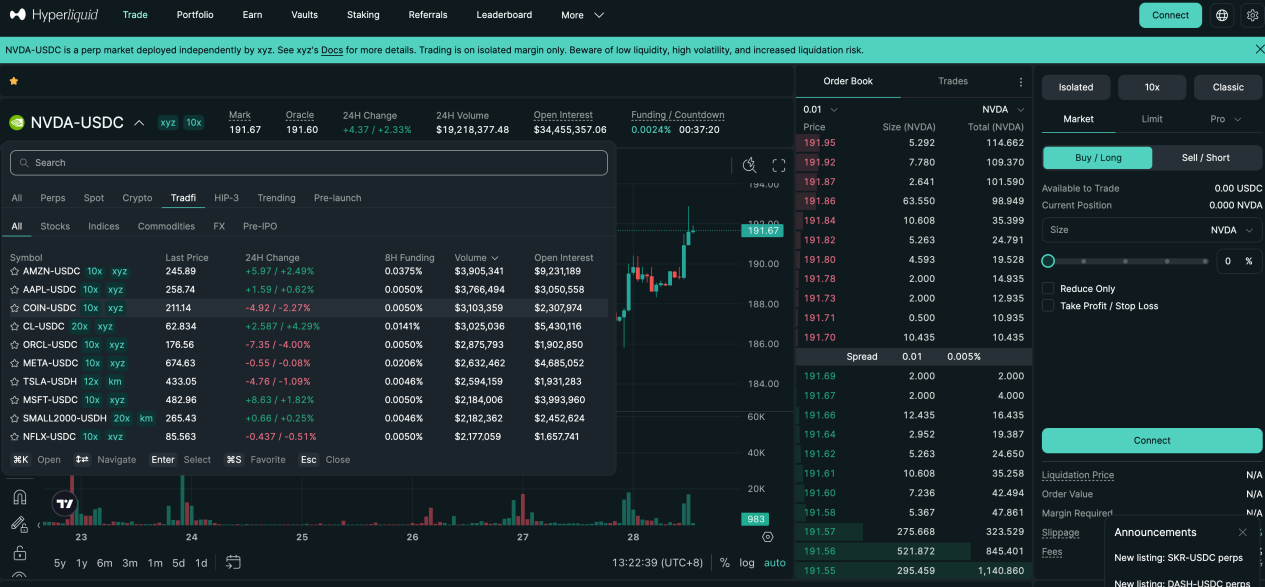
Aster has innovatively launched a dual-mode architecture, Simple and Pro, catering to users with varying risk appetites. Simple mode utilizes an AMM (Agent Merchant Transaction) pool mechanism, allowing users to open and close positions with one click and zero slippage, suitable for high-frequency, small-amount, and short-term trading, with a perpetual leverage limit of 25x for stocks. Pro mode, based on an on-chain order book, supports advanced order types such as limit orders and hidden orders, providing deeper liquidity and more granular strategy execution, with a perpetual leverage limit of 10x for stocks. Data shows that daily trading volume for NVDA and other tech stock contracts under Pro mode remains at several million dollars, with open interest steadily increasing, demonstrating continued participation from professional traders. Through this dual-layer design of "traffic entry point + deep market," Aster has achieved effective user segmentation and ecosystem expansion.
Lighter's core selling point is its zk-rollup provably matched system, where all transactions and settlements can be verified on-chain using zero-knowledge proofs, emphasizing transparency and fairness. Its perpetual equity offerings currently support 10 US stock instruments, with a uniform leverage of 10x, demonstrating a relatively robust risk control approach. The liquidity structure exhibits a clear concentration at the top – COIN (Coinbase) frequently exceeds ten million US dollars in daily trading volume, while instruments like NVDA, although with moderate trading volume, have high open interest, reflecting the presence of medium- to long-term strategic funds. Lighter strikes a clever balance in user experience: the front-end interface is extremely simple, suitable for beginners to quickly get started; the underlying layer remains a professional order book, meeting the execution needs of institutions.
It's worth noting that the traffic entry points for perpetual stock trading are expanding from a single official website to a diversified ecosystem. Based.one provides a more consumer-grade trading interface by aggregating the Hyperliquid contract engine; Base.app uses Lighter as a built-in trading module, allowing users to open positions without leaving their wallets; and super apps like UXUY further simplify the operation path, packaging perpetual stock trading as an experience close to a Web2 product. This division of labor and collaboration between the "underlying protocol + application layer entry point" is lowering the barrier to user participation and driving perpetual stock trading from a niche professional tool to a mass-market trading product.
IV. Regulatory Challenges: Finding a Balance Between Innovation and Compliance
The biggest uncertainty surrounding perpetual stock contracts stems from regulatory concerns. While there is currently no specific legislation globally addressing this type of product, regulators are closely monitoring its potential risks. The core issue lies in defining its legal status: does a perpetual stock contract constitute an unregistered securities derivative?
From a regulatory perspective, the U.S. SEC consistently adopts a substance-over-form principle for derivatives based on securities prices. As long as the economic substance of the product is highly correlated with the regulated securities, regardless of its technical packaging, it may fall under the jurisdiction of securities laws. The European Securities and Exchange Commission (ESMA) has also repeatedly emphasized under the MiCA framework that on-chain derivatives anchored to traditional financial assets must still comply with existing financial regulations. This means that although perpetual stocks do not involve actual equity custody, their close correlation with U.S. stock prices may lead them to be classified as securities derivatives or contracts for difference (CFDs), thereby triggering a series of compliance requirements such as licensing, disclosure, and investor protection.
Current regulatory focus remains on products directly mapped to physical assets, such as tokenized stocks. However, the regulatory attitude towards "synthetic risk exposures" like perpetual stocks is still under observation. Potential future regulatory paths include: strengthening the compliance responsibilities of front-end operators (such as trading interface providers and liquidity providers); requiring price indices and oracle data sources to be publicly transparent; restricting high leverage and strengthening KYC and geographical access requirements; and explicitly incorporating these products into the existing derivatives regulatory framework.
For the protocol, strategies to mitigate compliance risks include: clearly distinguishing between "price tracking" and "equity tokens," emphasizing the product's synthetic nature and risk hedging attributes; employing multi-source decentralized oracles to avoid suspicion of price manipulation; setting reasonable leverage caps and risk parameters to prevent excessive speculation; and fully disclosing product risks and legal disclaimers in the user agreement. In the long term, the compliant development of perpetual equity may require exploring pathways such as cooperation with licensed institutions, services in restricted jurisdictions, or innovative pilot programs based on regulatory sandboxes.
In addition to regulatory risks, perpetual equity contracts also face a range of market and technological risks. Oracle malfunctions or malicious manipulation could lead to erroneous liquidations; cross-market volatility mismatches could amplify tail risks; insufficient liquidity could trigger extreme slippage and difficulties in closing positions; and smart contract vulnerabilities could be exploited, resulting in financial losses. These risks necessitate that the protocol establish a multi-layered risk control system, including but not limited to: multi-oracle redundancy and anomaly detection, dynamic margin adjustments, insurance fund buffers, contract security audits, and bug bounty programs.
V. Future Outlook: From Niche Innovation to Mainstream Financial Infrastructure
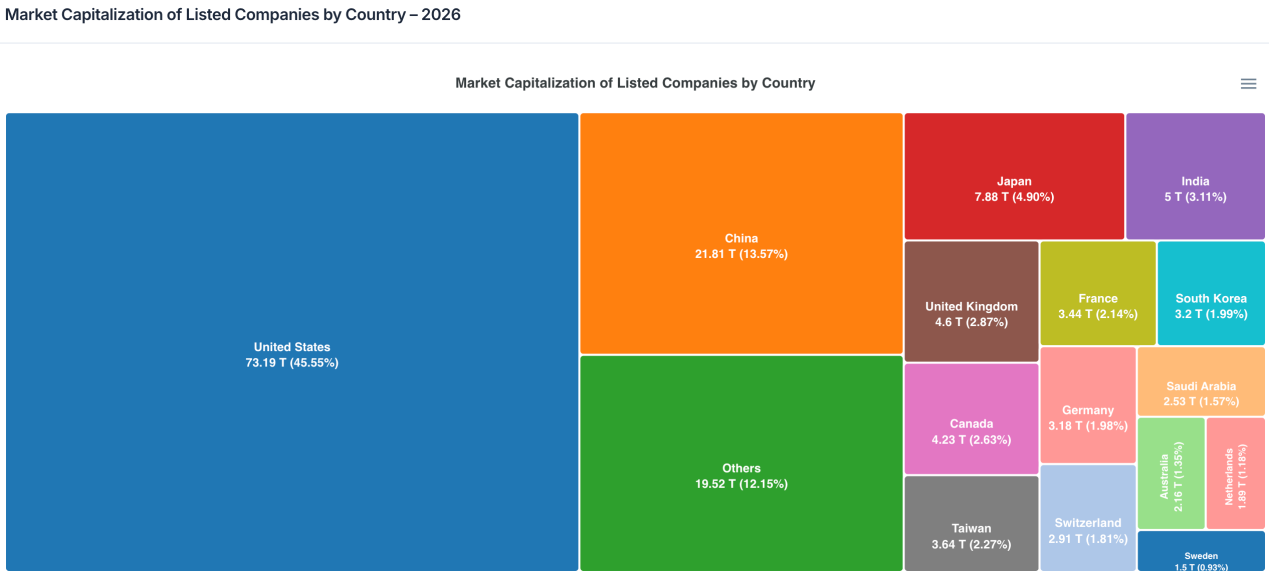
From a market size perspective, the potential for stock perpetual contracts is extremely vast. The total market capitalization of global listed companies is approaching $160 trillion, with non-US markets accounting for more than half, forming a massive asset pool of approximately $80 trillion. Even if only a very small percentage of funds participate through perpetual contracts, the absolute scale would easily reach hundreds of billions of dollars. Referring to the structural characteristic of the cryptocurrency market where perpetual contract trading volume is more than three times that of spot trading, stock perpetual contracts are expected to replicate a similar trend of derivatives in traditional asset classes.
In terms of product evolution, perpetual stock contracts may only be the starting point of the "all-asset perpetualization" trend. With the maturation of pricing mechanisms, clearing systems, and liquidity infrastructure, commodities (gold, crude oil), stock indices (S&P, Nasdaq), foreign exchange (Euro, Yen), and even macroeconomic assets such as interest rates may be introduced into the perpetual contract framework. Perp DEX will gradually evolve from a crypto-native trading platform into a comprehensive derivatives market covering multiple asset classes, becoming a key interface connecting traditional finance with the on-chain ecosystem.
The regulatory environment will gradually become clearer. It is expected that within the next 2-3 years, major jurisdictions will issue classification guidelines and regulatory frameworks for on-chain derivatives, thus clarifying the compliance boundaries of perpetual stocks. This may cause short-term pain, but in the long run, it will benefit industry consolidation and standardized development. Platforms that can proactively build compliance capabilities, establish risk management systems, and maintain communication with regulators will gain a competitive advantage under the new rules.
In short, perpetual stock contracts are at a critical juncture, moving from zero to one. They are both an inevitable choice for Perp DEX seeking a new growth narrative and a testing ground for the integration of traditional assets and crypto finance. Although the road ahead is fraught with technological challenges and regulatory uncertainties, the enormous market demand and asset scale behind them determine that this is an undeniable sector. In the future, perpetual stock contracts may not only become a pillar category in the on-chain derivatives market but also have the potential to reshape how global retail investors participate in US stock and even global asset trading, truly realizing borderless, 24/7, and democratized financial markets. In this process, protocols that can balance innovation, risk, and compliance are most likely to become the builders of the new era's financial infrastructure.