
Author: Scof, ChainCatcher
Editor: TB, ChainCatcher
Without any warm-up or major positive news, the cryptocurrency concept stock Bakkt soared by more than 50% overnight.
Not long ago, Bakkt was marginalized by the market due to customer loss and declining revenue, but now it has suddenly become a hot topic and the most eye-catching existence in crypto stocks. What is the rhythm behind the seemingly accidental surge? Is it a short-term speculative game, or a signal that the industry trend is quietly turning?
Bakkt surge, is it opportunity or emotion?
On May 13, Bakkt's stock price soared by more than 50% in a short period of time. This company, once regarded as a "bridge for traditional finance to enter the crypto world", has been in trouble with customer loss and shrinking revenue in the past few years. This sudden reversal has attracted market attention. The apparent reason is that it achieved a net profit of US$7.7 million in the first quarter, the first profit in recent years. But a closer look at the financial report will reveal that this is mainly due to cost reduction and one-time adjustments, and the core business has not improved significantly.
What really ignited the mood was the company's new strategy. Bakkt announced a partnership with DTR, founded by a former SoftBank executive, to launch AI plug-ins and stablecoin payment services, entering the popular "PayFi" track - a global payment infrastructure that combines AI agents with on-chain settlement. This "new narrative" of superimposing AI and encryption quickly sparked market speculation.
In addition, Bakkt's "M&A concept" has also been reactivated. Although the previous acquisition negotiations with Trump's TMTG failed, ICE still holds more than half of its shares, and the market has also heard that Apex Fintech may take over. Driven by the extremely small circulating volume and a high short position ratio of 23%, the short squeeze market quickly took place and the stock price was quickly pulled up.

From a fundamental perspective, the platform is still facing tremendous pressure. On the one hand, Bakkt's major client, Nasdaq-listed brokerage Webull, will terminate its cooperation with it in June. Bakkt once provided cryptocurrency trading and custody services to Webull, and the revenue generated by these services once accounted for more than 70% of Bakkt's total revenue. On the other hand, Bank of America will also end its cooperation with Bakkt. The termination of this cooperation affects Bakkt's loyalty service sector, which mainly provides solutions such as points redemption and digital rewards for corporate customers.
With the loss of two major customers, Bakkt's revenue structure has become more fragile. This round of surge is more like a concentrated release of short-term market sentiment rather than a substantial turning point in fundamentals.
Crypto stocks are collectively agitated. What is the market betting on?
Bakkt's unusual movement is not an isolated phenomenon. In the same period, the crypto concept stock sector generally strengthened, and many stocks rose significantly. Coinbase rose 23.97%, TeraWulf rose 10.06%, Amber Group and DMG Blockchain rose nearly 10%, and MicroStrategy also rebounded by more than 4%. Overall, the weekly increase in the crypto stock sector was close to 10%, showing that funds were intensively deployed in this track.
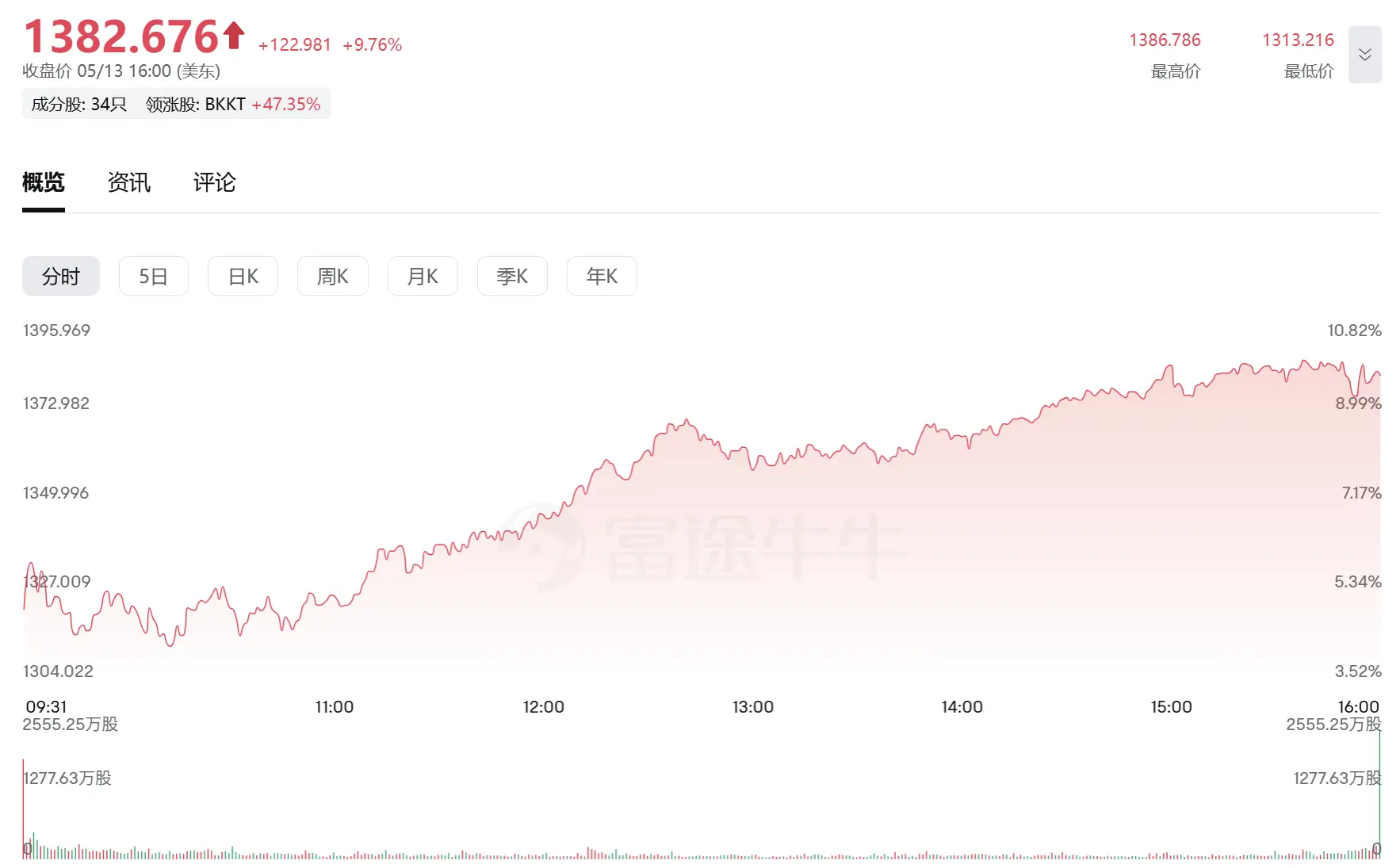
However, more importantly, the market has begun to re-examine the value of crypto "infrastructure". In the past few cycles of the crypto market, most of the funds flowed to exchanges, platform coins or mining companies, but now investors are gradually turning their attention to those "pipeline" companies - companies that provide custody, settlement, clearing, compliance, risk control and other services. They are more like the water, electricity and coal of this ecosystem, with a stable income model and are more easily adapted to the valuation system of traditional finance. Bakkt's surge hit this structural preference, and it is not the only one.
Traditional finance is entering the market
The real turning point of the crypto industry does not lie in the short-term rise in the stock price of a certain platform, but in the fact that more and more traditional financial institutions are choosing to join this game.
Internet brokerages in Hong Kong have taken the lead. Futu Securities launched cryptocurrency trading services, allowing users to directly top up and trade mainstream currencies such as Bitcoin, Ethereum, and USDT through Hong Kong and US stock accounts; Tiger Brokers launched crypto asset deposit, trading, and withdrawal functions, and connected them with traditional stock trading; Shengli Securities has also obtained a license to support crypto asset-related businesses, leading the market. Standard Chartered Bank's Hong Kong subsidiary announced that it will participate in the Hong Kong Monetary Authority's stablecoin sandbox with its partners, trying to explore on-chain payment solutions under the compliance framework.
At the same time, global payment giants are taking more radical actions. Stripe launched stablecoin accounts and programmable stablecoin USDB, providing services in 101 countries; Visa and Mastercard expanded their integration with partners such as Circle, connecting stablecoins such as USDC to their payment networks, allowing users to complete on-chain asset consumption through traditional cards; PayPal used a 3.7% yield to attract users to hold PYUSD, trying to build a closed settlement loop based on stablecoins. Even established cross-border remittance companies like MoneyGram connect traditional cash and on-chain assets through the stablecoin "Ramps", covering more than 170 countries.
The common point of these trends is that traditional finance no longer regards encryption as a scourge, but has begun to actively "on-chain" itself. This is both a response to changes in user needs and a pursuit of cost efficiency. Compared with traditional networks with high fees and slow settlement, stablecoins and blockchain technology provide a faster, cheaper and more transparent infrastructure. Whoever can take the lead in this new system is more likely to have a say in the future financial map.
Bakkt's new strategy is the result of following this trend. Although it is not as big and technical as giants such as Stripe and Visa, as an institution with a US license and custody and clearing capabilities, it is still likely to become a target for mergers and acquisitions or a portal for cooperation. This is exactly why the market revalues it - not to see how much money it makes today, but to see whether it has the potential to become the next ticket to the market.
Conclusion
Bakkt’s surge is a microcosm of this trend, but it is not the whole story. As the capital market begins to re-examine the value of crypto infrastructure, more and more traditional financial institutions are no longer shying away from crypto technology, and “on-chain finance” becomes an executable strategy rather than a distant fantasy, we are witnessing the beginning of a shift in the times.
In this round, the money will not be made by those who shout slogans to attract attention, but by those who truly build bridges, pave roads, and connect to mainstream systems.