
Author: Saurabh Deshpande
Original title: Capital Formation in Crypto
Compiled and edited by: BitpushNews
Experiments such as Coinbase's $400 million acquisition of Echo and Flying Tulip's perpetual put options demonstrate that financing methods are being completely restructured.
These models may differ, but they share a common goal: to ensure fairness, liquidity, and credibility in raising and deploying funds for new projects.
Coinbase's vertical integration
Coinbase recently acquired Echo, a community funding platform founded by Cobie, for approximately $400 million.
The same deal also included a $25 million NFT purchase aimed at reviving a podcast, imposing a binding obligation on hosts Cobie and Ledger Status to produce eight new episodes once the NFTs are activated. Echo has facilitated over 300 funding rounds, totaling more than $200 million.
This acquisition follows Coinbase's recent acquisition of Liquifi, thus completing its full stack of services for crypto project tokens and investments.
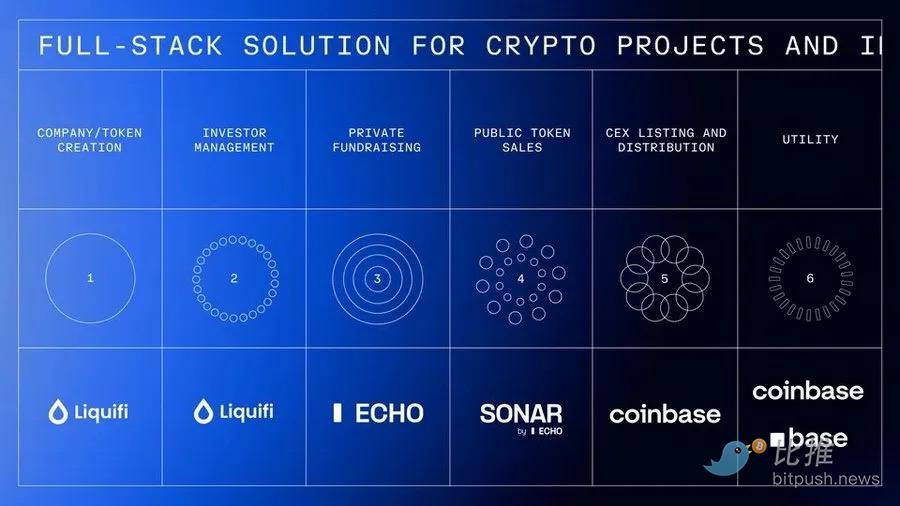
Project teams can use LiquiFi to create tokens and manage equity structures, raise funds through private groups on Echo or public offerings on Sonar, and then list the tokens on the Coinbase exchange for secondary market trading. Each stage creates revenue opportunities:
LiquiFi charges a token management service fee, Echo acquires value through a profit-sharing arrangement, and Coinbase earns transaction fees from the tokens it lists.
This integrated service stack enables Coinbase to profit from the entire project lifecycle, not just the transaction phase.
This is a good deal for Echo because without upstream integration with exchanges, generating sustainable revenue would be challenging. Currently, the model focuses on performance fees, which could take years to monetize, much like risky deals.
Why would Coinbase pay such a high price for a product that only helped raise half of the acquisition price (meaning Echo helped raise $200 million, while the acquisition price was $400 million)?
Please remember that the $200 million figure is not Echo's revenue, but merely the total value of the financing it has assisted in.
The consideration paid by Coinbase included its association with Cobie (which is considered one of the leading long-term players in the crypto space), the network effects of Echo, its technological infrastructure, its regulatory positioning, and its place in the emerging crypto capital formation framework.
Well-known projects such as MegaETH and Plasma have raised funds through Echo, with MegaETH choosing to raise a follow-on round of funding through Echo's public offering platform, Sonar.
This acquisition earned Coinbase the trust of its founders, who were skeptical of centralized exchanges, allowing it access to a community-driven investment network and the infrastructure to expand far beyond pure cryptocurrency into tokenized traditional assets.
Each project has three to four stakeholders: the team, users, private investors, and public investors. Finding the right balance between incentives and token distribution has always been challenging. When the crypto space launched ICOs between 2015 and 2017, we saw it as an honest model of "democratizing" early-stage project investment channels. But some sales sold out even before you could connect with MetaMask, and private sales used whitelisting, effectively excluding most retail buyers.
Of course, this model must also evolve due to regulatory concerns, but that's another topic. However, the story here isn't just about Coinbase's vertical integration; the key is how the financing mechanism itself has evolved.
Flying Tulip Perpetual Put Option
Andre Cronje's Flying Tulip aims to build a full-stack on-chain exchange, integrating spot trading, derivatives, lending, money markets, the native stablecoin (ftUSD), and on-chain insurance into a unified cross-margin system. Its goal is to compete with Coinbase and Binance, while also rivaling Ethena, Hyperliquid, Aave, and Uniswap at the product level.
The project uses an interesting fundraising mechanism that embeds a perpetual put option. Investors deposit assets and receive FT tokens at a price of $0.10 each (10 FT for every $1 invested), which are locked. Investors can burn their FT tokens at any time to redeem up to 100% of their initial investment. If someone deposits 10 ETH, they can redeem all 10 ETH at any time, regardless of the market price of FT.
This put option never expires, hence the term "perpetual." Redemptions are settled programmatically through an independent on-chain reserve managed by an audited smart contract funded by the raised capital. Queuing and rate-limiting mechanisms are in place to prevent abuse while maintaining solvency. If reserves are temporarily insufficient, requests are placed in a transparent queue and processed sequentially once funds are replenished.
This mechanism creates three options for investors and keeps incentives consistent.
- First, investors can hold locked tokens and retain redemption rights, thus maintaining downside protection while capturing any upside potential if the protocol succeeds.
- Secondly, they can redeem their original principal by destroying the tokens, which are then permanently destroyed.
- Alternatively, they can transfer their tokens to a CEX/DEX for withdrawal, but the put option expires immediately upon withdrawal, and the released principal goes to Flying Tulip for operations and token buybacks. This creates strong deflationary pressure: selling tokens means losing downside protection. Secondary market buyers do not have redemption rights. This protection only applies to participants in the initial sale, thus creating a two-tier token structure with different risk profiles.
The capital deployment strategy resolves an obvious paradox: since all raised funds have perpetual put options, the team cannot actually use these funds, thus the effective fundraising amount is zero.
Instead, the $1 billion raised will be deployed in a low-risk on-chain yield strategy with a target annualized return of approximately 4%. This funding is readily available. It will generate approximately $40 million annually, allocated to operating expenses (development, team, infrastructure), FT token buybacks (creating buying pressure), and ecosystem incentives.
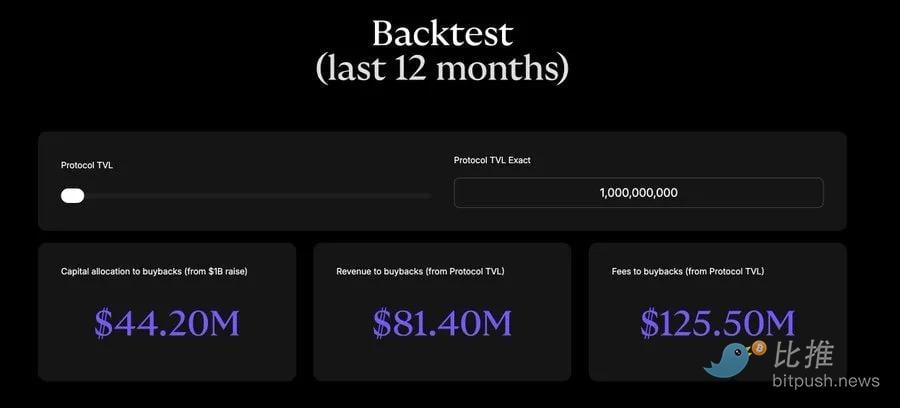
Over time, protocol fees from trading, lending, clearing, and insurance will provide additional funding for the buyback. For investors, the economic trade-off is to forgo the potential 4% return they could have earned by deploying their own capital in exchange for FT tokens, which offer upside potential and principal protection. Essentially, investors will only exercise their put option if the FT price falls below their purchase price of $0.10.
Yields are just one component of the revenue stream. In addition to lending, the product suite includes Automated Market Makers (AMMs), perpetual contracts, insurance, and a delta-neutral stablecoin that continuously earns yields.
In addition to the expected $40 million in revenue from deploying $1 billion in various low-risk DeFi strategies, other products may also generate revenue.
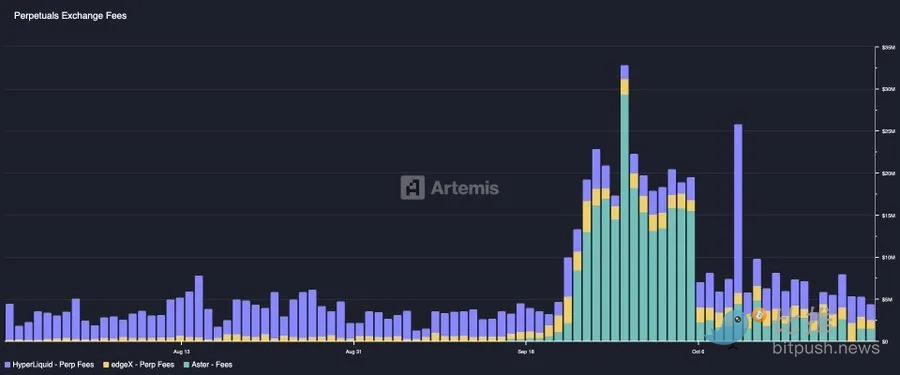
Top perpetual contract trading venues like Hyperliquid have generated $100 million in monthly transaction fees, which is almost double the income that $1 billion in capital could generate through DeFi lending at a 5-6% yield.
The token distribution model is drastically different from all previous crypto fundraising methods. Traditional ICOs and VC-backed projects typically allocate 10-30% to the team, 5-10% to advisors, 40-60% to investors, and 20-30% to the foundation/ecosystem, often with lock-up but guaranteed allocation. Flying Tulip allocates 100% of its tokens to investors (private and public) at launch, with the team and foundation receiving 0% initially. The team gains exposure only through public market buybacks funded by a share of protocol revenue, and is bound by a transparent, published timeline. If the project fails, the team receives nothing. The supply starts 100% owned by investors and gradually shifts to the foundation over time through redemptions, with redeemed tokens permanently burned. The token supply is capped based on the actual funds raised. If $500 million is raised, only 5 billion FT tokens will be minted; the fundraising window caps at 10 billion FT tokens (equivalent to $1 billion in funding).
This new mechanism addresses issues that Cronje himself experienced firsthand in the Yearn Finance and Sonic projects.
As he explained in his pitch document: "As a founder who has worked on two large token projects (Yearn and Sonic), I know firsthand the pressure that tokens bring. A token is a product in itself. If the price falls below the entry price for investors, it can lead to short-term decisions that might harm the protocol for the sake of the token. Providing a mechanism that reassures the team that there is a bottom line and that allows investors to get their principal back 'in the worst-case scenario' will greatly alleviate this pressure and overhead."
Perpetual put options decouple token mechanics from operating capital, eliminating the pressure to make protocol decisions based on token prices and allowing the team to focus on building sustainable products. Investors are protected but also incentivized to hold for upside potential, making the token less "life-or-death" for the project.
The self-reinforcing growth flywheel described in the Cronje documentation outlines the economic model: $1 billion in funding generates $40 million in annual revenue at a 4% annual rate, which is distributed between operations and token buybacks; protocol launch generates additional fees from trading, lending, liquidation, and insurance; these revenues fund further buybacks.
Redemptions combined with buybacks create deflationary supply pressure; reduced supply coupled with buying pressure drives up the price; higher token value attracts users and developers; more users generate more fees, funding more buybacks; and the cycle repeats. If the protocol's revenue eventually exceeds the initial revenue, enabling the project to be self-sustaining beyond the initial donations, then the model is successful.
On the one hand, investors gain downside protection and institutional-grade risk management. On the other hand, they face a real opportunity cost of a 4% annual return, as well as a loss of capital efficiency due to funds being locked up for below-market returns. This model only seems reasonable if the FT price appreciates significantly above $0.10.
Fund management risks include DeFi yields falling below 4%, the failure of yield protocols (such as Aave, Ethena, and Spark), and doubts about whether $40 million annually is truly sufficient to fund operations, competitive products, and meaningful buybacks. Furthermore, for Flying Tulip to surpass peers like Hyperliquid, it must truly become a liquidity hub, a tough battle given that existing players have already taken the lead and captured the market with excellent products.
Building a full-stack DeFi system with a 15-person team to compete with established protocols that have a significant first-mover advantage carries execution risks. Few teams can match the execution capabilities of Hyperliquid, a protocol that has generated over $800 million in fees since November 2024.
Flying Tulip reflects the evolution of lessons learned from Cronje's previous projects.
Yearn Finance (2020) pioneered a fair launch model with zero founder allocation (Andre had to mine his YFI) and grew from 0 to over $40,000 in a few months, reaching a market capitalization of over $1.1 billion in a month. Flying Tulip adopted the same zero team allocation but added institutional support ($200 million, while Yearn was 0 self-funded) and investor protection that Yearn lacked.
Keep3rV1's unexpected beta launch in 2020 (the token surged from $0 to $225 within hours) highlighted the risks of unaudited, sudden releases; Flying Tulip implemented audited contracts and clear documentation before its public sale. Experiences with token price pressures in the Fantom/Sonic project directly shaped the put option model.
Flying Tulip appears to combine the best elements—fair allocation, teamless allocation, structured launch, and investor protection through a novel perpetual put option mechanism. Its success hinges on the quality of the product and its ability to attract liquidity from a large user base already accustomed to competitors like Hyperliquid and centralized exchanges.
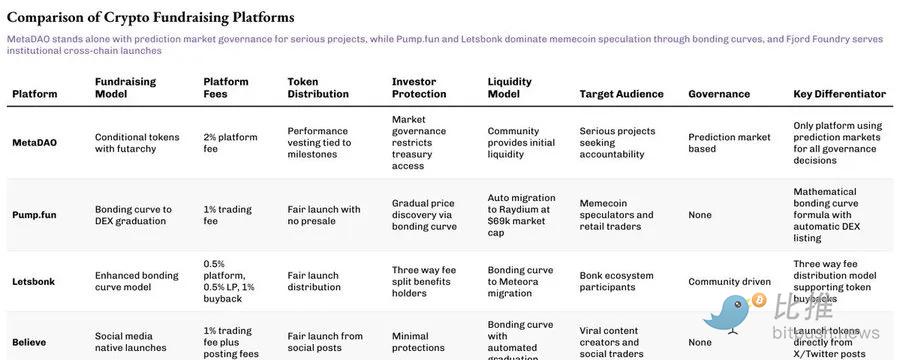
MetaDAO's funding is backed by Futarchy.
If Flying Tulip reimagined investor protection, then MetaDAO re-examined the other half of the equation: accountability.
Projects that raise funds through MatADAO do not actually receive the funds they raise. Instead, all capital is held in an on-chain treasury, and a conditional market validates every expenditure. Teams must propose how they intend to spend the money, and token holders bet on whether these actions will create value. Transactions only proceed if the market agrees. This is a structure that rewrites fundraising as governance, where financial control is distributed and code replaces trust.
Umbra Privacy is a groundbreaking example. This Solana-based privacy project secured over $150 million in committed investment, while its market capitalization was only $3 million, distributed pro rataly with any excess automatically refunded by a smart contract. All team tokens were locked after a price milestone, meaning the founders only realized value as the project truly grew. The result was a 7x return on investment after launch, demonstrating that even in a sophisticated market, investors still crave fairness, transparency, and structure.
MetaDAO's model may not have become mainstream yet, but it restores something the crypto space once promised: a system where the market, rather than regulators, determines what deserves funding.
Cryptocurrency funding is currently entering a period of reflection, and many preconceived notions are being challenged:
- The Echo case proves that even without direct access to exchanges, financing channels with high-quality community resources have huge valuation potential.
- The Flying Tulip experiment is validating whether a new investor protection mechanism can replace the traditional token economy model.
These explorations are reshaping our understanding of the value logic of the crypto market.
The success of these experiments depends not on how perfect the theory is, but on the actual implementation, whether users are willing to pay for it, and whether these mechanisms can withstand the test of market pressure.
The reason why financing models keep evolving is that the core contradictions between project owners, investors, and users have never been resolved.
Every new model claims to better balance the interests of all parties, but ultimately they all have to face the same real-world test—whether they can gain a foothold in the real market.