
On May 19, 2025, the last 30 seconds before the opening of the New York Stock Exchange. The trading terminal of the S&P 500 index fund flashed red instructions - hundreds of millions of dollars of funds poured into the Coinbase (COIN) stock pool like a tide. The fund managers tapped the keyboard expressionlessly. They didn't care about the philosophical ideals of Bitcoin, didn't understand the technological revolution of blockchain, and never even had a wallet address. But they knew one thing: the index rules required them to hold Coinbase, because from this moment on it was the new upstart of the S&P 500. Wall Street's capital machine quietly put the reins around the neck of crypto freedom.
1. The road to peace: from regulatory purgatory to financial temple
Coinbase's compliance counterattack is a bloody epic. Three years ago, the company was struggling to survive the SEC's lawsuit storm. In June 2023, the SEC filed a lawsuit against it on 13 counts of violating federal securities laws, accusing it of trading "unregistered securities." CEO Brian Armstrong angrily rebuked on social media: "If you want to sue, we will fight!"
A dramatic turn of events took place in 2025. In February, the SEC suddenly withdrew the lawsuit, and the Trump administration appointed a cryptocurrency-friendly lawyer to head the SEC, and the regulatory wind reversed 180 degrees. Three months later, Coinbase acquired the derivatives giant Deribit for a sky-high price of US$2.9 billion, controlling 70% of the world's open Bitcoin options contracts. When the door to the S&P 500 opened on May 19, Coinbase had transformed from a regulatory outcast to a financial elite.
2. Capital War: Reconstructing the Equation of Passive Funds
According to Oppenheimer analysts’ estimates, more than $15 trillion of index funds were forced to build positions, and the short-term passive buying demand alone was as high as $9 billion. More far-reaching impacts are surging in the undercurrent:
1.269 billion U.S. pension fund holders “unconsciously hold coins” through their 401K accounts, and 5 million teachers have become indirect participants in the crypto economy;
l Reconstruction of stock price fluctuation logic: passive allocation forms a buffer to partially hedge against the sharp fluctuations in the crypto market;
l Wall Street’s pricing power expands: After acquiring Deribit, Coinbase controls the Bitcoin options market, and capital penetrates into the core of crypto asset pricing;
This forced bundling is changing market behavior. Robinhood data shows that COIN searches have surged by 300%, but only 12% of users understand the nature of its business. When ordinary people's pension accounts are tied to COIN stock prices, the free volatility of the crypto market is being tamed by Wall Street's steady-state demand.
3. Twilight of Freedom: The Institutionalized Survival of Crypto Spirit
The crypto community cheered for Coinbase's inclusion in the S&P 500, but the perceptive have already sensed the crisis. When Michael Saylor hailed this as "an important milestone for Bitcoin" on X, he omitted the subtext of the second half of the sentence: the financialization of Bitcoin is essentially the co-optation of traditional capital.

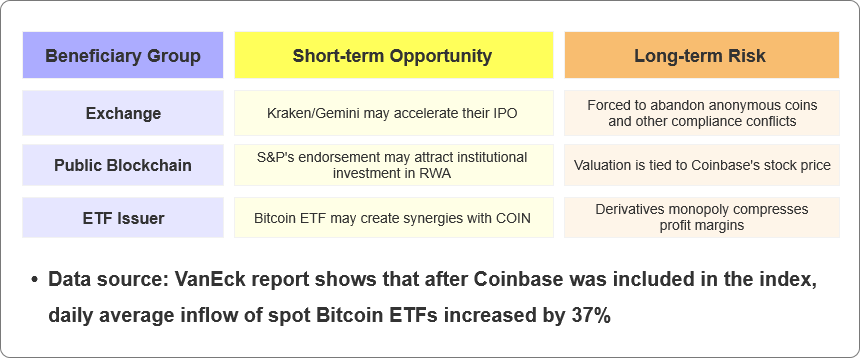
The long-short game after Coinbase was included in the S&P 500
lMulti-party logical chain
Regulatory amnesty → Index inclusion → Institutional holdings → Liquidity premium → Industry ETF acceleration
l Short side warning line
Compliance costs → innovation suppression → user loss → valuation decoupling from crypto markets → increased Wall Street manipulation
The real threat is at the value level. When the crypto spirit of "don't be evil" encounters the pressure of quarterly financial reports, Coinbase begins to remove anonymous coins and restrict DeFi access. The acquisition of Deribit is essentially to take over the derivatives market with the logic of centralized exchanges, which runs counter to the peer-to-peer electronic cash system envisioned by Satoshi Nakamoto.