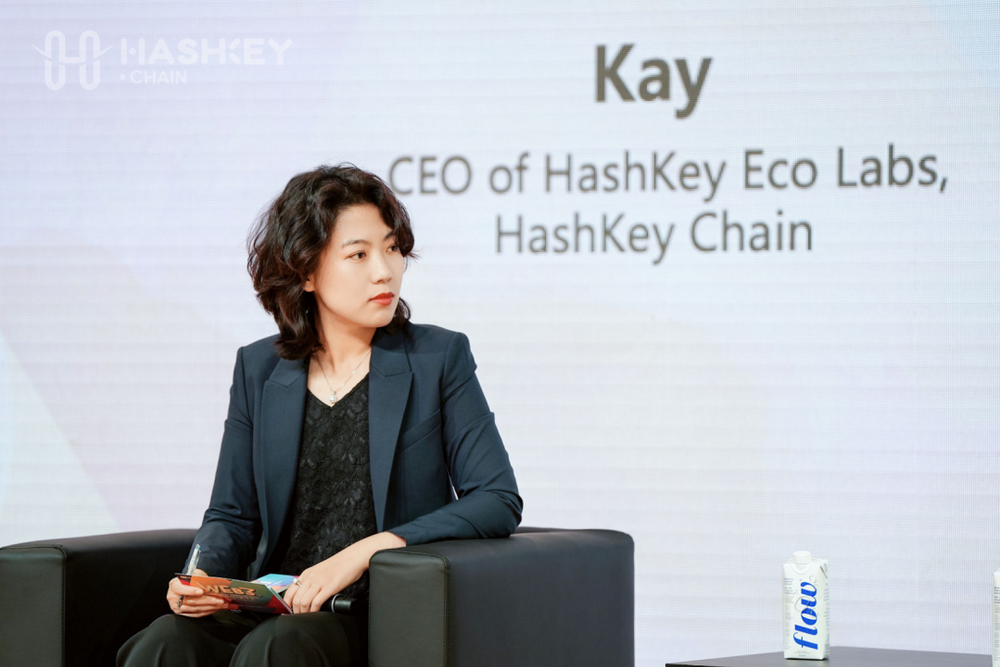
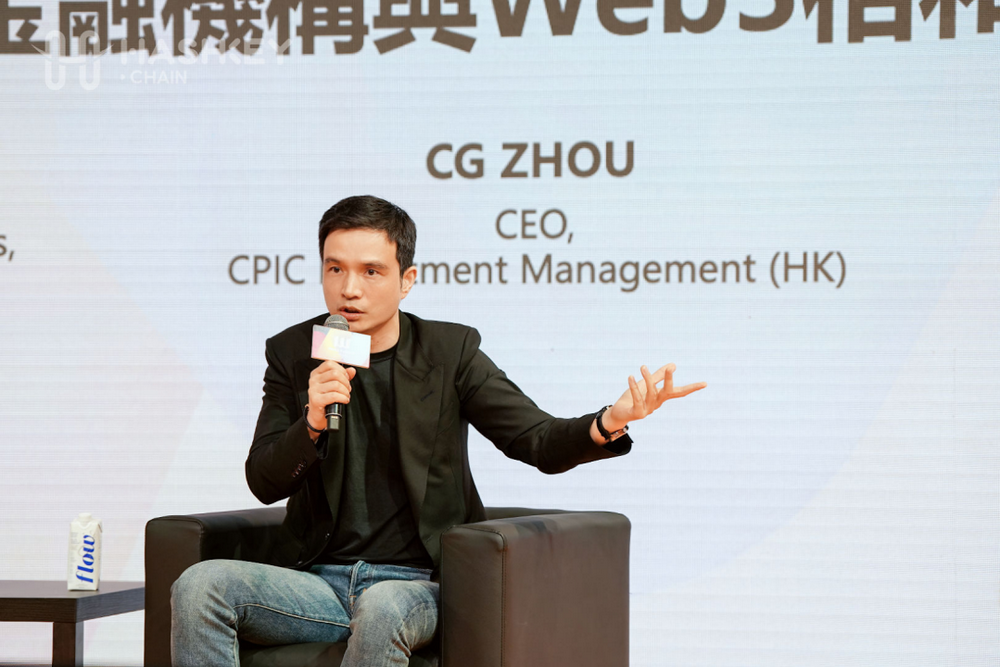
On April 6, at the WEB3 Festival, a sharing session with the theme of "Fireside Chat: When Financial Institutions and Web3 Reconcile" attracted a lot of attention. HashKey Eco Labs CEO Kay and China Pacific Insurance Investment Management (Hong Kong) Founder and CEO Mr. Zhou Chenggang (CG Zhou) had an in-depth discussion on blockchain technology, digital assets and the future trend of RWA. The following is the content of the conversation:
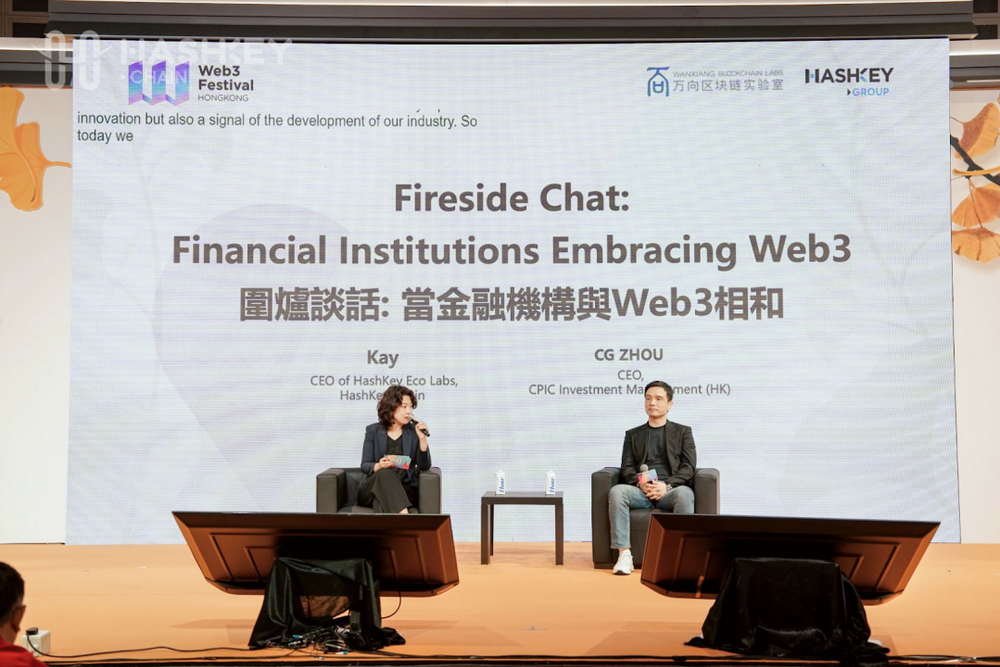
Kay: We just saw at the back of the venue that this panel is one of the most popular sessions in the entire event. The venue was packed with people, which fully demonstrated that both Web2 and Web3 practitioners pay close attention to the RWA track. The advancement of RWA is inseparable from the participation and support of traditional financial institutions, as well as the integration of Web3 technology and concepts. Therefore, today we will conduct an in-depth discussion on the theme of "the integration of Web3 and traditional finance".
I am Kay, and I am honored to host today's panel. We have also invited a distinguished guest, Mr. CG, founder and CEO of China Pacific Insurance Investment Management (Hong Kong). Welcome, please say hello to everyone and let more friends know you.
CG: Thank you Kay, good afternoon everyone. I am CG from CPIC Asset Management Hong Kong. I just took a look around the venue and found that our venue is very popular. It can be said to be the most lively one today. Thank you for your attention and support.
1. The opportunity and original intention of traditional financial institutions to enter Web3
Kay: In the past two years, blockchain technology has been gradually moving from proof of concept to practical application, especially in the traditional financial field, where more and more institutions have begun to pay attention to asset chain, transparency and efficient circulation. CPIC Hong Kong has taken an important step in this field by launching a tokenized US dollar money market fund, CPIC Estable MMF, and using HashKey Chain as the on-chain infrastructure. The subscription amount on the first day of its launch reached US$100 million. This is not only a product innovation, but also a signal of industry development. The question we are discussing today is: Why do institutions like CPIC, which have been deeply involved in the financial market for a long time, begin to pay attention to Web3? From an institutional perspective, what is the value of blockchain? What opportunities are worth exploring in the future?
As a Web3 practitioner, I would like to ask Mr. Zhou a question: Web3 was initially promoted by a group of technical geeks and native players, but in recent years, the attention of traditional institutions has increased rapidly. Blockchain technology has also transformed from a "geek toy" to an important technical facility in the financial field in less than 10 years. Mr. Zhou, as the helmsman of CPIC Hong Kong, how do you view this rapid change?
CG: From the perspective of our organization, whether it is RWA or asset tokenization, it is a "natural" thing. Because we obtained the relevant license issued by the Hong Kong Securities and Futures Commission two years ago, and during this period we also issued four Crypto Funds. In fact, we have begun to consider entering the direction of Tokenization or RWA more than a year ago. It is worth mentioning that the three letters "RWA" were not popular at that time, and may not even be widely used. For us, we are the managers of RWA ourselves, and what we manage on a daily basis are traditional financial assets such as stocks and bonds, rather than pure Crypto. So it is very natural for us to enter this field.
When we started preparing for RWA-related projects a year ago, we did not expect that many discussions at the Web3 Festival today would revolve around RWA, and we did not expect that this topic would be so popular. Our idea at the time was actually very simple - the revenue model on the chain seemed to be relatively limited, mainly reflected in two aspects: one is transaction fees, and the other is loan interest. In addition, many sources of "revenue" are actually based on the issuance of air coins, which we are reserved about.
Therefore, from our perspective, we manage real-world assets that have stable and sustainable returns. We hope to tokenize these assets, put them on the chain, and provide the Web3 ecosystem with asset products that are truly supported by underlying returns. This not only fills the gap in the market, but also hopes to rewrite some of the prejudices and misunderstandings of the traditional financial community about the Web3 world - they often feel that Web3 is "idling" and lacks real support. Through such practices, we hope to bring a more solid value foundation to the Web3 world and promote the healthier development of this industry.
2. Real challenges of transformation of traditional institutions
Kay: Thank you Mr. Zhou for your wonderful sharing. We have also deeply realized an important topic: all seemingly great innovations actually come from the accumulation of ordinary days. It is based on the deep understanding and long-term accumulation of the financial industry that CPIC Hong Kong can set up a benchmark case in the field of Web3.
But I would also like to raise a more specific question. We often compare the entry of traditional institutions into Web3 to "an elephant turning around", which is large in size, complicated in process, and has many practical obstacles. The entry of institutional investors also means higher requirements for security, compliance and liquidity. Mr. Zhou, what practical problems did CPIC Hong Kong encounter in the process of exploring Web3? How did you adapt and solve them step by step, and finally promote the smooth implementation of the project?
CG: This is a very good question. When we obtained the SFC license from the Hong Kong Securities and Futures Commission two years ago and started to prepare for the Crypto Fund, we investigated many similar funds on the market. It turned out that many funds had very weak internal controls, and some even had no middle and back-end, which is unacceptable in the traditional financial system.
So, at that time, many friends in the Web3 circle asked us "what are you doing" and "what can you bring". My answer was very direct: we hope to bring the mature experience and standardized processes accumulated by traditional finance over decades into Web3 asset management. Especially in terms of security, risk control and compliance, we want to establish a standard that can be compared with traditional funds.
Of course, we must also face reality. The current Web3 infrastructure is far from mature, and the most obvious problem is custody. In traditional asset management, asset custody is already very mature and secure, but in the Web3 field, from custody to bank interfaces to fund administrative services, many links are still being explored.
We can now achieve about 70%-80% of the standard of traditional funds, which is already a relatively high standard in the industry. We also always remain honest and transparent, and believe that with the continuous improvement of infrastructure, we will have the opportunity to further increase this ratio in the future and truly achieve the deep integration of traditional finance and Web3.
3. Practical Path Selection for Asset Tokenization
Kay: Thank you Mr. Zhou for sharing your insights, which also answered a long-standing question of ours: why many traditional asset management institutions have not made as rapid progress as expected in their exploration of blockchain. In fact, many Web3 infrastructures are currently unable to meet the high standards that traditional finance has already established.
This is also the value of HashKey as a Hong Kong compliant licensed institution. We originated in Hong Kong and currently have comprehensive compliance service capabilities in multiple fields such as public chains, exchanges, and custody, and can provide complete infrastructure support for asset chaining. We also look forward to more cooperation with CPIC Asset in the future.
RWA is one of the hottest topics in the Web3 field. Especially in the past two years, when people mention RWA, they always focus on asset types such as bonds and real estate. But the asset pool of insurance asset management is far more than that. In your opinion, which assets are most suitable for tokenization first? In the future, will we have the opportunity to see Taibao move "ballast assets" such as insurance policies and infrastructure investments to the chain?
CG: This is a key question. We have conducted a lot of discussions internally, and at this stage we are only focused on the tokenization of financial assets, not physical assets.
Why? Because the essence of tokenization is to issue a token on the chain that represents a real-world asset, and ensuring a strong connection between the token and the underlying asset is the most basic and difficult part. Take physical assets as an example, such as Moutai - how do you verify that this bottle of Moutai is real? If it is drunk, damaged, or fake, the trust bond between the token and the asset is broken.
In contrast, financial assets, especially standardized assets such as fund shares, can clearly guarantee the binding relationship between tokens and underlying assets in the legal framework, and are easy to supervise and manage. This is why we currently only choose financial assets as the objects of RWA.
Another core question is: Why do we need tokenization? This is not a decision that can be driven by "trends", but must have clear financial logic and practical significance. We believe that the core value of RWA has two aspects:
First, it lowers the threshold and expands the access of the investor group. In the past, only institutions could participate in certain high-threshold asset categories, but through tokenization, ordinary investors can also hold shares of such assets.
Second, it is to improve efficiency, including transaction convenience and cost reduction. If tokenization does not bring obvious improvements in liquidity, efficiency or security, it loses its meaning. For example, tokenizing a bottle of Moutai does not bring any additional benefits, but only increases complexity and cost.
Another example is real estate. Although there are mature paths to securitization through REITs and other means, whether it really needs to be further tokenized requires a detailed analysis of the value logic behind it. If it cannot bring new financial advantages, and it is only for the sake of "on-chaining", I think it is unsustainable.
In summary, the first thing to solve when doing RWA is “why do it”, followed by “what to do” and “how to do it”. Only tokenization that brings real value is worth promoting.
4. Advice for traditional financial institutions
Kay: This is indeed a very valuable sharing for every practitioner present here. Especially for those who are exploring the issuance through RWA, Mr. Zhou's views remind us to think about the most core essential issues. On this basis, I would like to ask Mr. Zhou, do you have any practical experience to share with traditional financial institutions who are still waiting? For those institutions that are still hesitating whether to enter the market, what basic capabilities do you think they need? In terms of organizational structure, talent pool or technology selection, what suggestions or experience can you draw on?
CG: First of all, I think RWA is indeed a trending and highly deterministic track. As a traditional financial practitioner, we have seen many "hot spots" in the Web3 field in the past few years - whether it is technology, ecology or application level, there are indeed many projects that come and go quickly, and it is difficult for us to judge the sustainability of many of them. But among all Web3 directions, RWA is the path that is closest to traditional financial logic and most likely to achieve large-scale implementation. It connects real-world assets and on-chain infrastructure, and this connection is something we can understand and evaluate.
Therefore, for traditional financial institutions, RWA is a direction worth investing in. It is recommended to set up a special innovation group or Web3 business unit in the organizational structure; in terms of manpower, reserve compound talents who understand both finance and on-chain mechanisms; in terms of technology, it is not necessary to build everything by yourself, but to choose a reliable, secure, and compliant cooperation platform - for example, we at HashKey are also very willing to provide support and cooperation in this regard.
We look forward to more and more traditional institutions joining in and jointly promoting the establishment and maturity of the RWA ecosystem.
5. Conclusion
Kay: It is not a one-shot process for institutions to enter Web3. They need to find feasible paths in the existing regulatory system and find a balance between innovation and stability. The cooperation between CPIC and HashKey Chain is just the beginning. I believe that in the near future, we will see more and more traditional financial assets achieve more efficient circulation through blockchain, and more institutions will truly enter Web3, allowing this industry to move from exploration to true maturity. Today's conversation reminds me of a saying: "History will not repeat itself, but it will rhyme." We have seen the harmony of traditional finance and Web3 from the practice of CPIC Hong Kong. The combination of the two has both the bottom-line thinking of compliance and the courage to innovate.
Thank you Mr. Zhou for sharing so sincerely and warmly, and thank you all for being here. I look forward to seeing more Chinese institutions in the wave of on-chain finance in the future. See you next time!