Author: Bootly
After five years in business, raising approximately $180 million in funding, and reaching a valuation that once approached $1 billion, Farcaster officially admitted that the Web3 social networking path had not worked.
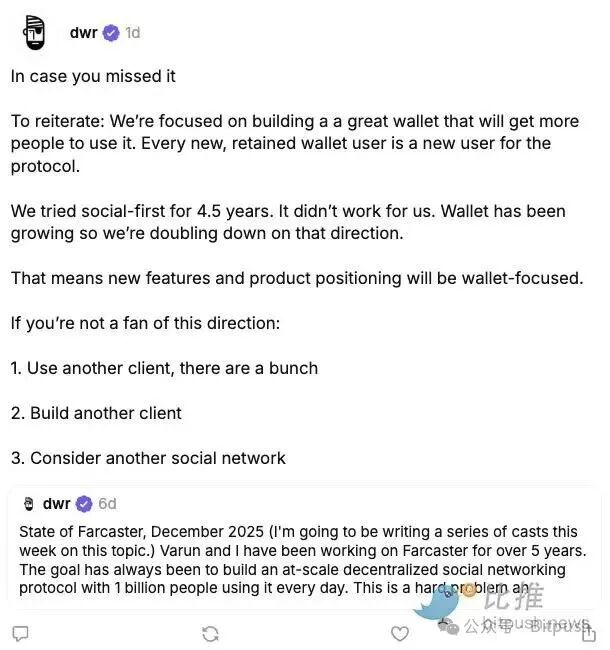
Recently, Farcaster co-founder Dan Romero posted a series of messages on the platform announcing that the team will abandon its "social-centric" product strategy and instead focus entirely on wallets. In his statement, this was not a proactive upgrade, but rather a choice forced upon them by reality after a long period of experimentation.
“We tried being social-first for 4.5 years, but it didn’t work.”
This assessment not only signifies Farcaster's transformation but also brings the structural challenges of Web3 social networking back into the spotlight.
Why did Farcaster fail to become a "decentralized Twitter"?
Farcaster was created in 2020, at the height of the Web3 narrative. It sought to solve three core problems of Web2 social platforms:
- Platform Monopoly and Censorship
- User data does not belong to you.
- Creators cannot directly monetize.
Its design concept is quite idealistic:
- Decentralized protocol layer
- Clients can be freely built
- Social relationships are on-chain and transferable.
Among a host of "decentralized social" projects, Farcaster was once considered the closest to Product-Market Fit (PMF). Especially after Warpcast went viral in 2023, a large number of KOLs joined Crypto on Twitter, making it look like the prototype of the next generation of social networks.
But the problems soon became apparent.
According to Farcaster's monthly active users (MAU) statistics on Dune Analytics, Farcaster's user growth trajectory presents a very clear, but not optimistic, pattern:
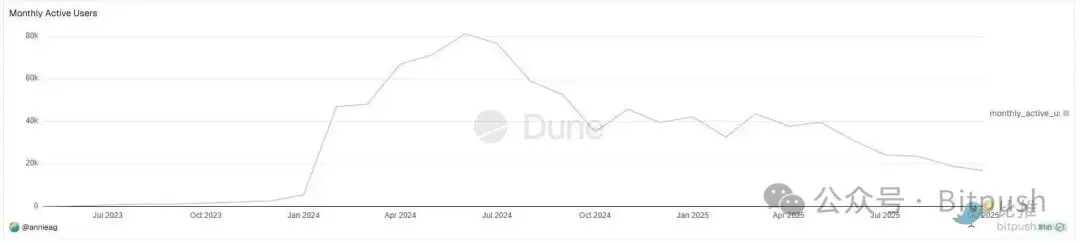
For most of 2023, Farcaster’s monthly active users were negligible; the real growth inflection point came in early 2024, with MAU rapidly increasing from a few thousand to about 40,000-50,000 in a short period of time, and even approaching 80,000 in mid-2024.
This is the only truly significant window of growth Farcaster has experienced since its inception. It's particularly noteworthy that this growth didn't occur during a bear market, but rather during a period of high activity in the Base ecosystem and a surge of SocialFi narratives.
However, this window of opportunity did not last long. Starting in the second half of 2024, monthly active user data showed a significant decline, and subsequently exhibited a fluctuating downward trend over the following year.
- MAU rebounded multiple times, but the highs continued to decline.
- By the second half of 2025, monthly active users had fallen to less than 20,000.
In fact, Farcaster's growth has always been unable to "break out of its niche" because its user structure is highly homogeneous:
- Crypto practitioners
- VC
- Builder
- Crypto Native users
For ordinary users:
- High registration threshold
- Social content is severely "internalized".
- The user experience is not better than X / Instagram.
This prevents Farcaster from ever achieving a true network effect.
DeFi KOL Ignas stated on X (@DeFiIgnas) that Farcaster "simply acknowledged a fact that everyone has felt for a long time":
The network effect of X (formerly Twitter) is so strong that it is almost impossible to break through head-on. This is not a problem with the crypto narrative, but rather a structural barrier inherent in social products.
This is why Ignas succinctly summarized Farcaster's new strategy in one sentence:
“It’s easier to add social features to a wallet than to add a wallet to a social product.”
This judgment essentially acknowledges that "social interaction is not the primary requirement of Web3".
"Bubble is comforting, but numbers are cold."
If MAU data answers the question "How well is Farcaster performing?", then another question is: How big is the market itself?
Crypto creator Wiimee has provided a set of striking comparative data on X.
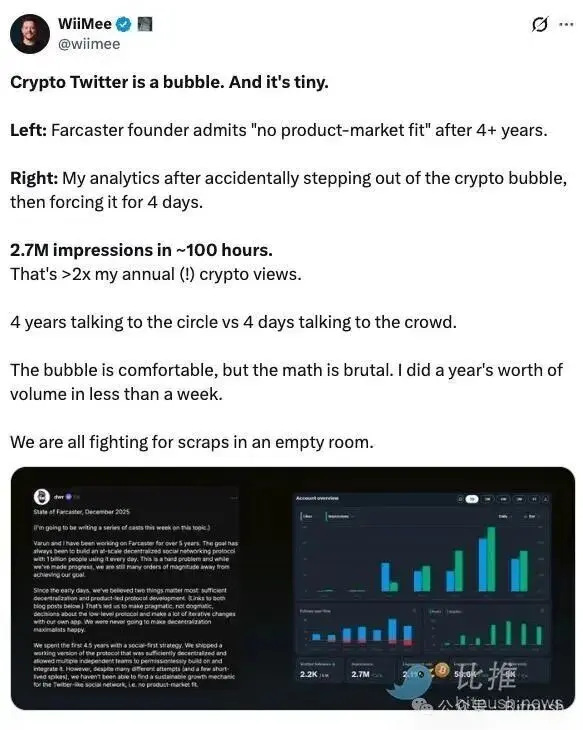
After "unexpectedly stepping out of the encrypted content circle," Wiimee created content for a broader audience for four consecutive days. His analysis data shows that he gained 2.7 million impressions in about 100 hours, more than twice the total number of views of all his encrypted content in a year.
He stated:
“Crypto Twitter is a bubble, and it’s very small. Four years of talking to insiders is not as effective as four days of talking to a general audience.”
This isn't a direct criticism of Farcaster, but rather reveals a more fundamental problem: encrypted social networking is inherently a highly self-sustaining ecosystem with extremely weak spillover capabilities. When content, relationships, and attention are all confined to the same group of native users, even the most sophisticated protocol design struggles to break through the market's growth ceiling.
This means that Farcaster's problem isn't that "the product isn't good enough," but rather that "there aren't enough people in the market."
The wallet, instead, ran out of PMF.
What truly changed Farcaster's internal judgment was not a reflection on social features, but the unexpected validation of the wallet.
In early 2024, Farcaster introduced a built-in wallet in its app, initially intended as a supplement to the social experience. However, usage data shows that the wallet's growth rate, usage frequency, and retention performance are significantly different from the social module.
In his public response, Dan Romero emphasized:
“Every new and retained wallet user is a new user of the protocol.”
This statement itself reveals the core logic behind the route adjustment. The wallet is not dealing with "expressive desires," but rather with real, rigid on-chain behavioral needs: transfers, transactions, signatures, and interactions with new applications.
In October, Farcaster acquired Clanker, an AI agent-driven token issuance tool, and gradually integrated it into its wallet system. This move was seen as a clear bet by the team on a "wallet-first" path.
From a business perspective, this direction has clear advantages:
- More frequent use
- The monetization path is clearer
- Closer integration with the on-chain ecosystem
In contrast, social features are more like icing on the cake than an engine driving growth.
While the wallet strategy is data-driven, it has also sparked controversy within the community.
Several long-term users have made it clear that they are not against the wallet itself, but rather uncomfortable with the cultural shift that follows: from "users" being redefined as "traders," and from "co-builders" being labeled as "old guards."
This exposes a real problem: when product direction changes, community sentiment is often harder to transfer than the roadmap. Farcaster's protocol layer remains decentralized, but the power to choose product direction still rests with the team. This contradiction is amplified during the transition.
Romero later acknowledged communication problems but also made it clear that the team had made a choice.
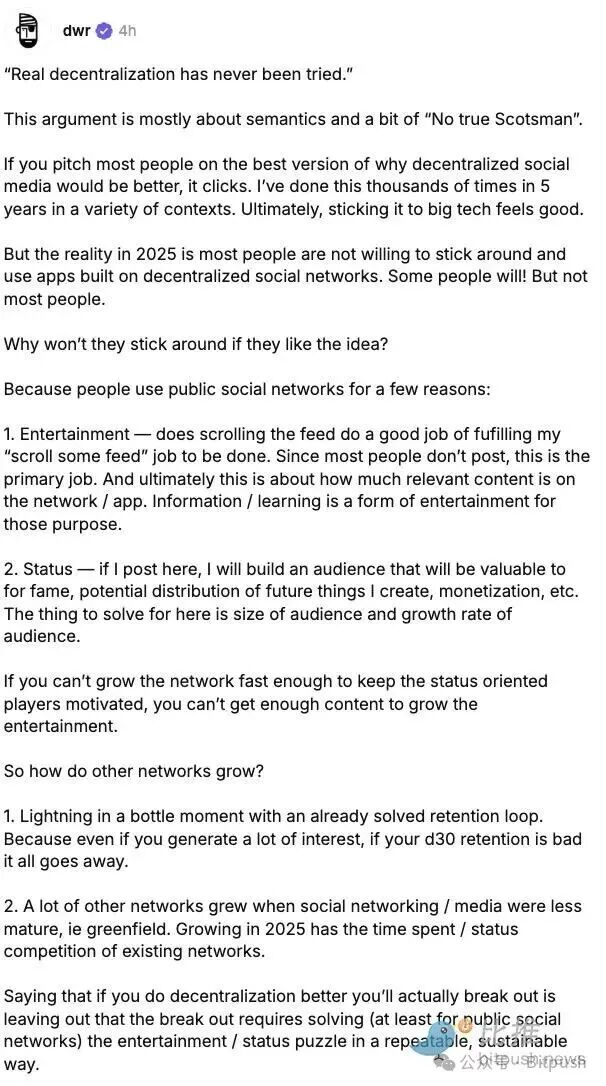
This is not arrogance, but a realistic decision commonly made by startups late in their lifecycle. In this sense, Farcaster did not abandon its social ideals, but rather its illusions about scaling them.
Perhaps, as one observer put it:
"Only when users stay for the tools can social interaction have a place to exist."
Farcaster's choice may not be the most romantic, but it may be the closest to reality: in-depth integration of native financial tools (wallets, trading, issuance) is the practical path to transforming them into sustainable business value.