
Author: ZHIXIONG PAN
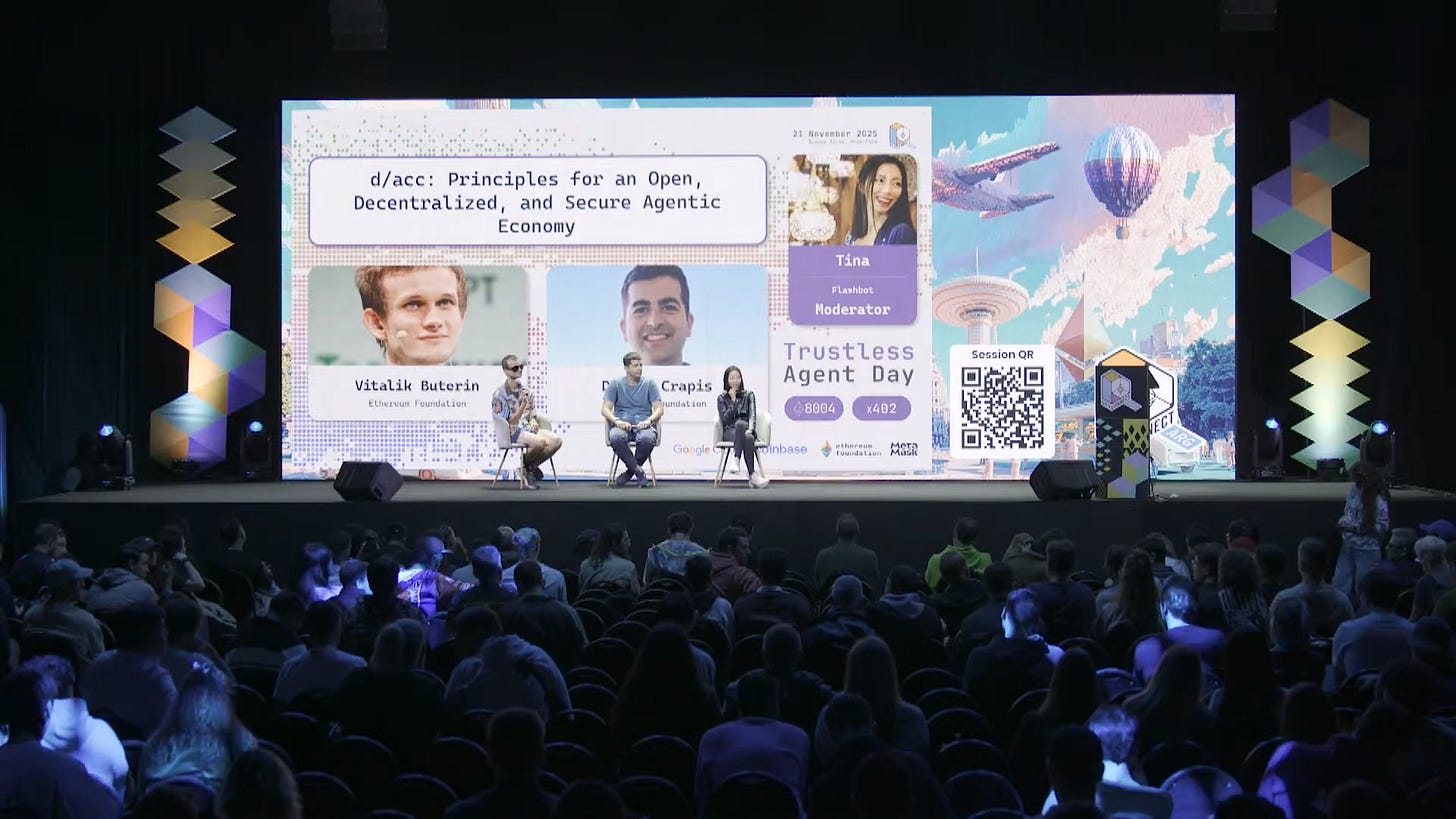
During Ethereum Devconnect, an event called Trustless Agent Day brought together leading thinkers at the intersection of Web3 and AI. This closing panel was hosted by Tina from Flashbots, with keynote speakers including Ethereum co-founder Vitalik Buterin and Davide Crapis, head of the Ethereum Foundation's dAI team.
This dialogue is not only about technical standards, but also a projection of the architecture of the future digital society: when AI agents become the main participants in economic activities, what kind of infrastructure, trust models and privacy protections do we need?
The Two Barriers of Infrastructure: Payments and Discovery (x402 and ERC-8004)
The dialogue is built on two core protocols: x402 for payments and ERC-8004 for service discovery, which form the cornerstone of the agent economy.
Vitalik's vision for reshaping micropayments
Vitalik began by expressing his excitement about micropayments in the AI era. He believes that the involvement of AI makes micropayments truly feasible. In the human world, deciding whether to pay 4 cents or 11 cents for this service is not only time-consuming but also mentally taxing, but for an AI agent, it's a millisecond-level computational decision.
Vitalik emphasized that "pay for what you consume" is the most efficient economic model. However, he also pointed out that such high-frequency payments must be built on the foundation of privacy protection. Without protection, the thousands of queries made by a single agent would completely expose a user's behavioral patterns. Therefore, combining this with ZK (zero-knowledge proof) technology is crucial. For example, a user could prepay a sum of money (e.g., $5) in exchange for credentials for 5,000 queries, and on the blockchain, these 5,000 queries would be unlinkable to each other.
Davide and ERC-8004: From Payment to Trust
If x402 solved the "how to pay" problem, Davide's ERC-8004 attempts to solve the "to whom to pay" problem. Davide stated that when he saw people starting to send micropayments to web services or AI via x402, a fundamental question arose: how do you trust these services?
ERC-8004 (Trustless Agent Standard) was thus developed. It's not a simple whitelist, but a decentralized service discovery mechanism. It allows service providers to register on-chain and demonstrate their capabilities. Davide divides trust into two categories:
- Soft Trust: Based on past performance, reputation, and audit results.
- Hard Trust: Guarantees based on cryptographic proofs or cryptoeconomics.
ERC-8004 standardizes the format for exchanging this information, enabling agents to autonomously find and verify service providers in decentralized networks.
The Elephant in the Room: The Gap Between Ideals and Reality
Before discussing the future, host Tina handed the microphone to the audience and initiated a discussion on "finding the elephant in the room," which refers to the obvious but overlooked pain points in the industry.
Agent's "Role-Playing" Crisis
Developer Shaw raised a pointed point: we don't yet have truly usable agents. He pointed out that most current agents are trained on textual data like Reddit, knowing the "theoretical steps to making a cake" but never actually "baking" one in the real world. Current agents attempt to trade and predict markets, which are "out-of-distribution" operations. To some extent, the current industry is engaged in an expensive LARP (Layered Role-Playing), lacking agents with true end-to-end execution capabilities.
The double whammy of cost and prejudice
Another developer, Tim, pointed out the economic unsustainability of the equation: the cost of reasoning is too high. Every tiny decision invocation burns through funds, and to achieve the x402 vision, the cost of a single decision must be reduced to below 10% of transaction fees. Currently, many startups are surviving solely on free credits from cloud service providers.
Furthermore, Andrew Miller poured cold water on reputation systems, arguing that history has shown they tend to favor incumbents and are prone to failure. He suggested that the only solution might be to utilize a Trusted Execution Environment (TEE) sandbox, allowing open-source agents to enter the sandbox to evaluate the security of closed-source agents.
Why blockchain? The native habitat of intelligent agents.
Given so many problems, why do we insist on building an agent economy on the blockchain? Vitalik and Davide offer an answer that goes beyond "payment tools".
On-chain games and synthetic assets
Vitalik proposed an interesting perspective: blockchain is the natural breeding ground for on-chain games, where "games" refers to market interactions in the sense of game theory.
He argues that agents don't need identity verification to build trust like humans do; they are better suited to a game-playing environment that is anonymous and trustless. More importantly, agents can understand and process extremely complex synthetic assets—financial products composed of baskets of goods that are difficult for humans to intuitively understand but logically sound for machines. This could give rise to an agent-specific market entirely different from human financial markets.
Constrained Delegation
Davide added from a security perspective that blockchain provides "hard rules." As humans increasingly delegate decision-making power to AI (i.e., agentization), we need a safety net. Smart contracts can implement restricted delegation; for example, I can allow my DeFi agent to move funds for arbitrage, but the underlying code of the smart contract is hardcoded to "prohibit withdrawals" to external addresses. This code-based constraint is a level of security that traditional Web2 APIs cannot provide.
Privacy as a "hygiene habit"
On the topic of privacy, Vitalik put forward a core argument: privacy is not a feature, but a hygiene.
He emphasized that we should not view privacy as a new trick to add to products, but rather as "no longer leaking data".
User Privacy > Service Privacy
On the priority of privacy protection, Vitalik's stance is clear: user privacy is far more important than service privacy. We don't want to live in a world where users are rated and tracked, but we need service providers (Agents) to have transparent and publicly available reputation records. He even envisions using ZooKeeper technology to achieve "negative reputation verification"—users can prove their interaction history (including records of negative reviews) without revealing their specific identity, thereby maintaining the system's honesty while protecting privacy.
How to enhance privacy: TEE and anonymization
Addressing ZK's performance bottleneck in inference computing power, the discussion focused on TEE (Trusted Execution Environment) as a pragmatic solution. While it increases hardware costs, it serves as a bridge between reality and ideals. Vitalik added that besides hardware-level protection, anonymization is another underestimated approach. By hiding the origin of requests through a mixed-net approach, even if content cannot be fully encrypted, users can be largely protected from targeted analysis.
The future of computing: the demise of the laptop?
Looking ahead to infrastructure over the next 5 to 10 years, Vitalik made a very futuristic prediction: laptops may disappear.
He believes that the current computing architecture has a fundamental economic contradiction: Local First, while the most trustworthy, is extremely inefficient in terms of computing power utilization (personal needs are pulse-like, and hardware not only wastes costs but also needs to be recharged when it is idle).
The future trend is the decoupling of computing and user interface (UI). With the proliferation of smartphones, smart glasses, watches, and even brain-computer interfaces, the form of UI will become extremely fragmented, while the computing core may be separated from personal terminals.
This raises a huge unsolved problem: we need a new operating system or underlying architecture that allows users to securely use remote computing power while still maintaining the same level of trust as if it were "running locally".
From Protocols to Applications
At the end of the conversation, Davide revealed that ERC-8004 will be launched on the Ethereum mainnet within a few weeks. For him, the past few months have been "Season 1," the stage of community building and standard establishment; the next stage will be "Season 2": the improvement of infrastructure (such as browsers and SDKs) and the incubation of killer applications.
Vitalik offered specific advice: If you want to create a "trustless" product in the field of AI, live translation is a perfect entry point. While current encrypted communication software protects transmission privacy, translation functions often rely on centralized cloud services, which is the biggest gap in the privacy protection chain.
This panel was not only a technical evangelism of ERC-8004 and x402, but also a profound discussion on how to preserve a degree of sovereignty and privacy for humanity through cryptography and decentralized networks in an era of rapid AI development.