Author: nairolf
Compiled by: TechFlow
"Friends, what is Hyperliquid's bidding mechanism?"
Here’s a (super) simple explanation of the HIP-1 proposal by @HyperliquidX.
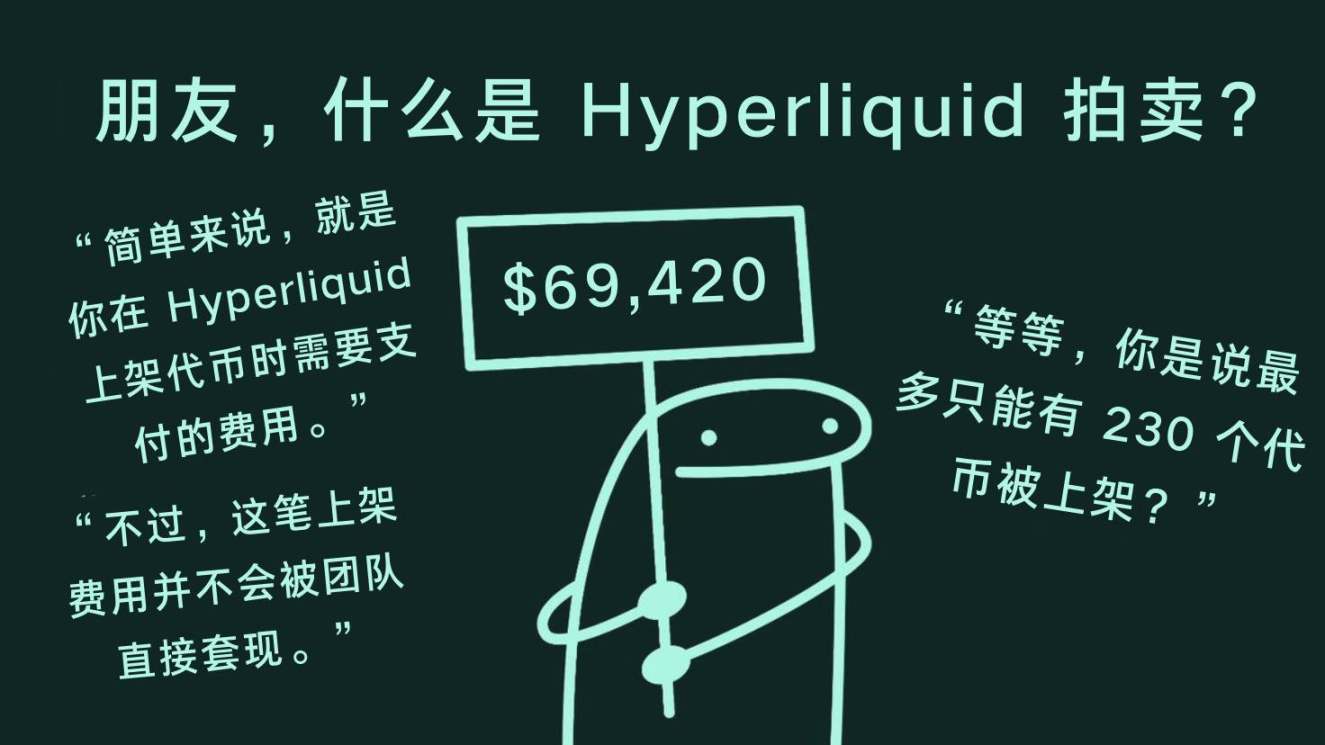
"What's this?"
HIP-1 is a standard for fungible tokens with a limited supply.
It defines the rules for how tokens are listed on the Hyperliquid platform. Tokens are sold via Dutch auctions, each lasting 31 hours, with the starting price being twice the previous auction price.
"Can't understand?"
Hyperliquid is a L1 blockchain with its own exchange.
It supports a variety of perpetual contract trading, allowing users to go long or short on almost any token and use leverage.
Additionally, it has a spot trading area, similar to Binance or Coinbase, but it is completely decentralized, I hope this helps you understand.
"I see, but how do you do that?"
Because Hyperliquid is decentralized, there needs to be a fair mechanism to decide which tokens can be listed, rather than a single team or individual making arbitrary decisions. This is different from centralized exchanges, which usually decide listings by charging fees or hand-picking tokens themselves.

"How do I do it specifically?"
Hyperliquid lists tokens through an auction mechanism.
In simple terms, every 31 hours, a new listing right will be publicly auctioned. The starting price of the auction is twice the price of the last listing right, and the price will gradually decrease over time until someone buys it.
"Give me an example."
Let’s say you want your “XYZ” token to be listed on Hyperliquid.
Contacting the team directly to request listing does not work. Instead, you need to purchase a "listing right", which requires participating in an auction.

"How much does it cost?"
The first step is to check the last transaction price of the "listing right", for example, $69,420.
The next auction will start at twice that price, at $138,840.
This price will gradually decrease over time until someone decides to buy it. After that, the auction process will repeat every 31 hours.
“So I can list my token?”
That’s right. Anyone can participate in the auction, and as long as they think the price is right, they can purchase the “listing rights” to have their tokens listed on Hyperliquid.
The 31-hour interval ensures that no too many tokens are listed, thus maintaining scarcity on the platform and uniqueness of the tokens.

Summarize
Hyperliquid’s auction mechanism determines the price at which new tokens are listed on spot exchanges.
Each auction is subject to time and price limits - an auction is held every 31 hours, with the starting price being twice the previous transaction price, and then the price gradually decreases until someone buys it.