Author: Deep Tide TechFlow
With Bitcoin's recent sharp decline, micro-strategies are also facing difficulties.
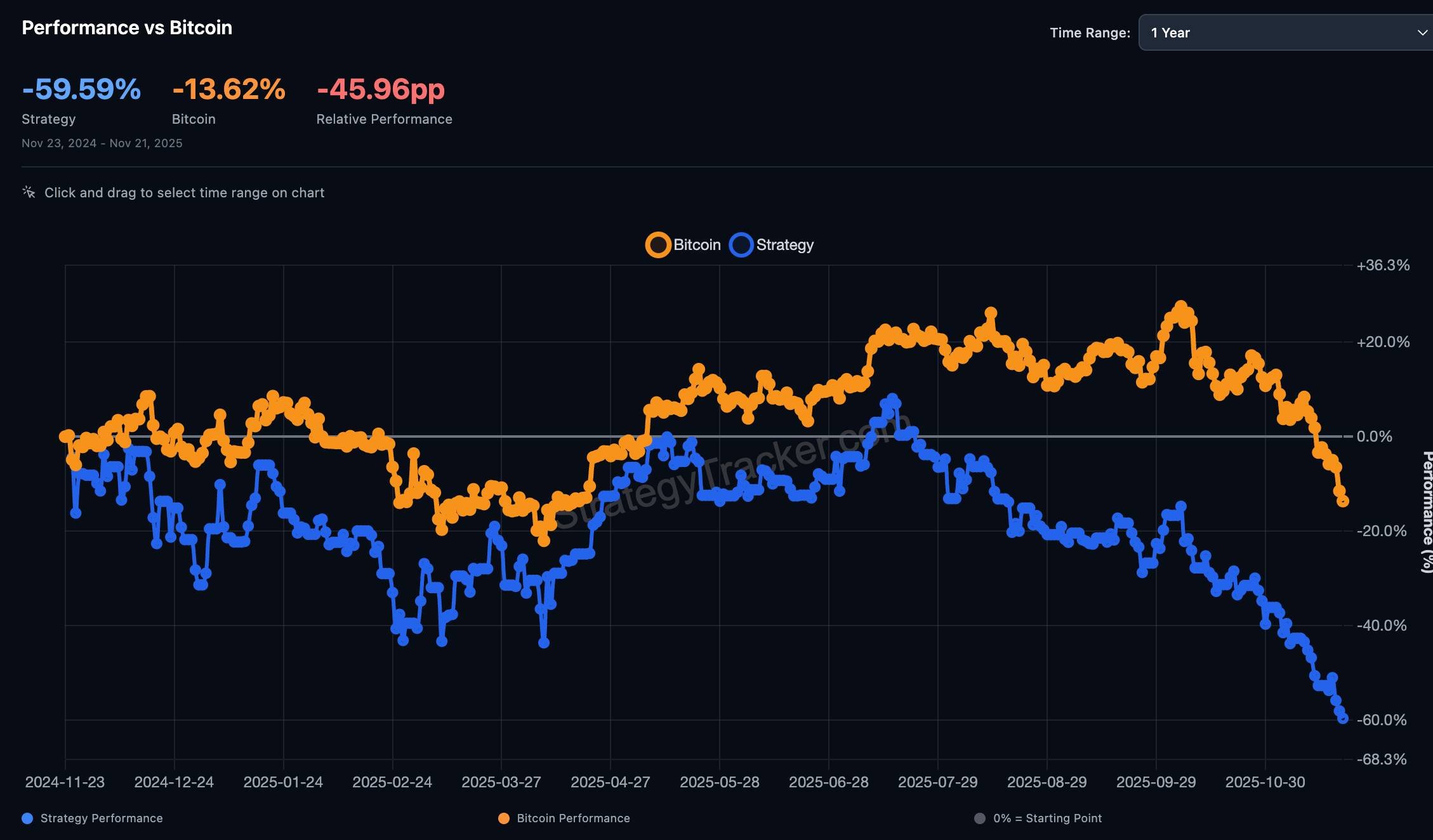
MSTR's stock price fell from a high of $474 to $177, a drop of 67%. During the same period, Bitcoin fell from $100,000 to $85,000, a drop of 15%.
Even more critical is mNAV, which is the premium of market capitalization relative to Bitcoin's net asset value.
At its peak, the market was willing to pay $2.50 for every $1 of Bitcoin held by MSTR; now that figure is $1.10, with almost no premium.
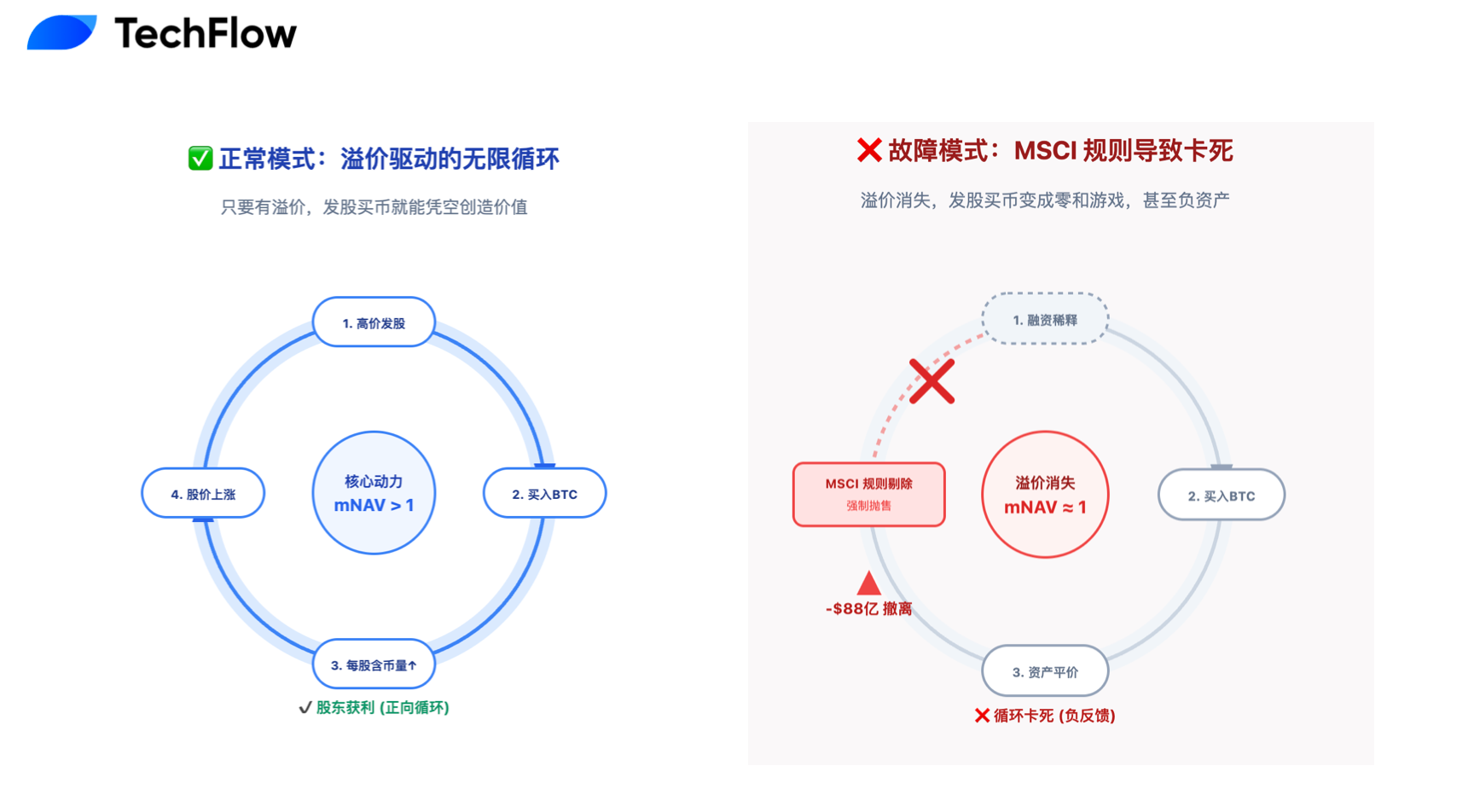
The old pattern was: issue stocks → buy Bitcoin → stock price rises (due to the premium) → issue more stocks. Now that the premium has disappeared, issuing stocks to buy Bitcoin has become a zero-sum game.
Why is this happening?
Of course, Bitcoin's recent sharp drop is one reason. But the fact that MSTR's drop was so much worse than BTC suggests an even bigger underlying panic:
MSTR may be removed from major global stock indices.
Simply put, there are trillions of dollars of funds worldwide that are "passive investors." They don't pick and choose stocks; they just mechanically buy all the constituent stocks in an index.
If you're in the index, this money automatically buys you; if you're kicked out, this money has to sell you, no questions asked.
This decision-making power rests with a few large index companies, with MSCI being the most important one.
MSCI is now considering a question: When 77% of a company's assets are in Bitcoin, is it still considered a normal company? Or is it actually a Bitcoin fund disguised as a publicly traded company?
The answer will be revealed on January 15, 2026. If MSTR is indeed kicked out, approximately $8.8 billion in passive funds will be forcibly withdrawn.
For a company that makes a living by printing stocks and buying currency, this is practically a death sentence.
When passive funds cannot buy MSTR
What is MSCI? Imagine it as the "exam setter" for the stock market.
Trillions of dollars in global pension funds, sovereign wealth funds, and ETFs are tracking indices compiled by MSCI. These funds do not conduct research or look at fundamentals; their task is to completely replicate the index—they buy whatever is in the index and avoid anything not included.

In September of this year, MSCI began discussing an issue:
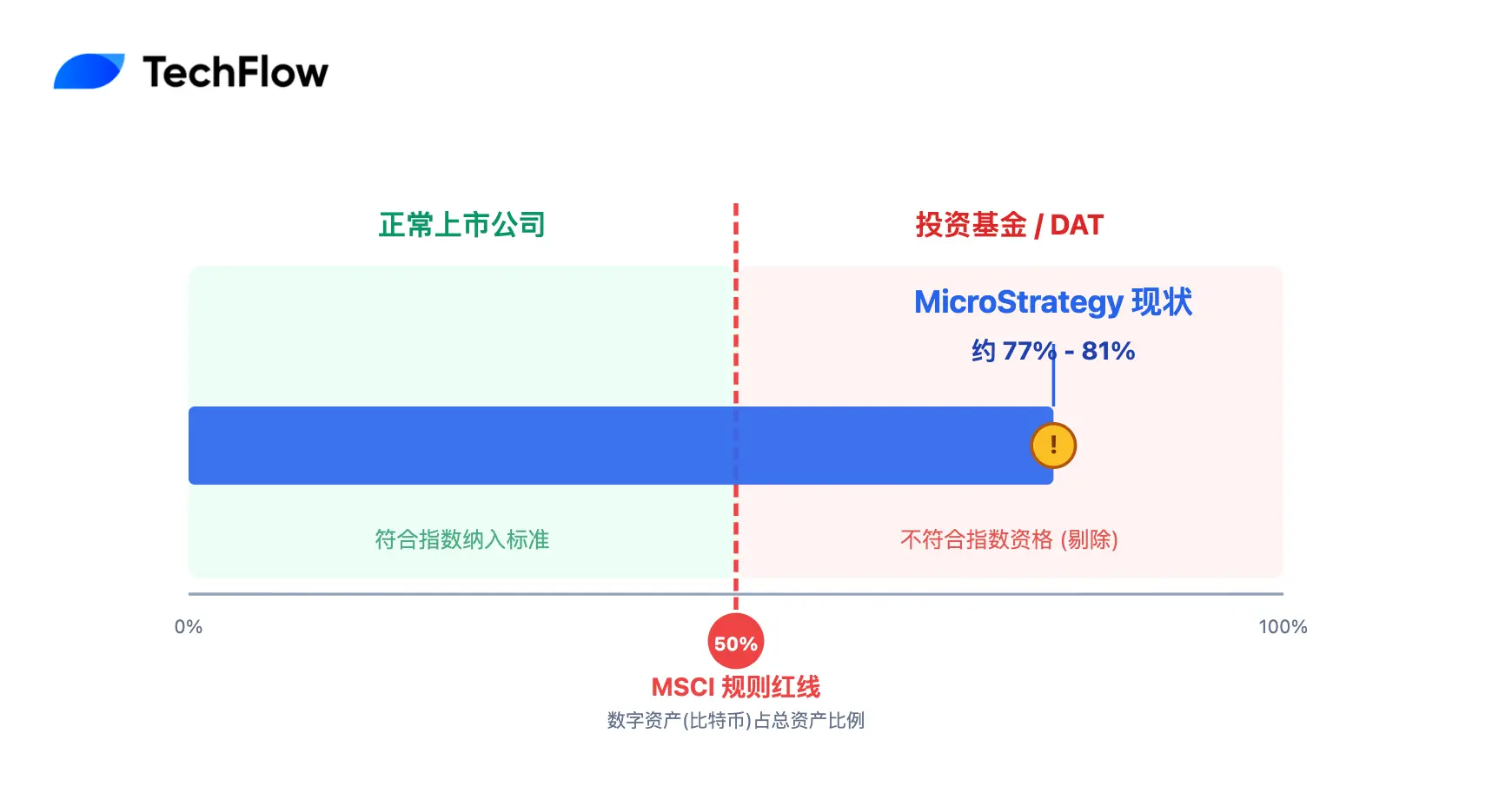
If a company's digital assets (mainly Bitcoin) exceed 50% of its total assets, can it still be considered a "normal publicly traded company"?
On October 10th, MSCI released its official consultation paper. The logic in the paper is straightforward: companies holding large amounts of Bitcoin are more like investment funds than "operating businesses." And investment funds are never allowed to be included in stock indices, just as you wouldn't put a bond fund in a tech stock index.
What is the current status of MicroStrategy? As of November 21, the company held 649,870 bitcoins, worth approximately $56.7 billion at current prices. The company's total assets are estimated at $73-78 billion. Bitcoin holdings comprise 77-81% of the total.
It far exceeds the 50% red line.
Worse still, CEO Michael Saylor never hides his intentions.
He has stated on multiple public occasions that the software business generates only $116 million in quarterly revenue and exists primarily to "provide cash flow to serve debt" and "provide regulatory legitimacy for the Bitcoin strategy."
What happens if I get kicked out?
According to a research report by JPMorgan Chase on November 20, if MSTR is simply removed from the MSCI index, it will face approximately $2.8 billion in passive capital outflows. However, if other major index providers (Nasdaq, Russell, FTSE, etc.) follow suit, the total outflow could reach $8.8 billion.
MSTR is currently included in several major indices, including MSCI USA, Nasdaq 100, and Russell 2000. Passive funds tracking these indices collectively hold approximately $9 billion worth of MSTR stock.
Once removed from the fund, these funds must be sold. They have no option; this is stipulated in the fund's prospectus.
What does $8.8 billion mean? MicroStrategy's daily trading volume is approximately $3-5 billion, but this includes a significant amount of high-frequency trading. If $8.8 billion in one-way selling pressure is released in the short term, it's equivalent to two or three consecutive days with only sell orders and no buy orders.
It's important to understand that MSTR's daily trading volume is $3-5 billion, but this includes high-frequency trading and liquidity provided by market makers. $8.8 billion in one-way selling pressure is equivalent to 2-3 days of total trading volume being sell orders. The bid-ask spread will widen from the current 0.1-0.3% to 2-5%.
History tells us that index adjustments are ruthless.
When Tesla was included in the S&P 500 in 2020, trading volume reached 10 times the usual amount in a single day. Conversely, when General Electric was removed from the Dow Jones Industrial Average in 2018, its stock price fell by 30% within a month of the announcement.
The consultation period ended on December 31st. The official decision will be announced on January 15th next year. Based on the current rules in the MSCI consultation document, being excluded is almost a certainty.
The flywheel for issuing shares and buying cryptocurrency got stuck.
MicroStrategy's core strategy over the past five years can be simplified into a cycle: raise money by issuing shares → buy Bitcoin → share price rises → issue more shares.
This model can only work if the stock has a premium. If the market is willing to pay $2.50 for every $1 of Bitcoin held by the company (mNAV = 2.5 times), then issuing new shares to buy Bitcoin can create value.
You dilute 10% of your shares, but your assets may increase by 15%, so the shareholders still make a profit overall.
At its peak in 2024, MicroStrategy's mNAV did indeed reach 2.5x, and even briefly touched 3x. The market's reasons for this premium included Saylor's execution capabilities, first-mover advantage, and the fact that it provided a convenient channel for institutions to indirectly hold Bitcoin.
But now mNAV has dropped to 1, which is basically at par.
The market may have already priced in the removal of MicroStrategy from MSCI.
Once removed from major indices, MicroStrategy will transform from a mainstream stock into a niche Bitcoin investment vehicle. A case in point is the Grayscale Bitcoin Trust (GBTC), which, after the emergence of better Bitcoin ETFs, went from a 40% premium to a long-term 20-30% discount.
When mNAV approaches 1, the flywheel stops turning.
Issuing 10 billion worth of new shares and buying 10 billion worth of Bitcoin doesn't change the company's total value. It's just a transfer from one hand to the other, diluting existing shareholders and creating nothing new.
Debt financing remains an option; MicroStrategy has already issued $7 billion in convertible bonds. However, debt must be repaid, and when the stock price falls, convertible bonds become pure debt burdens rather than quasi-equity.
Saylor's response and market views
Michael Saylor's response to the threat of being removed from MSCI was very much in his style.
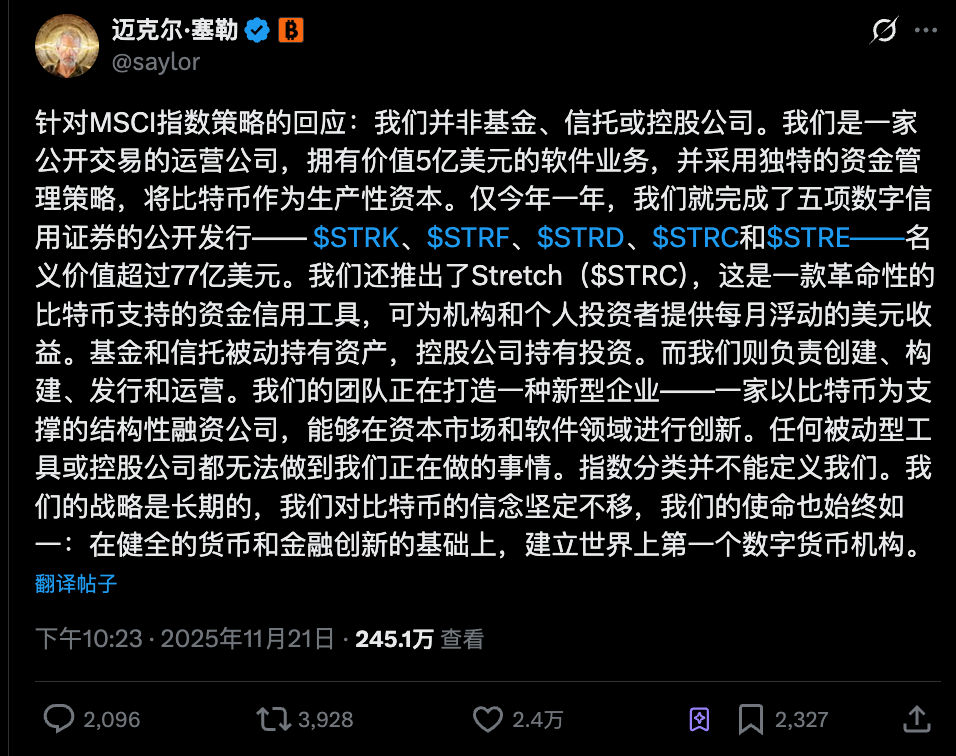
On November 21st, he published a long article on X, the core argument of which was: MicroStrategy is not a fund, a trust, or a holding company. He also used the art of language to circumvent MSCI's characterization:
"We are a publicly traded company with a $500 million software business and have adopted a unique Bitcoin capital strategy."
He emphasized that funds and trusts merely passively hold assets, while MicroStrategy "creates, builds, issues, and operates." This year, the company completed five public offerings of digital credit securities: STRK, STRF, SRD, STRC, and STRE.
The implication is that we are not simply hoarding coins, but engaging in complex financial operations.
But the market doesn't seem to care much about these explanations.
MSTR's stock price has decoupled from Bitcoin; not that the correlation has decreased, but rather that it has fallen even more sharply than Bitcoin. This likely reflects market concerns about its index status.
Joy Lou, a partner at Cycle Capital, posted that the average daily trading volume could plummet by 50-70% within 90 days of a stock being removed from the market.
Even more critical is the debt problem. MSTR has $7 billion in convertible bonds with conversion prices ranging from $143 to $672. If the stock price falls to the $180-$200 range, the debt burden will increase dramatically.
Her conclusion was pessimistic. The risk of MSTR falling below $150 would increase sharply after liquidity dried up.
Other community analyses also express pessimism. For example, some argue that removing MSTR from the index would lead to automatic selling of ETFs, causing stock prices to fall and dragging down BTC, thus creating a vicious cycle of a "double whammy" (a sharp decline in both earnings and valuations).
The so-called "Davis Double Kill" refers to the sharp drop in stock price caused by the decline in valuation and earnings per share.
Interestingly, all of these analysts mentioned the same word: passive.
The passive selling by the passive fund passively triggered debt clauses and passively lost liquidity. MSTR went from being an active Bitcoin pioneer to a passive victim of the rules.
The market consensus is becoming increasingly clear: this is not a matter of Bitcoin's price fluctuating, but rather a change in the rules of the game.
In a recent interview, Saylor reiterated his stance of never selling cryptocurrency. While MSTR has proven that companies can go all-in on Bitcoin, the MSCI index may be demonstrating that the cost of doing so is being ostracized by the mainstream market.
Is DAT still a good business under the 50% red line?
MicroStrategy isn't the only publicly traded company holding significant amounts of Bitcoin. According to MSCI's preliminary list, 38 companies are under observation, including Riot Platforms, Marathon Digital, and Metaplanet. They are all watching to see what happens on January 15th.
The rule is clear: 50% is the red line. If you exceed that, you're a fund, not a company.
This draws a clear line for all DAT companies: either keep their crypto holdings below 50% and remain in the mainstream market, or exceed 50% and accept being ostracized.
There is no middle ground. You can't both benefit from the passive buying of an index fund and become a Bitcoin fund yourself. MSCI rules don't allow this kind of arbitrage.
This is a blow to the way companies hold crypto assets.
For the past few years, Saylor has been preaching, persuading other CEOs to add Bitcoin to their balance sheets. MSTR's success (its stock price once surged tenfold) was the best advertisement, and now that advertisement is being taken down.
In the future, companies that want to hold large amounts of Bitcoin may need new structures. For example:
- Establish an independent Bitcoin trust or fund
- Indirect holding through purchasing Bitcoin ETFs
- Keep below the "safe line" of 49%.
Of course, some people think this is a good thing. Bitcoin shouldn't rely on any one company's financial engineering. Let Bitcoin be Bitcoin, let companies be companies, and let each go its own way.
Five years ago, Saylor pioneered corporate Bitcoin strategies. Five years later, it seems this is about to be brought to a close by a tedious financial document. But this may not be the end, but rather a forced evolution of new models in the market.
Because of MSCI's 50% cap, MicroStrategy won't go bankrupt, and Bitcoin won't go to zero. But the era of unlimited "printing stocks to buy cryptocurrencies" is over.
But for investors who still hold MSTR and various DAT company stocks, are you buying MSTR because you're bullish on Bitcoin or on Saylor himself? If it's the former, why not just buy the cryptocurrency or an ETF?
After being removed from the index, MSTR will become a niche investment. Liquidity will decrease, and volatility will increase. Can you accept that?
The final result will be revealed on January 15, 2026, and the market has already begun to vote with its feet.