
Author: Sandy Carter
Compiled by: Tim, PANews
PANews Editor's Note: This article was published on November 23, when the price of Bitcoin was below $85,000 and the market was in a state of extreme panic. The author reviews the occurrence of this crash and analyzes the possible reasons.
Bitcoin has fallen 30% from its peak, and gold has also retreated from above $4,200. According to the Financial Times, the Nasdaq experienced its worst week since April 2025, particularly heavyweight tech stocks. When Bitcoin reached $126,000, my friends were discussing its asset potential highlighted in a Forbes article; now they're all asking me, "Will Bitcoin go to zero?"
When "digital gold" plummeted along with physical gold, and highly sought-after AI concept stocks also collapsed collectively, were we witnessing a fundamental shift, or just a major correction? Does this mean that a massive collapse with everything falling in 2025 is unfolding?
It is rare for all assets (including those that are usually negatively correlated, such as gold and US stocks) to fall in unison, so I thought about it to study market trends.
Ultimately, the crash in 2025 was not just an isolated incident in the Bitcoin or AI fields, but essentially a liquidity crisis.
The liquidity crisis is reshaping the correlation between various assets.
What's happening with AI and the financial markets?
Just a month ago, according to CME's FedWatch tool, the probability of a federal government rate cut in December was as high as 93.7%. Now, the probability of a rate cut has fallen to 44.9%, a significant drop in a short period. When investors realize that their collective prediction of the Fed's policy direction has been wrong, they will simultaneously correct themselves.
Interest rate cuts typically boost the performance of both stocks and alternative assets such as gold and crypto assets, as lower borrowing costs reduce the value of cash. However, when expectations fail to materialize, the opposite can happen, sometimes triggering a more dramatic reversal, as seen in 2015.
At the same time, discussions about an AI bubble began to emerge in the market.
A CBS News analyst pointed out, "AI companies realize that investing huge sums in data center construction will inevitably put pressure on profits." Data reveals this harsh reality: Microsoft and Google announced that they will invest a total of more than $250 billion in AI infrastructure between 2024 and 2025, but whether these investments will bring corresponding returns was not clearly calculated in their earnings calls.
Even more worrying is the disconnect between expectations and performance among AI-related SaaS companies. Palantir is currently trading at 180 times its traceable earnings, while its customer acquisition costs have doubled year-over-year, a situation strikingly similar to that during the dot-com bubble.
A recent McKinsey report shows that only 23% of companies using generative AI have achieved significant efficiency improvements, but these companies still need to increase their AI investment. Despite ongoing industry discussions about the value AI creates for businesses, actual results are often difficult to quantify, and almost no companies publicly disclose their application outcomes.
Even tech giants like FANG are facing problems. Nvidia announced positive revenue growth, yet its stock price fell. This truly demonstrates that in the current turbulent times, even strong performance cannot stem the market's downward momentum. It's worth noting that recurring revenue isn't helping either. According to The Register, Nvidia plans to invest $100 billion in OpenAI, in which case OpenAI will reciprocate by purchasing $100 billion worth of Nvidia chips. This move appears to be Nvidia generating revenue out of its own pocket.
Over the past three months, the US dollar has finally surged to a high level. This has actually increased the cost for international buyers to purchase assets such as gold and Bitcoin. The strengthening dollar has undermined gold's traditional safe-haven function, meaning that investors have not flocked to gold and other precious metals. As the dollar strengthens, gold has lost its safe-haven status and has failed to provide investors with a safe haven.
Bitcoin crash: Death spiral or bull market correction?
Currently, Bitcoin is moving in tandem with stocks rather than acting as a hedging tool. This reality undermines the notion that Bitcoin is "digital gold." According to The Block, institutional investors have withdrawn $900 million from Bitcoin ETFs. When the market needs Bitcoin to move independently, it is instead following the lead of tech stocks. In fact, gold, stocks, and long-term bonds are currently outperforming Bitcoin.
However, Bitcoin has always been resilient throughout its history, experiencing both sharp drops and remarkable rebounds. While the current situation is different, institutional investors, pension funds, listed companies, and ETFs are all positioning themselves in Bitcoin. These factors have collectively created a market foundation that never existed before, providing Bitcoin with unprecedented bottom support and value endorsement.
With a surge in demand for downside protection for Bitcoin in the $80,000 to $85,000 range, the question is no longer whether Bitcoin can survive, but how it can stabilize and rebound from the current sell-off frenzy.
Lessons for Bitcoin Investors
The crash in the fall of 2025 revealed a fundamental shift in the mechanisms of the crypto market. The key message was that the era of easy money is over, and value investing is becoming the core guiding principle. Investors are no longer focused on speculation but on fundamental analysis. This investment philosophy applies equally to AI companies, Bitcoin traders, and the entire industry.
Some people are unconcerned about the possibility that we may be in an AI bubble. Robert Metcalfe once pointed out, "A bubble is a catalyst for innovation; it can give rise to innovations that might not have otherwise occurred." Sarbjeet Johal also believes that "a bubble is a manifestation of the system's self-healing mechanism, indicating that the entire system is functioning as designed."
However, we are indeed facing an asset correlation issue. The influx of institutional investors has created a new correlation between the crypto market and traditional tech stocks. When the Nasdaq suffered its worst weekly drop since April 2025, Bitcoin not only failed to act as a hedge but actually amplified the decline.
In 2013, Bitcoin surged while tech stocks remained flat and gold plummeted; in 2018, the crypto market experienced a sell-off while tech stocks rose; and in 2025, for the first time, gold, Bitcoin, and AI stocks all collectively corrected on the same day, which is a typical characteristic of a liquidity-driven market.
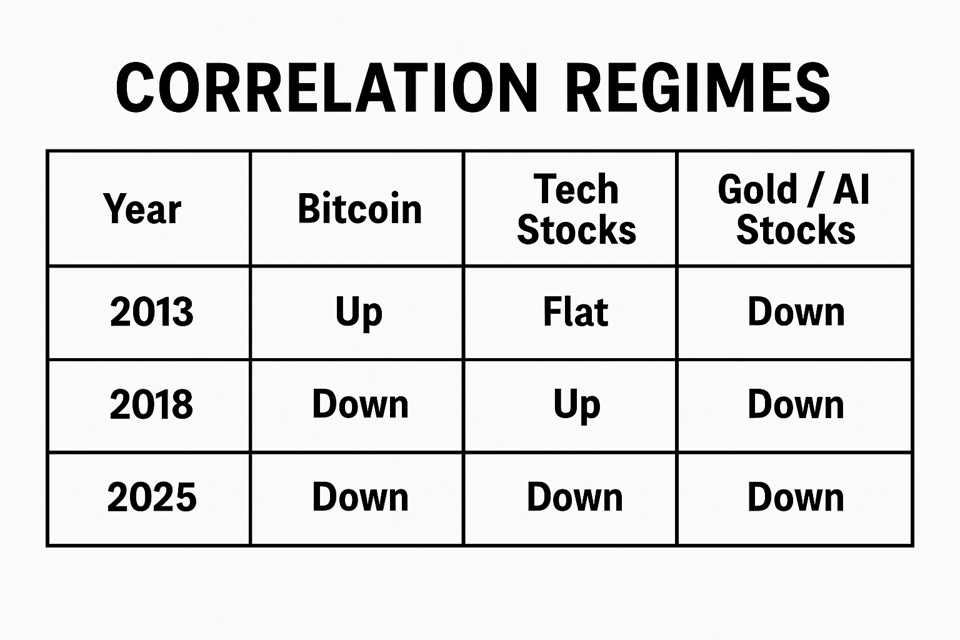
Data sources: CoinMarketCap Bitcoin historical price data, Nasdaq historical index data, Macrotrends gold price charts
As a result, traditional diversification strategies have become ineffective in the market.
Market Outlook: The Next 90 Days Will Determine Bitcoin's Price Movement
The most direct catalyst in the next 90 days will be the Federal Reserve's interest rate meeting on December 18. If the Fed decides to cut interest rates, risk assets may see a mild rebound by the end of the year. However, close attention should be paid to the Fed's policy guidance for 2026; any signal that interest rates will remain high for an extended period could trigger a new round of selling.
For Bitcoin, pay attention to three key price levels: $85,000 represents institutional support, where major ETFs have seen significant inflows; a drop below $75,000 could indicate new problems; and a break above $95,000 would confirm the bull market remains intact. These price levels will be tested by the market over the next 4-6 weeks.
Focus on Nvidia's fourth-quarter earnings report (Image provided by Justin Sullivan/Getty)
AI stocks follow different cyclical patterns. The fourth-quarter earnings season will be a key litmus test, requiring AI companies to demonstrate strong returns on their AI investments. Closely monitor Nvidia's forecasts for data center demand and the AI revenue figures from the FANG giants. Failure to meet expectations in any of these areas could trigger a new round of widespread declines in the sector.
Will Bitcoin go to zero?
Bitcoin is almost impossible to go to zero, but this crash reveals a deeper transformation: Bitcoin has evolved from a revolutionary outsider into a mature participant.
The real key issue is no longer survival, but identity.
What would happen if a digital asset designed to be uncorrelated with macroeconomics were to now fluctuate in sync with the Nasdaq?
This identity anxiety is not a temporary phenomenon. Bitcoin's trajectory over the next decade boils down to a simple choice: continue as a macro-sensitive institutional asset, or reclaim its independent nature?
Choosing the institutional path means Bitcoin will trade like a high-beta tech stock, its movements driven by Federal Reserve policy and fund positions. Choosing the decentralized path, however, requires different catalysts: including greater self-custody, stronger L2 adoption, increasing on-chain stablecoin transactions, and a sustainable mining economy.
The current generation of Bitcoin holders believes in its value narrative as "digital gold." The next generation will determine whether Bitcoin returns to its decentralized roots or resigns itself to becoming just another ordinary asset in a diversified investment portfolio.
The broad-based rally that began in 2020 has come to an end. Now, we are returning to the era of fundamental investing.
The market is like life; the most intriguing changes often occur at the apocalyptic moment when everything is collapsing. Bitcoin, reborn from chaos, may deviate from its original purpose, but this is not necessarily a bad thing.