Knowledge Context: Decentralized AI (DeAI)
Through blockchain technology, decentralized networks and community governance mechanisms, the core elements of artificial intelligence (AI) (data, computing power, model training and reasoning) are transferred from traditional centralized platforms (such as technology giants) to a paradigm running in decentralized networks. Its goal is to eliminate single point control, break data monopoly, enhance transparency and user sovereignty, and promote global participants to collaborate in the development of AI technology through incentive mechanisms.
Currently, decentralized AI is playing an increasingly important technical role in industries such as privacy protection, community autonomy, creator economy, and the Internet of Things.
Polkadot decentralized AI development trend
At the beginning of 2025, the trend of Polkadot ecosystem development of decentralized AI remains unabated. Projects such as NeuroWeb and Origin Trail are preparing to promote the deep integration of blockchain and artificial intelligence. By developing decentralized AI applications, they will lead the intersection of AI technology and Polkadot ecosystem, deepen innovative applications in the Web3 field, and further enhance the diverse technological advantages of Polkadot ecosystem.
In fact, the reason why the decentralized AI craze can set off a wave in the Polkadot ecosystem is inseparable from the advantages of its own ecosystem. On the one hand, Polkadot's high TPS (such as the Kusama network reached 128,184 TPS in the Spammenning activity) can ensure the stability of AI chain applications, which is sufficient to carry the processing of complex AI applications and ensure operational performance and technical capabilities. It is worth mentioning that based on the Substrate framework, developers can quickly build a blockchain dedicated to AI tasks in the Polkadot ecosystem, such as by integrating privacy computing modules (such as ZK) or decentralized computing methods to form a vertical AI parallel chain. This scheduling flexibility reduces the technical threshold for the integration of AI and blockchain.
On the other hand, Polkadot uses the XCM protocol to achieve on-chain data interaction and resource sharing, providing richer data support for AI projects and promoting the coordinated development of AI applications on different chains. Specifically, Polkadot's multi-chain architecture (relay chain + parallel chain) provides decentralized AI with natural cross-chain collaboration capabilities. Different parallel chains can focus on AI model training, data storage, computing power allocation and other sub-sectors, and achieve data and model interoperability through XCM (cross-consensus message format). For example, one chain is responsible for privacy computing, and the other chain runs the AI reasoning engine to jointly build a decentralized AI ecosystem.
From a practical perspective, the Polkadot Treasury will receive a fixed 15% inflation inflow, providing more funds and resources to support the development of AI innovation projects in the ecosystem. So in such an ideal internal and external environment, what decentralized AI projects are being developed or mature in the Polkadot ecosystem? Let's explore together!
Potential decentralized AI ecosystem project
Decentralized AI has already shown signs of development in the "old" projects of the Polkadot ecosystem. For example, Acala Network has created a financial intelligence platform by integrating DeFi and AI. Users can predict market trends and participate in on-chain derivatives transactions through AI models; Moonbeam supports seamless migration of Ethereum ecosystem AI projects through the construction of a cross-chain AI smart contract platform, and launched the "AI Oracle" service in 2024... In addition, the Polkadot ecosystem has the following potential projects that are launching their forays into the decentralized AI track:
OriginTrail
Origin Trail is an ecosystem dedicated to building a sustainable global economy by organizing trusted AI-backed knowledge assets. The project uses its unique decentralized knowledge graph (DKG) and NeuroWeb to provide AI-driven semantic search capabilities for global businesses and individuals.
Specifically, the project ecosystem has the following three significant advantages:
- Multi-chain compatibility: Designed for network effects across multiple blockchain ecosystems, supporting multiple blockchain technologies
- Modular design: The node adopts modular design, including blockchain module, data layer module, network module, API module and consensus module
- Zero-knowledge proof: Use zero-knowledge proof (zk-SNARKs) to implement consistency check algorithms on sensitive information to ensure data integrity and privacy protection
Currently, Origin Trail's functional scenario applications have involved industry tracks such as supply chain management, healthcare, scientific research, metaverse and games. Its technical solutions have been used on European supermarket shelves, helping to reduce information gaps in the supply chain by providing highly relevant data storage, processing and seamless circulation; in the safe distribution of medicines, actively protecting the privacy of patient data, and improving the efficiency of medical services. It is believed that more scientific and reliable intelligent scenarios will be realized in the Origin Trail ecosystem in the future.
NeuroWeb
NeuroWeb is a decentralized artificial intelligence on-chain ecosystem that aims to stimulate knowledge creation, connection and sharing through "knowledge mining". Its native token NEURO is committed to promoting the wave of AI knowledge economy and incentivizing community members who contribute relevant knowledge to the OriginTrail decentralized knowledge graph (DKG) (background knowledge: NeuroWeb was formerly the OriginTrail parachain and was transformed into NeuroWeb through a community governance vote in December 2023).
The core components of NeuroWeb are composed of decentralized knowledge graph (DKG), native token NEURO, zkNFT, etc., which can provide verifiable knowledge storage and sharing, ensure data transparency and security, and encourage users to contribute verifiable AI knowledge in "knowledge mining". It promotes the management and circulation of knowledge assets in the process of protecting user privacy, and at the same time seamlessly connects with other on-chain ecosystems. Overall, NeuroWeb also has ecological advantages and highlights such as high performance, interoperability, and transparency. At present, NeuroWeb has significant application advantages in educational platforms. It has collaborated with OriginTrail to launch Polkabot.ai, an AI assistant and education platform designed specifically for the Polkadot ecosystem, providing developers and users with instant help and rich educational resources.
The following are the important development nodes of NeuroWeb:
- 2022: NeuroWeb launches on Polkadot, conducts initial NEURO token distribution, and deploys decentralized knowledge graph
- 2023: NeuroWeb builds out its governance 1.0 system, removes Sudo, gives token holders full control of the blockchain, and integrates XCM with Moonbeam
- 2024: NeuroWeb wins second parachain auction, expands integration with Polkadot, and launches initial Paranet product
Gensyn.ai
Gensyn.ai is a blockchain-based decentralized deep learning computing protocol that aims to establish an artificial intelligence computing power market. The project breaks down complex machine learning tasks into multiple subtasks and uses computing resources from all over the world to achieve highly parallel computing. Gensyn.ai's goal is to improve the training efficiency and reduce costs of AI models through a decentralized approach, while ensuring fair distribution and use of computing resources.
Currently, Gensyn.ai's computing market development has entered the fast lane. By connecting developers with problem solvers, a global machine learning super cluster is formed using idle computing devices around the world (such as small data centers, personal gaming computers, Macs, and smartphones), increasing the available computing power of machine learning by dozens of times. Behind high performance is low operating costs. Gensyn.ai can reduce the training cost per hour to $0.4, maintaining high scalability and far lower than the high fees of using traditional cloud service providers. During 2021-2023, Gensyn.ai successfully completed three rounds of financing, obtaining $49.8 million in funds led by A16z and participated by Protocol Labs, Eden Block and other institutions, injecting strong momentum into the future development of the ecosystem.
Looking to the future, Gensyn.ai aims to democratize AI through decentralization, allowing more people to participate in AI technology innovation and application. The project plans to further improve the training efficiency and reduce costs of AI models through technological innovation and ecological cooperation, and provide more efficient and secure AI computing solutions for global companies and individuals. Let us wait and see!
Polkadot’s practical dilemma in developing decentralized AI
Even though the exploration of decentralized AI projects in the Polkadot ecosystem has entered a new stage, it is unavoidable that the ecosystem itself still faces difficulties and challenges in continuously promoting the development of decentralized AI, which urgently need to be faced and resolved by industry professionals together.
The first is the deep support for cross-chain technology. Although Polkadot's XCM protocol supports cross-chain communication, AI model training and reasoning require efficient data transmission and computing coordination, and the heterogeneous architecture of different parallel chains may lead to compatibility issues. While the development difficulty increases dramatically, developers also have to be proficient in the Substrate framework, smart contracts and AI algorithms, which brings more challenges to talent development.
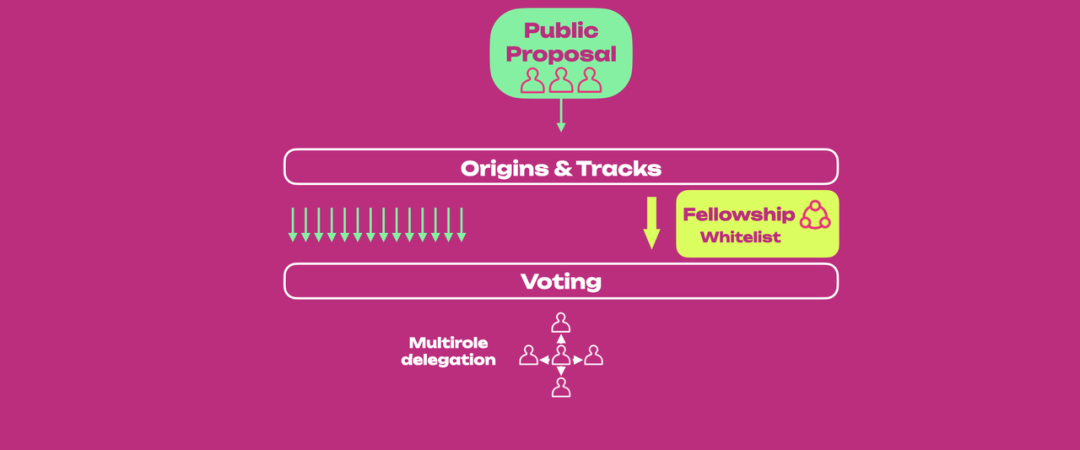
Secondly, there is the contradiction of the ecological governance mechanism. The Polkadot OpenGov governance model is committed to achieving decentralization, but the actual voting rate and decision-making process still need to be further improved, and the funding ratio between core developers and ecological projects needs to be further optimized. Only by supporting more actions to encourage community technological innovation and contribution can the competitiveness of ecological AI project development and exploration be improved. In addition, there are external competition and compliance risks that require Polkadot ecological followers to jointly promote research and exploration.
Looking forward to the new trend of DeAI in Polkadot ecosystem in 2025
Looking forward to the development opportunities in the new year, Polkadot may as well rely on its multi-chain architecture and Substrate development framework to provide more infrastructure-level resources and technical support for decentralized AI. Through cross-chain collaboration, modular design and community incentives, it will actively develop more application scenarios in the fields of decentralized training of AI models and privacy computing.
In terms of cross-chain AI support, we can cooperate with strong ecosystems such as Cosmos and Solana to build a cross-chain AI model application library and share computing power data resources; we can use the Polkadot on-chain governance mechanism to promote the formulation of a technical compliance framework and attract more Web2 companies to enter the ecosystem. From this, we can see that Polkadot still has the basic strength to break through the computing power and ecological dilemma in many future scenarios and applications, and is expected to achieve a deep transition from "blockchain + AI" to "AI native chain"!