
Author: Alvis
Recently, the crypto market has continued to fall, and the TVL (total locked volume) of major protocols has declined. However, in this downturn, there is one protocol that has bucked the trend and increased instead of decreased, that is Hyperliquid.
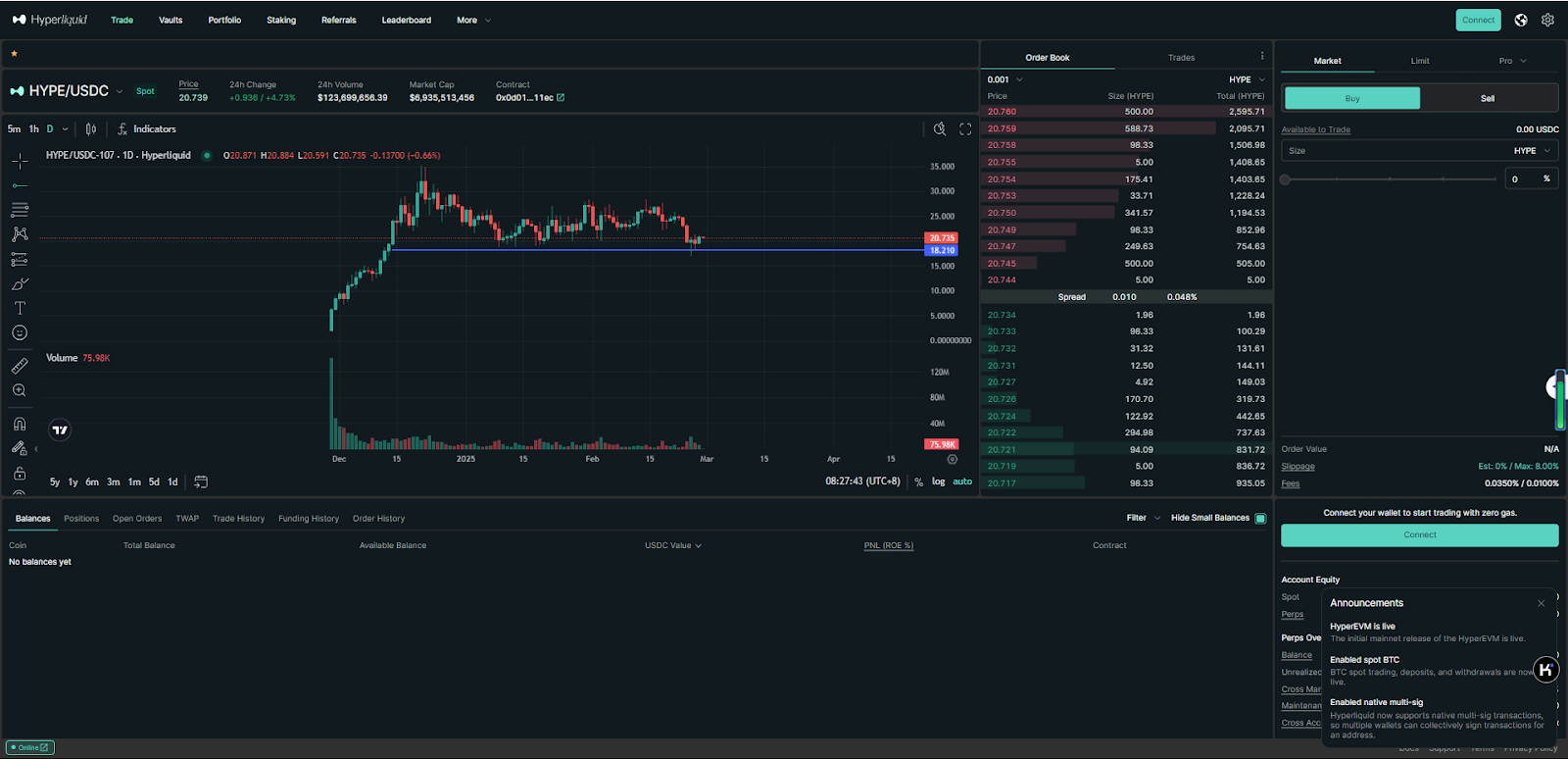
With its unique profit mechanism and strong trading volume, its token HYPE not only remained resilient in the falling market, but also earned US$2.19 million in protocol revenue in just 24 hours. Its 7-day revenue even surpassed Pumpfun, ranking seventh on the entire network's revenue list.
What makes Hyperliquid stand out in the crypto winter? How does it break the industry curse and achieve double growth in revenue and market value? Let's explore the driving force behind this phenomenon.
High-performance Layer 1 - Fully on-chain order book perpetual exchange Hyperliquid DEX
Hyperliquid's core product is its perpetual contract DEX, which enables traders to obtain up to 50x leverage on BTC, ETH, SOL and other assets. It has a fully on-chain order book and zero gas fees. Unlike Solana, which supports a wide range of decentralized applications (DApps), Hyperliquid's layer-1 is built specifically to optimize DeFi transaction efficiency.
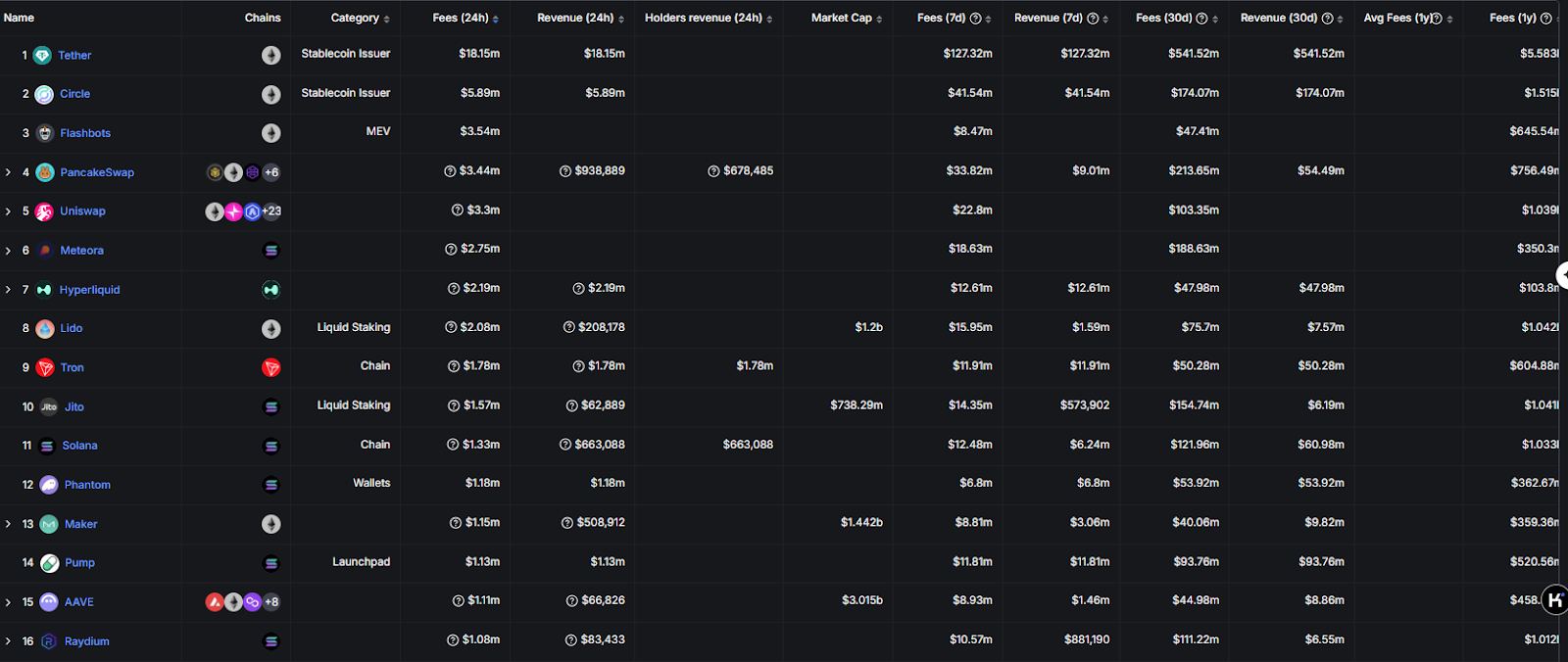
As of February 28, 2025, Hyperliquid (HYPE) ranked seventh among protocols with a 24-hour protocol revenue of $2.19 million and a 7-day cumulative performance of $12.61 million. It not only surpassed emerging protocols such as Pumpfun, but also established an absolute dominant position in the decentralized perpetual contract track.
Multi-dimensional innovation of income structure
Hyperliquid's revenue source breaks through the single model of traditional DEX relying on transaction fees and forms a three-stage rocket model:
- Derivatives transaction fees (accounting for more than 70% of revenue): The tiered fee system of 0.01%-0.035% for perpetual contracts, combined with an average daily trading volume of tens of billions of US dollars, constitutes the basic income base;
- Spot auction revenue: Through the HIP-1 token Dutch auction mechanism, the listing fee for a single project is $300,000-500,000, with an annualized revenue potential of over $140 million;
- Cross-chain bridging and ecological service fees: With the launch of HyperEVM, gas fees (paid in HYPE) and smart contract service fees will become new growth points.
Its core data indicators show a completely different growth logic from traditional DEX:
1. Disruptive breakthrough in transaction scale and efficiency
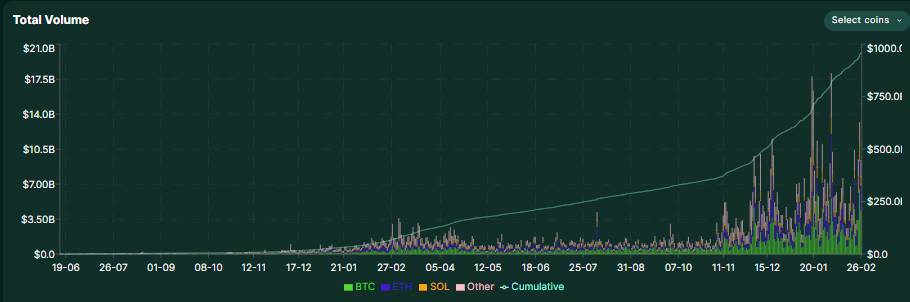
The daily trading volume has stabilized at the US$9 billion level, with a peak exceeding US$10 billion. This figure has reached 6%-10% of Binance's perpetual contract trading volume, far exceeding similar decentralized platforms (such as dYdX, GMX, etc.).
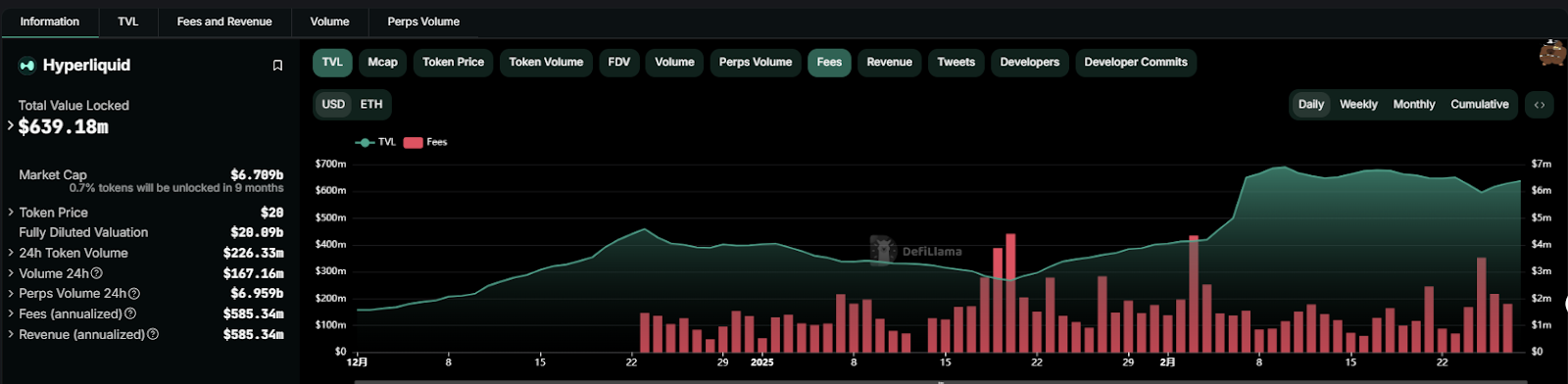
The TVL/Revenue ratio is only 50.6 (TVL $638 million vs 7-day revenue $12.61 million), significantly better than Uniswap (184.9) and Raydium (12.7). The top DEX Uniswap had revenue of $22.8 million during the same period, but its higher TVL highlights Hyperliquid's profit margin, which fully proves that its capital utilization rate has reached the top level in the industry.
Token Economics: Building a Perpetual Motion Machine for Value Capture
HYPE's token model design innovatively links protocol revenue directly with token value:
The Triple Drivers of the Deflation Engine
- 100% Revenue Repurchase and Destruction: The platform uses more than 70% of the derivative transaction fees and spot auction revenues to repurchase HYPE in the market and destroy it. Based on the current income level, the annualized destruction volume can reach 150 million, accounting for 21.4% of the circulation;
- Staking deflation mechanism: Validators need to stake HYPE to participate in the consensus. The current staking APY is 18.9%, attracting more than 31% of the circulation to be locked;
- Expansion of token practical scenarios: After the launch of HyperEVM, HYPE becomes an essential token for cross-chain gas payment and smart contract deployment, adding dual driving forces of developers and users on the demand side.
Time Game of Token Distribution
Unlocking risk controllability: Team tokens (23.8%) are locked until December 2025 and are released linearly (24 months), which is more conservative than similar projects (such as dYdX team unlocking immediately);
Community incentive reserve: 38.9% of tokens are used for ecological construction, and external liquidity is continuously attracted through transaction volume mining, developer incentives, etc. Data shows that every $1 of incentives can leverage $5.3 of TVL growth.
Valuation model construction: value reassessment from a multi-dimensional perspective
1. Relative valuation method (comparison with peers)
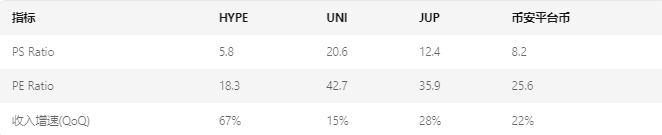
HYPE's current market capitalization of US$6.7 billion corresponds to a PS of 5.8, which is at the low end of the industry. Considering that its revenue growth rate is 3-4 times that of its peers, its PEG ratio is only 0.27, which is indeed undervalued overall.
2. DCF model calculation
Key assumptions:
- The compound growth rate of revenue in the next three years is 55% (conservative estimate)
- The staking yield rate remains above 15% to attract long-term holders
- HyperEVM ecosystem contributes more than 25% of new revenue
Discounting results:
- Reasonable valuation at the end of 2025: $48.2 (+130%)
- Target price in 2026: $79.5 (PEG returns to the industry average of 0.8)
3. On-chain Value Capture Coefficient (VCC)
Introducing TVL/(MC/TVL) indicator calculation:
- HYPE VCC=6.38/(69/6.38)=0.59
- Industry average = 0.31
The data shows that the value created by every $1 of TVL in the Hyperliquid ecosystem is 1.9 times the industry average.
Risk factors and market misjudgment
1. Re-examination of the “centralization question”
Hyperliquid’s native token, HYPE, was launched via an airdrop to 94,000 unique addresses in November 2024. This distribution drove a $2 billion market cap on day one, indicating strong community adoption.
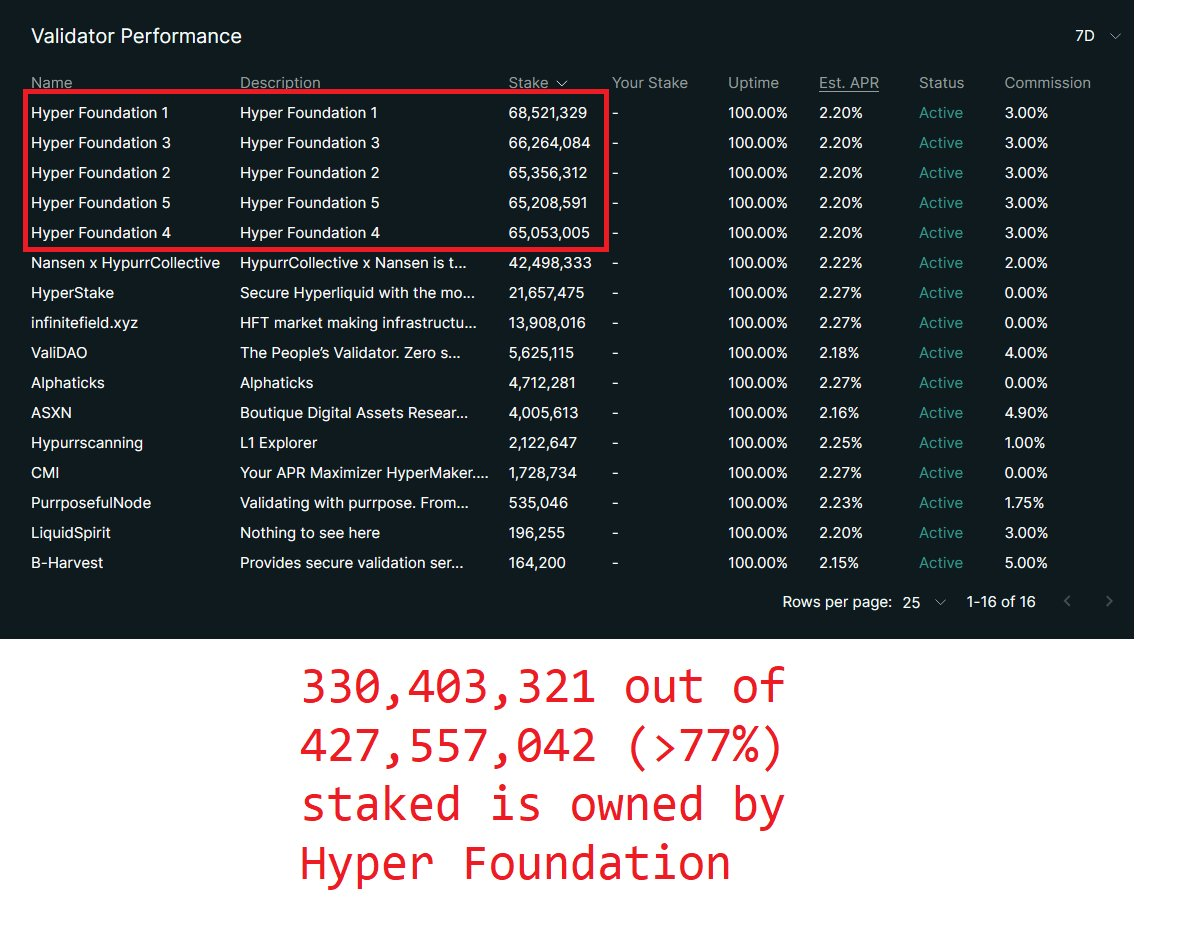
However, on-chain data shows that the team controls 78% of the stake.
Although node concentration is controversial, it is important to note that:
- The validator committee adopts a dynamic rotation system, randomly replacing 1/3 of the nodes every epoch (about 4 hours);
- The open source process is carried out in stages, and the RustVM core code has passed the CertiK audit.
2. Deep barriers in the competitive landscape
- Liquidity moat: The network effect formed by the daily trading volume of US$9 billion requires competitors to invest at least US$1.8 billion in vampire attacks (calculated based on a 0.2% incentive), while HYPE's repurchase mechanism can instantly offset more than 30% of the impact;
- Developer migration cost: HyperEVM is fully compatible with Solidity, but it achieves 10 times the performance of the EVM chain through HyperBFT, forming the advantage of "no threshold for development and generational difference in experience".
Conclusion: Strategic opportunities in value reconstruction
Hyperliquid reconstructs the rules of value flow on the chain through technological paradigm innovation:
- Short term (0-6 months): Benefiting from the surge in gas demand brought about by the launch of HyperEVM and the peak trading season of perpetual contracts in Q2, the target price is $35-42;
- Medium term (6-18 months): Ecosystem expansion diversifies the revenue structure, and PS is expected to catch up with Binance platform coins (8.2 → market value of US$9.2 billion);
- Long term (18 months+): If the revenue growth rate is maintained at 55%, it is expected to reach a market value of US$100 billion in 2026 and become a core component of Web3 financial infrastructure.
As the boundaries between traditional CEX and DEX become increasingly blurred, Hyperliquid has proven the possibility of a new path - achieving a paradigm revolution in financial efficiency through breakthroughs in blockchain native performance. While the market is still viewing HYPE with the valuation framework of DEX, its essence is already a new trinity that integrates CEX efficiency, DEX transparency, and L1 scalability, which is the core logic of its value reassessment.