Author: Gu Yu, ChainCatcher
The crypto world in 2025 is witnessing an unprecedented wave of mergers and acquisitions.
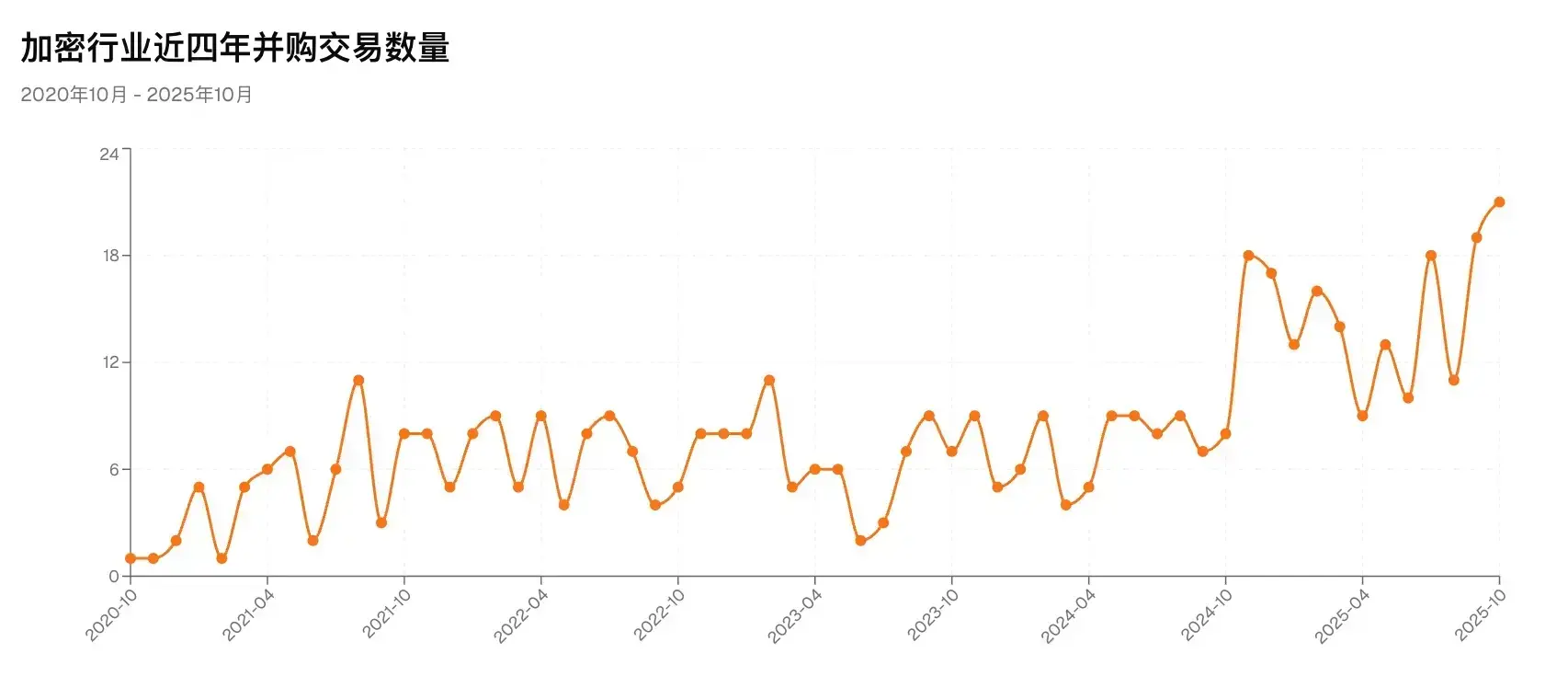
From DeFi protocols to asset management companies, from payment companies to infrastructure service providers, new mergers and acquisitions are happening almost daily. Kraken acquired futures trading platform NinjaTrader for $1.5 billion, and Coinbase recently made consecutive moves, acquiring derivatives exchange Deribit and on-chain fundraising platform Echo. According to RootData, the number of crypto mergers and acquisitions has reached 143 so far in 2025, not only breaking historical records but also representing a 93% increase compared to the same period last year.
Why are tech giants so keen on mergers and acquisitions in the current sluggish market? And what impact will the accumulation of these acquisitions have on the market?
I. Giants are trading time for capital
Mergers and acquisitions are the most direct means for giants to expand their battlefield and enhance their competitiveness.
In the past few years, giants like centralized exchanges have mostly thrived on transaction fees. However, with the secondary market turning bearish and regulations becoming stricter, simple transaction revenue is no longer enough to support growth, and external Web2 giants are eyeing the market. Therefore, they have begun to expand their reach through acquisitions—either to fill gaps in their ecosystem or to acquire compliance resources.
Through mergers and acquisitions, giants can skip the long period of independent research and development and market cultivation, and quickly bring competitors or complementary teams under their wing, thereby expanding their product matrix in a short period of time, such as from spot trading to derivatives, from trading to payment and custody, and improving the service capabilities of the entire product stack.
More importantly, by acquiring entities with existing regulatory approvals or well-established compliance structures, giants can more quickly obtain "proof of identity" for entering certain markets (such as licenses, compliance processes, or clearing channels in specific jurisdictions), saving time and costs compared to building their own compliance teams. This is especially important in the increasingly regulated and geographically diverse world of crypto.
Take Coinbase as an example. Since 2025, its acquisition strategy has been almost "full-chain": from derivatives exchanges to on-chain financing platforms, and then to compliant custody companies, covering multiple links such as trading, issuance, payment, and asset management. An industry insider close to Coinbase revealed: "What they want to do is to create a 'Goldman Sachs map' in the crypto field—not relying on coin prices, but on a service system."
Kraken's move follows a similar logic. NinjaTrader was a long-established player in the traditional financial world; by acquiring it, Kraken essentially gained a compliant channel recognized by US regulators, allowing it to bring traditional futures clients and tools into its ecosystem. In the future, Kraken will no longer need to take roundabout approaches to provide more comprehensive derivatives and futures trading services.
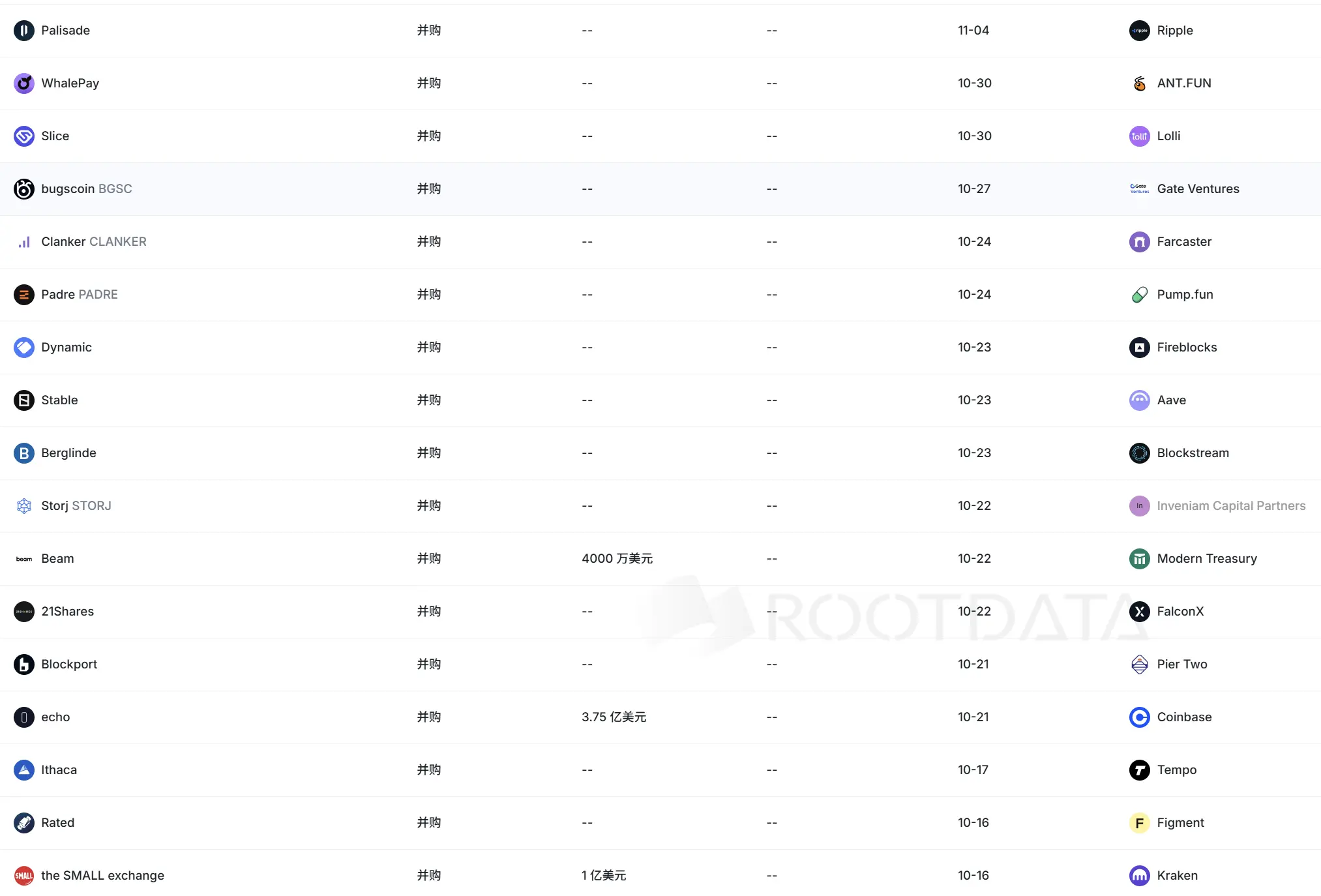
Recent M&A Events Source: RootData
In other words, while smaller projects are still struggling with their next round of financing and token issuance, the giants are already using cash to buy time and acquisitions to secure their future.
This trend isn't limited to giants like Coinbase; Web2 giants such as Robinhood, Mastercard, Stripe, and SoftBank are also involved. This means that Web3 is no longer just a game for entrepreneurs and retail investors; it's attracting deep participation from traditional capital, financial institutions, and even listed companies. Mergers and acquisitions have become a bridge for them to enter the Web3 space.
Moreover, the current market conditions provide them with a significant opportunity to increase their M&A investment. Currently, the primary crypto market remains sluggish, with the vast majority of crypto projects facing challenges in fundraising and exit strategies, placing them at a disadvantage in the capital markets. Therefore, giants with ample cash or access to capital markets can leverage their capital advantage to dominate M&A pricing and structuring. For sellers, transaction structures involving equity swaps, partial cash + stock, or strategic partnerships are often more secure than issuing tokens on the public market. Thus, those with strong capital have a natural advantage in M&A negotiations, enabling them to acquire key technologies, users, and licenses at a more cost-effective cost.
Part 2: Is the golden age for Web3 builders here?
In the past, the main exit path for many Web3 projects was "token issuance—price increase—buyback/cash out." This path is highly dependent on secondary market sentiment and easily swayed by token price fluctuations. Mergers and acquisitions offer projects a more stable alternative: integration by strategic buyers within or outside the ecosystem, obtaining cash/equity, or being incorporated into the product lines of larger platforms for continued development. This provides a smoother path to capitalization for teams and technologies, eliminating the need to pin all hopes on the "vampire-sucking" process of token issuance and exchange listing.
Mergers and acquisitions like Coinbase and Kraken have broadened the ways in which Web3 projects and teams can realize their value. In the current capital winter, this has also injected a boost of confidence into the primary crypto equity market, encouraging more funds to flow into it and giving more crypto entrepreneurs confidence.
The rise of mergers and acquisitions in the crypto industry is not accidental, but rather a result of market maturity, capital restructuring, and the combined effects of regulation and user demand. Mergers and acquisitions enable a faster reallocation of technology, users, and compliance capabilities within the crypto market. Leading companies use mergers and acquisitions to consolidate and expand their competitive advantages, while for smaller projects, mergers and acquisitions provide a more stable exit and development path.
In the long run, this wave of mergers and acquisitions is expected to incentivize many crypto projects to evolve from technical communities or marketing companies into truly commercial companies with clear user scenarios and solid technology, shifting their focus back to product experience, compliance, and commercialization. Undoubtedly, this will benefit the long-term healthy development of the industry and accelerate its mainstreaming process.
Of course, mergers and acquisitions are not a panacea. Giants still face many uncertainties, such as integration—how to integrate the acquired company's strengths into its organization, products, compliance, and customers. If integration fails, it often means "buying an empty shell." For example, there may be valuation bubbles, which can negatively impact the acquiring company's cash flow and profitability.
Regardless, this is a major boon for crypto entrepreneurs and the long-term crypto ecosystem. The market will provide a more favorable environment for projects that diligently cultivate technology and application scenarios. Questions like "How can we exit if you don't issue a token?" will gradually cease to haunt entrepreneurs and builders, and their golden age is about to begin.
The crypto industry in 2025 is at such a turning point. Rather than a game of capital, it is more accurately described as an inevitable step towards the maturity of the crypto industry.
In the coming years, we may see exchanges become more than just exchanges, but like one-stop financial supermarkets; wallets become more than just wallets, but on-chain financial gateways for users; and stablecoins become more than just stablecoins, but underlying currencies for cross-border instant settlement.
And all of this started with this wave of mergers and acquisitions.