Author: Fairy, ChainCatcher
Editor: TB, ChainCatcher
Bitcoin is a hidden chess piece in the new round of national competition.
This morning, the U.S. House of Representatives passed the GENIUS Act, the CLARITY Act, and the Anti-CBDC Surveillance State Act in succession, officially opening the curtain on the acceleration of crypto legislation.
When Bitcoin becomes a national policy, sovereign states are no longer spectators, but entrants, players, and even table flippers. As global currency games escalate, understanding the encryption layout of the "national team" may be a key step in understanding the next round of global financial trends.
This article will deeply sort out the current Bitcoin holdings and policy trends of major countries in the world, and provide insight into the true pattern of this "national holdings game."
⏰Time-saving version|Bitcoin holdings by country at a glance
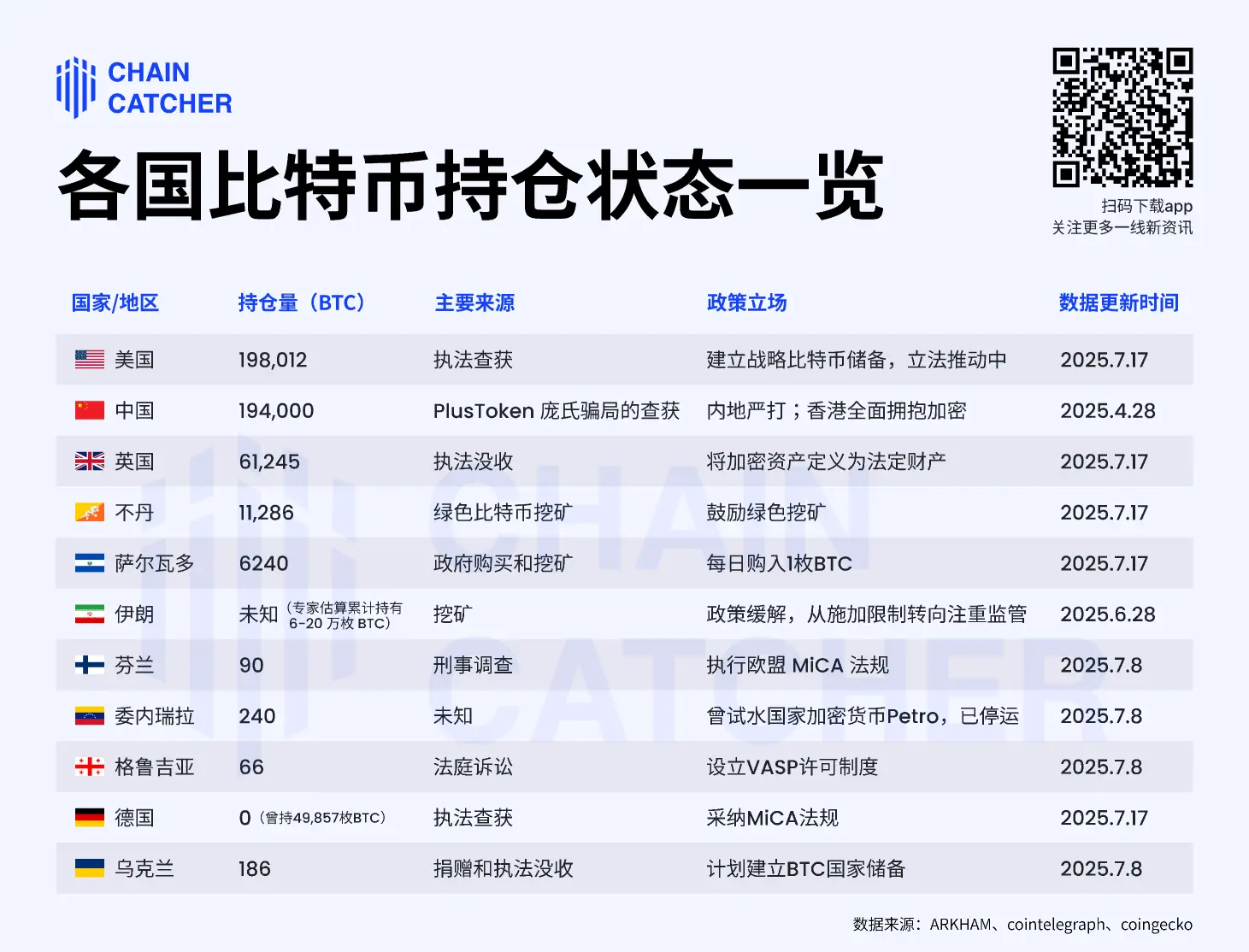
Let’s get straight to the point: The table below summarizes the number of Bitcoin holdings, source channels and policy attitudes of various countries, giving a quick overview of the crypto asset landscape of the “national team”.
📝Country-by-country analysis | Who is hoarding coins? Who is clearing out stocks?
USA
l Number of holdings: approximately 198,012 BTC
l Main source: Law enforcement seizures, including the Silk Road case, the Bitfinex hacking incident, etc.
Strategic trends:
In March 2025, the Trump administration signed an executive order to formally establish a strategic Bitcoin reserve and digital asset reserve.
As Crypto Week in the House of Representatives is underway, three crypto bills are being reviewed intensively: the GENIUS Act, the CLARITY Act, and the Anti-CBDC Act, which target stablecoins, digital asset classification, and central bank digital currencies, respectively.
The House of Representatives has passed all three bills. Among them, the CLARITY Act and the Anti-CBDC Act will be submitted to the Senate for deliberation; and the GENIUS Act is expected to be officially signed into law by Trump this Friday.
China
l Number of holdings: approximately 194,000 BTC
l Main source: Seizure of PlusToken Ponzi scheme in 2019
Strategic trends:
In 2017, the People's Bank of China and seven other ministries jointly issued a document to completely stop the operation of ICO and crypto trading platforms; in September 2021, the central bank and ten other ministries jointly issued a notice to clearly define cryptocurrency transactions as "illegal financial activities" and intensify efforts.
At present, there are signs that local governments are partially exploring stablecoins: for example, the Wuxi Municipal Party Committee’s reform task promotion meeting explored the use of stablecoins to empower foreign trade development; the Shanghai State-owned Assets Supervision and Administration Commission held a central group study meeting on the development trends and response strategies of cryptocurrencies and stablecoins.
In addition, Hong Kong, China has adopted an open attitude and fully embraced encryption. The Hong Kong Stablecoin Ordinance will take effect in August, and more than 50 companies in Hong Kong are interested in applying for stablecoin licenses.
U.K.
Number of holdings: About 61,000 BTC
Main source: Law enforcement confiscation for crimes such as money laundering
Strategic trends:
In September 2024, the Digital Asset Property Act was officially introduced, which clearly defines cryptocurrencies as personal property protected by law and provides clear judicial protection.
The UK Financial Conduct Authority (FCA) requires all virtual asset service providers to register and fully apply anti-money laundering (AML) and counter-terrorist financing (CFT) rules.
Bhutan
Number of holdings: approximately 11,286 BTC
Main source: Green Bitcoin mining based on hydropower resources
Strategic trends:
In 2019, the Royal Currency Bureau of Bhutan launched the "Cryptocurrency Mining Regulatory Sandbox Framework", which provides regulatory conditions for mining. The government has quietly established Bitcoin mines, using its abundant hydropower resources to "mine" BTC, and managed assets through the sovereign wealth fund Druk Holding & Investments (DHI).
Previously, Bhutan had 12,574 bitcoins through mining, accounting for about 30%-40% of its GDP. However, Bhutan also sells bitcoins from time to time, transferring 749.3 BTC to its Binance in the past half month, and still holds 11,2860 BTC.
El Salvador
Number of holdings: About 6240 BTC
Main sources: government purchases and mining
Strategic trends:
In 2021, El Salvador became the first country to adopt Bitcoin as legal tender. El Salvador requires that all commodity prices in the country can be priced in Bitcoin; any economic entity must accept Bitcoin payments; Bitcoin transactions are exempt from capital gains tax, and taxes can be paid in cryptocurrency.
At the beginning of 2025, due to pressure from the International Monetary Fund (IMF), El Salvador adjusted its policies: Bitcoin no longer has mandatory circulation status, but is instead "voluntarily accepted"; tax settlements are no longer accepted in cryptocurrencies.
Currently, Bitcoin remains an important part of the country’s economic strategy, and it maintains a policy of purchasing 1 BTC per day.
Iran
Number of holdings: unknown, experts estimate that the total number of BTC held is 60,000-200,000
Main source: local mining
Strategic trends:
In 2019, the government officially legalized Bitcoin mining and required miners to sell part of the BTC they mined to the central bank. According to Mastermined founder Andrew Scott Easton, Iran has mined more than 60,000 BTC so far; Sazmining founder Kent Halliburton believes that the total may have reached 100,000-200,000 BTC.
In December 2024, Iran changed its stance on digital currencies from imposing restrictions to focusing on regulation. Iran’s Minister of Economic Affairs and Finance Abdolnaser Hemmati emphasized the government’s plans to mitigate the economic risks posed by digital currencies while leveraging their potential benefits.
Finland
Number of holdings: About 90 BTC
Main sources: Seizures in criminal cases, especially proceeds from major drug busts in 2016
Strategic trends:
Finland once held 1,981 BTC, mostly confiscated by Finnish customs in criminal cases. In 2022, the government decided to donate 1,890 BTC to Ukraine by selling it, with some of the proceeds of the sale being "tens of millions of euros" as humanitarian aid.
Since 2018, the Finnish Financial Supervisory Authority (FIN-FSA) has included the crypto industry in the regulatory system of the Virtual Currency Providers Act; the Act requires all trading platforms, custodians, and wallet service providers to register and comply with KYC/AML and other compliance obligations.
Starting from 2025, Finland will fully implement the EU MiCA regulations, covering multiple dimensions such as stablecoins, DeFi, and crypto asset service providers, and the regulatory framework will be further aligned with the EU.
Georgia
Number of holdings: About 66 BTC
Primary source: Court proceedings
Strategic trends:
In 2022, Georgia adopted a new financial regulatory framework, bringing digital asset transactions and related businesses into the regulatory scope.
Starting from 2023, Georgia introduced the Virtual Asset Service Provider (VASP) Registration Law, requiring cryptocurrency-related companies to register with the National Bank and obtain a license, and must comply with the Financial Action Task Force (FATF) Anti-Money Laundering (AML) and Counter-Terrorist Financing (CFT).
Venezuela
Number of holdings: About 240 BTC
Primary Source: Unknown
Strategic trends:
Venezuela was one of the first countries in the world to "incorporate crypto assets into the national governance toolbox." In 2018, the government promulgated the Constitutional Decree on Crypto Assets and Related Activities, covering mining, trading, custody, platform operations, asset issuance, etc., and established a special agency SUNACRIP for supervision.
In the same year, the national sovereign digital currency Petro (PTR) was launched, claiming to be backed by oil and mineral resources and issued based on the DASH blockchain, but it always lacked transparency and market trust. In 2023, the SUNACRIP $3 billion corruption scandal broke out, leading to the complete collapse of the regulatory system, and Petro was officially shut down in 2024.
Faced with continued inflation, more and more Venezuelans are turning to stablecoins for risk aversion. In December 2024, experts said that stablecoin transactions currently account for almost half of all cryptocurrency transactions in Venezuela.
Ukraine
Number of holdings: About 186 BTC
Main sources: Global donations during the war, law enforcement seizures
Strategic trends:
Since the outbreak of the Russian-Ukrainian war in 2022, Ukraine has become the first country to adopt Bitcoin on a large scale due to the practical needs of war rather than ideology. Faced with the obstruction of traditional financial channels, Ukraine quickly converted cryptocurrency into cross-border "digital military expenditure."
In March 2022 alone, Ukraine raised more than $100 million in cryptocurrency donations through online platforms, holding as many as 46,351 bitcoins at one point. These funds were quickly invested in military equipment purchases, humanitarian aid, infrastructure repairs, and wartime logistics.
Ukraine is developing a legal framework for holding Bitcoin in its state reserves as of May 2025, with a dedicated parliamentary committee led by a finance official finalizing the draft legislation.
Germany
Number of holdings: About 0 BTC
Primary Source: Law enforcement seized 49,857 Bitcoins from the illegal movie piracy website Movie2k.to
Strategic trends:
In January 2024, the German government confiscated 49,857 Bitcoins (BTC) from the illegal movie piracy website Movie2k.to through law enforcement action. Only half a year later, the German government chose to sell all of these Bitcoins.
In 2021, Germany passed a new law that allows about 4,000 existing institutional investment funds to invest in cryptocurrency assets, and managers of institutional investment funds can allocate 20% of their funds to crypto assets. In December 2024, Germany fully adopted the EU Crypto Asset Market Regulation to regulate stablecoins, ICOs and DeFi to ensure market transparency and consumer protection.