
Source: Talking about Li and other things
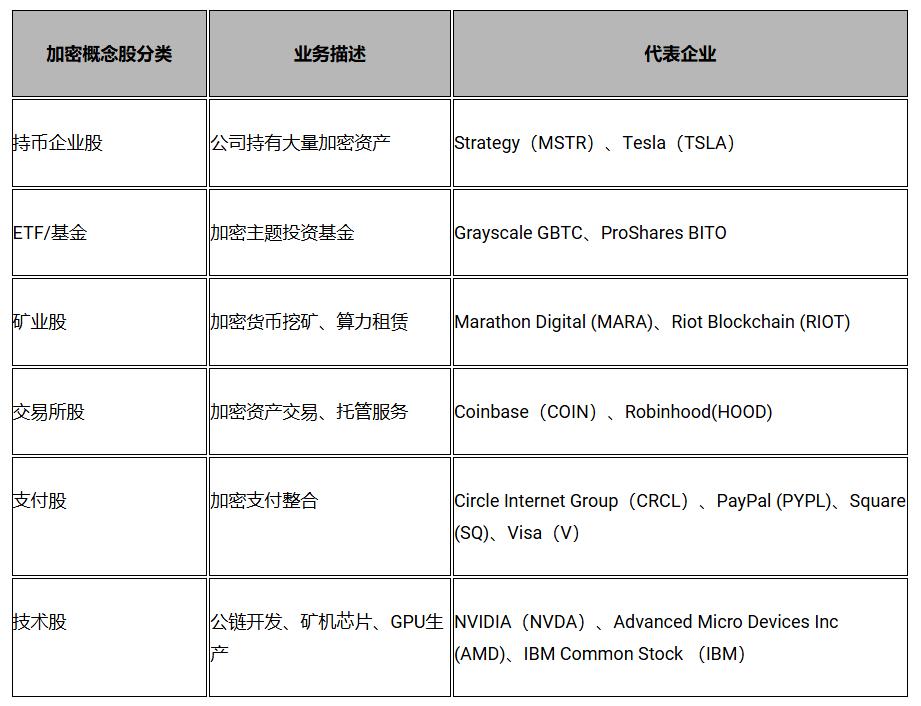
Recently, many partners seem to have been attracted by the popularity of U.S. and Hong Kong stocks. Compared with the trend of the crypto market itself, crypto concept stocks have indeed risen sharply. It seems that the topic of the U.S.ization of the cryptocurrency circle will continue to be hyped for some time.
However, since I no longer invest in US/Hong Kong stocks and only pay attention to daily fundamentals, I will not discuss this topic too much. Interested parties can conduct necessary research based on the following chart. As we mentioned in our previous article, the market is always full of opportunities, but also full of uncertainty, which is one of the reasons why most individual investors (retail investors) easily lose their way.
As far as the crypto market is concerned, as the recent upward momentum of Bitcoin is slowing down, altcoins seem to have hit bottom again. Coupled with the lively stock market next door, it seems that many people are now pessimistic about this field and believe that the bonus period of this field has passed.
I remember reading a statement before that any industry will go through roughly five stages of development, namely the technology-led stage, the product-led stage, the marketing-led stage, the cost-led stage, and the innovation-led stage. If we put the crypto market as a whole into this, we will get the following results:
Technology-dominated stage (2008–2012) : Bitcoin appeared and the concept of blockchain came into being. This period was mainly focused on initial innovation, mostly technological inventions.
Product-dominated stage (2013–2017) : Various tokens appeared, and smart contracts represented by ETH appeared. During this period, market competition was mainly concentrated on the functional level of products, and the market entered a period of product exploration.
Marketing-dominated stage (2017–2021) : The crypto bull market began to emerge, and various concepts such as ICO, DeFi, and NFT began to be hyped and popular. During this period, the user scale began to expand, and products began to show differentiated competition.
Cost-dominated stage (from 2022 to present) : major CEX and DEX began to attract users, various L1 and L2 chains flourished (but in fact they were all lowering gas fees). During this period, the crypto market began to pursue economies of scale, project parties began to compete in user scale, and institutions began to study cost control... everything seemed to be profit-oriented.
Innovation-led stage (now in its infancy or starting to happen locally) : During this period, the crypto industry will enter a stage of full popularization (except for some countries and regions), various policies or regulations (mainly in the United States) will begin to become relatively complete, giants will begin to monopolize (entry of large institutions such as MicroStrategy and BlackRock), and the overall development of the industry will fall into a new bottleneck (but the development trend is still slowly upward), and innovation or change is needed to break the bottleneck (for example, new directions such as AI and RWA seem to be trying to break some development bottlenecks in the past two years).
But no matter what stage the market develops to, there will always be opportunities. It’s just a matter of whether we can continue to seize some of them. As for the future of the crypto market, we don’t know. Anyway, no matter what others think now, at least we will still stick to this field and continue to be optimistic in the long term.
While looking forward to the future, we continue to focus on the present. Based on the current situation, the main reasons for the stagnation of the crypto market and the unclear short-term trend are roughly as follows:
1) Tensions in some countries/regions (such as the local war between Iran and Israel)
In previous articles, we speculated that Bitcoin might continue to try to approach or break through its all-time high in June, but the armed conflict in the Middle East has also hit the market like a black swan. However, we still retain the view in the article a few days ago (June 15): If the situation gets out of control again, it is not ruled out that the market will continue to experience relatively large fluctuations in the short term.
However, referring to the results of several previous conflicts between Iran and Israel, and the current threat of force and intervention by the United States, the probability of a full-scale war in the Middle East is low. Moreover, it seems that Iran is actually better at talking (but not at strength). As long as the United States asks Israel to exercise some restraint and both sides give each other a way out, it is estimated that it will eventually end in "peace talks."
If the next new Middle East crisis can be declared over in stages, then Bitcoin may continue to rebound and try to break new highs again. Of course, we do not rule out the possibility that similar black swan events will occur in other countries/regions and continue to affect the market, because geopolitics can indeed be an effective catalyst for deleveraging.
2) There is still some uncertainty about the Fed’s interest rate policy
Judging from Powell’s latest remarks (the first day of Powell’s congressional hearing on June 25, Beijing time), regarding the issue of interest rate cuts, he hinted during the question-and-answer session of the hearing that (Federal Reserve) officials are more likely to wait until at least the September meeting to see whether the tariff-driven price increases are lower than expected before resuming interest rate cuts.
Translated into plain language, the above sentence seems to mean: The Federal Reserve is still waiting and watching, and does not rule out the possibility of a rate cut in July, but it is more likely to wait until at least September.
Judging from market expectations, the probability of the Federal Reserve cutting interest rates in September this year has risen to 68.8%, as shown in the figure below.
However, compared with the Fed's continued wait-and-see attitude, Trump seems to have been very positive about the issue of interest rate cuts. He is also trying to directly push (pressure) the Fed to lower interest rates. This is actually easy to understand, because from Trump's perspective, lowering interest rates can significantly reduce the repayment cost of government debt, while also increasing the attractiveness of various risky assets.
Anyway, considering the current situation, we seem to be getting closer to the expected result of interest rate cuts, which will inevitably become an important catalyst for the market. We have mentioned this in our previous article (April 14): the Fed's interest rate cut will definitely happen, and it is only a matter of time. At the same time, we also reminded in that article that interest rate cuts are definitely good for the market, but don't equate interest rate cuts with price increases, because the market is always dynamic and volatile.
3) President Trump has brought new uncertainties regarding tariffs and other issues
It seems that we have never stopped talking about Trump since he started his campaign, as shown in the figure below.
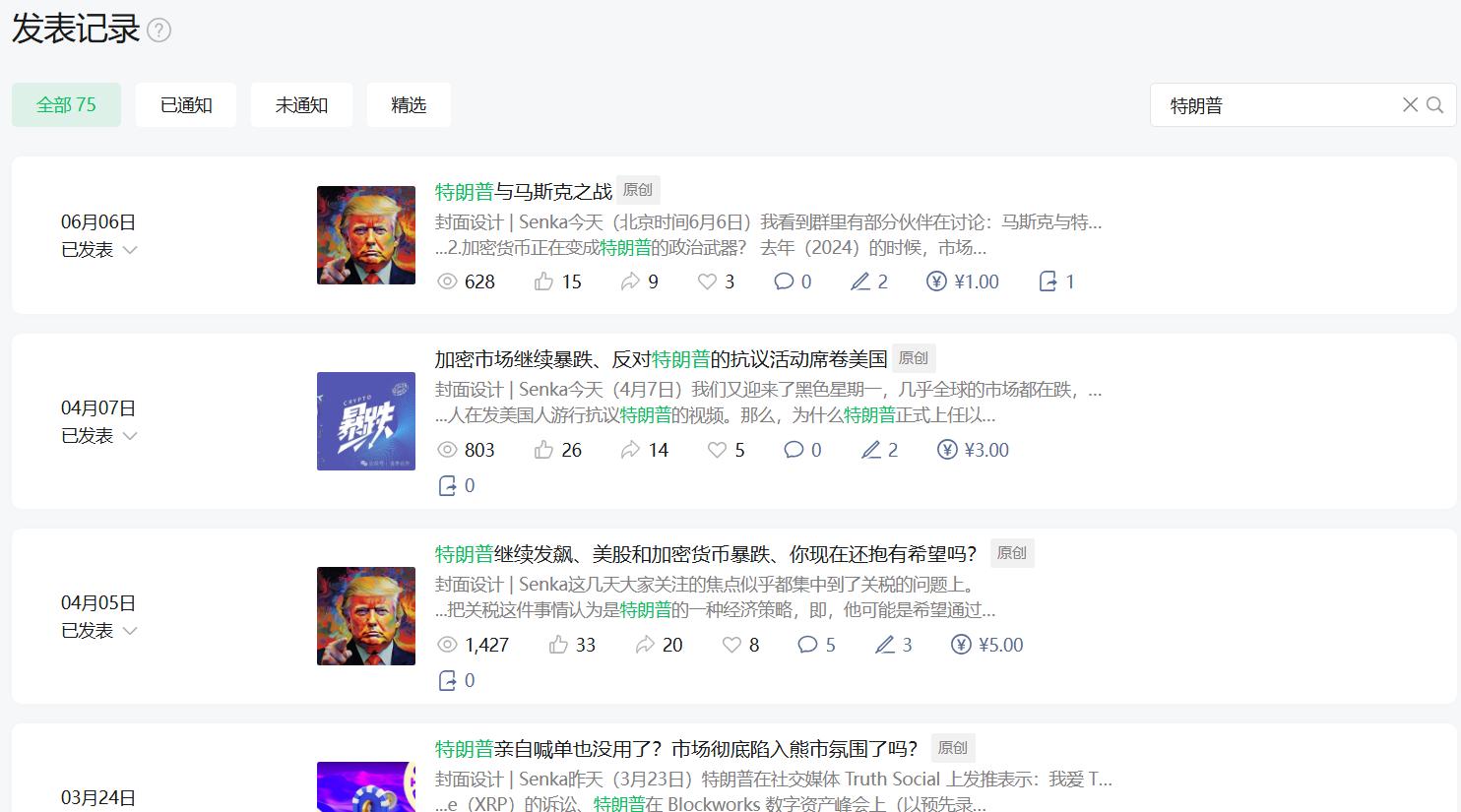
This is not only because he (including his family group) is deeply intervening in the crypto market. In addition to promoting the Bitcoin national strategic reserve plan, he even personally issues coins to reap profits. His words and deeds can always directly affect the trend of the global market (including the stock market, etc.).
Of course, in addition to the three aspects listed above, there are many factors that affect market trends (known and unknown), which is also the main reason why the short-term market cannot be accurately predicted. Here is what we mentioned in the previous article (June 23): The only thing we can do is to manage our positions and find trading opportunities that suit us in the complex "game" of geopolitical games + market structure changes + macroeconomic expectations.
In addition, in the previous article (June 23), we also mentioned: For the current encryption market, we should divide it into two independent plans to implement, that is, the investment plan for Bitcoin and the investment plan for altcoins should no longer be confused.
Although our own investment strategy is currently mainly biased towards Bitcoin, judging from the messages in the background, many people still prefer to invest in altcoins. This is very understandable, because compared with the theoretically limited increase in Bitcoin, the increase in altcoins seems to be more imaginative. This is also a question of how to balance returns and personal risk preferences.
In fact, we have already shared a lot of discussions on the topic of copycat season in our previous articles. To sum it up in one sentence: we probably won’t be able to see the traditional copycat season again, but the mini copycat season will still have the chance to appear.
Although some traditional experiences, rules or indicators may no longer be fully applicable to the mini-altcoin season, the underlying logic of the market (liquidity law) will not change. Funds are always profit-seeking and will not have so-called faith in Bitcoin (including any other cryptocurrency). They will only flow to all profitable places.
In other words, most institutional investors are currently injecting funds into Bitcoin, but everything has a stage. When the price of Bitcoin reaches a certain level, making Bitcoin no longer have investment value, it is possible that funds may flow back to some altcoins, such as those altcoins that have passed ETFs (including those that may pass ETFs) or crypto-related companies that have already IPOed (including those that may go public).
If you still want to find some possible opportunities in altcoins, then our advice at this stage remains unchanged: continue to evaluate your risk appetite. You just need to pay close attention to changes in the BTC.D indicator and market sentiment, which will help you better determine the right entry time.
For example, the crypto concept of US/Hong Kong stocks is being hyped now. If you chase this hot topic now, it seems that you will face higher risks. It is better to think about it in a different way. If the funds have finished hyping the stock market, do you think they will continue to hype related concepts in the crypto market? If you think so, then for the current hot stablecoin concept, you can continue to think about which other crypto sectors are related to it?
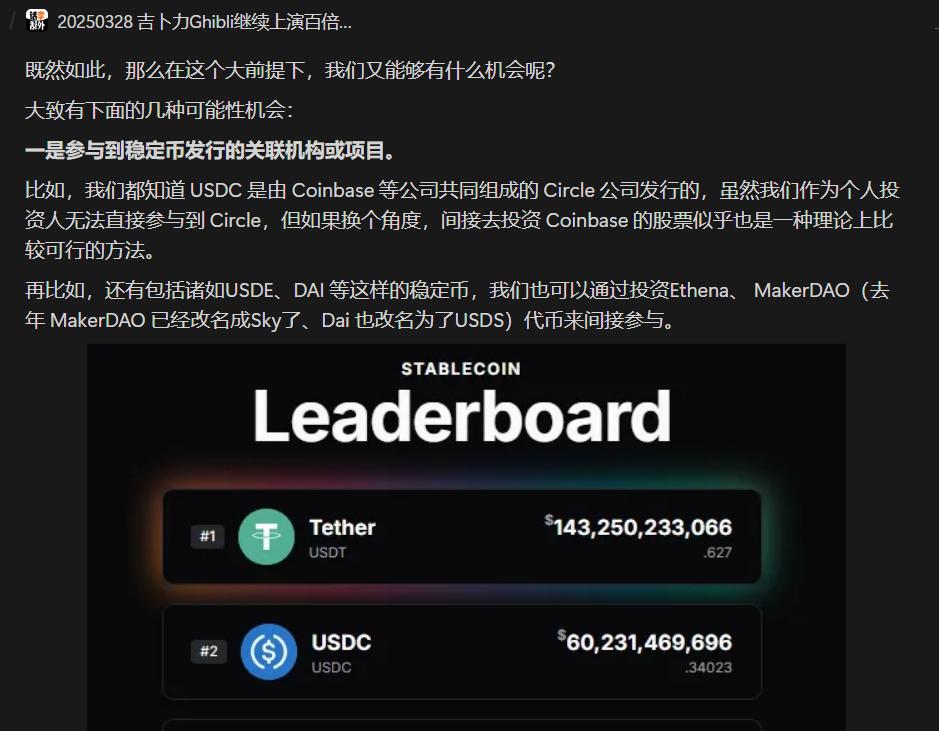
We have actually sorted this out in some of our previous articles. For example, in the article on March 28, we mentioned two opportunities: one is to participate in the affiliated institutions or projects of stablecoin issuance. The other is to participate in DeFi, RWA and other projects on the chain. As shown in the figure below.
In short, instead of passively chasing after whatever is popular, it is better to calm down and find 1-2 targeted niches that you are interested in, and then keep paying attention to and conducting in-depth research. At the same time, pay attention to some indicators that you think are necessary (such as K-line ), policy trends, or on-chain data (such as capital flows). This will increase your chances of discovering potential opportunities in advance.
Here is a simple example. During the bear market in 2022-2023, if you could firmly see (believe) that Bitcoin would definitely rise to $100,000, then you would not think that Bitcoins priced at $20,000, $30,000, or $50,000 were expensive. Similarly, if you chased Bitcoin because it broke through $100,000 and attracted attention, and you don’t understand what Bitcoin is, and you don’t have a relatively clear view or expectation of Bitcoin’s future, then it will be difficult for you to hold on to it.
To give another example, if you believe that the ETH ETF will increase staking in the third quarter of this year and the SOL ETF will be officially approved, then you can still accumulate ETH and SOL, including the top projects/protocol tokens related to their respective ecosystems.
This is actually also applicable to the stock market. For example, when we talked about CRCL stock a few days ago (June 15), its price was $133. In the following days, the price rose directly to nearly $300, and then fell back to $198 in the past two days. If you chased CRCL at $300 because the topic of crypto concept stocks was popular, but you don’t have a clear view or expectation of Circle’s future, then it will be difficult for you to hold it, and it may even lead to a loss on the books. If you firmly believe that Circle will rise to $1,000 in the future, then you can buy it now and hold it at any time.
Of course, expectations are expectations, and there is still a risk consideration here, which is the issue of how to manage positions that we have mentioned many times before. Because everyone’s situation is different, let’s take Bitcoin as an example. Although Bitcoin is already $100,000 now, and we also believe that Bitcoin may continue to rise to $300,000 in the future (for example, within 5 years), we will not go all in now, and will continue to use the existing hoarding strategy to execute operations in stages.
There are roughly three types of investment thinking: ordinary logic, expert logic, and super expert logic. In simple terms, ordinary logic means that you are greedy when others are greedy (the most vivid example is FOMO chasing hot spots and high prices), expert logic means that you are fearful when others are greedy (selling at high prices to take profits), and super expert logic means that you are even greedier when others are greedy (requires extremely strong channels, capabilities or technologies). However, for most of us ordinary investors, if we can understand and follow the expert logic stage, we can basically be ahead of more than 90% of retail investors.
That’s all for today. The sources of the images/data cited in the text have been added to Notion. The above content is only personal opinion and analysis, and is only for learning records and communication purposes, and does not constitute any investment advice.