On October 27, the 6th Blockchain Global Summit hosted by Wanxiang Blockchain Lab opened grandly at the W Hotel on the Bund in Shanghai. Dr. Xiao Feng, Chairman and General Manager of Wanxiang Blockchain, made his debut at the main venue of the summit and delivered a speech entitled "The Ultimate Conjecture of Blockchain Application Model". Dr. Xiao believes that blockchain technology will usher in a large-scale outbreak of applications in the process of optimization and improvement. The ultimate application model of blockchain will be to make blockchain a public infrastructure through highly integrated functions, thereby lowering the threshold for entrepreneurship, stimulating enthusiasm for innovation, and giving birth to great applications.
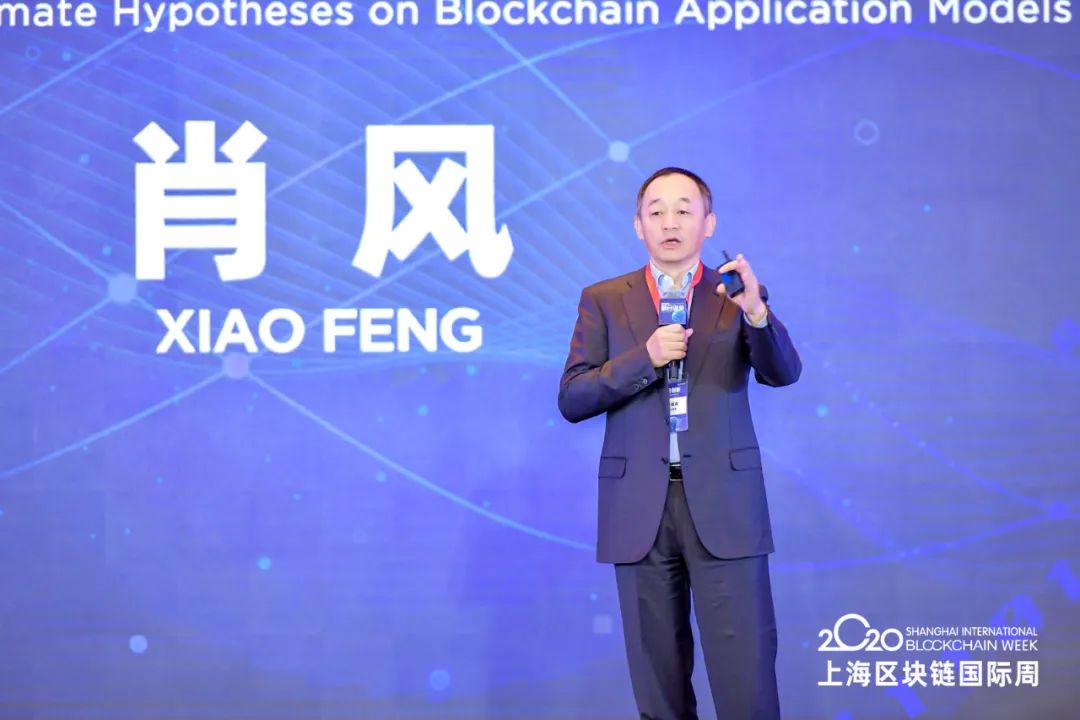
The full text of the speech is as follows:
Xiao Feng: It’s already six o’clock in the afternoon. Thank you all very much for sticking with me. It’s also very tiring to listen to the guests’ sharing here all day.
The title of my speech is "The Ultimate Conjecture of Blockchain Application Model". First of all, I would like to state that this is a conjecture. It may make sense in part, but it certainly does not make sense in all. We can say with certainty that the overall technical framework of blockchain, especially public blockchain, has been completed by the end of this year. Dfinity will be officially launched on December 31. By the end of this year, with projects like this coming online one after another, it can be said that the overall architecture of blockchain has been completely completed. This is somewhat similar to the process of determining the TCP/IP protocol in the early 1990s.
Of course, in the next two to three years, there is still a lot of room for optimization and improvement in the overall model and framework of blockchain, but it can be foreseen that starting from the end of this year, blockchain will experience continuous optimization of the technical framework on the one hand, and a huge explosion of applications on the other.
How will the application of blockchain explode? This is a topic I am trying to discuss today. When thinking about the direction or explosion of blockchain applications, I have developed a framework from the perspective of application layering. This framework is from the Internet to blockchain from top to bottom, and from blockchain to the Internet from bottom to top. From distributed networks, distributed databases, distributed computing to distributed ledgers. Distributed ledgers are something that the Internet already has. Of course, with the advent of blockchain, distributed storage and distributed computing are no longer the same as distributed storage and computing in the Internet concept. On the one hand, it is distributed, and at the same time, it is more decentralized than distributed. For example, Dfinity calls itself the Internet computer. Why is it called an Internet computer instead of a blockchain computer? Because in terms of distributed computing, a large part of it is indeed something in the scope of the Internet, not something purely on the blockchain. Although traceability and evidence storage are blockchain applications, they actually also contain elements of Internet technology. Distributed ledgers are a dividing line. Going beyond distributed ledgers and going down and deeper, it becomes more and more blockchain-like, and more blockchain technology is used.
This is especially true for distributed governance. Whether it is the economic model or the consensus algorithm involved in distributed governance, blockchain technology is used. Because if you want to use a community governance mechanism, you need to design a good consensus algorithm. Under distributed governance, going deeper is distributed applications. Distributed applications go further and become crypto-economy. A complete distributed business world is built in this way.
It is not that blockchain applications are only available in distributed commerce. There are blockchain applications at every level. It is just that some applications have a large intersection with the Internet, while some applications are more like pure blockchain applications. This is the stratification I made from the application perspective. I broke down the Internet technology and blockchain technology and put them into these levels. Not being completely bound by the order or stratification of technology will be helpful for us to think about the ultimate application of blockchain.
Since the advent of computers or information technology, we can see that in terms of application, the application of these technologies has gone through three stages. The first stage is the pure information technology period. In the 1970s, 1980s, and 1990s, information technology supported some commercial applications. The software systems used by everyone may have hundreds of thousands, hundreds of thousands, or even millions of lines of code. The second stage is the Internet platform period. The Internet platform sinks many complex software into infrastructure. The third stage is the blockchain period. Blockchain further sinks the Internet platform into infrastructure. If we study the application of information technology and digital technology as a whole, we will find that in the past few decades, we have continuously sunk the application layer into infrastructure and then brought new changes to the application layer. The sinking brought by blockchain finally produced distributed applications.
Some people say that finance has been completely scenario-based. There is a famous saying: "Banking services are everywhere, except in banks." But why is finance scenario-based? Financial services are provided according to specific scenarios? From the perspective of infrastructure, financial services are actually being sunk into infrastructure. Financial services themselves are very good business applications, and with the development of technology, they are gradually becoming infrastructure. Take third-party payment as an example. It used to be a lucrative industry, and everyone was chasing it, but it turned out that it couldn't make money. Who can use third-party payment the most? The answer is Internet companies. Because third-party payment has become a free industry public infrastructure for Internet companies such as social networking, e-commerce, food delivery, and shared bicycles. From this we can see that the application layer that was once very prominent in the Internet industry is gradually sinking into infrastructure.
Blockchain is the epitome of this sinking. I will elaborate on this point later. From software systems, Internet platforms to blockchain, in this sinking process, the software system is actually very complicated to use when it is designed. For example, in the era without browsers, you have to use the command line to run various software in the Windows operating system. But how many people can use the command line? Therefore, the original Window system is an information technology application that is very difficult to learn and popularize.
On the Internet platform, these complex software systems have all sunk. The Internet platform provides very light, very simple, and very easy-to-use applications in the form of APPs, such as WeChat. Although an application like WeChat is backed by a huge software system that requires hundreds of thousands of lines of code, for users, it is just an easy-to-use APP. Grandpa and grandma can also use it to send red envelopes, and even grab red envelopes faster than young people.
In the blockchain era, APP will continue to sink. The blockchain era uses smart contracts. It is like a small program, simpler than APP. An APP needs tens of thousands of lines of code, but a smart contract may only need hundreds or thousands of lines of code to form an application.
In addition, the Internet platform is demand-driven, that is, consumers drive the operation of the network. In the blockchain era, it is no longer driven by consumers, but by developers, because blockchain is a developer-friendly network. Currently, the best blockchain systems are built by developer communities. Any blockchain system without a developer community will definitely not be viable.
But why is the blockchain era not driven by the C-end? As Vitalik Buterin put it this morning: Why does blockchain have no killer applications? Because it is a killer network. It is a network driven by developers, driven by the supply side, and finally reaches the consumer side. It can be seen that blockchain is completely different from the Internet, and starting a business on blockchain is also very different from starting a business on the Internet.
Below I will explain what is the ultimate model of blockchain application through two cases. The first case is Uniswap, which many speakers today talked about. Two young people replaced a centralized system that required 100,000 or hundreds of thousands of lines of code with 500 lines of code. What does this case show? It is very predictive and foresighted. Let us see that blockchain-based applications must not use 50,000 or 100,000 lines of code to complete one thing. Smart contracts cannot be composed of 50,000 or 100,000 lines of code, but only hundreds or thousands of lines of code. Although Uniswap has defects, it only takes hundreds or thousands of lines of code to surpass a system supported by tens of thousands of lines of code and operated by thousands of people. Such a successful case may indicate that blockchain-based applications should have the following characteristics:
First, applications are provided through smart contracts, and all smart contracts only require thousands or tens of thousands of lines of code. The reason why Uniswap can replace such a centralized system with hundreds or thousands of lines of code is that blockchain has done the most thorough job in integrating various technologies and sinking into infrastructure. The distributed network, distributed database, distributed storage, distributed computing, distributed ledger, and distributed governance that I mentioned earlier have all become free infrastructure. For example, public chains do not require permission or development costs, which greatly reduces the cost for young people. We have not heard of Uniswap going for financing. On the contrary, after it succeeded, capital began to chase it. But in the Internet age, can you say that you can start a business without capital? Any application in the Internet age, let alone letting Internet giants carry you, even if you carry it on it, it will have many audits and licensing processes for you. But there are no such audits and licensing processes on public chains.
I saw a demo, Dfinity, which used 1,000 lines of code to write a decentralized TikTok. Of course, it is just a demo. I look forward to seeing a decentralized application that replaces TikTok written in 1,000 lines of code after the Dfinity mainnet is actually launched. If this can come true, it will confirm my ultimate conjecture about the blockchain application model: blockchain-based applications are smart contracts that only require hundreds or thousands of lines of code.
These two cases are very predictive, and perhaps this is the direction of blockchain application development. Blockchain has become the infrastructure of applications, integrating multiple functions such as storage, computing, incentives, ledgers, identities, accounts, addresses, etc., forming a commercial infrastructure with the following characteristics:
Feature 1: It must be open source. If it is not open source, it cannot become a trusted infrastructure.
Feature 2: Must be open. That is, no permission is required, and entrepreneurs do not need to get approval from anyone to do their own thing.
Feature 3: Shared governance mechanism and shared benefit distribution. From Shareholder to Stakeholder, this is the change brought by blockchain. Stakeholder capitalism is a shared capitalist mechanism, not a centralized capitalist mechanism. At the same time, it should be distributed, decentralized, and self-organized. Although blockchain is a public infrastructure, it no longer has the drawbacks that physical public infrastructure naturally brings, namely the "tragedy of the commons."
I personally look forward to the fact that after the overall architecture is completed this year, the infrastructure of blockchain will continue to be optimized in the next two to three years, and will be optimized to be able to undertake large-scale killer applications. What does such operation mean? It means that anyone who knows code can freely deploy their own applications on this platform with low threshold, low code, low capital, and low operation. This application may only have 1,000 or 500 lines of code. What has this application become? It has become a highly trusted, highly reliable, highly secure, high-yield, and highly decentralized application. Such applications cannot be brought by the Internet world, but only by the blockchain world.
Imagine that on such an infrastructure for freely publishing applications, 10 million entrepreneurs in China can start their own businesses freely. I believe that there will be many more great applications emerging than in the original Internet era with high thresholds, high code, high capital investment, and high operation. On that Internet platform, only 200,000 people in China were qualified to start a business, because there were many conditions for starting a business at that time. You had to find funds, manpower, set up a company, find a traffic platform for the application, and operate traffic. Storage, computing, trust and other problems all need to be solved by yourself. But on the blockchain, these are all free and free public infrastructure, which lowers the threshold for entrepreneurship and allows the number of people who are qualified to start a business to increase from 200,000 to 10 million. The chance of great applications emerging among 10 million people is definitely much greater than that among 200,000 people.
In summary, the application of the Internet has liberated consumers, and the application of blockchain has liberated developers. Liberating developers means liberating entrepreneurs. Therefore, only based on blockchain can "mass entrepreneurship and innovation" be realized. Blockchain is the best platform for "mass entrepreneurship and innovation". Thank you!