
Recently, Lawyer Liu has seen that some lawyers’ self-media accounts have begun to “evolve” to “seek benefits” for the vast number of friends who speculate in cryptocurrencies—personally teaching how to deposit and withdraw money “legally” and “safely”, and completely get rid of the trouble of having your card frozen. Is this really reliable?
1. Why are deposits and withdrawals in the cryptocurrency world so risky?
The reason why many people have such a great demand for safe and legal deposits and withdrawals is mainly because many cryptocurrency traders currently encounter many legal difficulties in the process of depositing and withdrawing funds. For example, when cashing out virtual currencies that they legally hold, suspicious funds are received and frozen by judicial authorities or banks; or friends who intend to buy cryptocurrencies follow the rules of the exchange platform, but the merchant selling U may have received other people's funds involved in the case through the merchant's collection account, and eventually other innocent buyers are also accidentally injured, and the judicial authorities freeze all bank cards that have transaction records with U merchants.
The above situation is just a relatively simple card freezing mode. In reality, more complex three-party or even four-party transactions or due to various "coincidences", involving online gambling, pyramid schemes and other funds, it is even more difficult to unfreeze. These situations combined make friends in the cryptocurrency circle tread on thin ice when depositing and withdrawing funds.

2. Are there any legal and safe channels for depositing and withdrawing funds at present?
Since the 10 ministries and commissions of the State issued the "Notice on Further Preventing and Dealing with the Risks of Virtual Currency Trading Speculation" (the "924 Notice" often referred to by insiders) in September 2021, my country has adopted a strong regulatory policy for virtual currency-related business activities within the country. Basically, all channels for mainland citizens to invest in virtual currencies are completely blocked. At this time, some people still use legal and legal deposit and withdrawal teaching to attract traffic and even amount, which is actually bad intentions.
Lawyer Liu provides a comprehensive interpretation of my country’s current regulatory policies on virtual currencies (mainly the “924 Notice”) from the following aspects, and analyzes why there are currently no completely legal, compliant, and safe deposit and withdrawal channels in mainland China:
1. Characterization of virtual currency business
my country currently uniformly defines the following types of businesses as illegal financial activities.
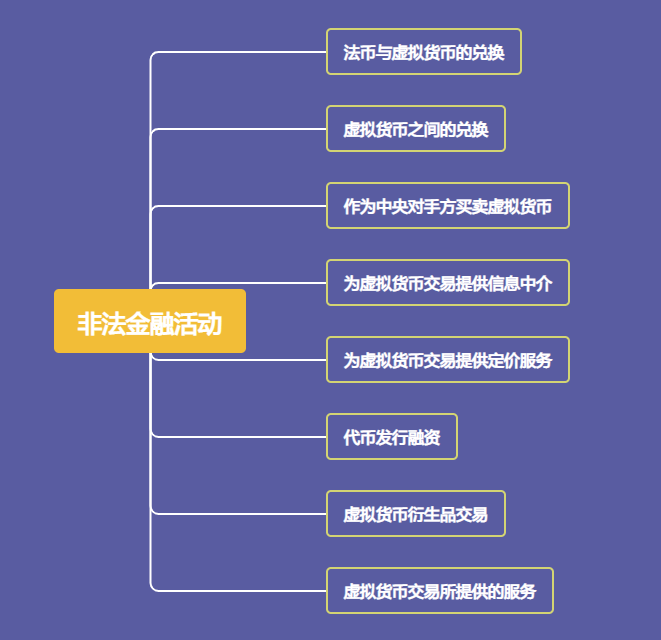
The above eight categories of business almost completely cover the business activities related to virtual currency, so why are there still so many people speculating in virtual currency in China? The reason is that in my country's current regulatory regulations, there is actually no explicit prohibition on ordinary citizens from investing in virtual currency. The original words of the "924 Notice" are: "Any legal person, non-legal person organization and natural person who invests in virtual currency and related derivatives, which violates the public prosecution morality, the relevant civil legal acts are invalid, and the losses caused by this shall be borne by themselves." This sentence is definitely not to encourage everyone to speculate in virtual currency, but it does not prohibit ordinary citizens, legal persons, and other organizations from investing in virtual currency, although they need to bear the risks themselves, and Chinese law does not provide any protection.
(II) Virtual Currency Exchanges
Regarding virtual currency exchanges, the "924 Notice" stipulates that services provided by overseas virtual currency exchanges to mainland Chinese residents through the Internet are illegal financial activities. Although it is stipulated here that the actions of exchanges are illegal financial activities, no legal consequences are stipulated for mainland residents who use overseas virtual currency exchanges. However, we need to pay attention that when mainland residents passively participate in an illegal financial activity, the legal risks they face are obvious. Having their cards frozen when depositing or withdrawing funds is only the most superficial manifestation of this legal risk. The calm waters that follow are very likely to turn into turbulent waves (for example, the "frozen friends" whose cards are frozen become suspects in criminal cases).
3. Domestic payment channels
Currently, my country does not allow any financial institution or non-bank payment institution to provide services for virtual currency-related businesses under regulation.
Third-party payment institutions, including large and medium-sized banks, WeChat, and Alipay, all issued announcements in various forms in 2021, stating that users are prohibited from using their payment and settlement channels to conduct virtual currency transactions. Once discovered, their account usage rights will be restricted, their accounts will be cancelled, etc.
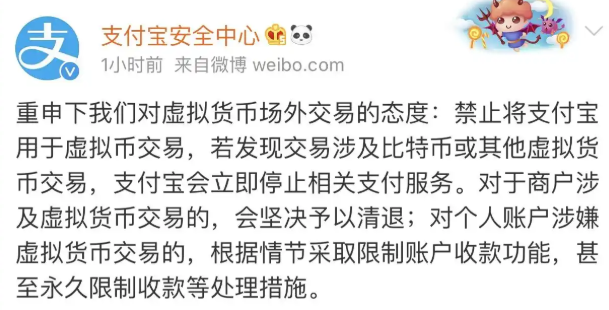
(Information released by Alipay’s official Weibo account)
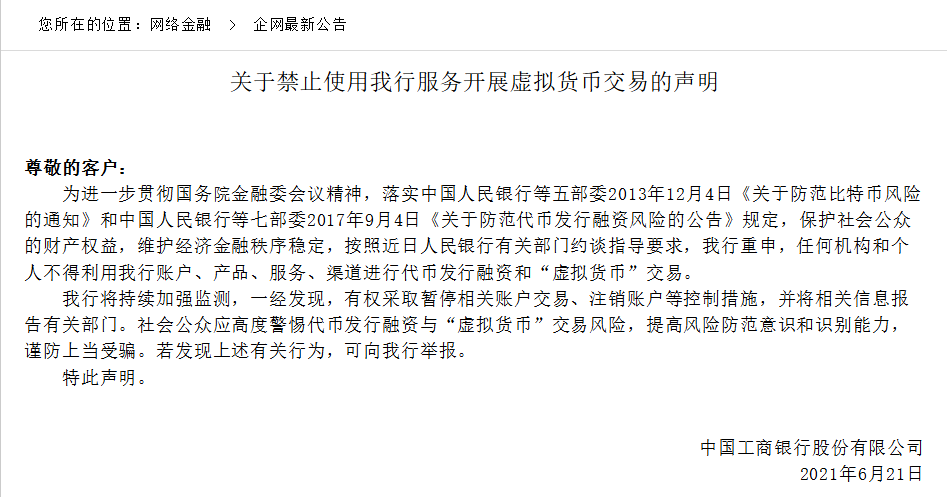
(Information released on the official website of Industrial and Commercial Bank of China)
So, in this situation, how can anyone make the virtual currency trading completely "legal and safe"? As long as you use a bank, WeChat, or Alipay to transfer money, regardless of whether it is suspected of illegal financial activities, this behavior itself violates the "Service Agreement" between the user and the bank or payment company, and at least constitutes a breach of contract in the "Civil Code".
(IV) Risks of transactions between individuals
If the transaction is conducted between natural persons outside the venue, can the risk be avoided by using cash? Judging from the cases represented by Lawyer Liu in the cryptocurrency circle, this method is more risky. There is a transfer record in the transfer transaction, which can be used as evidence in case of any problems; however, in pure cash transactions, it is difficult to ensure that "one hand hands over the money and the other hand transfers the currency". We have encountered situations where one party does not transfer the currency after receiving the money, or does not pay after receiving the currency; there are even cases where one party pretends to pay after receiving the currency, and then snatches the money back after the other party relaxes his vigilance.
3. Conclusion
Generally speaking, the entire virtual currency transaction in China is inherently "sinful". Although it cannot be said that virtual currency investment and trading are completely prohibited, there are no "legal" and "safe" investment and trading channels. It can only be said that the law enforcement agencies are limited in their power and cannot investigate them one by one. Therefore, Lawyer Liu recommends that you have a clear understanding of the current legal status of virtual currency in the mainland. We also hope that domestic regulators can accept virtual currency to a certain extent, appropriately relax the mainland's regulatory policies, and give appropriate tolerance to the law-abiding cryptocurrency trading groups.