
Author: Sanqing, Forest News
On February 2nd, Hyperliquid announced that its HIP-4 proposal had been launched on the testnet. This proposal aims to build a prediction market infrastructure by introducing "Outcome Trading." Furthermore, from late January to early February 2026, the cryptocurrency market weakened, with Bitcoin's price briefly falling below $75,000 and the broader market experiencing a correction. However, Hyperliquid's native token, HYPE, bucked the trend, rising by over 40% in the past week.
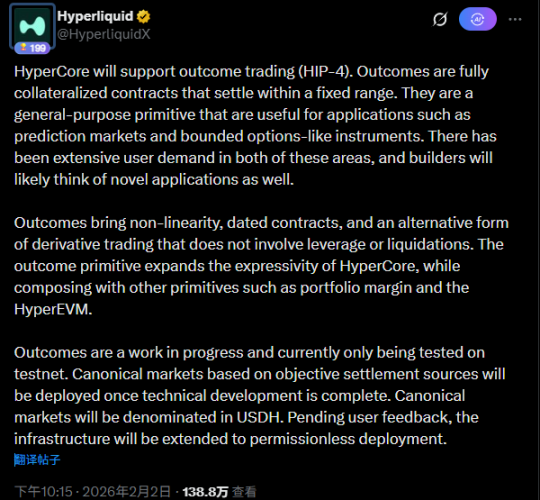
Image source: Hyperliquid tweet
However, as its business expanded, Hyperliquid faced accusations of technology infringement from a competitor. On February 2nd, Sky Guo, founder of the RWA public blockchain project Cypherium, publicly accused Hyperliquid on social media of infringing on his patented technology. Sky Guo believes that Hyperliquid's underlying consensus engine, HyperCore, uses a patented PoS version of the HotStuff optimization algorithm and demanded that it cease its infringing activities.
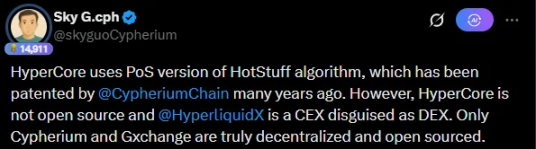
Image source: Sky Guo's tweet
The core dispute: the technical boundaries of patent US 11,411,721 B2
The core of this dispute points to a formal patent issued by the United States Patent and Trademark Office (USPTO) on August 9, 2022, numbered US 11,411,721 B2. The assignee of this patent is Cypherium Blockchain Inc., and its title is "Systems and methods for selecting and utilizing a committee of validator nodes in a distributed system."
This patent details a mechanism for dynamically selecting and reconfiguring a validator committee, supporting node election via PoW, PoS, or PoA, and emphasizes the use of aggregate signatures to improve consensus efficiency and fault tolerance. The patent also proposes specific implementation paths such as two-phase reconfiguration and tree-structured hierarchical propagation.
Cypherium believes that these technologies are key to HotStuff's successful deployment in large-scale, high-performance networks such as Hyperliquid 200,000 TPS, which is also the core barrier to its patent rights.
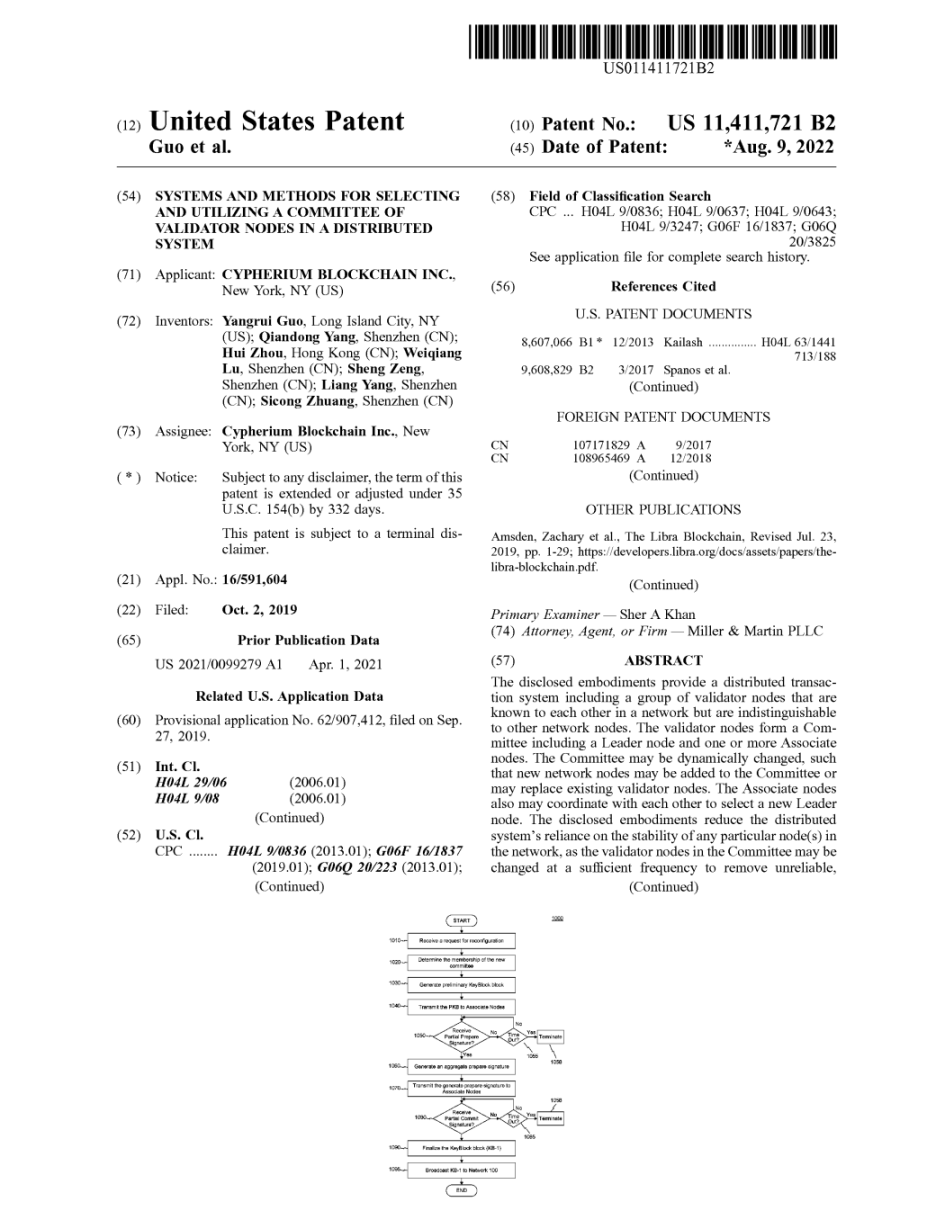
Cypherium Patent US 11,411,721 B2 Homepage | Image Source: Google Patent Directory
The technical dispute lies in the improvements and applications of the consensus algorithm HotStuff by both sides, but HotStuff itself is an open-source consensus protocol that was released by the academic community between 2018 and 2019.
Cypherium's CypherBFT combines PoW with HotStuff to achieve permissionless operation, while Hyperliquid's HyperBFT is a custom variant optimized for low-latency transactions.
However, Cypherium claims its patent covers specific enhancement logic for HotStuff in a PoS environment, and Hyperliquid has not yet responded to whether HyperBFT used the unique claims covered by the patent.
Accusations Escalate: From Questioning Transparency to Attacking Infringement
Prior to this infringement allegation, Sky Guo's criticisms of Hyperliquid mainly focused on code transparency.
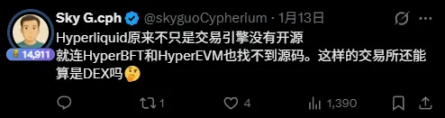
Image source: Sky Guo's tweet
This lack of transparency, on the one hand, protects Hyperliquid's commercial advantage in high-concurrency processing, but on the other hand, makes it difficult for it to prove its innocence through public audits when faced with external technical challenges.
Sky Guo believes that HyperCore achieved its sub-second finality precisely because it borrowed the dynamic committee selection logic from its patent.
Sky Guo claims to have sent a lawyer's letter to the Hyperliquid team and relevant personnel, accusing them of using patented technology without permission. He states that Hyperliquid is currently avoiding the issue and has not responded to the legal letter.
Is it solid evidence or just a publicity stunt?
From a superficial legal and technical perspective, Cypherium's US patent 11,411,721 B2 is indeed a formally issued legal document, and its scope of protection covers key aspects of the consensus mechanism, such as dynamic committee selection, signature aggregation, and two-phase reconfiguration.
According to Hyperliquid's publicly available technical documentation, the underlying HyperCore engine does indeed run on HyperBFT, a custom variant based on the HotStuff algorithm, which is precisely the technical improvement that is the focus of the patent claims.
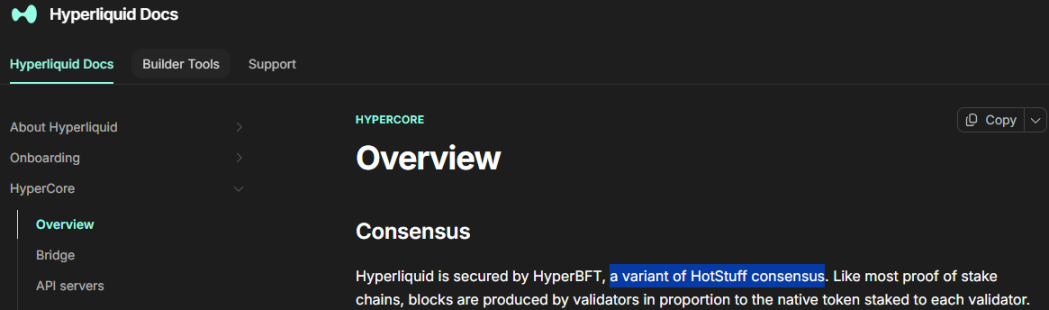
Image source: Hyperliquid Docs
Furthermore, since Hyperliquid's core codebase is currently not open source, this black-box nature makes it difficult for outsiders to determine whether its specific implementation path circumvents relevant patents through public code audits.
In fact, HotStuff and its variants are nothing new in the high-performance Layer 1 race. From the failed Libra/Diem of Meta (formerly Facebook), to the currently popular Aptos (AptosBFT) and Monad (MonadBFT), as well as the iterations of core consensus in Sui's early research, all have been deeply influenced by HotStuff's linear communication complexity and responsive design.
Furthermore, the timing and context of this accusation are thought-provoking. Sky Guo's release of the infringement accusation (at 12:00 PM on February 3rd) coincided with a period of strong performance in the HYPE token market and increased interest in the prediction market driven by the HIP-4 proposal.
On social media platforms, some KOLs expressed their support for this rights protection action, but the comment sections of related posts showed what appeared to be promotional content about "G-Exchange". "G-Exchange" is a new project that will soon be launched within the Cypherium ecosystem. The coincidence of this technical accusation and the pre-launch hype for the new project makes this series of rights protection actions seem like a publicity stunt to promote the new business.
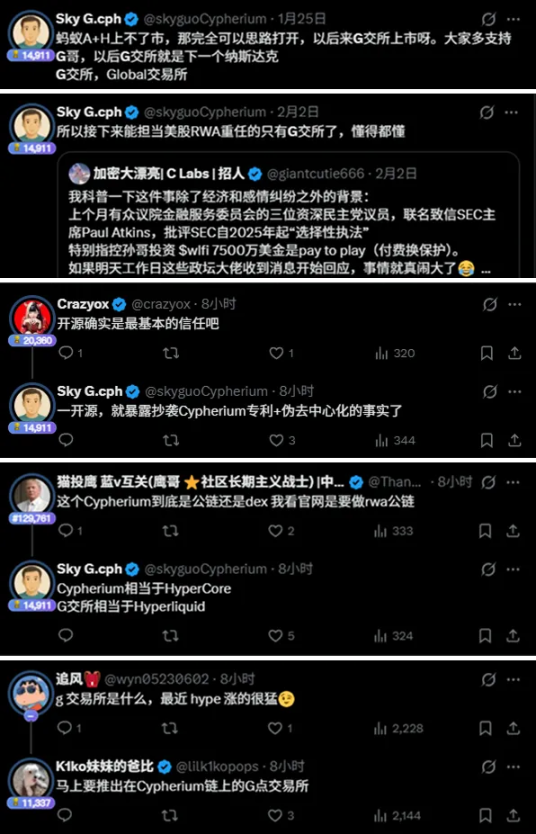
Image source: tweets from Sky Guo and other X accounts.
Whether the accusations are solid evidence or mere marketing ploys, Hyperliquid appears to have reached a crossroads. As its business expands, the community's calls for greater transparency are growing. Faced with allegations of infringement, will Hyperliquid maintain its advantage of being an opaque entity, or will it prove its innocence through partial open-source releases or third-party audits? This hinges on the foundation of trust in its decentralized narrative.
Note: 9.92 million HYPE tokens will be unlocked on February 6, representing 2.79% of the circulating supply, with a value of approximately $357 million (at a price of $36).