Early-stage capital formation is undergoing a profound structural transformation. Internet Capital Markets (ICMs) are redefining how funds are pooled online, shifting capital formation from traditional gatekeeping mechanisms to a more open, transparent, and globalized model. It constructs a new path from idea to publicly traded company through four continuous and interconnected layers—early-stage formation, community issuance, market infrastructure, and real-world bridging. This research, a collaboration between Bloom Protocol, The Meteorite Collective, and Meteora, aims to systematically depict this rapidly maturing financial stack.
In this system, Bloom Protocol focuses on the upstream "early formation layer," responsible for identifying and verifying genuine community support; Meteora plays a key role in the "community issuance layer," allowing attention to be quickly converted into tradable capital; Solana's infrastructure provides an institutional-level execution environment to ensure the fairness and consistency of transactions; and the real-world asset bridge layer connects on-chain capital with the traditional financial system, enabling the growth of the internet capital market to extend to the multi-trillion-dollar real economy.
The ICM market is expanding rapidly.
Between 2024 and 2025, the growth rate of the ICM-related ecosystem far exceeded industry expectations. Token Launch platforms and ICM-related infrastructure together processed tens of billions of dollars in transaction volume, and many platforms demonstrated stable and sustainable revenue capabilities.
Among these platforms, Meteora's DLMM (Dynamic Liquidity Market Maker) stands out. Within two years, it propelled Solana's liquidity infrastructure from less than $1 billion in TVL to over $20 billion in cumulative trading volume, gradually becoming one of the most efficient adaptive liquidity mechanisms in the crypto space. Meanwhile, a series of launchpads for ICMs, such as BAGS, Believe App, and Help.fun, have facilitated hundreds of token issuances, contributing massive liquidity to both primary and secondary markets.
According to data from Blockworks Research and Token Terminal, Launchpad revenue grew more than tenfold year-on-year in 2025; leading platforms achieved annualized transaction fee revenue between $5 million and $15 million. While most of ICM's traffic currently comes from memes and cultural tokens, its underlying structure mirrors the early stages of DeFi: experimentation followed by scaling, and finally, infrastructure development. The difference lies in this: this time, liquidity is driven not by mining incentives, but by attention itself—narrative, community, and culture become the new asset pricing basis in the on-chain market.
Overall, between January and November 2025 alone, ICM-driven trading volume on Solana and other ecosystems exceeded tens of billions of dollars. This scale signifies that attention is moving toward a mature financial primitive, and the internet capital market is in the early stages of rapid formation.
Four stages of the Internet capital market
As AI drives product development costs to extremely low levels and the number of "individual entrepreneurs" grows rapidly, competition among founders intensifies. In an era where products are easy to manufacture, the real bottleneck shifts from "making a product" to "how to raise early-stage capital and build genuine community conviction." Traditional fundraising methods—whether VC or public offerings—cannot meet this speed and scale. Founders need a faster, fairer, and more market-responsive way to generate early-stage capital.
Against this backdrop, a new financial architecture began to emerge: the Internet Capital Market (ICM). It is built on a simple but powerful premise: anyone, anywhere, can transform real community support into tradable capital.
The architecture of ICM consists of four interconnected layers:
- Early Formation – making real support visible and verifiable;
- Community Launch – Enabling attention to be instantly converted into capital;
- Market infrastructure – enabling capital formation to achieve sustainable market depth;
- Real Asset Bridges (RWA & Traditional Bridges) – Connecting on-chain capital to the trillion-dollar real-world financial system.
These four stages reinforce each other, ultimately forming a complete and sustainable capital formation system.
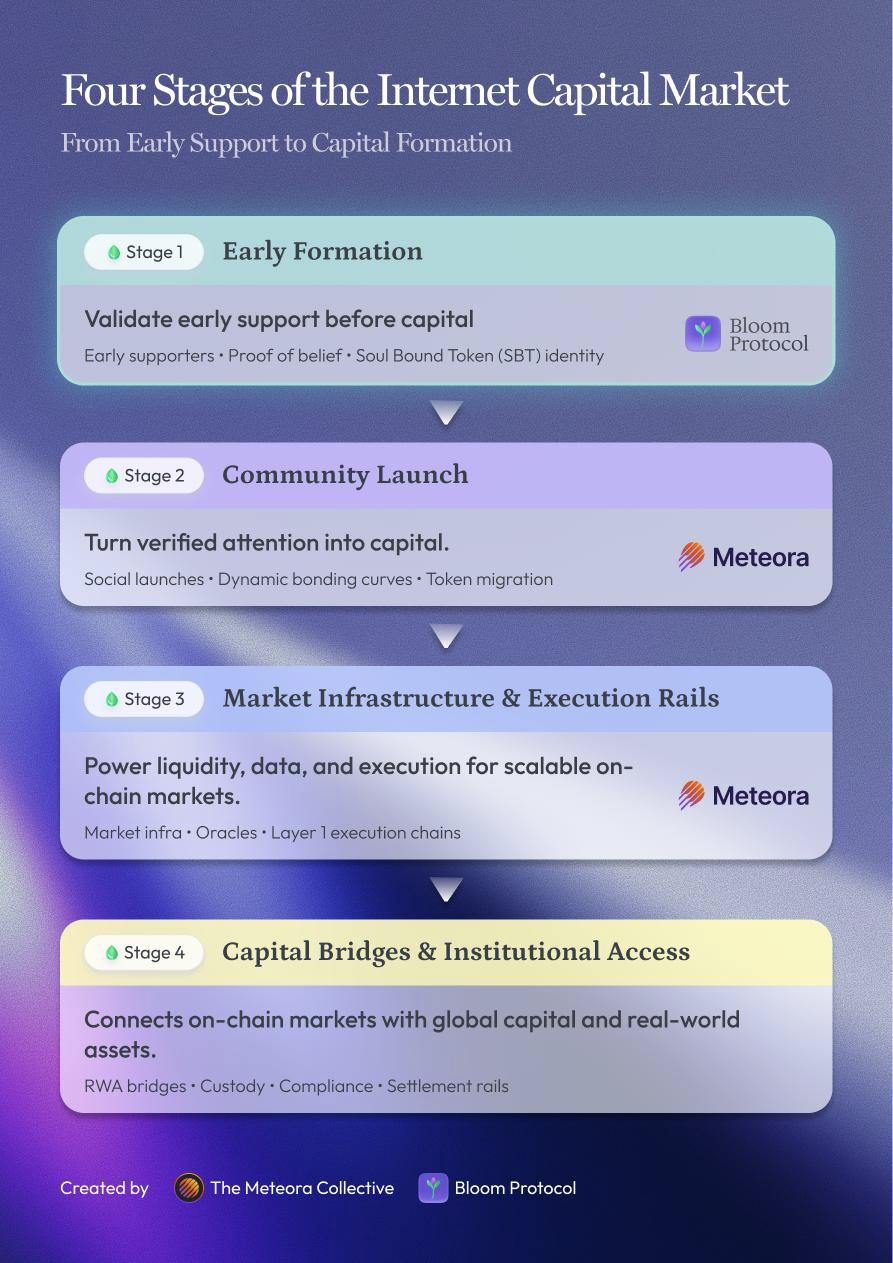
Phase 1: Early Formation – The Foundation That Was Missing in the Past
While hackathons, developer communities, and educational platforms make product prototyping easy, few mechanisms can translate initial community conviction into sustainable momentum. This is precisely the stage that Bloom Protocol addresses.
Bloom is designed for the next generation of "product founders"—an era where AI is driving product development costs to near zero and Web2 and Web3 are increasingly merging naturally in the hands of builders. Bloom provides a complete mechanism for teams to build early convictions, validate market needs, and ultimately transform that early support into capital.
Bloom's mission system (Bloom Missions) and Soul-Bound Tokens (SBTs) form a key foundation. Through Bloom AI Co-Pilot, the team can quickly design missions to test Product-Market Fit (PMF) and attract backers who truly understand the product's value. Backers receive SBTs with "future uses," which not only validate their early beliefs but can also be converted into assets later, enabling a flexible transition from "community engagement" to "capital formation."
Bloom's role in ICM is to provide "proven products with early-stage traction" to downstream ecosystems (such as Meteora). When these projects enter the Community Launch phase, they can immediately access on-chain liquidity, allowing attention to be directly converted into capital. The entire structure is cross-ecosystem compatible and can be integrated with any network and issuance system that prioritizes product-driven teams.
Phase Two: Community Launch – Turning Attention into Capital
Once the early support layer ensures the project possesses quality and genuine participation from its initial stages, the community launch phase undertakes another crucial task: transforming these proven beliefs into capital accessible to everyone . It is during this phase that the revolution in the internet capital market first manifests itself in a truly visible form before the public.
Within the Solana ecosystem, this breakthrough stems from Meteora's innovative liquidity architecture—centered around Dynamic Bonding Curves and an open liquidity module. Meteora significantly lowers the technical and financial barriers to token creation, enabling any project to launch its token offering in a fairer and more efficient manner, thus laying a crucial foundation for the current wave of community-driven on-chain token issuances.
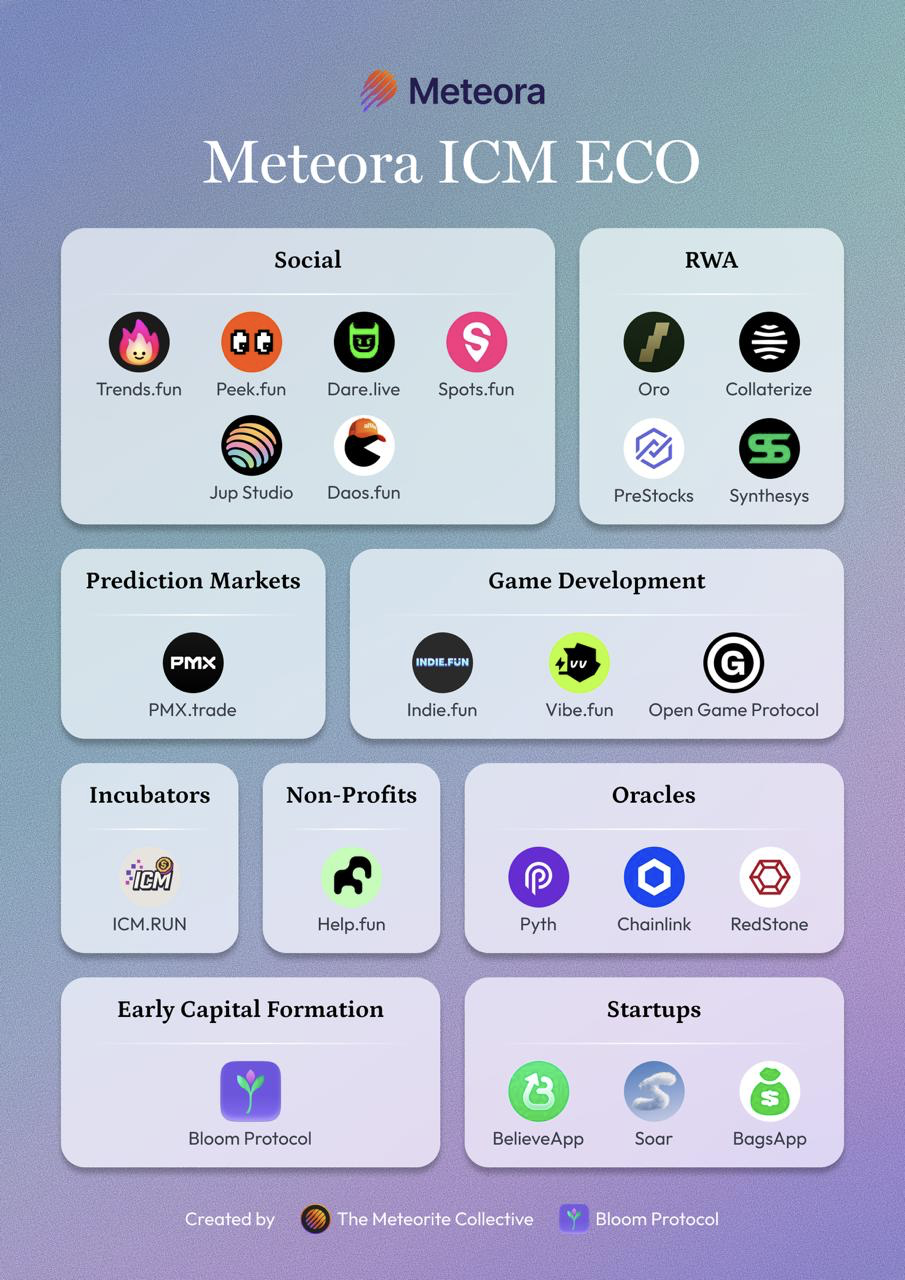
Trends (trends.fun) demonstrates the core logic of attention capitalization. Popular trends or memes are no longer just fleeting signals on social media, but assets that can be instantly minted into tokens. The Suolala explosion is a prime example: a meme created by the Chinese community spread into a cross-cultural internet character economy within days; holders collaborated to produce fan content, extend across blockchains, and even create charity versions. Once attention is priced, the community can collectively own and spread narratives, a scale effect that is difficult to achieve with the traditional internet. This community-driven capitalization of attention lays the foundation for the next stage: not only can culture and memes be priced, but more serious products and companies can also be guided to on-chain capital markets according to the same logic.
More companies participating
As the Meteora-based issuance model matures, more and more teams are beginning to explore bringing truly revenue-generating startups into the on-chain capital market. Platforms like ICM.RUN, Help.Fun, Soar, and Crafts are actively promoting project screening, issuance process optimization, and capital pipeline standardization, enabling "company-level" projects to enter ICM more smoothly.
Help.Fun applies Meteora's indirect distribution mechanism to a permissioned, mission-driven launchpad. While ensuring project quality, it prioritizes public good, directing revenue to charitable causes, thus creating a "controlled and sustainable" distribution model. ICM.RUN further expands its ecosystem through a DAO incubation model, providing projects with community guidance, ecosystem collaboration opportunities, and early market exposure, enabling teams to build a solid foundation before entering the public market.
As the internet capital market matures, the next stage is no longer limited to "issuing tokens," but rather involves moving the entire company structure onto the blockchain. MetaDAO is a prime example of this shift, redefining how startups launch, govern, and raise funds within the ICM framework.
Through a governance system based on futarchy (prediction market governance), MetaDAO decouples decision-making from centralized committees, allowing prediction markets to evaluate whether proposals can enhance the value of agreements. For startups and early-stage teams, this mechanism provides a highly transparent path, enabling decisions on ownership allocation, treasury capital allocation, and funding for new projects to be based on measurable performance rather than hierarchy and political considerations.
In practice, MetaDAO functions as both an on-chain accelerator and a governance shell, containing modules such as Automated Market Maker (AMM) and Treasury Management, making it a self-contained economic system. Any team can leverage these modules, driven by programmable incentives, to quickly build its own "internet-native company" without relying on cumbersome traditional oversight systems.
Therefore, MetaDAO marks a key turning point in the internet capital market, moving from "project issuance" to "programmable company formation," making it a self-sustaining ecosystem with institutional potential.
These cases collectively demonstrate that Meteora's liquidity architecture opens the door for creators to transform validated beliefs into tradable capital and lays the foundation for the next phase of ICM—a cross-ecosystem, sustainable market infrastructure.
As more ecosystems adopt similar basic modules, the paradigm provided by Meteora has become an important blueprint for the evolution of the internet capital market, enabling it to complete a full closed loop from "belief formation" to "capital formation" in a continuous and interoperable process.
Phase Three: Market Infrastructure – From Liquidity to Durability
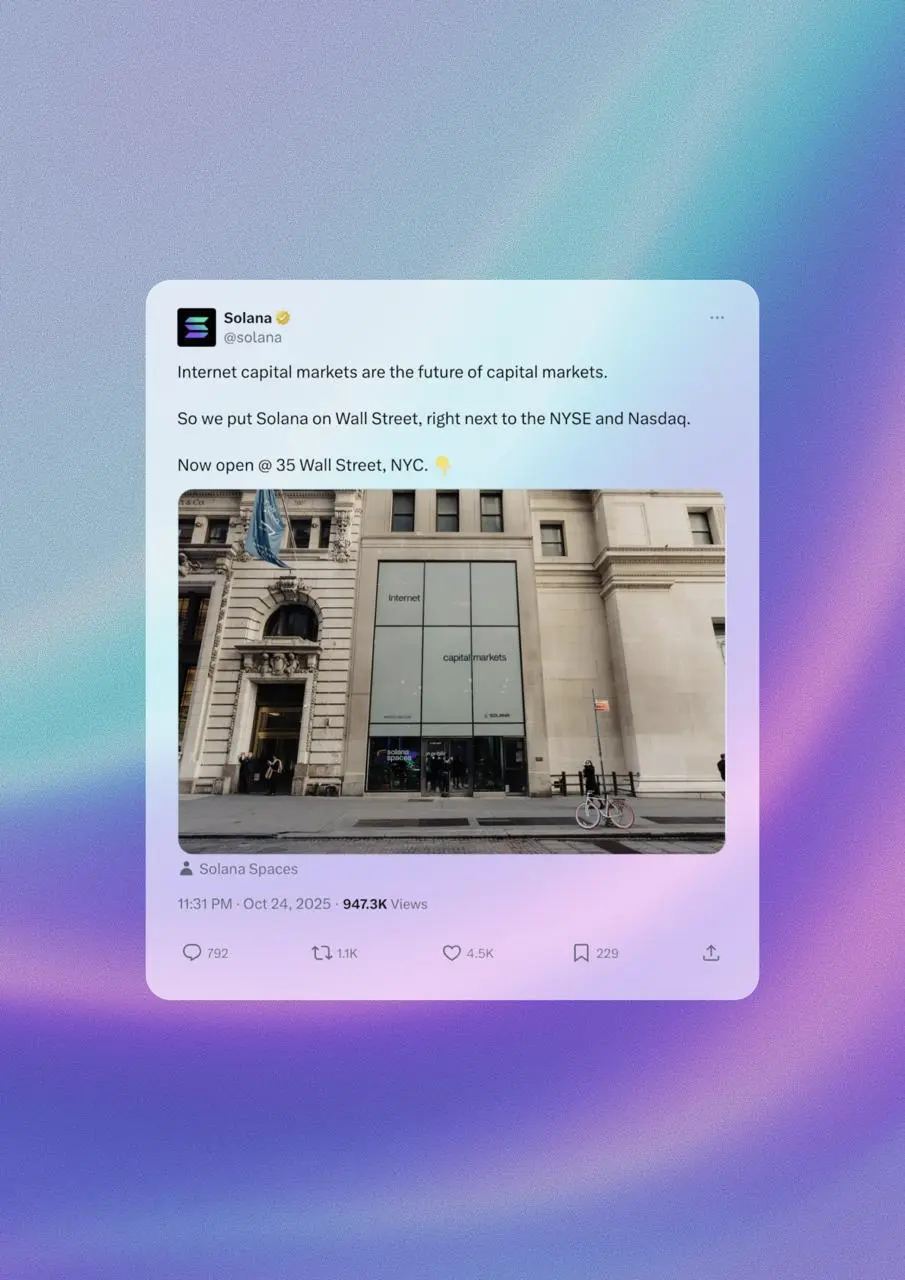
Community-based issuances have demonstrated that "capital can form at the speed of social media," but for the market to exist in the long term, deeper issues at the micro-structural level must be addressed: order matching, fairness, latency, and liquidity distribution. These are NASDAQ-level challenges, and Solana is treating them as core roadmaps, not just improving TPS.
Building upon Solana's foundational implementation, Metaplex, Meteora, and MetaDAO are constructing tools that can truly be used by builders and users.
Metaplex, the most mature asset issuance framework on Solana, has created over 920 million digital assets and processed over $10 billion in cumulative transactions. Genesis Protocol, launched in 2025, ushered in the era of structured issuance. Its auction mechanism effectively reduces interference from MEVs and bots, making the issuance process fairer and more transparent. The successful issuance of DeFiTuna's $TUNA and Portals projects demonstrates the positive effects of structured ICM Launches: more reasonable price discovery and more equitable participation.
Meteora addresses the most critical issue after token launch—liquidity depletion. DLMM uses an adaptive mechanism to maintain continuous liquidity for tokens throughout their growth cycle, enabling many community tokens that would otherwise quickly fail to maintain market depth over the long term.
MetaDAO completes this structure by using prediction market-based governance to allow all capital to enter the circulation system, making fundraising, liquidity, and governance a closed and self-reinforcing system.
Together, these three elements form a closed loop of ICM infrastructure, encompassing asset issuance, market liquidity, and governance coordination, enabling the on-chain market to evolve towards an "institutional" level.
Phase Four: Real-World Assets and Traditional Bridges – Connecting Trillions of Dollars in the Endgame
The final layer concerns whether ICM can truly connect to the real-world economy.
In 2025, Wall Street began to take a substantial step onto the blockchain: BlackRock announced the launch of the RWA fund based on on-chain tokens; CME completed the first batch of Sol and XRP options trading; and Western Union launched USDPT, a stablecoin based on Solana, bringing its remittance network of hundreds of millions of users onto the blockchain.
On-chain RWA platforms are also maturing rapidly: Backed's xStocks has tokenized more than 60 US stocks and ETFs, enabling 24/7 trading; Collaterize and Synthesys provide institutional-grade asset tokenization and on-chain fund management; and PreStocks introduces pre-IPO equity into ICM, making private equity liquid.
At the same time, financial institutions in East Asia and Japan have also begun to build on-chain treasury infrastructure (cash layer). For example, tokenized money market funds issued by Chinese fund companies, billions of dollars in assets managed by Securitize, and the on-chain treasury mechanism of DFDV JP all enable on-chain projects to manage treasury storage and flow securely and compliantly.
Visa and Mastercard have also incorporated USDC clearing into their systems; Worldcoin provides over ten million verified human identities; and licensed brokers like Futu are bringing tokenized assets into traditional channels. The infrastructure for the bridge layer is already in place, enabling ICM to directly interconnect with the traditional capital system.
Conclusion: A new capitalist order is taking shape.
The internet capital market is rapidly becoming a parallel structure to traditional capital formation methods.
Bloom Protocol ensures that the beliefs of upstream backers are clean, real, and verifiable; the Meteora ecosystem instantly translates this "verified attention" into open liquidity; Solana's infrastructure gives these markets institutional-level execution quality; and the RWA bridge extends all of this into the real-world financial system.
For founders, this means they no longer need to wait for VC approval or go through a lengthy IPO process;
For supporters, early involvement is no longer just emotional investment, but a contribution that can be recorded, respected, and valued.
For institutions, this is a transparent, programmable, and global market system.