Author: @Jjay_dm
Compiled by: Deep Tide TechFlow
Market Update – November 24, 2025
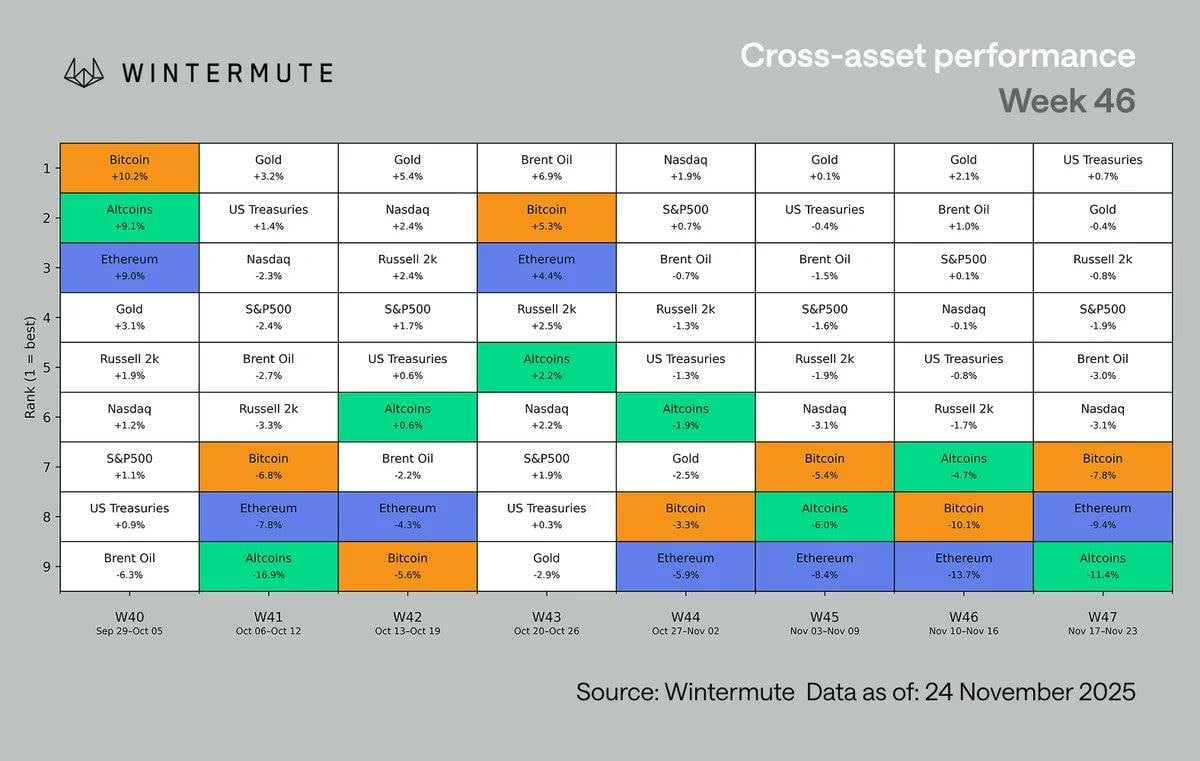
The collapse of AI-driven market momentum triggered a shift in risk aversion, causing the cryptocurrency market capitalization to fall below $3 trillion, marking its third consecutive week as the worst-performing major asset class. Weak employment data, declining expectations of interest rate cuts, and pressure in the Japanese market, coupled with thin liquidity during the holiday season, further weighed on the market. Cryptocurrency market positioning has been readjusted, funding rates have turned negative, and spot trading volume remains stable.
Macro Update
Risk appetite deteriorated sharply this week, and the AI-driven stock market momentum finally stalled. Despite another strong earnings report from Nvidia, the rally was short-lived, with the market immediately using the rebound as an opportunity to sell. This reaction marks a clear shift in market behavior: investors used aggressive selling to indicate that AI trading is losing support from new buying. As US tech stocks retreated, the pressure directly impacted the cryptocurrency market, with its total market capitalization falling below $3 trillion for the first time since April.
Macroeconomic data further exacerbated market fragility:
- Non-farm payrolls (NFP) increased by 119,000, but the unemployment rate rose to 4.4%.
- The probability of a December rate cut has dropped to about 30%.
- Japanese markets are under pressure, with a steepening yield curve (bear market steepness) and a weakening yen raising concerns about its ability to continue absorbing US Treasuries.
- European and Asian markets also performed weakly, with the Chinese market experiencing profit-taking in the AI sector and renewed pressure on the real estate market.
- UK inflation eased, but its impact was limited against the backdrop of low liquidity during the US Thanksgiving holiday.
As a result, cryptocurrencies were the worst-performing major asset class for the third consecutive week, with widespread selling and long liquidation leading to the largest declines in altcoins.
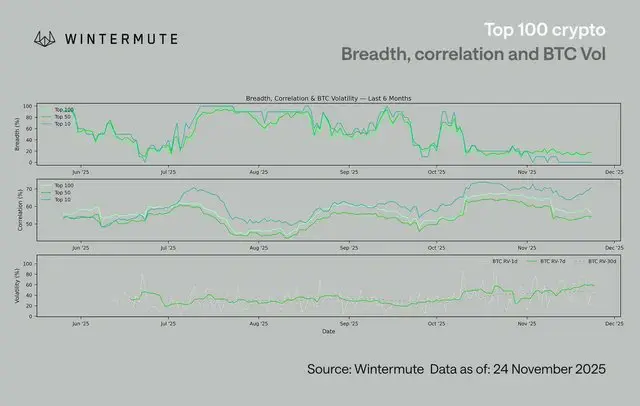
Despite the continued instability of the macroeconomic environment, the internal structure of the cryptocurrency market is undergoing positive changes. Funding rates turned negative for the first time since Bitcoin (BTC) traded near $115,000 at the end of October, marking the longest period of negative funding since October 26th. Leveraged funds are biased towards shorting, while capital flows are returning to the spot market, which has shown surprisingly strong trading volume despite the shortened holiday trading week. This combination suggests that the market has completed a comprehensive reset and will be in a more favorable stable state once macroeconomic pressures ease.
Among the top 100 tokens by market capitalization, correlation is concentrated primarily in the top 10, and these tokens also performed the worst. This reflects that the largest assets are trading as a single macro sector, entirely tied to broader risk sentiment. In contrast, tokens ranked 50-100 have experienced relatively smaller declines and show early signs of decoupling, with their trading relying more on unique drivers. This aligns with the reality of the market: some narrow narratives (such as proxy protocols, privacy, and decentralized IoT DePIN) are still driving short-term outperformance even when the overall market is weak.
Meanwhile, Bitcoin volatility continues to climb, with the 7-day realized volatility (RV) rising back to near 50.
Performance across all sectors was generally weak, with highly volatile sectors being hit hardest by the sell-off:
- Layer 2 (L2) fell by 14.9%.
- The gaming sector fell 12.0%.
- Decentralized Internet of Things (DePIN) fell 11.4%.
- Artificial intelligence (AI) stocks fell 10.5%.
- Small and mid-cap assets also underperformed.
- Core Layer 1 protocols fell 7.0%, while the GMCI-30 index (@gmci_) fell 7.2%, performing slightly better.
This round of decline was almost indiscriminate, clearly reflecting the widespread de-risking sentiment driven by macroeconomics that has permeated all sectors.
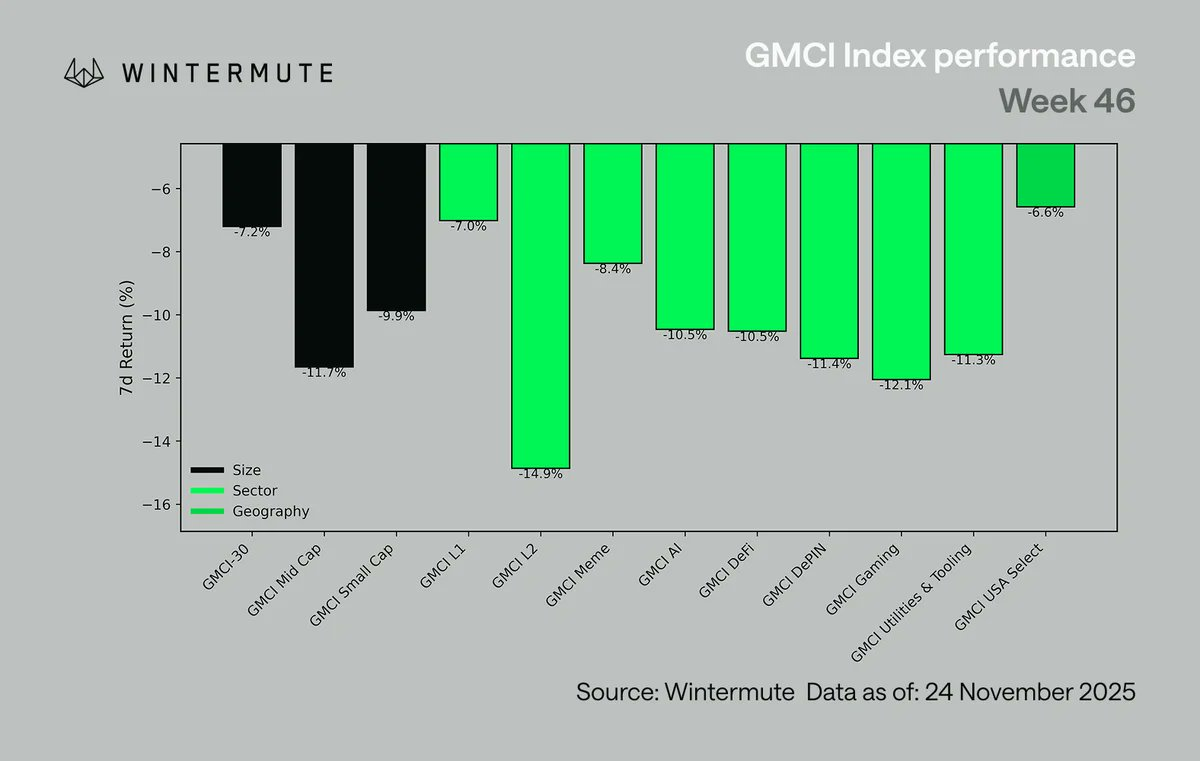
The chart above shows data from Monday to Monday, therefore it differs from the first chart.
Our Viewpoint
Despite the digital asset market being deeply mired in a deleveraging wave triggered by the macro environment, the market is now in a phase where consolidation is finally showing promise.
After undergoing macro-driven deleveraging, digital assets were initially pressured by the cooling AI hype and subsequently by adjustments in market expectations by the Federal Reserve. However, the market's internal structure has now significantly improved. Mainstream assets have shown more pronounced relative strength, market sentiment has been fully cleared, and leverage risk has been greatly reduced. Total open interest in perpetual contracts has decreased from approximately $230 billion in early October to approximately $135 billion today, primarily due to deleveraging in long-tail assets and systemic capital outflows. This change has pushed market activity back into the spot market, where depth and liquidity have performed better than expected in a holiday liquidity-scarce environment.
This is crucial: when leverage ratios fall to such low levels and the spot market becomes the primary trading channel, market recovery tends to be more orderly than the mechanical squeeze seen at the beginning of the year. The presence of negative funding rates and net short perpetual contracts also reduces the risk of further forced liquidations, providing the market with more breathing room, especially given the stabilizing macroeconomic environment. The next few days will determine how we enter the final month of the year, but after weeks of macroeconomic pressure, the market is finally poised for consolidation.