
Author: Luke, Mars Finance
introduction
The NS token surged 103% in just one hour, breaking through 0.43 USDT, then fell back slightly, and is currently trading at 0.38 USDT. This wave of gains has attracted widespread attention and surprised many retail investors: Why has a blockchain domain name token that was not well known suddenly become the focus of the market? This article will deeply analyze the technical advantages and economic model of NS, compare it with Ethereum Name Service (ENS), and finally explore whether the blockchain domain name track has investment potential.
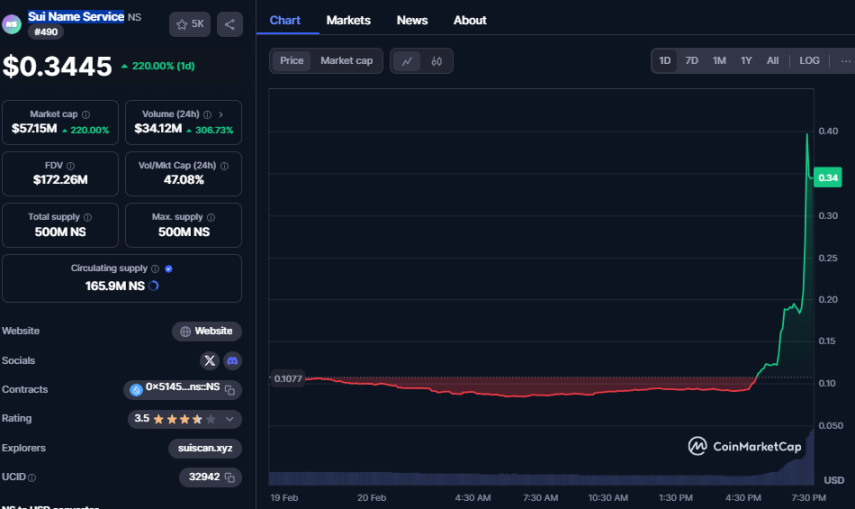
The surge caused by whale liquidation
The surge in NS was not entirely driven by the token economic model, but was triggered by the fund operations of giant whales, which is quite similar to the GameStop incident in the past. At that time, the giant whales quickly created a short-term boom in the market through large-scale replenishment and airdrop positions.
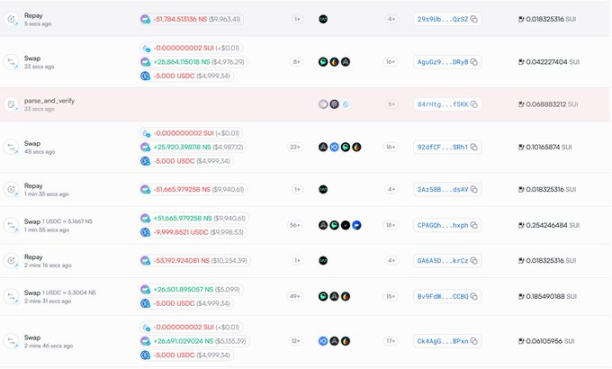
A whale invested funds in the Navi platform in early 2025 and used NS as collateral for the loan while conducting short operations on the exchange. The whale first lent NS, sold short, and then used the profits to repay the loan and re-collateralize NS, forming a continuous cycle of capital operations. However, the space for this operation has gradually dried up. If other investors start to withdraw their NS on Navi, the whale's short position may be quickly liquidated.
According to on-chain data, the surge on February 20 was caused by one or a group of whales trying to cover short positions and repay loans by repurchasing 75,000 NS per minute, which triggered violent price fluctuations. In this process, the joint counterattack of retail investors played a role in fueling the trend, similar to the "squeeze" effect in the stock market, causing the price to soar to 0.43 USDT.
Although this situation seems to give retail investors an opportunity to make short-term profits, it also hides greater risks. The whales' covering positions and airdrops may form an unstable capital cycle in the market, and if retail investors and investors withdraw their NS, the whales' short positions may be quickly liquidated, further exacerbating price fluctuations. Therefore, this type of market surge is both an opportunity and a bubble.
What is NS? Blockchain domain name service in Sui ecosystem
Sui Name Service (NS) is a core technology in the Sui ecosystem, which provides users with a simple and easy-to-remember blockchain address solution. In the blockchain world, long strings of addresses are often a headache, and the goal of NS is to make these complex addresses more concise and easy to identify. For example, the address "0xd77861e972e02feb0927611eb934b67a1f9e60782e36cdef61f6779919b6a8cd" on Sui may confuse you, but with NS, you can convert it into a short identifier like "@john" or "john.sui", similar to when you create a username on social media, except that it is completely decentralized and runs on the Sui blockchain.
Developed by the Mysten Labs team, NS leverages the high-performance architecture of the Sui blockchain to provide up to 100,000 transactions per second, enabling it to handle a large number of transactions. Users only need to pay about 20 SUI (equivalent to a few dollars) to register a domain name, and the V2 upgrade in June 2024 also added a subdomain function, making naming more flexible, similar to "@john.family". The core mission of NS is to provide a decentralized "domain name yellow pages" for Web3 and provide more convenient digital identity and asset management for the blockchain world.
NS vs. ENS: A battle between a newcomer and an old player
To understand the potential of NS, let's compare it with ENS, a veteran giant in the blockchain domain name field. ENS, as a core project in the Ethereum ecosystem, has been the dominant player in the domain name market as early as 2021. It provides users with concise addresses like "vitalik.eth". With Ethereum's huge ecosystem and first-mover advantage, ENS has become the most popular domain name service in the blockchain world. ENS has registered more than 2.6 million domain names to date, and its price has soared from the initial $43 to $85.69 in November 2021, and then fell back to $6.7 (October 2023) due to the bear market, and now it has recovered to the $25-35 range.
But ENS also faces some challenges. The most significant shortcoming is the high gas fee, which often makes the annual domain name registration cost as high as $5 to $640, and short domain names are particularly expensive, often requiring 300 ETH (hundreds of thousands of dollars). In addition, due to Ethereum's transaction speed and handling fee issues, the registration and use costs of ENS are relatively high for ordinary users.
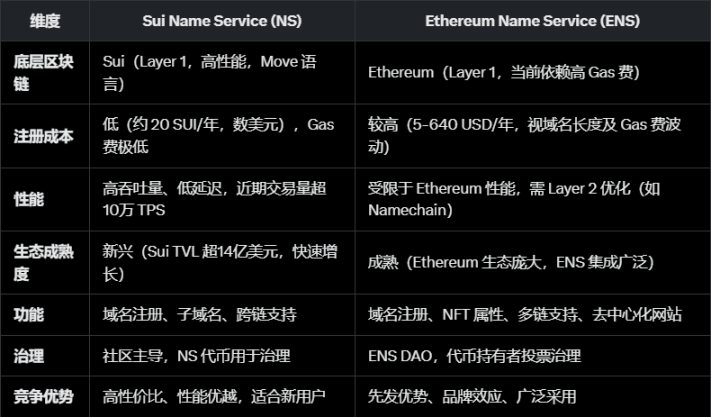
Unlike ENS, NS runs on the Sui blockchain, which has significant advantages. Sui is known for its high-performance transaction architecture, and the transaction speed can easily reach 100,000 transactions per second, which gives NS a huge advantage in both cost and efficiency. It only costs a few dollars to register a domain name like "@john" for NS, and its gas fee is almost negligible. Thanks to the rapid development of the Sui ecosystem and its low-cost advantages, NS is likely to achieve rapid growth in emerging markets.
However, the ecosystem of NS is not as mature as that of ENS, and its user base and market size lag far behind ENS. Retail investors need to remain patient and wait for its gradual development in the ecosystem.
Domain name track: Web3's "ID card fever" has both potential and risks
Blockchain domain names are rapidly becoming one of the infrastructures of the Web3 ecosystem, similar to the Domain Name System (DNS) in the traditional Internet. It not only simplifies complex blockchain addresses, but also provides a decentralized, verifiable identity system for decentralized applications (DApps), NFTs, and digital assets. Just as .com domain names became scarce assets on the Internet in the 1990s, blockchain domain names may become "digital ID cards" in the Web3 field. With the surge in the number of Web3 users, the market demand for blockchain domain names will also rise.
In this field, NS and ENS represent two different competitive strategies. ENS, as a leader in the Ethereum ecosystem, has become the "big brother" of blockchain domain names by virtue of Ethereum's strong ecosystem and first-mover advantage. It currently has more than 2.6 million domain names registered and has firmly locked in the high-end market through its integrated wallets, DApps, and NFT uses. Despite this, ENS's high gas fees and high registration costs remain its main shortcomings, especially for ordinary users, where domain name registration costs are high.
In contrast, NS has demonstrated strong competitiveness in the market by relying on the high performance and low cost advantages of the Sui blockchain. The transaction speed of the Sui blockchain is extremely fast, the cost of registering a domain name is only a few dollars, and the gas fee is almost negligible, making it very attractive in emerging markets. However, NS is still in its early stages of development, and its ecosystem and user base are far less than ENS, so investors need to be cautious.
Overall, although the market has great potential, speculation and regulatory changes may still bring risks to investors. Nevertheless, blockchain domain names are still an important cornerstone of the Web3 ecosystem. Whoever can accurately grasp market demand will be able to profit in this track.
Conclusion: This surge is only a temporary opportunity, and risks still exist
Although the short-term surge in NS has attracted great attention from the market, this price surge may only be a short-term fluctuation caused by the liquidation of whale airdrop positions. Similar to the "squeeze effect" in the stock market, whales conduct large-scale repurchases to cover short positions. Although this pushes up prices, this fluctuation is likely to be temporary and unsustainable. Although retail investors have obtained higher returns in the short term, the risks behind this surge cannot be ignored.
With the fluctuation of market sentiment and the limitation of circulation, NS may face the risk of price correction, especially when the operation of whales ends and the market support may weaken. Therefore, although NS has potential in Sui ecology, investors must remain cautious and not be misled by short-term price fluctuations. For investors who want to hold for a long time, they should pay close attention to the long-term development, technological progress and ecological construction of the project, rather than relying solely on short-term market popularity.
In the crypto market, opportunities and risks always coexist. Investors need to make rational judgments and do a good job of risk management. The future of NS is still full of uncertainty, and this surge is just a short-lived drama in the crypto market, which may not last. Therefore, it is recommended that retail investors stay sober when participating and avoid blindly chasing high prices, so as not to fall into the risks brought by short-term bubbles.