
Author: YBB Capital Researcher Ac-Core
TL;DR
In the long run, Bitcoin through ETF is not good. There is a huge gap between the trading volume of Hong Kong Bitcoin ETF and that of the United States Bitcoin ETF. There is no doubt that US capital is gradually engulfing the crypto market. Bitcoin ETF divides the market into black and white parts. The white part only has the single financial attribute of speculative trading under the framework of centralized financial supervision, while the black part has more native blockchain activity and trading opportunities, but faces regulatory pressure due to "illegality";
MicroStrategy has achieved efficient arbitrage between stocks, bonds and Bitcoin through its capital structure design, closely linking its stocks with the fluctuations of Bitcoin prices, thereby achieving lower-risk returns in the long run. The strategy is to issue unlimited bonds with assets and raise itself with unlimited leverage. This requires a long-term Bitcoin bull market to maintain its own value. Therefore, the odds of Citron shorting micro-strategy are higher than directly shorting Bitcoin, but micro-strategy is It is certain that the price trend of Bitcoin in the future will be a slow rise without large fluctuations;
Trump's crypto-friendly policy will not only not lose the dollar's status as a global reserve currency, but will also strengthen the dollar's pricing power in the crypto market. Trump is holding on to the dollar's dominance with his left hand and refusing to compromise, while fighting against the lack of trust in national fiat currencies with his right hand. Bitcoin, the strongest weapon, is held on to, and is being consolidated in both directions to hedge risks.
1. US capital gradually engulfs the crypto market
1.1 Hong Kong-US ETF Data
According to Glassnode data on December 3, 2024, the holdings of the US Bitcoin Spot ETF are only 13,000 away from surpassing Satoshi Nakamoto, with the holdings of the two being 1,083,000 and 1,096,000 respectively. The total assets of the US Bitcoin Spot ETF are The net value reached $103.91B Bitcoin, accounting for 5.49% of the total market value of Bitcoin. At the same time, according to Aastocks on December 3, the total trading volume of the three Bitcoin spot ETFs in Hong Kong in November was about 12. Billion Hong Kong dollars.
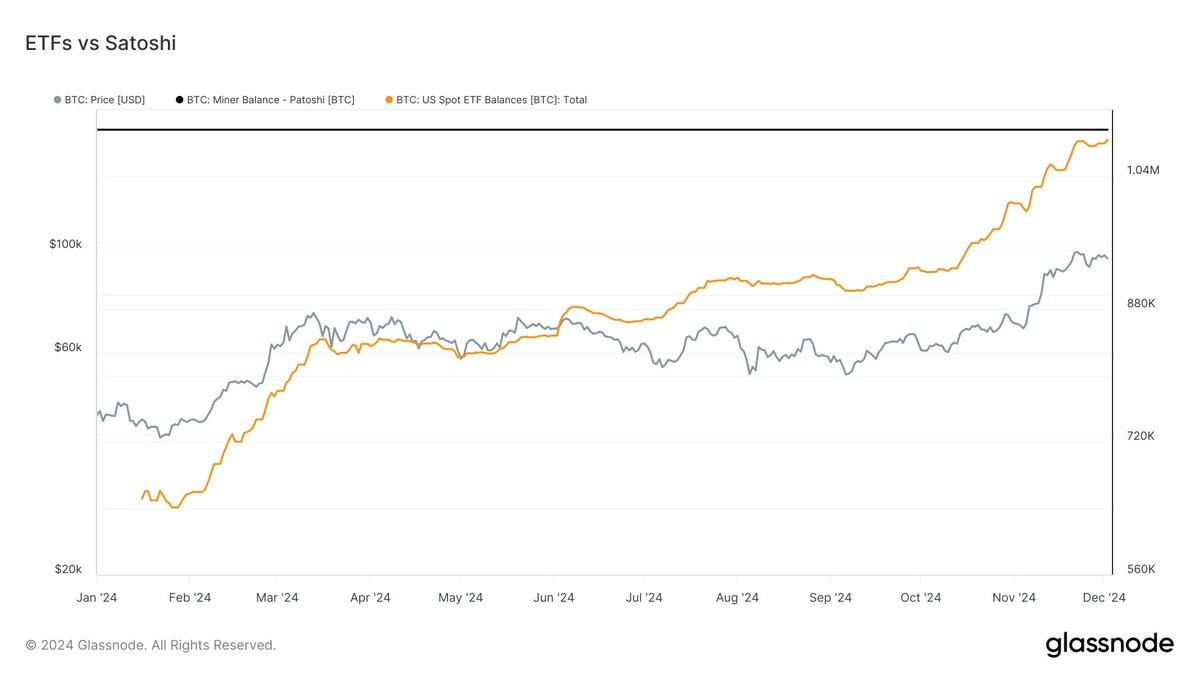
Image source: Glassnode
US capital is deeply involved in and influencing the global crypto market, and even dominates the development of the crypto industry. ETFs have pushed Bitcoin from an alternative asset to a mainstream asset, but they have also weakened the decentralized nature of Bitcoin. ETFs have brought a lot of traditional The influx of capital has also meant that Wall Street has firmly controlled the pricing power of Bitcoin.
1.2 The “black and white division” of Bitcoin ETF
Classifying Bitcoin as a commodity means that it must follow the same tax rules as other commodities such as stocks and bonds. However, the impact of the launch of a Bitcoin ETF is not exactly the same as the launch of other commodity ETFs, such as gold ETFs and silver ETFs. , crude oil ETF. The currently approved or approved Bitcoin ETFs are different from the market's recognition of Bitcoin itself:
The path of commodity ETF is like a person (trustee) holding physical assets or commodities in his left hand needs to entrust them to an intermediate custodian (such as a copper warehouse and a gold bank vault), and an authorized institution is required to complete the transfer and record. Etc. After the shares are launched (such as fund shares), the right hand side will have share holders to buy and sell, subscribe, etc. and use funds to purchase shares.
However, in the above process, the front end (design, development, sales and after-sales service, etc.) will involve physical delivery, spot delivery and cash delivery. However, the front end of the Bitcoin ETF approved by the US SEC (the subscription and redemption of shares) ) is a cash settlement method, which is also what Cathie Wood has been arguing about. She hopes that it can be completed by physical settlement, but this is impossible to achieve in practice.
Because cash custodians in the United States are institutions under the traditional centralized financial framework that conduct cash subscription and redemption transactions, this also means that the first half of the Bitcoin ETF is completely centralized.
At the end of Bitcoin ETF, it is difficult to confirm the centralized regulatory framework. The reason is that if you want to recognize Bitcoin, it needs to become a commodity under the existing centralized financial framework, and you will never recognize that Bitcoin can replace legal currency. Therefore, Bitcoin can only be used for various financial product derivatives, such as futures, options, and ETFs, under the condition that it fully complies with the regulations.
Therefore, the emergence of Bitcoin ETF means the complete failure of Bitcoin ETF to fight against legal currency. The decentralization of Bitcoin ETF is meaningless. The front end needs to rely entirely on the legal custody of Coinbase and ensure that the entire buying and selling transaction chain is Legally public and traceable.
The black and white of Bitcoin will be completely divided due to ETF:
The white part now: Under the centralized regulatory framework, through a wide range of financialized product derivatives, the market price volatility is reduced, and as legal participants become more and more widespread, the speculative volatility of Bitcoin commodities will gradually decrease. After Bitcoin passed the ETF, the white part has lost its important demand side (the decentralized and anonymous attributes of Bitcoin) in the supply and demand relationship of the market, and only has a single financial attribute that can be speculated. Under the decentralized regulatory framework, it also means that more taxes need to be paid, making the original function of Bitcoin to transfer assets and avoid taxes no longer exist. That is, the endorsement is transferred from the decentralized chain to the centralized government.
The former black part: The main reason why the crypto market will rise and fall sharply is that it has the characteristics of opacity and anonymity, which makes it easy to be manipulated. At the same time, the black part of the market will be more open and have more native value of blockchain. There are more trading opportunities due to the emergence of the white part. However, due to the emergence of the white part, the black part that is unwilling to turn into white will be forever excluded from the centralized regulatory framework and lose its pricing power, just like paying a fine to the SEC.
2. Trump’s Crypto All-Star Cabinet Selection
2.1 Cabinet members
In the 2024 US presidential election, Trump's victory may lead the US government to have a more open attitude towards cryptocurrencies compared to the restrictive policies of regulatory agencies such as the SEC, the Federal Reserve, and the FDIC during the Biden administration. According to Labs data, the nominations for Trump’s new administration are as follows:

Image source: @chaos_labs
Howard Lutnick (Transition Team Leader and Nominee for Commerce Secretary):
Lutnick, as CEO of Cantor Fitzgerald, is an open supporter of cryptocurrencies. His firm has actively explored the blockchain and digital asset space, including a strategic investment in Tether.
Scott Bessent (Nominee for Secretary of Finance):
Bessent, a veteran hedge fund manager, supports cryptocurrency, believing it represents freedom and will exist for a long time. He is more friendly to cryptocurrency than former Treasury Secretary candidate Paulson.
Tulsi Gabbard (Nominee for Director of National Intelligence):
Gabbard supports Bitcoin with privacy and decentralization as its core concepts, and invested in Ethereum and Litecoin in 2017.
Robert F. Kennedy Jr. (Nominee for Secretary of Health and Human Services):
Kennedy has publicly supported Bitcoin as a tool to combat the debasement of fiat currencies and could become an ally of the crypto industry.
Pam Bondi (Attorney General nominee):
Bondi has not yet made a clear statement on cryptocurrencies, and its policy direction is unclear.
Michael Waltz (National Security Advisor Nominee):
Waltz is an active supporter of cryptocurrencies, emphasizing their role in promoting economic competitiveness and technological independence.
Brendan Carr (FCC Chairman Nominee):
Carr is known for his anti-censorship and support for technological innovation, and may provide technical infrastructure support for the crypto industry.
Hester Peirce & Mark Uyeda (potential candidates for SEC Chairman):
Peirce is a staunch supporter of cryptocurrencies and advocates for regulatory clarity. Uyeda has been critical of the SEC’s tough stance on cryptocurrencies, calling for clear regulatory rules.
2.2 Crypto-friendly policies are a financial tool to hedge against the lack of trust in the global reserve of the US dollar
Will the White House's promotion of Bitcoin in the future shake people's trust in the US dollar as the world's reserve currency, thereby weakening the dollar's status? American scholar Vitaliy Katsenelson proposed that after the market sentiment towards the US dollar has been disturbed, At present, the White House's promotion of Bitcoin may shake people's trust in the US dollar as the global reserve currency, thereby weakening the status of the US dollar. As for the current fiscal challenges, "what can really make America continue to be great is not Bitcoin, but controlling debt and deficit."
Perhaps Trump's actions may become a hedge for the US government against the risk of the dollar losing its dominance in the future. In the context of economic globalization, all countries hope to achieve the international circulation, reserve and settlement of their own legal currencies. In the world, there is a trilemma among monetary sovereignty, free capital flow and fixed exchange rate. The important value of Bitcoin is that it provides a new solution to national institutional contradictions and economic sanctions in the context of economic globalization.
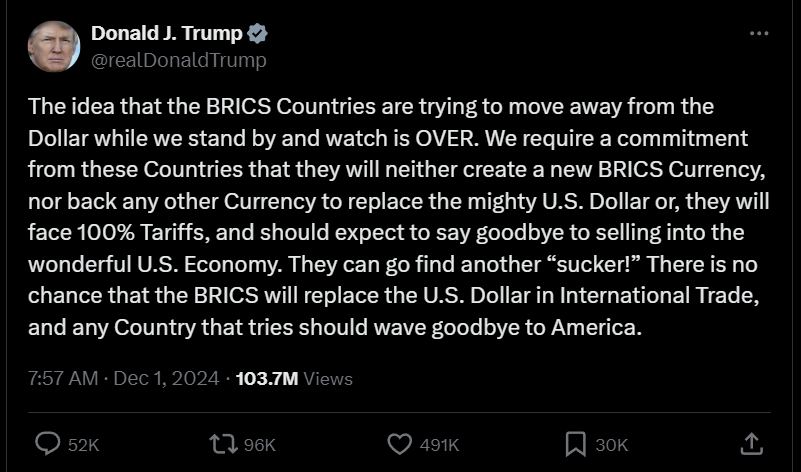
Image source: @realDonaldTrump
On December 1, 2024, Trump said on social media platform X that the era of BRICS countries trying to break away from the US dollar is over. He asked these countries to promise not to create a new BRICS currency or support any other currency that might replace the US dollar. currency, or face a 100% tariff and loss of access to the U.S. market.
Today, Trump seems to be holding on to the dominant position of the US dollar with his left hand and refusing to compromise, while holding on to Bitcoin, the strongest weapon to combat the lack of trust in national legal currencies, with his right hand. This is consolidating the US dollar's international settlement rights and pricing power in the crypto market in both directions.
3. The long-short battle between MicroStrategy and Citron Capital
During the U.S. stock trading session on November 21, Citron Research, a well-known short-selling institution, released a message on the social platform X, stating that it planned to short the "Bitcoin-heavy stock" MicroStrategy (MSTR). This news caused MicroStrategy's stock price to fall sharply, once from The intraday high has retreated by more than 21%.
The next day, MicroStrategy Executive Chairman Michael Saylor responded in an interview with CNBC that the company not only relies on Bitcoin's volatile trading to make profits, but also leverages its investment in Bitcoin through the ATM mechanism. Therefore, as long as the price of Bitcoin continues to rise, the company will Can maintain profitability.
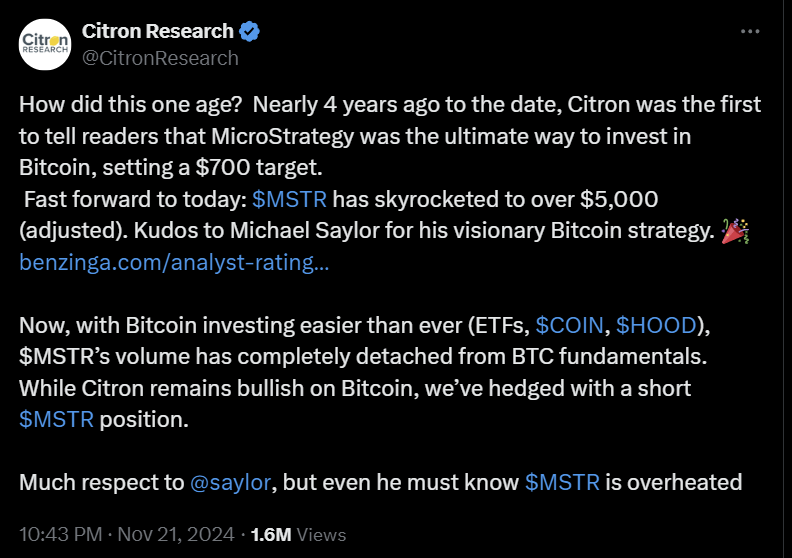
Image source: @CitronResearch
In general, MicroStrategy (MSTR)'s stock premium and its strategy of achieving profitability through the ATM (At The Market) mechanism, leverage in Bitcoin investment, and the views of short-selling institutions on this can be summarized as follows:
Sources of stock premium:
Most of MSTR's premium comes from the ATM mechanism. Citron Research believes that MSTR's stock has become an alternative investment to Bitcoin, and its stock price has an unreasonable premium compared to Bitcoin, so it decided to short MSTR. However, Michael Saylor refuted this view, arguing that the short sellers ignored MSTR's important profit model.
MicroStrategy’s leverage:
Leverage and Bitcoin Investment: Saylor pointed out that MSTR invests in Bitcoin through debt issuance and financing, relying on the volatility of Bitcoin to make profits. The company raises funds flexibly through the ATM mechanism to avoid the discounted issuance in traditional financing, while taking advantage of high Trading volume is used to achieve large-scale stock sales and obtain arbitrage opportunities for stock premiums.
Advantages of ATM mechanism:
The ATM model allows MSTR to raise funds flexibly and transfer the volatility, risk, and performance of debt to common stock. By doing so, the company is able to earn returns far higher than the cost of borrowing and the appreciation of Bitcoin. For example, Saylor pointed out that By financing an investment in Bitcoin at an interest rate of 6%, if Bitcoin rises by 30%, the company's actual return will be about 80%.
Specific profit cases:
By issuing $3 billion in convertible bonds, the company expects to achieve earnings per share of $125 within 10 years. If the price of Bitcoin continues to rise, Saylor predicts that the company's long-term benefits will be very substantial. For example, two weeks ago MSTR raised funds through the ATM mechanism $4.6 billion, trading at a 70% premium, earning $3 billion in Bitcoin in five days, equivalent to $12.5 per share, and long-term gains are expected to reach $33.6 billion.
Risk of Bitcoin falling:
Saylor believes that buying MSTR stock means that investors have accepted the risk of a fall in the price of Bitcoin. If you want to get a high return, you must take the corresponding risk. He expects Bitcoin to rise 29% per year in the future, and MSTR's stock price will rise by 29%. Up 60% every year.
MSTR's market performance:
So far this year, MSTR's stock price has risen 516%, far exceeding Bitcoin's 132% increase over the same period, and even exceeding AI leader Nvidia's 195% increase. Saylor believes that MSTR has become one of the fastest growing and most profitable companies in the United States.
Regarding Citron’s short selling, MSTR CEO said that Citron does not understand where MSTR’s premium over Bitcoin comes from and explained:
“If we invest in Bitcoin with funding at 6% interest, when the price of Bitcoin rises by 30%, we actually get an 80% spread in the price of Bitcoin (a function of the equity premium, conversion premium, and Bitcoin premium). ”
“The company issued $3 billion in convertible bonds. Based on an 80% Bitcoin price difference, this $3 billion investment can generate $125 per share in earnings within 10 years.”
This means that as long as the price of Bitcoin keeps rising, the company will continue to make money:
“Two weeks ago, we did $4.6 billion in ATM and traded at a 70% spread, which means we made $3 billion in Bitcoin in five days. That’s about $12.50 per share. If you calculate it over 10 years, , earnings would be $33.6 billion, or about $150 per share.”
In summary, MicroStrategy's operating model achieves efficient arbitrage among stocks, bonds, and currencies through the design of capital structure, and highly binds its stocks to the rise and fall of Bitcoin prices to ensure the company's Profits can be made at low risk in the long term. However, the essence of micro-strategy is to issue unlimited bonds with assets and raise its own value with unlimited leverage, which requires a long-term Bitcoin bull market to maintain its own value. However, there is no doubt that Citron shorted micro- The odds of this strategy are far greater than those of shorting Bitcoin, so MicroStrategy is also confident that the future price trend of Bitcoin will be a slow rise without major fluctuations.
IV. Summary
Image source: Tradesanta
The United States is constantly strengthening its control rights in the crypto industry, and market opportunities are constantly shifting to centralization. The decentralized crypto utopia world is gradually compromising with centralization and "handing over" its rights. The continuous influx of funds into ETFs is just a pain-relieving capsule that cannot cure the disease.
In the long run, Bitcoin through ETF is not good. There is a huge gap between the trading volume of Hong Kong Bitcoin ETF and that of the United States Bitcoin ETF. Judging from the circulation volume of capital, US capital is gradually engulfing the crypto market. Even though China is an absolute leader in the mining field, it is still at a disadvantage in terms of capital markets and policy orientation. Perhaps the long-term impact of Bitcoin ETFs in the future will accelerate the normalization of crypto asset transactions. This is the beginning and also the end. The end.
References:
Fu Peng: Let’s talk about the SEC and Bitcoin ETF-black and white centralization