Author: Nancy, PANews
As the first modular blockchain, Celestia once shone brightly, especially the large-scale airdrop after its launch, which ignited the enthusiasm of the entire track. However, a recent long post revealed the controversy of Celestia executives cashing out, profit transfer and public opinion manipulation, which made this star project fall into public doubt. Although its co-founder responded that these remarks were FUD, it is an undeniable fact that Celestia's ecological activity and token performance have both plummeted, the market enthusiasm has cooled sharply, and the modular narrative is facing severe tests.
Celestia responds to allegations of cashing out and manipulating public opinion, saying it has more than $100 million in cash reserves
On June 23, a long post published by Twitter user @0xCircusLover attracted widespread attention in the crypto community. Although these revelations have not been fully confirmed, they have pushed it to the forefront.

In terms of token unlocking and cashing out, @0xCircusLover pointed out that all C-level executives of Celestia completed token unlocking as early as early October 2024, and other team members unlocked and continued to sell tokens in late that month. Among them, co-founder Mustafa was accused of selling more than $25 million in tokens off-site and then moved to Dubai.
It is worth noting that in October 2024, Celestia's token TIA launched a large-scale token unlocking of up to $1 billion, accounting for about 80% of the circulation at the time, which once caused market panic. More controversially, the Celestia Foundation announced the completion of a $100 million financing on the eve of the unlocking, and its tokens also soared on the same day due to this good news. However, it was revealed that the financing was actually an over-the-counter sale completed with some institutions through OTC methods a few months ago, but it was repackaged as a financing announcement before the unlocking, and Celestia's trading intentions also aroused community doubts.
At the same time, the post also revealed the "gray area" that may exist in Celestia's marketing strategy. Among them, crypto KOL @ayyyeandy was accused of receiving large sums of money to support Celestia and even deeply involved in the project's marketing. @0xCircusLover said that specific evidence is yet to be made public. David Hoffman, co-founder of the media platform Bankless, also encountered doubts for frequently recommending TIA. @0xCircusLover pointed out that he was not an end user of the project, nor did he build any DA protocol, nor did he tweet about other alt-DAs so frequently, and there was also a contradictory statement of "whether to hold a position" that was inconsistent before and after.
In response to the doubts, David later publicly responded, "I first bought TIA on February 26, 2024, and disclosed the relevant holdings on the Bankless page; I sold this part of the assets on May 30, and updated the disclosure page accordingly. I or Bankless have never accepted any undisclosed consideration from the Celestia team."
In addition to the controversy over cashing out and publicity, the post further revealed Celestia's internal problems. Yaz Khoury, the former head of developer relations, was fired for "suspected sexual harassment" and has since left the crypto industry. @0xCircusLover claimed to have the victim's testimony and related evidence. Celestia was also accused of buying out its competitor Abstract for seven figures in US dollars, forcing it to give up cooperation with EigenLayer, which is also in the modular direction, thereby suppressing potential competitors.
Facing the storm of public opinion, Celestia co-founder Mustafa Al-Bassam recently responded that despite the current FUD, all Celestia founders, early employees, core engineers and about 50 employees are sticking to their posts, and their work enthusiasm is no different from when the project was founded five years ago. He said frankly that even if someone spreads ridiculous FUD remarks such as Celestia being the initiator of the 9/11 incident, he doesn't care. Mustafa said that he has been in the encryption field since 2010 and knows that the industry needs a strong heart and ability to withstand pressure to survive. After all, all tokens will experience a 95% drop in their life cycle.
At the same time, Mustafa emphasized, "We have more than $100 million in capital reserves, enough to support more than six years of operations, and we are ready for a protracted war."
Multiple data have fallen across the board. Has the modular narrative failed?
As the modular narrative craze gradually fades, Celestia is currently facing dual challenges in the market and technology.
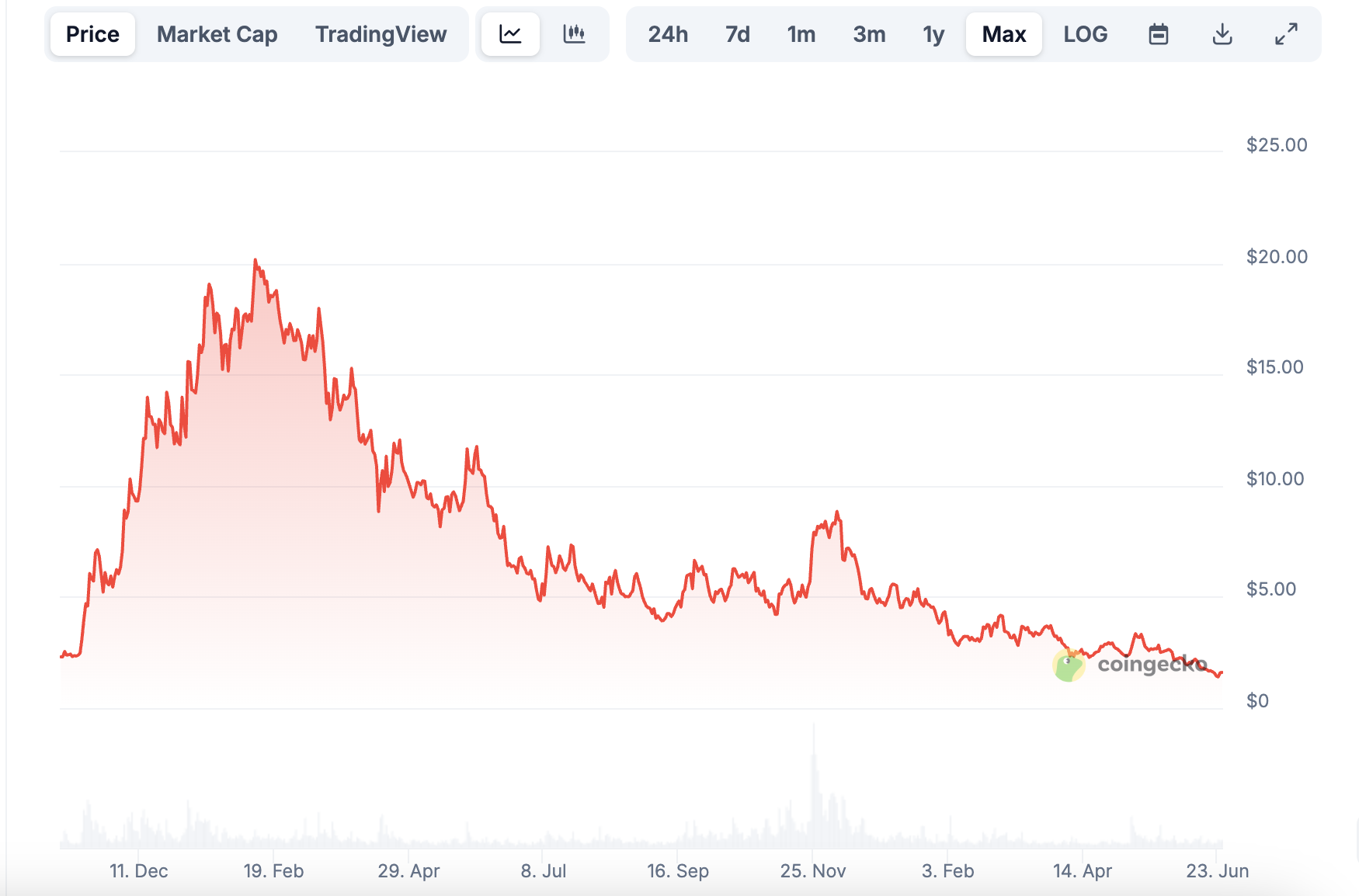
According to Coingecko data, as of June 24, the price of TIA has fallen to $1.56, a 91.75% drop from its historical peak of about $19.07. The market value has also fallen from more than $3.9 billion at its peak to about $1 billion, and market attention has cooled significantly.
On-chain activities also cooled down. Blockworks data shows that the actual use of Celestia has dropped significantly. Among them, the daily income was as high as 1.6 million US dollars during the hottest period of the modular concept, but as of June 22, the daily income dropped sharply to 99.7 US dollars, a drop of 99.9%; the number of transactions also dropped from a peak of 5.8 million to only tens of thousands per day, indicating that the activity of ecological users has dropped sharply; the amount of data transmitted to Blobs has dropped sharply from a peak of 279,934 MB to 21,135 MB, and the core usage of the DA layer has shrunk; in addition, the scale of TIA pledge has also dropped from tens of billions of US dollars to more than one billion US dollars, and the enthusiasm for capital lock-up has weakened, which may be closely related to the fluctuation of token prices and the decline in investor confidence.
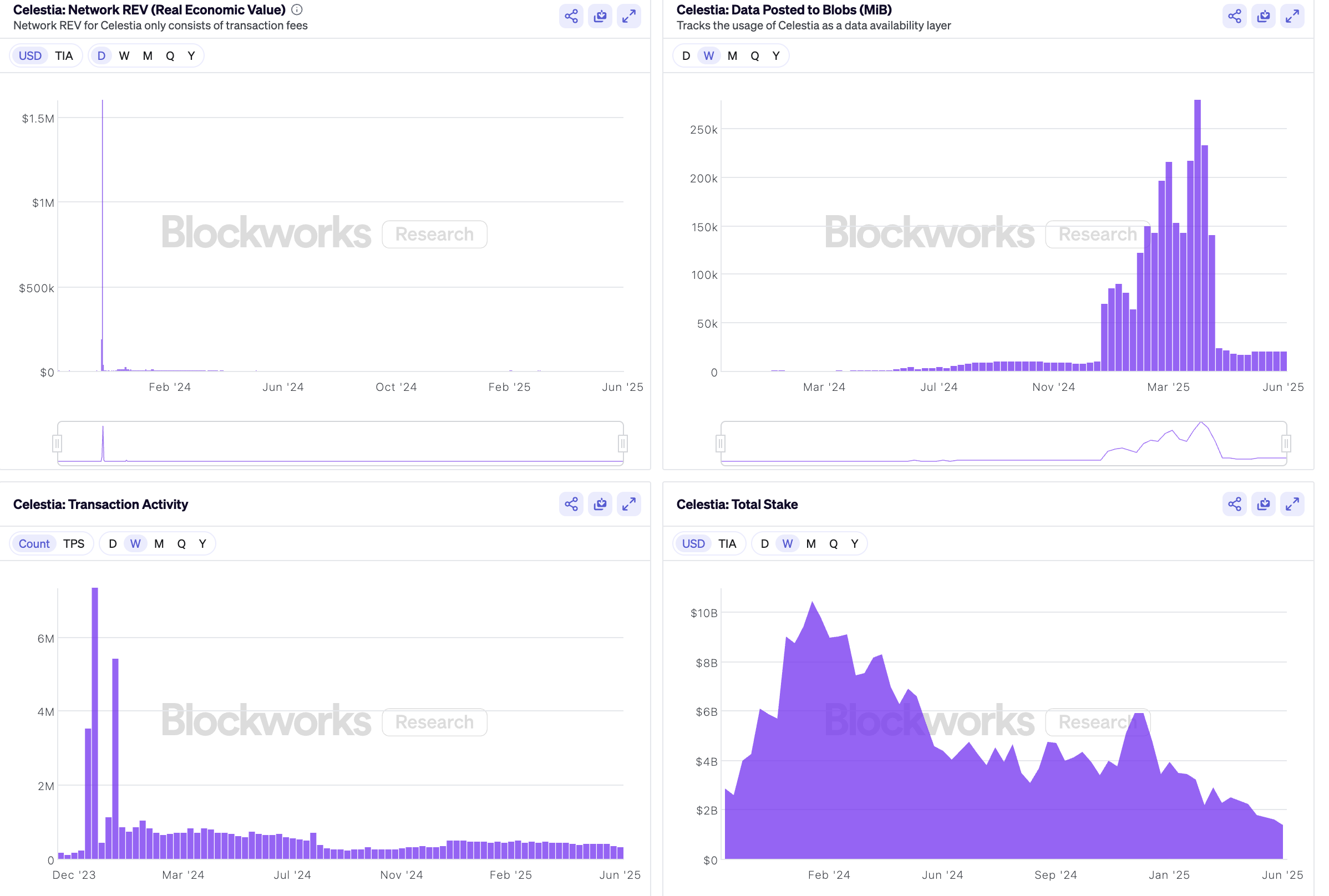
These data not only confirm the cyclical cooling of the modular narrative, but also reveal the bottlenecks of projects like Celestia in implementing actual use cases.
Of course, Celestia is not lying flat. Despite the sluggish market performance, Celestia has still made progress in technology research and development and ecological development in recent months.
For example, in terms of technology, in April this year, Celestia released the mamo-1 public test network, with a block size of 128MB, 16 times the existing main network's 8MB block, and supports 21.33MB of unlicensed data throughput per second. The test network consists of 21 verification nodes distributed in Amsterdam, Paris and Warsaw, simulating the real-world network environment.
In terms of governance, in June, Celestia co-founder John Adler proposed to use Proof-of-Governance (PoG) as the ultimate solution for liquidity pledge tokens (LSTs). The proposal intends to significantly reduce the proportion of unnecessary token issuance in the Celestia protocol from 5% to 0.25%, fundamentally alleviating inflationary pressure. More importantly, the PoG solution will achieve seamless docking with LST while ensuring the security of the protocol, allowing TIA to be more conveniently used in Celestia's native DeFi ecosystem, improving the actual application scenarios and liquidity of tokens, and helping Celestia accumulate value through revenue (REV) and fees.
In terms of ecology, in April, Ethena and Securitize jointly built the Converge chain, and Celestia became its data availability layer; VanEck launched a new exchange-traded product tracking TIA on Euronext Amsterdam and Euronext Paris; in May, Celestia announced the integration of Hyperlane as its native interoperability solution; TIA was launched on the Korean exchange Upbit, etc.
Celestia's current predicament is actually the real state of most current crypto projects after experiencing a narrative boom. After the "storytelling" stage, the market begins to return to rationality, and only products that are truly used and verified have the ability to cross cycles.