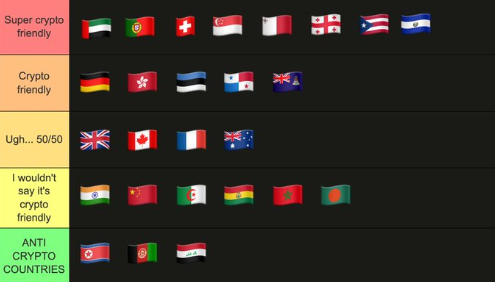
α. Top Tier Countries
🇦🇪 United Arab Emirates/Dubai
Taxation: Personal crypto assets have long been tax-free, and value-added tax has also been exempted since 2018; commercial mining is only levied 5%.
**Regulation: **Three major regulatory frameworks: VARA, ADGM, and DIFC, 650+ licensed crypto companies, and plans to launch a national stablecoin anchored to the dirham in 2025.
**Supporting:** Real estate, airlines and even land offices accept crypto payments. DMCC and DIFC can speed up the issuance of licenses and support foreign holders to open bank accounts.
🇵🇹 Portugal
Taxation: Tax-free for holdings exceeding 365 days, short-term and commercial crypto income is subject to a maximum tax of 28%.
Regulation: MiCA regulations provide clear guidance, and the CASP local license is expected to take effect in 2026.
Ecosystem: Lisbon is a hub for Web3 startups and digital nomads in Europe.
🇨🇭 Switzerland (Zug “Crypto Valley”)
Taxation: Personal crypto income is tax-free in most states, but professional mining and staking are subject to 0–40% tax.
Regulation: FINMA establishes a DLT framework and the law recognizes crypto assets as property.
Supporting facilities: Banks accept custody, 1,100+ blockchain companies have landed, and stability and compliance are extremely strong.
🇸🇬 Singapore
Taxation: There is no capital gains tax for individuals, but companies are subject to corporate tax.
*Regulation: MAS’s supervision is strict but clear, promoting stablecoins, asset tokenization and payment innovation.
Ecosystem: With global exchange headquarters and R&D established, the Asian crypto-financial ecosystem is steadily taking shape.
🇲🇹 Malta
Taxation: Personal tax exemption, corporate tax can be reduced to 5-12% through the VFA Act.
Regulation: The first country in Europe to establish ICO regulations, with a large number of licensed exchanges and custodians.
🇬🇪 Georgia
Taxation: Personal crypto is tax-free, corporate tax is 15%.
Ecosystem: Mining-friendly, low-cost, and open-policy, it is a safe haven for emerging Web3 entrepreneurs.
🇵🇷 Puerto Rico (U.S. territory)
Taxation: U.S. citizens can enjoy 0 capital gains tax under Act 60, but they must meet the immigration and residence requirements.
Ecosystem: It has the U.S. banking system and can legally avoid taxes in the U.S., but IRS scrutiny will become stricter starting in 2024.
β. Neutral-Friendly
🇩🇪 Germany
Taxation: Tax-free for holdings over 1 year, and also tax-free for short-term holdings ≤ €1,000. A 14–45% tax is levied on the amount exceeding this.
Regulation: BaFin issues licenses under the MiCA framework. Suitable for long-term holders and institutional investors.
🇭🇰 Hong Kong
Taxation: There is no capital gains tax for individuals, but business crypto income is subject to tax.
Regulation: SFC stablecoin license is coming soon. Tradable ETF is a bridge between Eastern and Western crypto capital.
🇪🇪 Estonia
Taxation: Crypto assets are subject to capital gains tax, and the corporate tax system is relatively simple.
Ecosystem: The e-residency system attracts global entrepreneurs, and the financial system is prudent but unfriendly.
🇵🇦 Panama
Taxation: Capital gains are theoretically tax-free, but enforcement is vague.
Ecosystem: The dollarized economy + encrypted remittance scenario has potential, but compliance and infrastructure are weak.
🇰🇾 Cayman Islands
Taxation: 0 capital gains tax, attracting global hedge funds and crypto VCs.
Disadvantages: High cost of living, suitable for high net worth individuals.
γ. Countries with strict regulation/poor experience (50/50 Countries)
🇬🇧 United Kingdom: Strict KYC, high risk of P2P transactions being blocked by banks.
🇨🇦 Canada: Regulation varies from province to province, and banks often restrict crypto-related accounts.
🇫🇷 France: Full implementation of MiCA, high compliance costs.
🇦🇺 Australia: Crypto assets are taxed the same as other assets, and supervision is becoming stricter.
Note: The above countries have a good foundation of Web3 talent and capital, but their policies are complex and not suitable for users who pursue freedom and asset confidentiality.
δ. Extremely Unfriendly Countries (Crypto-Hostile)
🇮🇳 India: A fixed 30% crypto income tax + 1% TDS for each transaction is levied, and the transaction cost is extremely high.
🇨🇳 China: A complete ban on crypto trading and mining, only allowing the use of national CBDC.
🇩🇿 🇧🇴 🇧🇩, etc.: Crypto is completely illegal, and trading/holding it is a criminal risk.
🇲🇦 Morocco: Still officially banned, but regulatory reforms are being considered.
ε. Extremely Anti-Crypto Countries (Total Ban Zones)
🇰🇵 North Korea: Banned for civilians, but government engages in black market crypto trading.
🇦🇫 Afghanistan: Taliban government shuts down all exchanges.
🇮🇶 Iraq: The Central Bank has issued a ban on cryptocurrency transactions and platforms.
Conclusion:
The bull market is about to end in 2025. If you have achieved financial freedom, now is the golden window to choose "global identity + asset security + tax structure" for the next decade.
Choosing a crypto-friendly country that suits you is not just about tax avoidance, but also a core step to protect you from being backlashed by the system and to make your assets "permanently free."