Preface
Recently, three major parallel EVM projects have launched their testnets simultaneously: Monad on February 19, MegaETH on March 21, and Pharos on March 24. After AI Agent, the main narrative of Web3 technology seems to have returned to parallel EVM, the hottest narrative in early 2024.

EVM (Ethereum Virtual Machine) is the core of Ethereum, responsible for running smart contracts and processing transactions. EVM is a computing engine that provides abstractions for computing and storage, but EVM has no scheduling function. Ethereum's execution module takes out transactions one by one from the block, and EVM is responsible for executing them in sequence. Although sequential execution ensures that transactions and smart contracts can be executed in a deterministic order and guarantees security, it may cause network congestion and delays when facing high loads.
Parallel EVM greatly improves the throughput of the network by allowing multiple operations to be executed simultaneously, thereby enhancing the performance and scalability of the entire blockchain. In fact, what we refer to as parallel EVM is actually a high-performance EVM-compatible blockchain, which not only introduces parallel execution, but also has comprehensive upgrades from consensus, transactions, pipelines, storage to hardware acceleration. The purpose is to enable the blockchain network to process more transactions in a shorter time, effectively solving the network congestion and delay problems of traditional blockchains.
This article will take a deep dive into the background and architecture of the three projects: Monad, MegaETH, and Pharos, as well as the trade-offs that developers have chosen.
Monad
Monad is a high-performance EVM-compatible Layer1 blockchain developed by Monad Labs. Monad improves the scalability of the system while maintaining decentralization, solving the low throughput problem of existing EVM-compatible blockchains.
Monad Labs was co-founded in 2022 by Keone Hon, James Hunsaker, and Eunice Giarta, of which Keone and James are former employees of market making giant Jump Trading, and Eunice comes from a non-Crypto background.
In February 2023, Monad Labs completed a seed round of financing of $19 million, led by Dragonfly; in April 2024, Monad Labs completed a new round of financing of $225 million, led by Paradigm. Monad is currently valued at $3 billion.
The key advantage of Monad is that it can handle up to 10,000 transactions per second with a 1 second block time. This is mainly due to optimizations in the following four areas:
MonadBFT: A high-performance consensus mechanism based on an improved version of HotStuff. Used to achieve consistency in transaction ordering under partial synchronization conditions in the presence of Byzantine actors. First, MonadBFT uses a two-stage BFT algorithm with optimistic responsiveness, linear communication overhead in common cases, and quadratic communication overhead in timeout cases; second, MonadBFT uses a hybrid signature scheme, the integrity and authenticity of the message are provided by ECDSA signatures, and the aggregatable message types (voting and timeout) are provided by BLS signatures, which solves the scalability problem; and, in Monad, nodes do not maintain a global transaction pool, but a local transaction pool, and transactions are forwarded by RPC nodes to several subsequent leader nodes, thereby effectively reducing bandwidth usage and transaction delays; finally, MonadBFT's message propagation also uses the RaptorCast protocol, which not only converts block proposals into erasure code blocks, but also sends each block to all validators through a two-level broadcast tree. RaptorCast uses the entire upload bandwidth of the entire network to propagate block proposals to all validators while retaining Byzantine fault tolerance. Due to these characteristics, MonadBFT can achieve efficient and robust blockchain consensus;
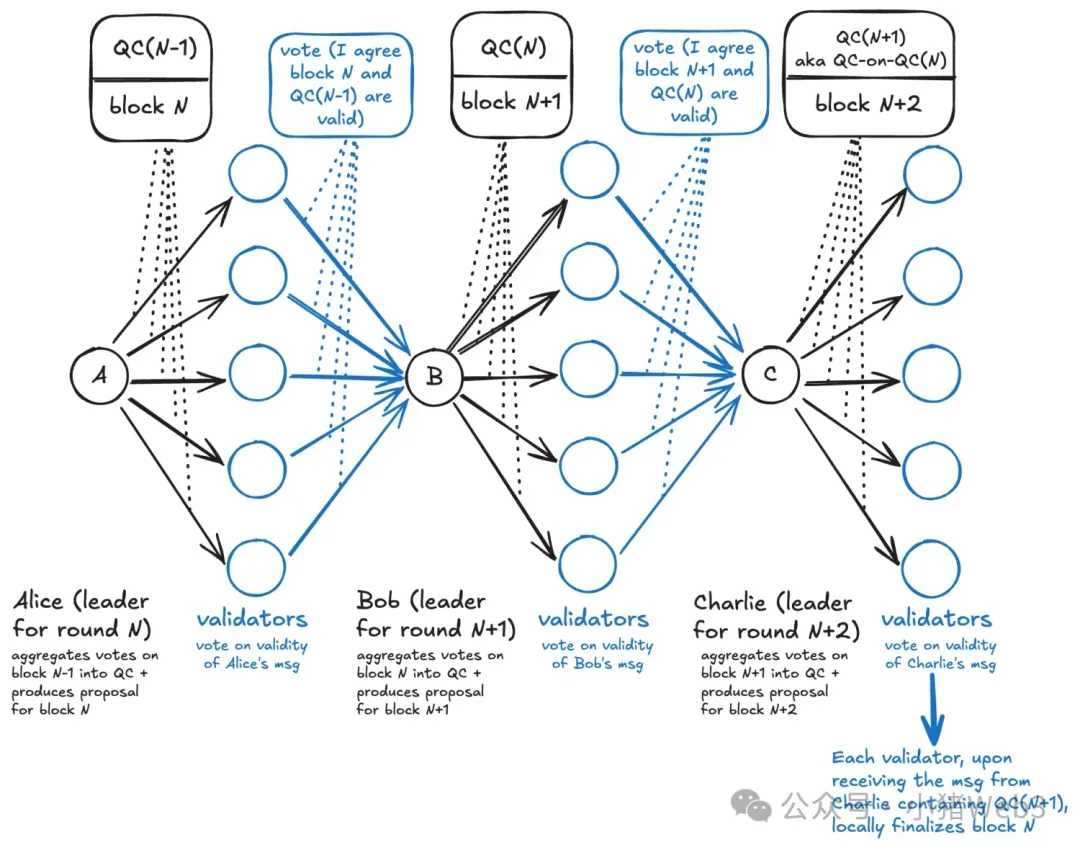
Asynchronous execution: Asynchronous execution allows Monad to significantly increase execution throughput by separating consensus from execution. Separating consensus from execution allows Monad to significantly increase the execution budget because execution changes from taking up a small portion of the block time to taking up the entire block time. First, Monad block proposals do not include state roots. In order to prevent node forks, block proposals also include state roots from 3 blocks ago, allowing nodes to detect whether they have forked; second, the leader node builds blocks from a delayed state perspective. In order to defend against DDoS attacks, the Monad node verifies whether the balance of the account is sufficient to meet the highest debit in the user account associated with the ongoing transaction; finally, after the node receives the proposed block, although the block has not been finalized at this time, the node can still execute the proposed block locally during this period, but there is no guarantee that it will be voted or finalized. Due to these characteristics, Monad is allowed to achieve significant speed improvements, allowing a single-shard blockchain to scale to millions of users;
Parallel execution: Monad uses an optimistic execution approach, which starts executing subsequent transactions before earlier transactions in the block are completed, and the updated status of each transaction is merged in order. This sometimes leads to incorrect execution results. To solve this problem, Monad tracks the inputs used in the execution of transactions and compares them with the outputs of previous transactions. If there is a difference, it indicates that the transaction needs to be re-executed with the correct data. In addition, Monad uses a static code analyzer when executing transactions to predict dependencies between transactions to avoid invalid parallel execution. In the best case, Monad can predict many dependencies in advance; in the worst case, it falls back to a simple execution mode. Monad's parallel execution technology not only improves network efficiency and throughput, but also reduces transaction failures due to parallel execution by optimizing execution strategies;
MonadDB: MonadDB is a key component in Monad, used to provide high performance while maintaining full compatibility with Ethereum. MonadDB is a customized KV database designed to store verified blockchain data. First, MonadDB natively implements the Merkle Patricia Trie data structure on disk and in memory, and implements its own indexing system, eliminating file system dependencies, so that Merkle Patricia Trie nodes can be efficiently stored on disk; second, MonadDB uses asynchronous I/O, making full use of the latest kernel support for asynchronous I/O, avoiding the generation of a large number of kernel threads to handle pending I/O requests in an attempt to perform work asynchronously; finally, MonadDB also uses concurrency control, sequential writes, data compression and other technologies to further optimize the performance of MonadDB. Due to these characteristics, MonadDB reduces data access time, increases transaction processing speed, and thus improves the performance of the entire blockchain network.
MegaETH
MegaETH is the fastest Layer2 blockchain currently, developed by MegaLabs. MegaETH is unique in that it focuses on real-time blockchain performance, providing ultra-low latency and scalability for applications that require instant response.
MegaLabs was founded in early 2023. CEO Li Yilong holds a Ph.D. in computer science from Stanford University and has worked at software company Runtime Verification Inc.; CTO Yang Lei is a Ph.D. from MIT; CBO Kong Shuyao is the former global head of business development at Consensys; and growth director Namik Muduroglu has worked at Consensys and Hypersphere.
In June 2024, MegaLabs completed a seed round of financing of $20 million, led by Dragonfly; in December 2024, MegaLabs conducted a community round of financing on the Echo platform and completed the financing target of $10 million in 3 minutes. MegaETH is currently valued at over $200 million.
MegaETH has 100k TPS and a block time of about 10ms, and can achieve millisecond response time even under high load. This is mainly due to the following technical features:
Node specialization: MegaETH nodes of different roles have different functions and require different hardware configurations. There are three roles in MegaETH: The Sequencer is responsible for transaction sorting and execution. There is only one centralized node, which saves the consensus overhead. The Sequencer publishes the generated blocks, witness data and state differences to EigenDA (data availability layer) to ensure that these data are available in the network; Provers obtain blocks and witness data from the Sequencer and perform stateless verification through dedicated hardware, that is, blocks can be verified asynchronously and out of order without storing the entire blockchain state; Full nodes receive state differences from the Sequencer, update local states, and can verify the validity of blocks through the proof network to ensure the consistency and security of the blockchain;
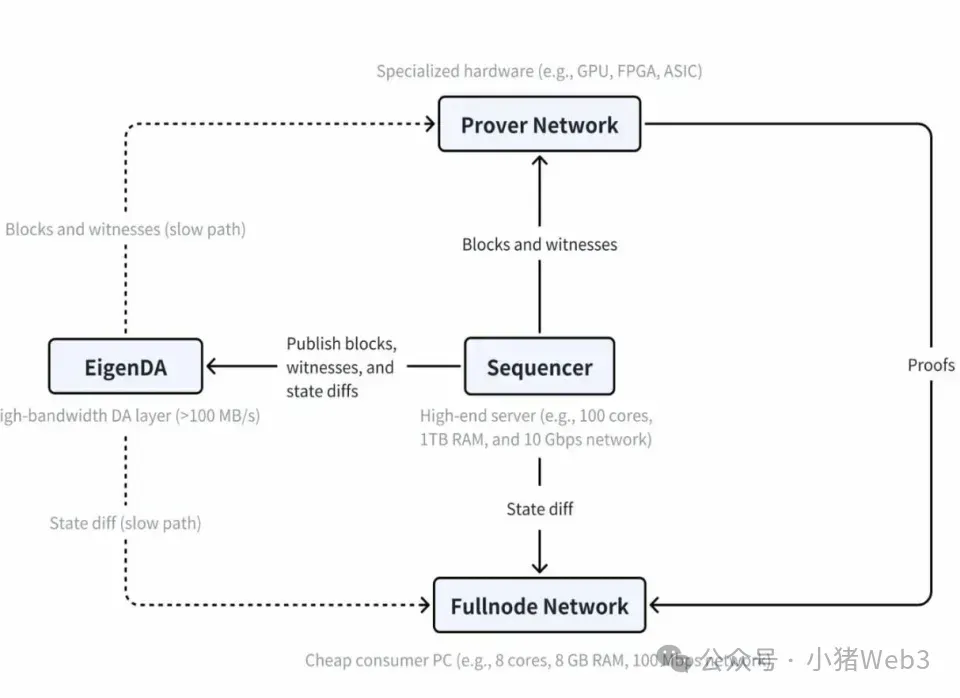
Targeted optimization: MegaETH "prescribes the right medicine" for various problems faced by traditional EVM blockchains. To address the problem of high latency in acquiring state data, MegaETH has designed a new state Trie with extremely high memory and I/O efficiency, which can be smoothly expanded to several TB of state data without incurring additional I/O costs; to address the problem of serial execution, MegaETH's sorter can adopt any parallel execution strategy; to address the problem of low interpreter efficiency, MegaETH uses a JIT compiler to eliminate interpretation overhead, bringing performance close to bare metal execution to computationally intensive Dapps; to address the problem of excessive state synchronization bandwidth, MegaETH has designed an efficient state difference encoding and transmission method that can synchronize a large number of state updates under limited bandwidth. At the same time, MegaETH can synchronize state updates of complex transactions within bandwidth constraints by using advanced compression technology;
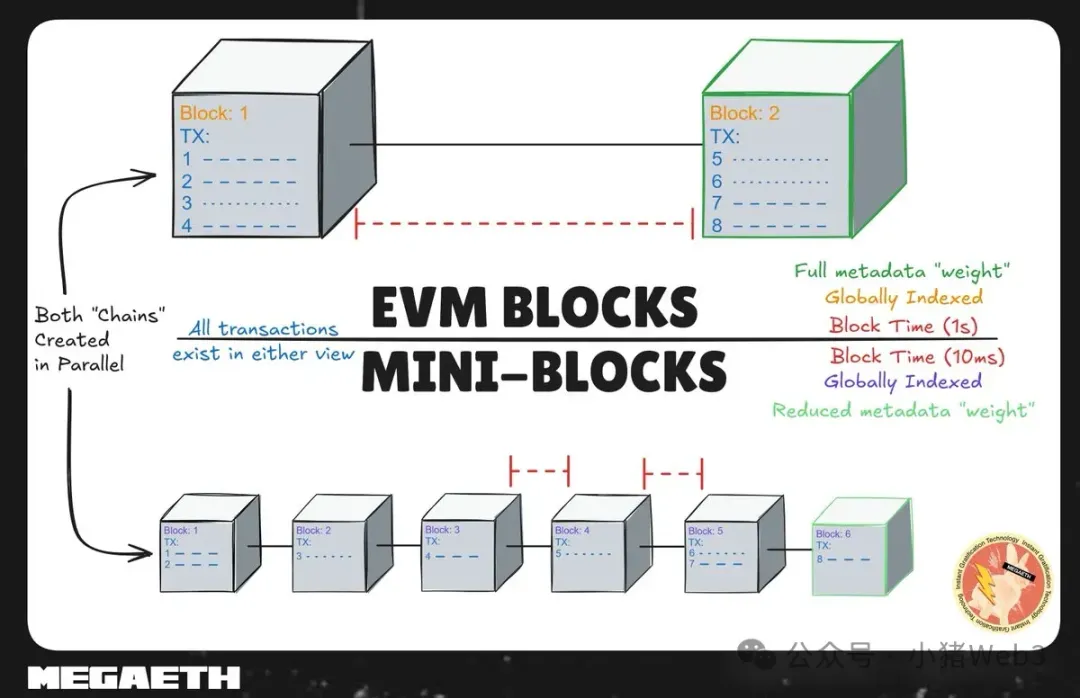
Mini Blocks: MegaETH performs a pre-confirmation every 10 milliseconds, called Mini Blocks. The block header of the standard EVM Blocks takes up a considerable amount of space (500+ bytes), and the calculation of the three Merkle Roots is also quite time-consuming, so using the standard EVM Block will impose a huge burden on the light client. MegaETH's Mini Blocks are generated in parallel with EVM Blocks and provide the same inclusion guarantee, but greatly shorten the interval for propagation to the rest of the network. The light client uses MegaETH's unique Realtime API to obtain transactions that are already in Mini Blocks but not yet in EVM Blocks.
Pharos
Pharos is positioned as a high-performance EVM-compatible Layer1 blockchain, committed to creating the best RWA and Payment ecosystem. Pharos has an ultra-high performance of processing 50,000 transactions per second and consuming 2 billion units of gas (2 gigagas) per second.

Pharos was founded in 2024. CEO Alex Zhang was formerly CTO of Ant Chain and later CEO of Ant Chain's Web3 brand ZAN; CTO Wishlonger was formerly CSO of Ant Chain; CMO Laura was responsible for marketing at Solana Labs and successfully sold out the first generation of Solana mobile phone Saga; COO Sally worked at OKX; CCO Matthew led ecosystem building and business development at Stellar and Ripple.
In November 2024, Pharos completed a seed round of financing of US$8 million, led by Lightspeed Faction and Hack VC.
The "Degree of Parallelization (DP)" framework proposed by Pharos divides blockchain parallelization capabilities into six levels (DP0-DP5). Ethereum is DP0, with no parallelization at all, while from DP1 to DP5, improved consensus mechanisms, parallel transactions, pipelining, parallel Merkelization and accelerated state access and parallel heterogeneous computing are implemented respectively.
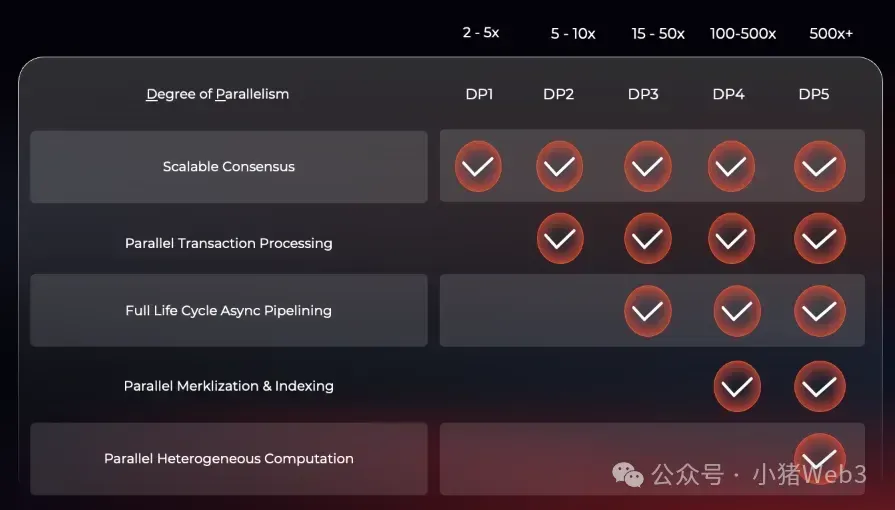
Pharos adopts the DP5 full-stack parallel architecture, which is fully upgraded from consensus, transaction, pipeline, storage to hardware acceleration:
Scalable consensus protocol: A high-throughput, low-latency BFT consensus protocol that fully utilizes the entire network resources;
Dual virtual machine parallel execution: a parallel EVM and WASM execution layer, using advanced compilation technology;
Full lifecycle asynchronous pipeline: parallel and asynchronous processing is achieved through the entire life cycle of each transaction and between blocks;
High-performance storage with Authenticated Data Structure (ADS): Provides excellent throughput, low-latency I/O, and cost-effective state storage, securely scaling to billions of accounts;
Modular Special Processing Network (SPN): Enables seamless integration of new software, hardware, and geographic dispersion to support a variety of use cases and emerging technologies.
Summarize
Thanks to Ethereum's long-term and sufficient user education, EVM has the most developers and the largest DApp ecosystem in the Web3 world, and has almost become a Javascript-like existence in the Web2 world. However, Ethereum's scalability problem has seriously hindered the further development of EVM, so parallel EVM has become one of the most important technical directions.
Monad strikes a balance between scalability and decentralization through its parallel execution model, providing developers with 10,000 TPS throughput without compromising EVM compatibility. Its independent consensus provides autonomy but sacrifices Ethereum’s security guarantees, which may hinder developers who prioritize trust and shared security.
MegaETH is undoubtedly the best in terms of latency and throughput (TPS), with ultra-low latency of 10 milliseconds and a throughput of 100,000 TPS. It is suitable for applications that require near-instant responses, such as GameFi, SocialFi, and high-frequency trading scenarios, but due to its centralized sorter design, it may raise questions about decentralization.
Pharos has a transaction processing capacity of up to 50K TPS and 2 gGas/s, and its performance is comparable to emerging high-performance EVM blockchains such as Monad and MegaETH. At the same time, Pharos' "Ant Gene" focuses on RWA-Fi, which is compliant with institutional clients and requirements, and can truly meet the future market's demand for compliant and efficient blockchain infrastructure.
From the public data, the performance of MegaETH and Pharos is much better than Monad, but considering that Monad has the largest financing and sufficient development resources to make breakthroughs, there is no absolute leader in the competition between Monad, MegaETH and Pharos, leaving developers with more trade-offs in terms of performance, decentralization or specialization priority.