
Author: Martin
> Behind the myth of digital gold’s scarcity lies countless wealth that can never be awakened
In the cold winter of 2017, British programmer James Howells knelt on the edge of the Newport landfill, trying to convince the city government to allow him to dig out an accidentally discarded hard drive - which contained the private keys to 7,500 bitcoins. At the time, the price of Bitcoin was about $19,000, and this wealth was worth $140 million. However, the city government rejected his request on the grounds of "damage to the environment."

Eight years later, with Bitcoin breaking through $100,000, the asset has swelled to $850 million, but the hard drive is still rotting under hundreds of thousands of tons of garbage. Howells' tragedy is not an isolated case:
• An American programmer forgot the password to $200 million worth of Bitcoin and only had two trial and error attempts left;
• Early miners lost 5,000 bitcoins mined in 2009 due to hard drive damage;
• Of the 850,000 bitcoins stolen from the Mt. Gox exchange, 650,000 are still missing.
In the early summer of 2025, a Bitcoin wallet that had been dormant for 15 years suddenly revived and transferred $50 million worth of Bitcoin to a trading platform. The reappearance of this wallet, which had been dormant since 2010, caused quite a stir in the blockchain world.
However, such "resurrection" is only a rare case. According to research by blockchain analysis company Chainalysis, the vast majority of long-dormant Bitcoin wallets will remain dormant forever, their private keys have long been forgotten or destroyed, and the Bitcoins inside have become digital treasure chests that cannot be opened on the blockchain.
1. Disappearing Bitcoin: Shocking Data
As of August 2025, how much of the maximum supply of Bitcoin, 21 million, has been permanently lost?

1. Core data scope
• 2.87 million–3.79 million (17%–23% of mined supply)
Based on Chainalysis' research in July 2025, this data was obtained through analysis of blockchain transaction activity, coin age, and address dormancy, covering scenarios such as early mining losses and forgotten private keys.
• 2.3 million–3.2 million (11%–15% of total supply)
Another online study broke down the losses into three categories: Satoshi Nakamoto coins (1.1 million), addresses that have not been moved for more than seven years (1.8 million to 2.4 million), and coins mistakenly sent to black hole addresses (about 100,000).
•Over 6 million (over 30% of mined tokens)
Cane Island's June 2025 report stated that if the loss of private keys, hardware damage and lack of heirs are taken into account, the amount of losses may be higher, and it is predicted that the number of losses will exceed 7 million in September 2025.
2. Impact of actual circulation volume
• Mined: 19.88 million (94.66%)
• Remaining unmined amount: 1.12 million (5.34%)
• Permanently lost: 2.87 million to 3.79 million (17%-23% of circulating supply)
• Actual circulation: only 16 million to 17 million
More than 6 million bitcoins are either permanently lost or highly illiquid, meaning nearly a third of the bitcoin supply has effectively withdrawn from circulation, new research shows.
2. Why did Bitcoin "disappear"?
The essence of losing Bitcoin is the permanent loss of access to the private key. Unlike traditional bank accounts where passwords can be retrieved through identity verification, the decentralized nature of Bitcoin determines that if the private key is lost, the funds are lost forever.

1. Early adopters became the hardest hit (2009-2013):
• At the time, Bitcoin was worth very little (less than one cent per BTC), and users lacked awareness of safe storage.
•Storing private keys in volatile media such as text files or emails
• The device is scrapped or the paper wallet is discarded
•Famous case: James Howells accidentally discarded a hard drive containing the private keys to 8,000 Bitcoins, now worth nearly $900 million
2. Modern loss cases still exist:
• Hardware wallet failure and no backup
• Mistakenly sending assets to the wrong chain (e.g. BTC to ETH address)
• Lack of private key inheritance planning, no one knows after the holder passes away
3. Classification of loss reasons
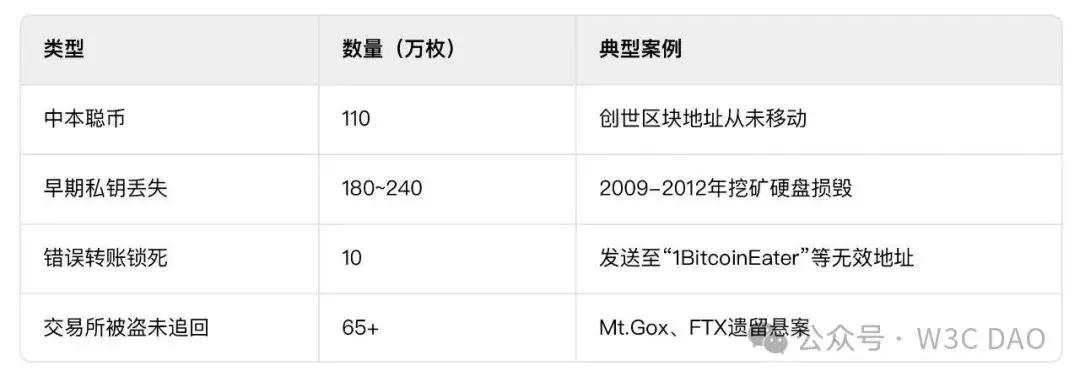
4. The Sleeping Whale Wallet
About 1.75 million wallets that have been inactive for ten years hold 1.79 million bitcoins (worth over $121 billion), of which 99% have a balance of less than 50 bitcoins, most of which were forgotten by early users.
The status of Bitcoin's anonymous founder, Satoshi Nakamoto, remains one of the most fascinating mysteries in the crypto world. It is estimated that Nakamoto earned around 1.1 million Bitcoins through mining in the early days of the Bitcoin network.
These bitcoins have not been moved since 2010, creating the longest dormant record in blockchain history. It is generally believed in the industry that these bitcoins may have been lost forever - whether due to accidental loss of private keys or intentional sealing by the founder.
At current prices, this wealth is worth more than $120 billion. If even a small portion of Satoshi Nakamoto's Bitcoin is transferred one day, the entire cryptocurrency market will experience an earthquake.
3. Halving Effect: Scarcity Upgrades
In May 2024, Bitcoin successfully completed its fourth block reward halving, and the miner block reward was reduced from 6.25 BTC to 3.125. This mechanism reduced Bitcoin's annual inflation rate from approximately 1.7% to 0.85%, officially entering a new cycle of greater scarcity.

After the halving, only 450 new bitcoins are created daily, making it as scarce as gold. Meanwhile, although the “loss rate” of bitcoins has decreased, it still persists:
• Modern wallet technology has improved significantly since the early high loss rates (2009-2013)
• Human error is still inevitable: loss of private keys, forgotten backups, hardware failures, etc.
• Intergenerational inheritance issues emerge: the death of early holders causes some Bitcoin to be permanently "sunk"
Historical data shows that the first three halvings (2012, 2016 and 2020) were all accompanied by significant price increase cycles, and increased scarcity is the core support for Bitcoin's value storage properties.
Bitcoin’s “absolute scarcity” is thus reinforced:
1. Stock-to-flow (S2F) ratio surges
The amount lost is equivalent to three halving effects: if calculated based on the loss of 3.79 million coins, the actual scarcity is 22.7% higher than the theoretical value.
2. Opportunities of On-Chain Data “Distortion”
Traditional analysis models have become ineffective due to the large number of dormant coins, but new tools such as the 2-year rolling MVRV-Z score more accurately capture active supply fluctuations. In 2025, this indicator showed that the scarcity of the circulating supply reached a historical peak.
3. The Ultimate Logic of Digital Gold
Compared to gold's 2% annual supply growth, Bitcoin has effectively entered a deflationary phase due to losses. A Bitwise report indicates that by 2025, institutions will be vying not just for Bitcoin but for "the irreplaceable blockchain genesis block assets."
4. The collision of new ecology and scarcity
Innovations in the Bitcoin ecosystem are also reshaping its scarcity characteristics. The BRC-20 token standard that emerged in 2023 is based on Bitcoin ordinal technology and allows data to be burned on a single "satoshi" (the smallest unit of Bitcoin) to create a unique digital asset.

The impact of this innovation was twofold:
• Positive side: Expands the concept of Bitcoin as “digital gold”, enables tokenization, and attracts a wider user base
• Challenges: Triggering a surge in Bitcoin network transactions, driving up transaction fees and intensifying competition for block space
The prosperity of BRC-20 further highlights the status of the Bitcoin mainnet as a scarce digital space. With the development of Bitcoin Layer 2 solutions (such as Lightning Network and Stacks), every byte on the main chain becomes more precious.
1. Scarcity: The cornerstone of Bitcoin’s value
The scarcity created by Bitcoin losses and halvings provides a solid foundation for its status as “digital gold”:
2. Permanent Supply Reduction:
• Lost Bitcoins are equivalent to permanent destruction, irreversibly reducing the total circulating supply
• Unlike HODLers who may sell in the future, lost Bitcoins never return to the market
3. Impact of market dynamics:
• Available supply decreases, driving up value even as demand stabilizes or grows
• Reduce market selling pressure and lower the risk of flash crashes caused by large-scale liquidations
4. Strengthening psychological value:
• Lost stories reinforce Bitcoin’s “digital treasure” narrative
• Investors assign a higher intrinsic value to accessible Bitcoin
Bitcoin’s scarcity is a core feature of its design, and lost Bitcoins have inadvertently amplified this feature, making Bitcoin even scarcer over time than its designers intended.
Sleeping wealth, flowing value
As of mid-2025, over 75% of the Bitcoin network supply is controlled by long-term holders (LTH), demonstrating a strong "hoarding" consensus. Combined with millions of permanently lost Bitcoins, the actual circulating supply is only a small fraction of the total.

Institutions such as BlackRock and Fidelity continue to increase their holdings through Bitcoin spot ETFs. These ETFs currently hold more than 1.36 million bitcoins. The influx of institutional funds has further tightened the available supply.
Although these dormant Bitcoin treasures are a huge loss for the original owners, they inadvertently strengthen the value proposition of the entire network. Every Bitcoin that is permanently lost increases the scarcity premium of existing Bitcoins. A story of eternal deflation is accidentally written into the Bitcoin code base.
As Bitcoin journeys toward full circulation in 2140, lost Bitcoins will become eternal digital monuments on the blockchain, silently telling a complex history of technological innovation and human negligence. Their existence reminds us that in the world of digital assets, safekeeping is not only a choice, but also a responsibility.