
Author:jiayi
When there is a real shift in the technological paradigm, we often see the craze first, not the system.
The same is true of the AI wave we are experiencing.
As a primary investor, I always believe that betting on the deepest transformative power of the industry is far more worthwhile than chasing superficial narratives.
In the past year, I have seen a lot of projects such as RWA, Consumer, infoFi, etc. They are undoubtedly exploring the intersection of the real world and the on-chain system.
But the trend is becoming increasingly clear: no matter which route the project takes, it will eventually enter the collaborative logic of AI and use AI to improve competitiveness and efficiency.
For example, RWA, thinking about how to use AI for risk control optimization, off-chain data verification and dynamic pricing is the future;
Or consumers or DeFi who are in urgent need of excellent user experience also need AI to complete user behavior prediction, strategy generation, incentive distribution, and other directions of the track. I will not go into details about this.
Therefore, whether it is asset digitization or experience optimization, these seemingly independent narratives will eventually converge on the same technical logic: if the infrastructure does not have the integration and carrying capabilities of AI, it will not be able to support the complex collaboration of the next generation of applications.
In my opinion, the future of AI is not as simple as "becoming stronger" and "being used more and more". The real paradigm change lies in the reconstruction of the collaborative logic.
Just like the early changes in the Internet, it was not because we invented DNS or browsers, but because it allowed everyone to participate in content creation and turn ideas into products for the first time, thus giving birth to an entire open ecosystem.
AI is also following this path: Agent will become everyone's intelligent co-creation body, helping you turn professional knowledge, creativity and tasks into automated productivity tools and even monetize them.
This is a very difficult question to answer in today’s Web2 world, and it also reflects some of the underlying logic behind my view on the AI+Web3 track: making AI collaborative, tradable, and profit-sharing is the only system that is truly worth building.
What I want to talk about today is Sahara, the only project that attempts to systematically build the underlying AI operation from a chain-level structure.

The essence of investment is worldview, identifying the value system of choice
My investment logic is not to add the narrative of the public chain to AI, and then see which team seems to have a better background and then bet.
Investing is essentially a choice of worldview, and I am always asking myself a core question: Can the future of AI be shared by more people?
Can it use blockchain to reconstruct the value attribution and distribution logic of AI, so that ordinary users, developers and other different roles have the opportunity to participate, contribute and continue to benefit? It's very simple. Only when this logic appears, I think this kind of project has the potential to become a disruptor, rather than "abandoning the public chain +1".
To find the answer, I basically scanned all the AI projects I could get my hands on until I came across Sahara. Tyler, the co-founder of Sahara, gave me the answer that we should build an open, participatory ecosystem that everyone can own and benefit from.
This sentence is simple, but it hits the soft spot of traditional public chains: they often serve developers in a one-way manner, and the token economic design is mostly limited to Gas Fee or governance. They can rarely truly support the positive cycle of the ecology, and it is even more difficult to support the sustainable development of an emerging track.
I know that this road is full of challenges, but that is precisely why it is a revolution that cannot be rejected - and why I am determined to invest.
As I emphasized in my previous article on the evolution from Web2 to Web3: the real paradigm shift is not about building a single product, but about building a supporting system. (Readers interested in this logic are welcome to check out that article.)
And Sahara was one of the most anticipated cases I predicted at the time.

From investment to 8 times valuation and heavy investment
If I initially invested in Sahara because it was doing exactly what I thought was the real leading mission of AI - building an AI economy and infrastructure system, then what made me rush to invest in Sahara at 8 times the previous round valuation in just half a year was that I felt a rare power in this team.
One of the two co-founders is the youngest tenured professor at USC, majoring in AI. I think the value of tenured professors born in the 1990s in American universities is not only in the academic field, but also in the fact that they still have dreams, energy and the courage to realize their dreams at this age. I have known Professor Ren for more than a year, and I have seen what a genius who can work more than ten hours a day, is emotionally stable and humble is.
Tyler, former investment director of BN Lab, is responsible for North American investment and incubators. Needless to say, he is familiar with web3. He is extremely self-disciplined: he only sleeps for multiples of 1.5 hours, and he insists on exercising to maintain his condition no matter how busy he is. He does not touch sugar to keep his mind clear, and works more than 13 hours a day. I once laughed and said that he was a robot, and he just responded lightly: "I am lucky to be busy today." His dopamine source is to promote the progress of the project every day. Dreaming is his passion, and he does not need other fuel.
I am very glad to have met them and changed myself. I finally started to sleep as regularly as possible, my mood gradually stabilized, and I started to exercise...
So when someone says that Sahara was favored by capital because of luck, I will add without hesitation that "the pursuit of capital is an inevitable result." I remember vividly that it was difficult to raise funds in the primary market, but Sahara was chased by the primary market for investment.
What everyone remembers is that Polychain, Binance, and Pentera invested in Sahara. Sahara opened the era of Samsung's investment in the field of Web3 AI. Its winning of the Samsung AI Award was an important reason for Samsung's investment. In addition, some funds with heavy AI positions, national banks, etc. are all guests of Sahara. What you can see is that a group of institutions that are more inclined to traditional technology and industrial resources have begun to quietly bet on AI × Web3 because of Sahara.
Capital will only pay for certain direction and execution - this is a positive feedback for Sahara's technical depth, team background, system design and execution capabilities.
This is why it can run some real and solid structural indicators:
More than 3.2 million accounts have been activated on the test network, and there are more than 200,000 data platform annotators (with millions in the queue). Their customers include leading companies such as Microsoft, Amazon, Character.AI, Motherson, and have achieved tens of millions of dollars in revenue.
In this infrastructure chain, at least from "who will do it" to "can it be done", Sahara has gone deeper and more steadily than 99% of "AI Narrative projects".

The ultimate goal of the public chain: to enable all contributors to continue to benefit and drive a positive economic cycle
Let’s go back to our original logic of judgment: In the system that combines AI and blockchain, is there really a mechanism that allows every contributor to be seen, recorded, and continuously rewarded?
Model training and data optimization cannot be separated from the support of a large amount of annotation and interaction; conversely, if there is a lack of user contribution, the project itself will have to invest more money to purchase data and outsource annotation, which not only increases costs but also weakens the value drive of community co-construction.
Sahara is one of the few Web3 AI projects that allows ordinary users to "participate in data construction from day one." Its data annotation task system is running every day, and a large number of community users are actively participating in annotation and prompt creation. This is not only helping to improve the system, but also investing in the future with data.
Through Sahara's mechanism, not only the quality of the model is improved, but more people are allowed to understand and participate in this decentralized AI ecosystem, linking data contribution with revenue to form a truly virtuous circle.
A typical example is the Myshell project on BNB Chain, which uses Sahara's decentralized data collection and human-machine collaborative annotation to quickly build a high-quality data set covering multiple languages and accents, greatly improving the training efficiency of its TTS and voice cloning models. This also promoted its open source projects such as VoiceClone and MeloTTS to obtain thousands of GitHub stars and more than 2 million Hugging Face downloads.
At the same time, users who participated in data annotation also received token rewards issued by Myshell, forming a two-way incentive closed loop between developers and data contributors.
Sahara's "copyright without permission" mechanism ensures the open circulation and reuse of AI assets while protecting the rights and interests of all participants - this is the underlying logic that drives the explosive growth of the entire ecosystem.
Why is this a scenario with long-term value support?
Imagine if you want to build an AI application, you naturally hope that your model is more accurate and closer to real users than others.
The key advantage of Sahara is that it connects you to a large and active data network - hundreds of thousands, and in the future millions of annotators. They can continuously provide you with customized, high-quality data services, allowing you to iterate your model faster.
More importantly, this is not a one-time deal. Through Sahara, you are connected to a potential early user community; and these contributors are likely to be the real users of your product in the future.
This connection is not a one-time buyout. Through Sahara's smart contract system and property rights confirmation mechanism, a long-term, traceable and sustainable incentive system can be achieved.
No matter how many times the data is called, contributors will receive continuous profits, and the income is dynamically linked to usage behavior.
But this is not just a profit model for the data annotation and model training phase. Sahara builds an economic system that covers the entire life cycle of AI models. After the model is launched, each link of the call, combination, and cross-chain reuse has a built-in profit-sharing mechanism, allowing value to be captured over a longer period of time.
Model developers, optimizers, validators, computing power contribution nodes, etc. will be able to continue to benefit at different stages from now on, rather than just relying on a single transaction or buyout.
Such a system brings compound interest to model combination calls and cross-chain reuse. A trained model, like a building block, can be repeatedly called and combined by different applications, and each call creates new benefits for the original contributors.
Because of this, I agree with Sahara's underlying belief: a truly healthy AI economic system cannot be just about data plundering, model buyouts, or just letting a few people take all the benefits. Instead, it must be open, collaborative, and win-win - everyone can participate, every valuable contribution can be recorded, and will continue to be rewarded in the future.
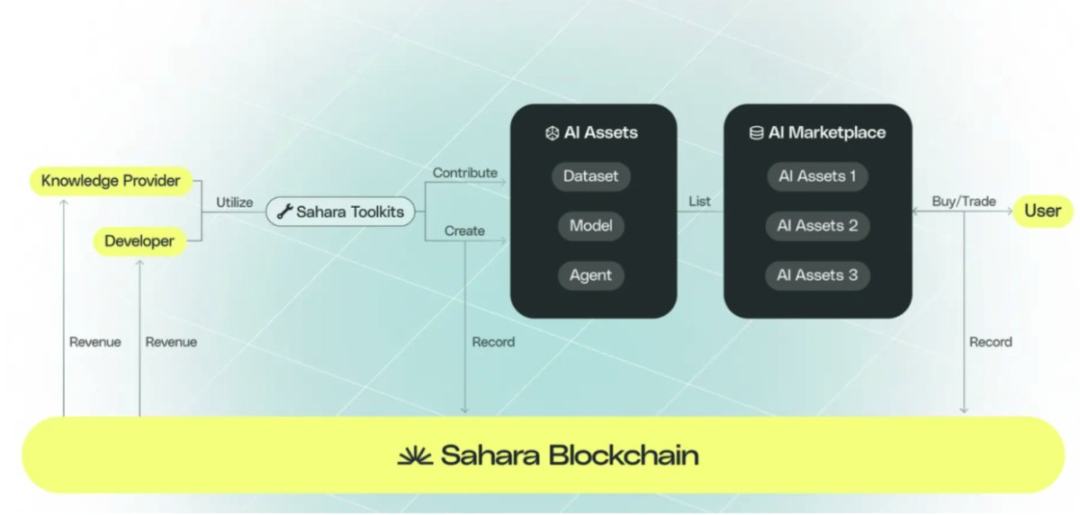
But the closer you get to the real structure, the more challenges you face.
Although I am optimistic about Sahara, I will not hide the challenges that the project will face because of my investment stance.
A major advantage of the Sahara architecture is that it is not limited to a single chain or ecosystem.
Its system was designed from the beginning to be open, full-chain, and standardized: it supports deployment on any EVM-compatible chain. At the same time, it also provides a standard API interface, allowing Web2 systems - whether e-commerce backend, enterprise SaaS or mobile apps - to directly call Sahara's model services and complete on-chain settlement.
However, although this kind of architectural design is extremely rare, it also has a core risk: the value of infrastructure lies not in "what it can do" but in "who is willing to do what based on it".
To become a trusted, adopted, and combined AI protocol layer, the key to Sahara lies in how ecosystem participants evaluate its technical maturity, stability, and future predictability. Although the system itself has been built, it remains unknown whether it can really attract a large number of projects to land based on its standards.
It is undeniable that Sahara has achieved key verification: serving leading companies such as Microsoft, Snapchat, MIT, Motherson Group, Amazon, providing them with relevant data services, and handling some of the industry's most difficult data demand problems, becoming an early signal to verify the feasibility of this system.
However, it should be noted that these collaborations mainly come from the Web2 world. What really determines Sahara's long-term development is still the maturity and penetration of the entire Web3 AI track. Sahara benefits from the general trend of Web3 AI, but if it wants to truly unleash the value of its own infrastructure, it still needs the implementation and improvement of more Web3 native AI products and technical solutions.
But don’t forget, Sahara is currently the only one of its kind.
In the field of chain-level infrastructure designed natively for AI, although there are many imitators who have proposed conceptual frameworks, up to now, only Sahara has achieved full implementation from on-chain ownership confirmation, off-chain execution, cross-chain calls to technical closed loop and real revenue, and has obtained actual customer verification.
This brings Sahara both "exclusive advantages" and structural risks: if successful, it will define the industry benchmark for the entire Web3 × AI Infra; but if it fails, AI Layer1 may be seen as a premature layout.
Since it is now the only option in this field, the market's judgment on it will naturally be more rigorous and calm - it must stand the test of time and ecology.

Finally, a message to all builders and observers: Seize the window of the construction period, rather than regretting it after it is completed.
For me, the core of every primary investment decision lies in three things: the depth of understanding of the world, the dimension of judging trends, and the willpower of the team to go through cycles. Products and functions are important, but they are often just the concrete manifestation of these underlying cognitions.
Web3 is not short of ideas or stories. What it lacks are the hands that can turn logic into order, and the people who truly know what to insist on and what to give up.
Whether Sahara can become the next paradigm-level chain, I can’t guarantee.
But it is indeed the only attempt currently worth taking seriously, watching seriously, and betting seriously.
If you are waiting for the day when everything is running smoothly, the ecosystem is formed, and industry consensus is established - then the opportunity is no longer yours.
So, maybe you should really panic. Not because you missed something, but because you happened to hit a point in time when the system was just starting.
While others are still watching and waiting for the market to give clear signals, you already know that this system exists, its direction is clear, and its structure has been established, but no one really understands it yet.
Most people will flock to it after it is running smoothly, but you are standing at the node where the flywheel has not yet started and the standard has not yet been finalized.
This isn't a sure-fire opportunity, but it's a real start.
Not everyone can understand it, but you have seen "something ahead of consensus."