
Author: Zuo Ye
In the West, finance is a means of social mobilization, and it can only be effective when the "state-society" is separated or even opposed. However, in large Eastern countries where the state and family are structurally similar, social mobilization relies on water conservancy projects and governance capabilities.
We'll begin here by recounting the phenomenon I've observed: after a decade of hasty Ethereum + dApp narratives, DeFi has shifted its focus to the Apple Store's Consumer DeFi mobile app competition.
Compared to exchanges and wallets that were listed on major app stores early on, DeFi, which has always been based on web platforms, arrived very late. Compared to virtual wallets and digital banks that target niche markets of low-income and credit-poor individuals, DeFi, which cannot solve the credit system problem, arrived too early.
Amid this dilemma, there is even a narrative of human society transitioning from monetary banking to fiscal monetary policy.
The Ministry of Finance regains control of the currency.
The Times 03/Jan/2009 Chancellor on brink of second bailout for banks.
Consumer-grade DeFi takes Aave and Coinbase's built-in Morpho as its entry point, directly targeting end users. However, our story must begin with the issuance process of modern currencies to complete the background of DeFi Apps surpassing DeFi dApps.
Gold and silver are not naturally currency. When humans need to exchange on a large scale, commodities emerge as a general equivalent. Due to their various characteristics, gold and silver were eventually accepted by the entire human society.
Throughout human societies before the Industrial Revolution, regardless of political system or level of development, metal coinage was the mainstream, and the monetary system was essentially managed by the finance department.
The "central bank-bank" system we are familiar with is actually a very recent story. In the early days, developed countries generally followed the process of establishing a central bank to handle banking crises when necessary, including the Federal Reserve, which we are most familiar with.
Throughout this historical process, the finance department, as an administrative branch, has been in an awkward position of diminishing power. However, the "central bank-bank" system is not without its flaws. In the central bank's management of banks, banks rely on the interest rate spread between deposits and loans to earn profits, while the central bank influences banks through the reserve requirement ratio.
Image caption: The role of the interest rate spread and the reserve requirement ratio.
Image source: @zuoyeweb3
Of course, this is a simplified and outdated version.
The simplification omits the process of the money multiplier. Banks do not need to have 100% reserves to issue loans, hence the leverage effect. The central bank will not force banks to have full reserves; instead, it needs to use leverage to adjust the money supply of the entire society.
The only ones who suffer are the users. Deposits outside of reserves lack a rigid guarantee of redemption. When neither the central bank nor the banks are willing to pay the price, the users become the necessary cost of money supply and withdrawal.
Outdated means that banks no longer fully accept the central bank's command. The most typical example is Japan after the Plaza Accord, which effectively launched QE/QQE (officially known as quantitative easing, commonly known as excessive money printing). Under the command of extremely low or even negative interest rates, banks cannot benefit from the interest rate spread between deposits and loans, and banks will choose to lie flat.
Therefore, central banks will directly intervene to buy assets, thereby bypassing banks to supply money. This is exemplified by the Federal Reserve buying bonds and the Bank of Japan buying stocks. The entire system is becoming increasingly rigid, causing the most important clearing ability of the economic cycle to completely fail: Japan's huge zombie companies, the TBTF (Too Big to Fall) Wall Street financial giants formed after 2008 in the United States, and the emergency intervention after the collapse of Silicon Valley Bank in 2023.
What does all this have to do with cryptocurrency?
The 2008 financial crisis directly spurred the creation of Bitcoin, and the collapse of Silicon Valley Bank in 2023 directly triggered a wave of opposition to CBDCs (Central Bank Digital Currencies) in the United States. In a House vote in May 2024, Republicans unanimously voted against developing CBDCs and instead supported private stablecoins.
The latter logic is somewhat convoluted. We might think that after Silicon Valley Bank, as a crypto-friendly bank, collapsed and even caused a significant decoupling of USDC, the United States should turn to supporting CBDC. However, in reality, the Federal Reserve's dollar stablecoin or CBDC has formed a de facto confrontation with the US Treasury stablecoin led by the executive branch and Congress.
The Federal Reserve itself originated from the chaos and crisis of the post-"free dollar" system in 1907. After its establishment in 1913, it was an odd situation of "gold reserves + private banks" coexisting. At that time, gold was directly managed by the Federal Reserve until 1934 when its management was transferred to the Treasury Department. Before the collapse of the Bretton Woods system, gold was always the reserve asset of the US dollar.
However, after the Bretton Woods system, the US dollar is essentially a fiat currency, or a stablecoin based on US Treasury bonds. This conflicts with the Treasury Department's position. From the public's perspective, the US dollar and US Treasury bonds are two sides of the same coin, but from the Treasury Department's perspective, US Treasury bonds are the true form of the US dollar, and the Federal Reserve's private nature is interfering with national interests.
Returning to cryptocurrencies, especially stablecoins, those based on US Treasury bonds grant the Treasury and other administrative departments the power to issue currency outside the Federal Reserve. This is why Congress cooperates with the government to ban the issuance of CBDCs.
Only by looking at it from this perspective can we understand the appeal of Bitcoin to Trump. Family interests are just a pretext. The fact that the entire administrative system can accept Bitcoin only shows that the pricing power of crypto assets is profitable for them.
Image caption: Changes in USDT/USDC reserves
Image source: @IMFNews
The underlying assets of today's mainstream USD stablecoins are nothing more than USD cash, US Treasury bonds, BTC/ETH and other interest-bearing bonds (corporate bonds). However, in reality, USDT/USDC are reducing the proportion of USD cash and shifting significantly to US Treasury bonds.
This is not a short-term move under the interest-earning strategy, but rather a coordination with the shift from USD stablecoins to US Treasury stablecoins. The internationalization of USDT is nothing more than buying more gold.
The future stablecoin market will only be a three-way competition between US Treasury stablecoins, gold stablecoins, and BTC/ETH stablecoins. There won't be a direct confrontation between US dollar stablecoins and non-US dollar stablecoins. Surely no one truly believes that euro stablecoins will become mainstream!
By using stablecoins based on US Treasury bonds, the Treasury regained the power to issue currency, but stablecoins cannot directly replace the money multiplier or leverage issuance mechanisms of banks.
Treating banks as DeFi products
Physics has never truly existed, and neither has the commodity attribute of money.
In theory, the historical mission of the Federal Reserve should have ended after the collapse of the Bretton Woods system, just like the First and Second United States Banks. Therefore, the Federal Reserve has continued to play a role in regulating prices and stabilizing financial markets.
As mentioned earlier, under the background of inflation, the central bank can no longer influence the money supply through the reserve requirement ratio. Instead, it directly intervenes to purchase asset packages. This leverage mechanism is not only inefficient, but also unable to clear out inferior assets.
The progress and crisis of DeFi are giving us another option. Allowing crises to exist and occur is itself a clearing mechanism at work, forming a framework where the "invisible hand" (DeFi) is responsible for the leverage cycle and the "visible hand" (US Treasury stablecoins) is responsible for the underlying stability.
In short, on-chain assets are actually beneficial to regulation, as information technology can penetrate the web of ignorance.
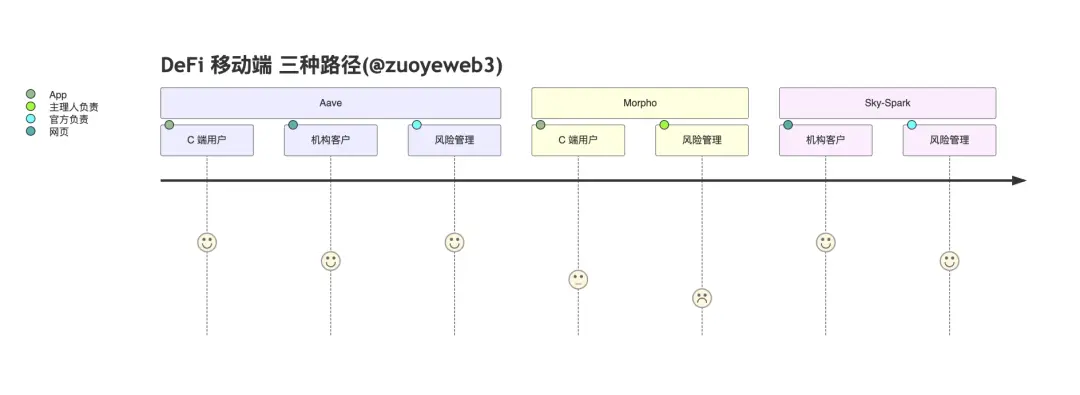
In terms of specific implementation methods, Aave builds its own C-end App to directly connect with users, Morpho uses Coinbase to adopt a B2B2C model, and Spark in the Sky ecosystem abandons the mobile terminal and focuses on serving institutional clients.
The specific mechanisms of the three can be further subdivided. Aave is a combination of end-users + institutional clients (Horizon) + official risk control. Morpho is a combination of risk control by the administrator + front-end outsourcing to Coinbase. Spark itself is a sub-DAO of Sky and is derived from a fork of Aave. It mainly targets institutions and the on-chain market, which can be understood as temporarily avoiding Aave's dominance.
Sky is unique in that it is an on-chain stablecoin issuer (DAI->USDS) that hopes to expand its scope of use. It is fundamentally different from Aave and Morpho. Pure lending protocols need to remain sufficiently open to attract various assets, so Aave's GHO is unlikely to have a future.
Sky needs to strike a balance between USDS and lending openness.
After Aave voted against USDS as a reserve asset, people were surprised to find that Sky's own Spark also didn't really support USDS, while Spark was embracing PYUSD issued by PayPal.
Although Sky hopes to balance the two by setting up different sub-DAOs, this inherent conflict between stablecoin issuers and open lending protocols will accompany Sky's development for a long time.
In contrast, Ethena acted decisively, partnering with Hyperliquid's front-end product, Based, to promote the HYPE/USDe spot trading pair and offer rebates. Ethena directly embraced the existing ecosystem, such as Hyperliquid, temporarily abandoning the need to build its own ecosystem and public chain, and focusing on its role as a single stablecoin issuer.
Currently, Aave is the closest to a fully-featured DeFi app and is a near-bank-level product. Starting from the wealth management/yield sector, it directly reaches end users and hopes to use its brand and risk control experience to migrate traditional mainstream customers to the blockchain. Morpho, on the other hand, hopes to learn from the USDC model, link itself with Coinbase to amplify its intermediary role, and facilitate deeper cooperation between more fund managers and Coinbase.
Image caption: Morpho and Coinbase partnership model
Image source: @Morpho
Morpho represents another extreme open approach: USDC + Morpho + Base => Coinbase. Behind the $1 billion loan amount lies the heavy responsibility of challenging USDT and blocking USDe/USDS through the Yield product. Coinbase is the biggest beneficiary of USDC.
What does all this have to do with US Treasury stablecoins?
For the first time, the central role of banks has been bypassed in the entire process of generating stablecoin on-chain revenue and acquiring off-chain customers. This does not mean that banks are not needed, but rather that banks are increasingly becoming intermediaries for deposits and withdrawals. Although on-chain DeFi cannot solve the problem of the credit system, and there are many issues such as the capital efficiency of over-collateralization and the risk control capabilities of the manager's vault.
However, permissionless DeFi stacks can indeed play a role in leverage cycles, and the collapse of a manager's vault can indeed serve as a market clearing mechanism.
Under the traditional "central bank-bank" system, third-party or fourth-party clients such as payment providers, or powerful large banks, are all susceptible to secondary clearing, which can impair the central bank's ability to conduct thorough management and lead to misjudgments of the economic system.
In the modern "stablecoin-lending protocol" system, no matter how many times a loan is revolved or how great the risk of the manager's vault is, it can be quantified and transparent. The only thing to be careful about is not trying to introduce more trust assumptions, such as off-chain negotiation and early intervention by lawyers, as this will lead to low efficiency in the use of funds.
In other words, DeFi will not defeat banks through permissionless regulatory arbitrage, but rather through capital efficiency.
More than a century after central banks established their control over currency issuance, the Treasury system is for the first time bypassing its entanglement with gold and reconsidering regaining control of the currency system. DeFi will also bear the heavy responsibility of re-issuing new currencies and clearing out assets.
There will no longer be a distinction between M0/M1/M2; there will only be a distinction between US Treasury stablecoins and DeFi utilization rates.
Conclusion
Crypto sends its greetings to all its friends, hoping they will witness a spectacular bull market after a long bear market, while the overly impatient banking industry will be the first to go.
The Federal Reserve's attempt to set up Skinny Master Accounts for stablecoin issuers and the OCC's efforts to quell banks' concerns about stablecoins poaching deposits are all actions driven by banking anxiety and regulatory self-preservation measures.
Let's consider the most extreme scenario: if 100% of US Treasury bonds were minted into stablecoins, if 100% of the yield from these stablecoins were distributed to users, and if 100% of the yield was invested in US Treasury bonds by users, would MMT become a reality or fail completely?
Perhaps this is the significance of Crypto: in the current era of AI, we need to rethink economics by following in Satoshi Nakamoto's footsteps and try to depict the real-world significance of cryptocurrencies, rather than blindly following Vitalik's lead.