
The Digital Euro Conference 2025 was successfully concluded on March 27 in Frankfurt, the “Heart of European Finance”. Starlabs Consulting attended the event as an official partner. During the conference, Tamara Ferreira Schmidt, Executive Director of the Digital Euro Association (DEA), the organizer, gave a wonderful presentation that was impressive.
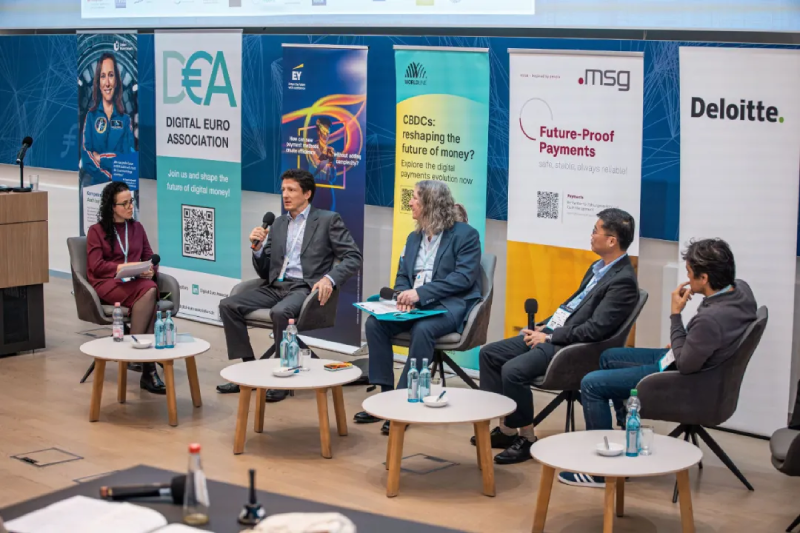
First from left: Tamara Ferreira Schmidt
Schmidt has an interesting background: she started out as a physicist and later entered the financial markets, with more than 15 years of professional experience in financial engineering, capital markets, and derivatives. She is a recipient of the prestigious German Chancellor Scholarship from the Alexander von Humboldt Foundation, and has conducted in-depth research on the role of alternative financing in shaping the early entrepreneurial ecosystems in Brazil and Germany. She is also a prestigious consultant and content creator, focusing on investments, startups, innovation, digital currencies, and blockchains, and has spoken at several internationally renowned events, including the Brazil-Germany Fintech eTour, TEDx KanzlerPark, Web 3.0 Disruptors Week, Crypto Assets Conference, Digital Euro Conference, Brussels Blockchain Week, CBDC Conference, and Nordic Blockchain Conference.

Starlabs Consulting interviewed Ms. Schmidt in this issue of "Disruptors Unplugged". She discussed in depth the relationship between traditional finance (TradFi) and decentralized finance (DeFi), tokenization and alternative financing, and CBDC and traditional currencies, cryptocurrencies and stablecoins from the perspective of a practitioner, researcher, and rule-making promoter. She also made many constructive suggestions on how Web3 companies can enter Europe and emerging markets, and how women can better participate in the field of digital assets.
Highlights
- Alternative financing aims to unlock capital outside of the traditional banking environment. Tokenization better enables this through decentralized ownership, disintermediation, and global, 24/7 liquidity.
- CBDC offers a unique value proposition by combining the stability of central bank money with the programmability and efficiency of digital assets. It is not meant to replace the existing system, but to enhance the resilience, inclusiveness and sovereignty of the monetary system in the digital age.
- The EU not only views cryptocurrencies as a new asset class, but is also looking at how tokenization and distributed ledger technology can reshape traditional financial infrastructure.
- Emerging markets present some of the greatest opportunities for digital assets, not because they are lagging in development, but because they have the potential to bypass traditional systems entirely.
The following are highlights from the conversation on this episode of “Disruptors Unplugged.”
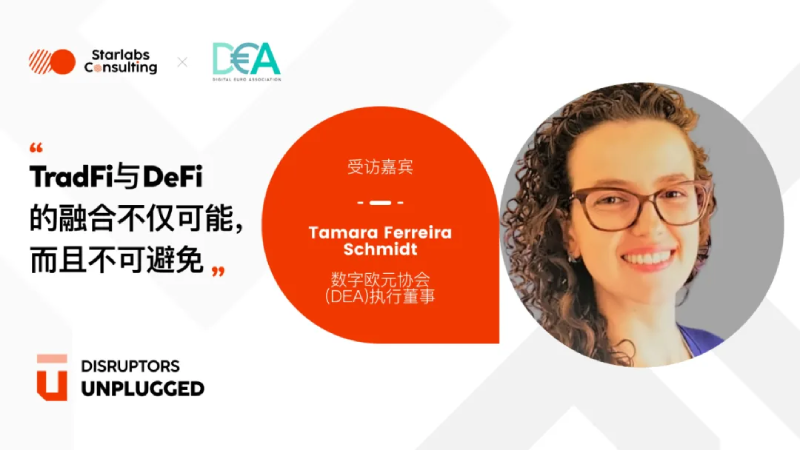
Starlabs Consulting: You have a very rich career experience. When did you start to get involved in the blockchain field? What made you interested in blockchain and digital assets?
Schmidt: My initial interest in the blockchain industry dates back to 2016, when I was pursuing my master's degree and researching how blockchain technology could be applied to the Brazilian Stock Exchange B3 (Brasil Bolsa Balcão). I was working at B3 at the time and was attracted by the huge potential of this technology - it could reshape the financial industry, especially the infrastructure provided by exchanges, such as trading, custody and depository services. At that moment, I realized that Blockchain was no longer just a buzzword, but could truly change the financial market.
Starlabs Consulting: How do you view the relationship between TradFi and Defi? Do you think they can be integrated and complement each other?
Schmidt: I think the convergence of TradFi and DeFi is not only possible, but inevitable. Not because the two are naturally consistent, but because user expectations are evolving rapidly. People today want financial services to be faster, cheaper, and more inclusive. Neither TradFi or DeFi alone can fully meet these requirements. TradFi provides scale, compliance, and institutional trust, while DeFi brings speed, composability, and programmability. The real innovation is to combine these advantages, such as through tokenized assets with legal clarity, integrating smart contracts into financial infrastructure, and providing regulated ways to participate in decentralized markets.
DeFi is not about replacing TradFi, but about streamlining processes and broadening access, even to non-financial assets like intellectual property or digital art.
It solves long-standing challenges such as counterparty risk through tools such as automation, decentralization, and transparency. This does not mean completely eliminating third parties, but redefining their roles. For example, banks can transform into access points for DeFi protocols, just as they connect to centralized exchanges today.
For the tokenization of traditional assets to succeed in a decentralized environment, collaboration is essential. We need regulatory bridges, common standards, and strong technical integration. The future of finance will not be about choosing between the two, but about building a cohesive, interoperable system where innovation and trust support each other.
Starlabs Consulting: In your career and research, there is a word that is frequently mentioned - Alternative Financing. What does it mean? Is tokenization an ideal alternative financing solution?
Schmidt: Alternative Financing is about releasing capital outside the traditional banking environment. It includes crowdinvesting, crowdfunding, peer-to-peer lending, accounts receivable financing, and the increasingly popular tokenization model. Its goal is to make financial services more inclusive, especially for groups that are not covered or underserved by banks, such as small and medium-sized enterprises, creative people or early-stage entrepreneurial projects. These groups have long been outside the traditional credit system.
In my research, I explore how alternative finance has developed in response to the inefficiencies of traditional capital markets. Digital platforms connect capital to opportunities in entirely new ways. Tokenization enables this through decentralized ownership, disintermediation, and 24/7 global liquidity. Imagine a small business raising capital through a tokenized revenue-sharing agreement, or a community solar project securitized and traded globally as micro-shares, all managed by smart contracts.
Of course, this is still an emerging field. Technology is developing rapidly, but regulation and infrastructure have not kept up. We need a clear, legally sound and inclusive regulatory framework. This can not only improve the way finance works, but also broaden the channels for financial participation.
Starlabs Consulting: Please introduce your DEA, its mission, what it mainly does and its future vision.
DEA official website
Schmidt: The mission of the Digital Euro Association (DEA) is to shape the future of digital currencies by connecting the policy, technology and social spheres. Although the digital euro is our core focus, our work goes far beyond that. We explore the entire digital currency ecosystem, including central bank digital currencies (CBDCs), stablecoins, tokenized deposits and other types of digital currencies.
We bring together a wide range of stakeholders, from central banks and regulators to fintech innovators, academics and members of civil society. Our goal is to foster dialogue, conduct research and support effective policymaking. Through working groups, publications, events and strategic partnerships, we work to help Europe become a global leader in digital currency innovation, with transparency, inclusiveness and technological autonomy as cornerstones.
Ultimately, our vision is for Europe’s future currency to be both forward-looking and aligned with democratic values. This means building new infrastructure that puts people, privacy and trust at its core.
Starlabs Consulting: What unique benefits do you think CBDC or digital euro have that traditional currencies (such as the euro) and cryptocurrencies and stablecoins do not have?
Schmidt: CBDCs offer a unique value proposition by combining the stability of central bank money with the programmability and efficiency of digital assets:
- Unlike stablecoins, there is no issuer risk;
- Unlike cash, it supports automated operations, can be used offline, and can be easily integrated with digital platforms;
- Unlike cryptocurrencies, it is based on public trust and backed by monetary policy.
What makes CBDC unique is its systemic design. Its development takes into account the three core elements of the payment system: payment instruments, infrastructure, and payment solutions.
Most e-money systems focus primarily on payment instruments, such as prepaid cards or digital wallets like PayPal and Revolut. In contrast, fast payment systems emphasize infrastructure and how to connect private players. CBDC aims to unify all these elements into a complete, state-backed system.
This means that CBDC is more than just a digital version of cash. If it focuses on privacy, offline usability, and seamless interoperability during development, it can become the base layer for public digital currencies. CBDC is not meant to replace the existing system, but to enhance the resilience, inclusiveness, and sovereignty of the monetary system in the digital age.
Starlabs Consulting: What do you think of China's CBDC? The Trump administration opposes the launch of a CBDC in the United States. What do you think of this? How is the digital euro different from existing CBDC designs?
Schmidt: China's pioneering efforts have demonstrated what is possible at scale, and also revealed how top-level design can affect outcomes, especially in terms of privacy. The United States' hesitation stems from ideological resistance and legitimate concerns about centralized control. A digital euro would be an attempt by Europe to find a middle ground that protects individual freedoms, maintains financial stability, and avoids excessive state intervention.
Starlabs Consulting: Stablecoins are gaining more and more attention around the world. How do you see the future of stablecoins in Europe, especially in terms of market acceptance and regulatory policies?
Schmidt: The EU's Markets in Crypto-Assets Regulation (MiCAR) lays the foundation for a more unified and predictable environment. Stablecoin issuers need to meet clear standards in terms of reserve backing, governance, transparency and risk management. This brings much-needed legal certainty to the market and is a welcome step forward, as well-regulated stablecoins can provide real value in the financial system.
Euro-denominated stablecoins are likely to become a key tool in B2B payments, remittances, DeFi, and digital marketplaces. They combine the speed of cryptocurrencies with the price stability of fiat currencies, making them very attractive to businesses and consumers.
But success will not only belong to those projects with the most advanced technology, but also to those projects that can combine innovation with compliance, win regulatory trust, and smoothly integrate with existing financial infrastructure. In a market as heavily regulated as the EU, obtaining regulatory approval is no longer an obstacle, but a competitive advantage.
Starlabs Consulting: Please briefly introduce Europe’s regulatory attitude and trends towards digital currency and the encryption industry.
Schmidt: Europe has adopted a clear "regulation first" strategy. This strategy may frustrate fast-moving innovators, but ultimately lays a solid and reliable foundation. The EU's goal is to create a safe, consistent, and innovation-friendly environment for digital assets, and MiCAR is an important milestone in achieving this goal. MiCAR provides the necessary legal clarity, covering everything from asset-backed stablecoins to crypto asset service providers, and establishes a unified regulatory framework for all 27 member states.
But MiCAR is just the beginning. Another key development is the Distributed Ledger Technology (DLT) Pilot Program, which allows market participants to test tokenized securities in a regulated sandbox. This shows that the EU is not only looking at cryptocurrencies as a new asset class, but also focusing on how tokenization and distributed ledger technology can reshape traditional financial infrastructure.
Looking ahead, we can expect that future regulation will cover areas such as tokenized deposits, decentralized finance, and wholesale CBDCs. The broader trend is that regulation will be activity-based rather than entity-specific, technology-neutral rather than overly specific, and committed to cross-jurisdictional coordination rather than fragmentation.
While this approach may appear slow, it is building long-term legal certainty and institutional stability to support further development of the digital asset industry.
Starlabs Consulting: If a Web3 company wants to come to Europe to expand its market and customers, please give them some practical advice.
Schmidt: First of all, you need to understand the regulatory environment. With the implementation of MiCAR, Europe is moving towards a unified framework, which requires companies to take compliance seriously. Companies need to assess the legal adaptability of their products and make corresponding adjustments.
Localization is also important. It’s not just a matter of language or currency, but also about understanding how European market users think about trust, money, and data. Working with local experts or companies can make regulatory integration and market positioning smoother.
It is also important to build connections with customers, regulators and other players in the ecosystem early on. Organizations like DEA can help bridge this gap, connecting innovators with policy and the researcher community. Despite the complexity of the European market, the opportunities are real for those willing to put in the groundwork.
Starlabs Consulting: You are also familiar with the Brazilian financial market. What opportunities do you think digital assets will have in emerging markets? Please also give some practical advice to Web3 entrepreneurs who plan to acquire customers in these markets (such as South America, Africa, the Middle East, and Asia).
Schmidt: Emerging markets present some of the greatest opportunities for digital assets, not because they are lagging behind, but because they have the potential to bypass traditional systems entirely. We have seen this with mobile banking, with countries like Kenya and Brazil outpacing many developed economies in mobile banking adoption and innovation. The same trend is playing out in digital assets and decentralized finance.
In Brazil, for example, the launch of Pix revolutionized real-time payments, and through the central bank’s digital real initiative (Drex), Brazil is exploring how tokenized deposits and programmable money can reshape its financial infrastructure. These are not just incremental improvements, but foundational changes.
That being said, Web3 entrepreneurs should be wary of a one-size-fits-all approach. The challenges in these markets are real, ranging from currency volatility and limited access to credit to underdeveloped capital markets and high remittance costs. But these challenges are often very local. The key to success is to listen first, then act. The focus is on solving real local problems, rather than prioritizing the elegance of the technology.
Working closely with local partners, whether fintech startups, community organizations or regulators, can open doors that external solutions often cannot. It’s not just about exporting technology, but about fostering financial resilience and self-determination in a way that reflects local realities.
Starlabs Consulting: We see many women like you who have achieved remarkable success in the Web3 field. What advice do you have for other women who want to enter the fintech or digital asset fields? Do you support them in embarking on this adventure?
Schmidt: Yes, I would encourage them, but with a realistic and clear perspective on the industry. The fintech and digital asset space is full of potential, but it is also complex, dynamic, and challenging. A technical background is certainly helpful, but it is not required. My own career began in physics, then moved into traditional financial markets, and eventually expanded to blockchain and decentralized finance. This interdisciplinary path allowed me to look at both the technical and institutional aspects of the industry and build bridges between the two when needed.
For women considering entering this field, I recommend focusing on a few key areas: building a solid understanding of key technologies, staying abreast of the changing regulatory environment, and figuring out where your specific skills can add value. This is not about trying to master everything at once, but about learning in a targeted way and positioning yourself strategically.
I also recommend building a professional network early on. This is not just for exposure, but to create a space where you can exchange ideas, share experiences, and get honest feedback. This kind of interaction is often critical to personal and professional growth.
While the industry still has shortcomings in terms of gender balance, especially at the leadership level, there is still ample room for meaningful contributions, especially from those who have the stability, critical thinking and ability to challenge existing assumptions. A solid analytical foundation and a deep understanding of how the financial system works are extremely valuable in every corner of this field.