
Original title: A True Account of the Vaulta Foundation's "Empty Stake": Price Crash, Auditor Disappearance, and Complete Collapse of Community Trust
Original author: MMK (@mmk_btc), Vaulta community member
Original editor: Rhythm Assistant, BlockBeats
Editor's Note: Many people know about EOS, the early public blockchain that raised a whopping $4.2 billion seven years ago and was considered one of the earliest "Ethereum killers." However, many are unaware that after BM was ousted from EOS, its parent company, Block.one, took the previously raised funds and focused on building Bullish, the exchange platform preparing for its IPO. The remaining EOS was taken over by the EOS Network Foundation, with CEO Yves La Rose, nicknamed "Big Beard" by the community for his thick beard. Big Beard later spearheaded the renaming of EOS to Vaulta, shifting the focus to Web3 banking, and the EOS Network Foundation was renamed the Vaulta Foundation. Recently, Big Beard's sudden departure has sparked community discontent and accusations against his past actions.
The Vaulta Foundation (formerly the EOS Network Foundation) is experiencing an unprecedented collapse of trust: it burned through tens of millions of dollars in four years, yet the price of its token repeatedly hit new lows; projects failed one after another, and the ledger went from being publicly available to being discontinued; the management resigned "gracefully," but the handover of authority has been delayed... This article will expose the many mysteries surrounding Vaulta and tell a story of a company that squandered its resources.
Yves' resignation: A dignified departure or behind-the-scenes "rule from behind the scenes"?
On November 12, 2025, Yves La Rose, the former CEO of the Vaulta Foundation (formerly the EOS Network Foundation, hereinafter referred to as VF), suddenly announced his resignation on the X platform, stating that he had notified the 21 block producers on October 29 that he would voluntarily step down and elect new representatives through on-chain governance. The statement was politely worded, full of "gratitude" and "vision," but four weeks later the community was surprised to find that the core multisignature accounts of Vaulta were still in Yves's hands, and there was no handover at all.
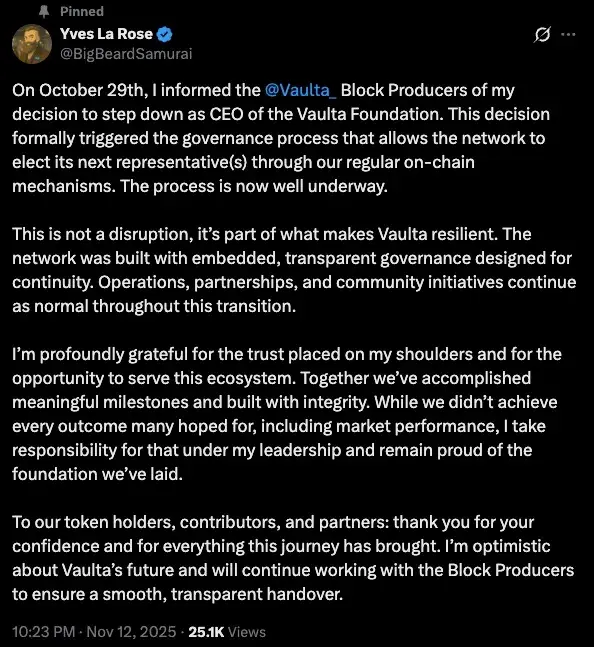
Yves' personal resignation statement
Furthermore, after resigning, Yves secretly pushed for Greymass founder Aaron Cox to succeed him. The first thing Aaron did upon being thrust into the spotlight was to propose a massive $10 million (EOS) grant to continue paying for core development. This move sparked widespread skepticism within the community: it was essentially using a figurehead to "stay afloat" and transfer remaining company funds.
Charge 1: Extravagant spending, with marketing expenditures going unaccounted for.
Since VF was founded in 2021, its ecosystem development has not accelerated over time.
Instead, the community is seeing a different, more unsettling curve: budgets are expanding year after year, but results are shrinking year after year.
VF launched a market expansion plan in 2022-2023 under the banner of "eco-revitalization." VF did indeed recruit an excellent marketing team, and they also made efforts in brand operations and international events.
But the crucial question remains—what have these massive investments actually brought about?
According to the nine quarterly reports disclosed, marketing-related expenses alone reached: $1,709,800 in Q4 2022 and another $1,072,887 in Q1 2023.
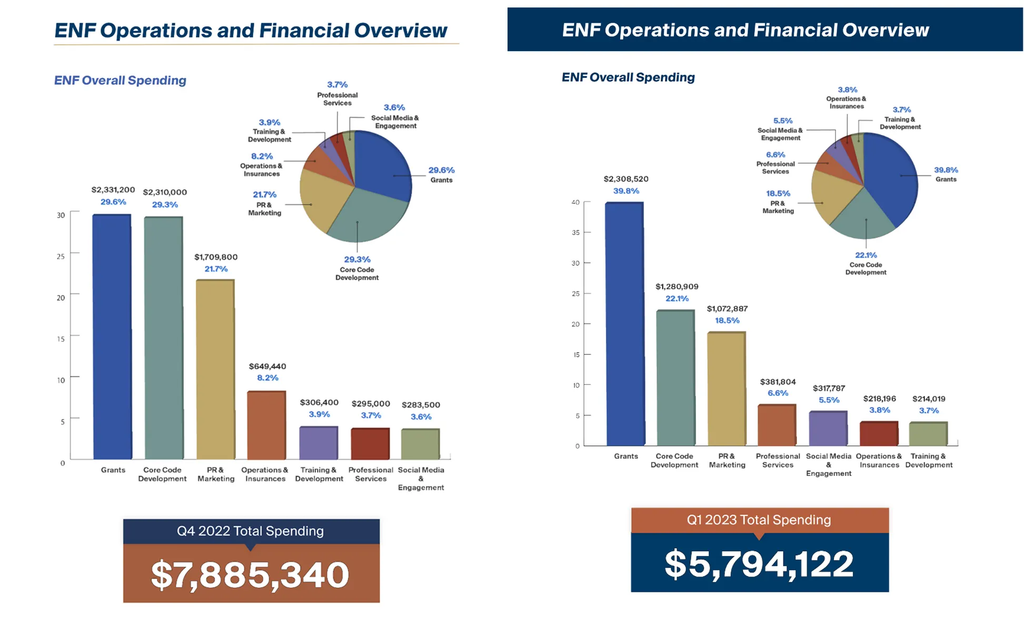
In just six months, a massive budget of nearly $2.8 million was poured into brand promotion and public relations activities. However, the only results the community could see were: increased conference attendance, photos, and media coverage; increased Twitter followers; 2000 days of downtime; and EVM performance testing.
These data points aren't meaningless, but they resemble PR slides rather than a true reflection of the ecosystem's state. Developer growth? Absent. Daily on-chain activity? Not disclosed. TVL? Almost nonexistent. Why is community awareness decreasing despite increased spending? When all reports only discuss "highlights" and not "achievements," transparency naturally slides into a black box.
Charge #2: Immediately handing out money upon taking office; Greymass's $5 million budget remains controversial.
In June 2024, VF allocated $15 million (EOS) to establish a "middleware special fund". The first batch of $5 million (EOS) was allocated to the Greymass team, and the remaining $10 million is still in the eosio.mware account.
On-chain data shows that funds were transferred from the foundation's eosio.mware account to Greymass's newly established account uxuiuxuiuxui; subsequently, this wallet transferred funds monthly to the http://funds.gm account with a note "Operation + USD/CAD price," resembling a "salary payment"; then http://funds.gm transferred funds to http://rewards.gm, and finally distributed them to several accounts such as jesta, inconsistent, and http://apporc.gm, with transfer records noted "Reward Payout + USD amount"; most of the salaried accounts quickly transferred the funds to Kraken Kraken accounts or exchanges such as Coinbase to cash out after receiving them.
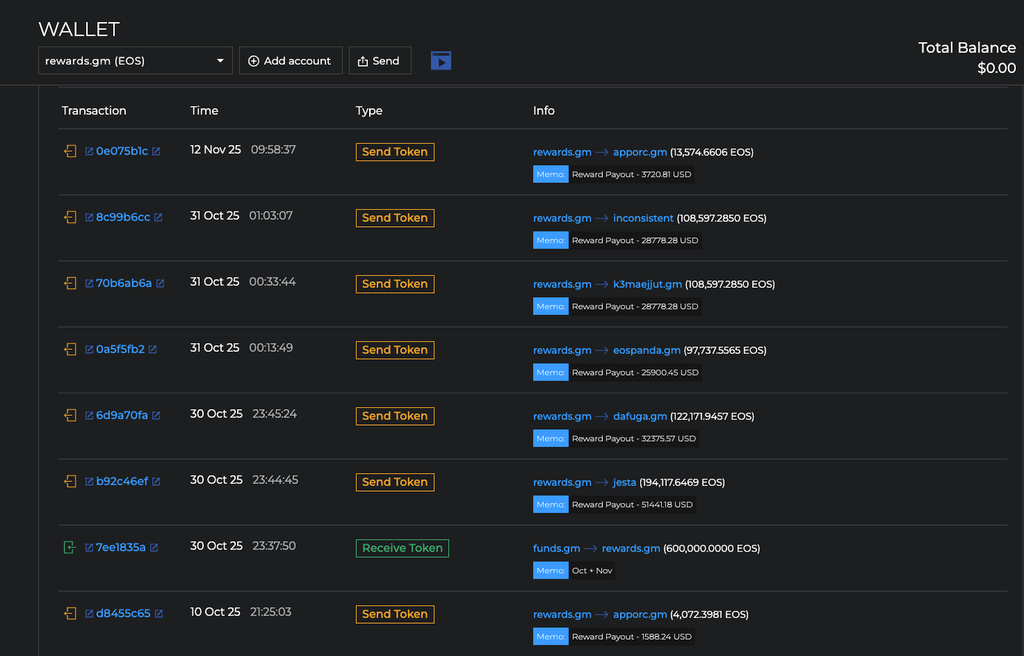
On-chain transaction records in rewards.gm (data source)
Additional note: The "middleware" built by Greymass refers to infrastructure tools that simplify the account creation and interaction process.
Although the Greymass team released several development updates in the early stages of funding, there have been almost no technical achievements or interim summaries released in the past year. In particular, Greymass' middleware tools still have many technical issues in terms of compatibility and stability, and have not yet been widely adopted by mainstream developers.
The community's concerns revolve around the following: Did the $5 million (EOS) fund involve duplicate salaries or unidentified accounts receiving payments, indicating a lack of transparency? Did the fund allocation closely coincide with Aaron's appointment, suggesting a possible "self-approved budget"? Did the salary distribution structure lack third-party oversight? We do not deny Greymass's past contributions to the ecosystem's development, nor do we deny Aaron's early technical reputation. However, were they misled regarding the new policies? Did the project deviate from its original development goals after losing oversight?
These questions remain unresolved.
It can be confirmed that the silence and low output of the "Greymass Five Million Project" have made it difficult for the foundation to respond to the crisis of trust from the outside world, and have further exacerbated the community's doubts about the rationality of the foundation's use of funds.
Third charge: The foundation remained silent during the cryptocurrency price crash, leaving its responsibilities a blind spot.
If technological achievements can be debated and marketing effectiveness can be quantified, then token prices are the most honest indicator.
This year, $A (EOS) has plummeted, hitting a low of $0.21—a dangerous signal that should send any ecosystem into a red alert. However, despite repeated inquiries from the community, the foundation's response has remained consistent: "Price fluctuations are not within the foundation's purview."
This statement itself is irrefutable.
Technology organizations have no obligation to manipulate the market. But the contradiction lies in the fact that when all ecosystem indicators decline and community confidence collapses, the foundation makes no discussion of "stabilizing expectations" or "market stabilization mechanisms".
What followed was an even more unsettling move: the foundation announced its "dissolution" without a roadmap or handover plan.
The community's question is not whether the foundation should be held responsible for the price of the coin, but rather: why did it choose to withdraw at a critical moment when the ecosystem was facing a crisis of trust? Was it due to powerlessness, lack of will, or some issues that were inconvenient to face? Responsibility has vanished in this crash.
Fourth charge: From weekly updates to complete stoppage, Transparent disappeared without a trace.
When VF was first established, transparency was its biggest selling point.
2021: Weekly updates (Everything EOS Weekly Report), providing real-time updates to the community on progress;
2022: Monthly Yield Report – a few months of slight slackening, but still acceptable;
2023: Quarterly Report (ENF Quarterly report)
2024: Silence...
2025: Silence...
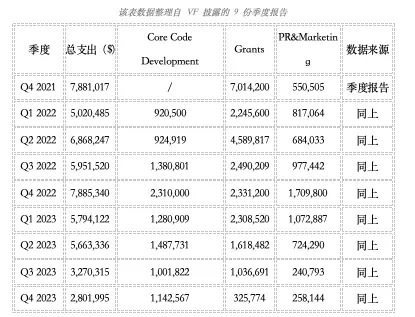
According to the published reports, VF's spending peaked in the fourth quarter of 2022 at $7,885,340; spending gradually declined in subsequent quarters.
However, these reports often only publish the total amount, lacking detailed classifications and breakdowns, making it difficult for outsiders to determine where the funds went. The community has long had concerns about the huge expenditures and lack of transparency.
The report repeatedly mentions projects such as Grant Framework and Pomelo, but these projects were temporarily suspended in 2023. Meanwhile, the funds promised in the white paper to be dedicated to specific projects have not been implemented in detail or publicly liquidated, and their whereabouts after being transferred to exchanges remain a mystery.
This breakdown in transparency, coupled with years of extravagance, ultimately led to a collapse in community confidence.
From frequent disclosures to gradual sparseness, and now to complete cessation of updates, the disappearance of transparency has almost perfectly synchronized with the ecological heat curve.
More notably, no financial reports have been released since Q1 2024. There has been no financial audit, no budget allocation, no project list, and no outstanding appropriations.
The community was forced to accept the fact that the foundation's operations had gone from "highly transparent" to "completely black box".
Meanwhile, many of the collaboration projects that VF had touted in high-profile talks have mostly stalled at the "communication stage," lacking any real implementation. The promised "transparent operation" has ultimately become a silent abyss.
Fifth charge: Arbitrary allocation of funds; Grants became a "black hole," and no one knew where the money went.
Looking back at the foundation's early days, VF did attempt to rebuild the Vaulta (EOS) ecosystem through various grant programs, including the Grant Framework, Recognition Grants, and a public grant pool used in conjunction with Pomelo.
During that phase, funds were disbursed quickly and on a large scale, with the aim of "stopping the bleeding quickly."
We cannot deny that it did play a role in boosting morale in the early stages.
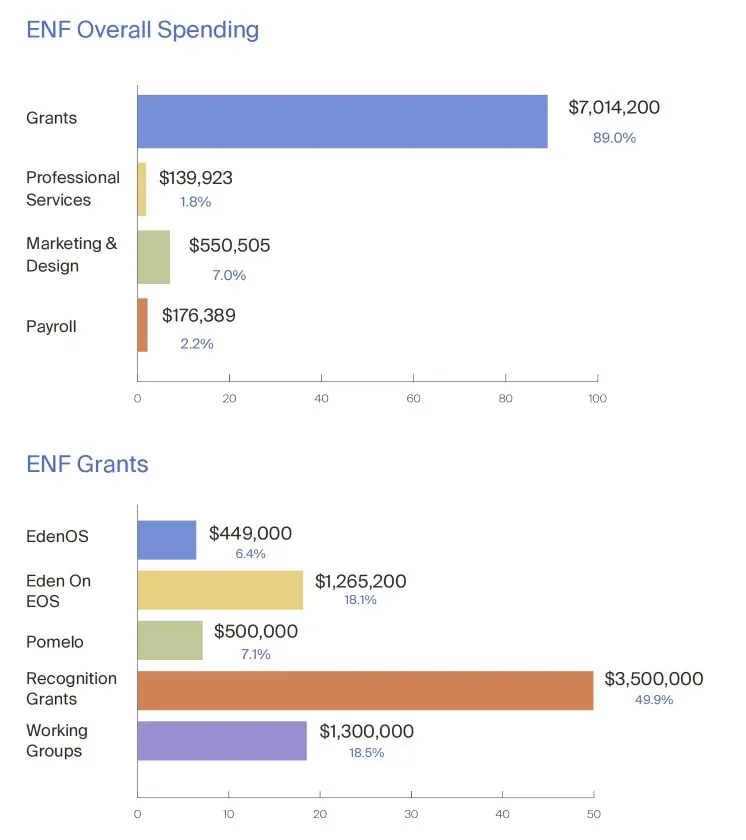
Here's some additional information about Grants: VF grants are divided into the publicly recruited "Grant Framework" (milestone-based grants), which are open to individuals, teams, or companies and are mostly for technology projects; Recognition Grants (rewards given to projects); and grants distributed to ecosystem projects through public funding channels such as Pomelo. In other words, grants can be used for both for-profit and public welfare/charity projects.
For example—in its first report of Q4 2021, VF allocated funds in one go:
$3.5 million in Recognition Grants (an average of $100,000 per project);
$1.3 million was allocated to five technical working groups to write a blue book;
$1.265 million was donated to support the community self-governing organization EdenOnEOS;
$500,000 was allocated as a funding pool for Pomelo in its first quarter.
However, the problem is that this is the only quarter in which VF has fully disclosed the recipients of its grants over the next four years.
From Q4 2021 to Q4 2023, although grants consistently accounted for the largest share of quarterly expenditures (in some quarters even reaching 40% to 60% of total expenditures), the reports: no longer disclosed specific recipients of grants; did not disclose the actual amount received for each project; did not disclose project acceptance status; did not mention details of fund usage; and did not explain whether projects achieved milestones.
In other words, the numbers are still there, but the information is gone.
Only the first quarter report disclosed the flow of funds for each project. In the eight subsequent reports, Grants' grant expenditures remained the "largest item," but no longer provided details about the beneficiary projects or outcomes.
You can see how much money was spent, but no one ever knows where it went.
Does the funding truly drive the ecosystem? Is the money being used effectively? Are projects being delivered? Why does the foundation never disclose more information?
This inevitably raises questions: Did the foundation initially use the guise of "ecological funding" to distribute large sums of money? Externally, it may be using this as a pretext to buy off communities and win people's hearts, while internally it may be accumulating inflationary funds and reserves, lacking results and oversight.
The VF match pool has a total of over ten million US dollars, but most projects are updated very rarely, and some even disappear after the funds are withdrawn.
The end of another era
The Vaulta Foundation, which initially pledged governance reform with a "transparent and community-driven" approach, has gradually become closed and corrupt over the past four years.
From Yves's dignified resignation without relinquishing power, to the lack of accountability for the $5 million (EOS) middleware allocation, from the ineffective marketing expenditures of millions every quarter to the complete disappearance of information after ecosystem allocations—this is not a failure of "decentralized governance," but a victory of "centralized plunder."
This lengthy document is not only a list of offenses, but also a warning.
The collapse of Vaulta is not only a tragedy for EOS, but also a microcosm of the trampling of Web3 ideals.