

Written by: 1912212.eth, Foresight News
For a decade after Bitcoin's birth, crypto was seen merely as a fringe experiment, using the cypherpunk spirit to challenge the central bank-dominated monetary system. However, with the maturation and development of public blockchains and DeFi, the boundaries between crypto and traditional finance (TradFi) are blurring at an alarming rate.
We are witnessing the arrival of a new era of comprehensive asset classes: investors are no longer confined to a single market, but are pursuing cross-border liquidity, diversification, and immediacy. The total size of global financial assets has exceeded $400 trillion, with stocks, foreign exchange, and commodities dominating, while the market capitalization of cryptocurrencies, though only about $3 trillion, is penetrating traditional sectors with its high growth and innovation.
This trend is driven by multiple factors. First, the involvement of institutional investors has been a game-changer. Since 2024, traditional giants like BlackRock have entered the crypto market through ETFs and tokenized assets, fueling the rise of RWAs. RWAs bring traditional assets like bonds and commodities onto the blockchain, enabling 24/7 trading and fragmented ownership. Second, technological advancements such as blockchain interoperability and the maturity of DeFi protocols have made crypto less of an isolated entity. L2 and cross-chain bridging allow funds to flow freely between different ecosystems, smoothing out friction between crypto and TradeFi.
The macroeconomic environment has also accelerated this convergence. Inflationary pressures, geopolitical risks, and interest rate volatility have prompted investors to seek hedging tools. While the traditional foreign exchange market boasts $7.5 trillion in daily trading volume, its trading hours are limited by weekdays and time zones; in contrast, the crypto market never closes, offering real-time responsiveness. Commodity markets such as gold and crude oil are subject to volatile prices due to supply chain disruptions, and crypto derivatives allow investors to participate with leverage, without the need for physical ownership.
Landmark events signifying the disappearance of boundaries include regulatory changes in 2025, such as the US SEC approving more crypto ETFs and the EU's MiCA framework regulating the use of stablecoins.
What chemical reaction will occur when the boundary begins to disappear?
Bitget TradFi, which officially launched on January 5, 2026, is a typical example of this wave. It attempts to challenge the monopoly of traditional brokers by bridging crypto and global exchanges through a single account.
One account for trading global assets
According to the latest data from DefiLlama, the total TVL of DeFi has risen to $117.9 billion, still at a historical high. Among them, the total value of RWA has reached $17.131 billion, experiencing explosive growth since 2025.
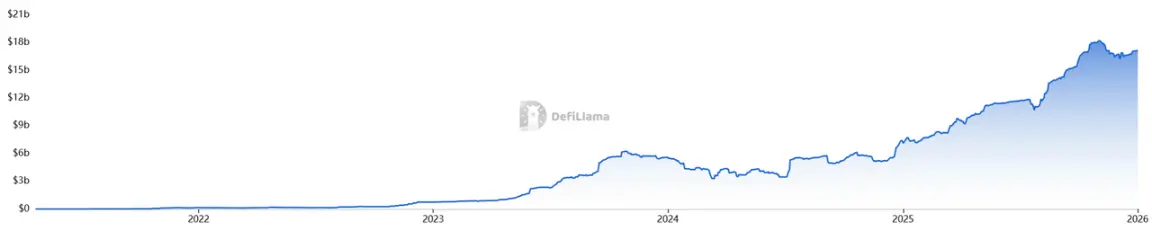
Retail investors and institutions are trading not only native crypto assets, but also any RWA asset.
Retail investors are shifting from Robinhood-style stock apps to multi-asset platforms, while institutions are leveraging API integrations for automated arbitrage. Ultimately, this multi-asset trend heralds a frictionless financial world where crypto is no longer supplementary but a core engine.
Currently, leading perpetual contract exchanges such as Hyperliquid, Aster, and Lighter have already listed trading instruments such as US stocks and gold, and their trading volume and open interest are considerable. Furthermore, some trading protocols that primarily trade traditional assets like RWA, such as Ostium, have received substantial venture capital funding, aiming to grab a share of the market.
Boundaries are disappearing, and Bitget TradFi is a functional product that turns theory into practice.
TradFi, launched by Bitget in December 2025, allows users to access traditional financial assets through a single account and trade using USDT as margin. The official definition of the product is a "cross-market trading platform" integrating crypto with forex, metals, commodities, and indices. This is not simply an asset expansion, but rather the construction of a "global exchange" ecosystem, allowing users to participate in multiple markets without leaving the Bitget App.
The assets have a wide coverage, mainly including:
- Foreign Exchange (FX): Supports major currency pairs such as EUR/USD, GBP/USD, USD/JPY, etc. The foreign exchange market is the core of TradFi, accounting for the vast majority of global financial trading volume daily. Bitget TradFi allows users to trade with USDT leverage, with leverage ratios reaching hundreds of times.
- Metals and Precious Metals: Gold (XAU/USD) and Silver (XAG/USD) are in the spotlight. Gold and silver have attracted considerable attention and enthusiasm from the market this year thanks to their strong price performance.
- Commodities: These include palladium (XPD), one of the world's rarest precious metals, Arabica coffee, Brent crude oil, copper, and more. Energy prices fluctuate wildly due to the Middle East conflict; Bitget TradFi provides real-time quotes and leverage tools for hedging.
- Indices: Covering major global stock indices such as the S&P 500, Nasdaq, and Hang Seng Index. Users can bet on market direction through CFDs (Contracts for Difference) instead of buying individual stocks.
A careful observer will notice that Bitget's asset selection isn't particularly comprehensive—it excludes illiquid assets like bonds or real estate, but focuses on high-frequency trading instruments to match the preferences of crypto users. Compared to traditional brokers like Interactive Brokers, TradeFi's asset selection is more streamlined, emphasizing highly liquid global markets.
Extensive coverage alone is far from enough. The transaction experience is the key.
Bitget TradFi integrates with the MetaTrader 5 (MT5) platform, a standard tool in TradFi that supports advanced charting, Expert Advisors (EAs), and algorithmic trading. Users connect to MT5 through their Bitget accounts without additional registration. Its core mechanism is CFD: users do not own the underlying assets but instead enter into contracts with the platform, settling profits and losses based on price differences.
Bitget TradFi did not create a strange crypto interface. Instead, it uses MT5, a global financial standard tool, to allow traders outside the crypto circle to smoothly enter the crypto-driven financial ecosystem without changing any operating habits or giving up any EA (Expert Advisor) strategies.
Bitget uses USDT as a bridge, allowing crypto users to transfer funds directly from their wallets instead of through bank transfers. The transaction process is as follows: Users deposit USDT into Bitget, which is converted into MT5 account balance for trading. At settlement, profits and losses are returned in USDT, supporting instant withdrawal to crypto wallets or on-chain addresses. This undoubtedly eliminates the significant inconvenience and hassle of repeated deposits and withdrawals.
In terms of security, Bitget employs cold and hot wallet separation, multi-signature, and third-party auditing. MT5 integration ensures real-time data synchronization, but potential risks include slippage (price execution deviation) and forced liquidation.
Overall, Bitget TradFi aims to provide practical bridging. It targets crypto-native users, offering access to TradFi; however, its reliance on external liquidity providers may expose limitations in extreme market conditions, so investors should still be mindful of risk management.
Features
Investors who have traded cryptocurrencies will likely experience significant discomfort when trying traditional trading platforms and brokers. Conversely, users who switch from traditional stock trading platforms to crypto exchanges will undoubtedly have a completely new understanding of the trading experience.
Traditional brokers like FXCM or OANDA rely on banking systems and regulatory frameworks, while crypto accounts leverage blockchain and stablecoins, offering unique advantages. A closer look at barriers to entry, fees, and capital efficiency reveals significant strengths in both.
First, the barrier to entry is low .
Traditional forex/commodity trading requires strict KYC (Know Your Customer) procedures, including identity verification, address verification, and bank account linkage. Account opening can take several days, and investors in Southeast Asia, Latin America, and other regions may face extremely high local barriers to accessing assets such as the S&P 500 index or Brent crude oil. Furthermore, leverage ratios are subject to regulatory caps; for example, the EU's ESMA stipulates a maximum of 1:30 for retail investors.
In contrast, Bitget TradFi has a lower barrier to entry; users only need a crypto wallet and basic verification to deposit USDT. Through a single account and stablecoins, investors in any region can bridge the geo-financial divide and enjoy liquidity synchronized with Wall Street. In a sense, Bitget TradFi can be considered a platform for equalizing access to high-quality global assets.
With leverage up to 500, it attracts those with a high risk appetite and meets the needs of investors with high volatility.
This is particularly user-friendly for emerging markets – funds can be transferred directly from other exchanges or on-chain wallets without the need for foreign exchange conversion or cross-border transfers. Bitget holds multiple licenses and is regulated by the Mauritius Financial Services Commission (FSC), ensuring the fairness and security of transactions.
Secondly, the rates have been reduced significantly .
For example, if the opening position value is the same $100,000 for a gold contract and a Bitcoin contract, the latter has a transaction fee of 20 USDT, while the transaction fee for gold is as low as 1.5 USDT.
TradFi offers transaction fees as low as 1/13th of traditional crypto contracts, and is over 90% cheaper than ordinary coin-margined/perpetual contracts. This allows for more than 10 times the leverage of the same capital, completely solving the problem of crypto retail investors being deterred by high transaction fees when trying to trade gold/forex.
Don't underestimate a transaction fee. As users increase their trading frequency and position size, it can accumulate into a significant expense over time.
According to the official documentation, Bitget VIP3 and above users currently enjoy commission discounts on trading forex, precious metals, commodities, oil, and indices.
Capital efficiency is also a major highlight.
Traditional systems rely on SWIFT or ACH transfers, with deposits taking 1-3 days and withdrawals even slower. Deposits from traditional brokers (such as Interactive Brokers or FXCM) require multiple layers of bank review, while Bitget TradFi uses blockchain technology to achieve "instant" financial liquidity. This is not only a benefit for crypto players but also a necessity for global arbitrageurs.
No interest is earned when funds are idle. Crypto accounts, on the other hand, allow for instant transfers: USDT is confirmed on the blockchain in seconds, supporting DeFi lending and earning interest.
On Bitget TradFi, users can staking or investing their idle USDT in liquidity pools to earn interest while trading. Capital utilization is higher—switching from crypto futures to forex is a simple click, avoiding the need for diversification across multiple platforms. Quantitatively, traditional brokers have a T+2 turnover cycle, while crypto platforms are close to real-time. This is crucial in fast-paced markets, such as the Fed's rate hike cycle in 2025, where rapid response allows for seizing opportunities.
Overall, crypto accounts are more efficient for forex/commodity trading for crypto natives, but are better suited for experienced traders.
Real-world testing experience
To evaluate the real-world performance of Bitget TradFi, I simulated a typical user flow based on the official guidelines and user feedback. Test environment: Android app version, using a test account.
One important point to note is that users first need to create an MT5 account password (different from the Bitget main account).
The main screen displays real-time quotes: forex pairs, candlestick charts, and indicators such as MACD and RSI are customizable. Trading on this platform is not significantly different from regular cryptocurrency trading.
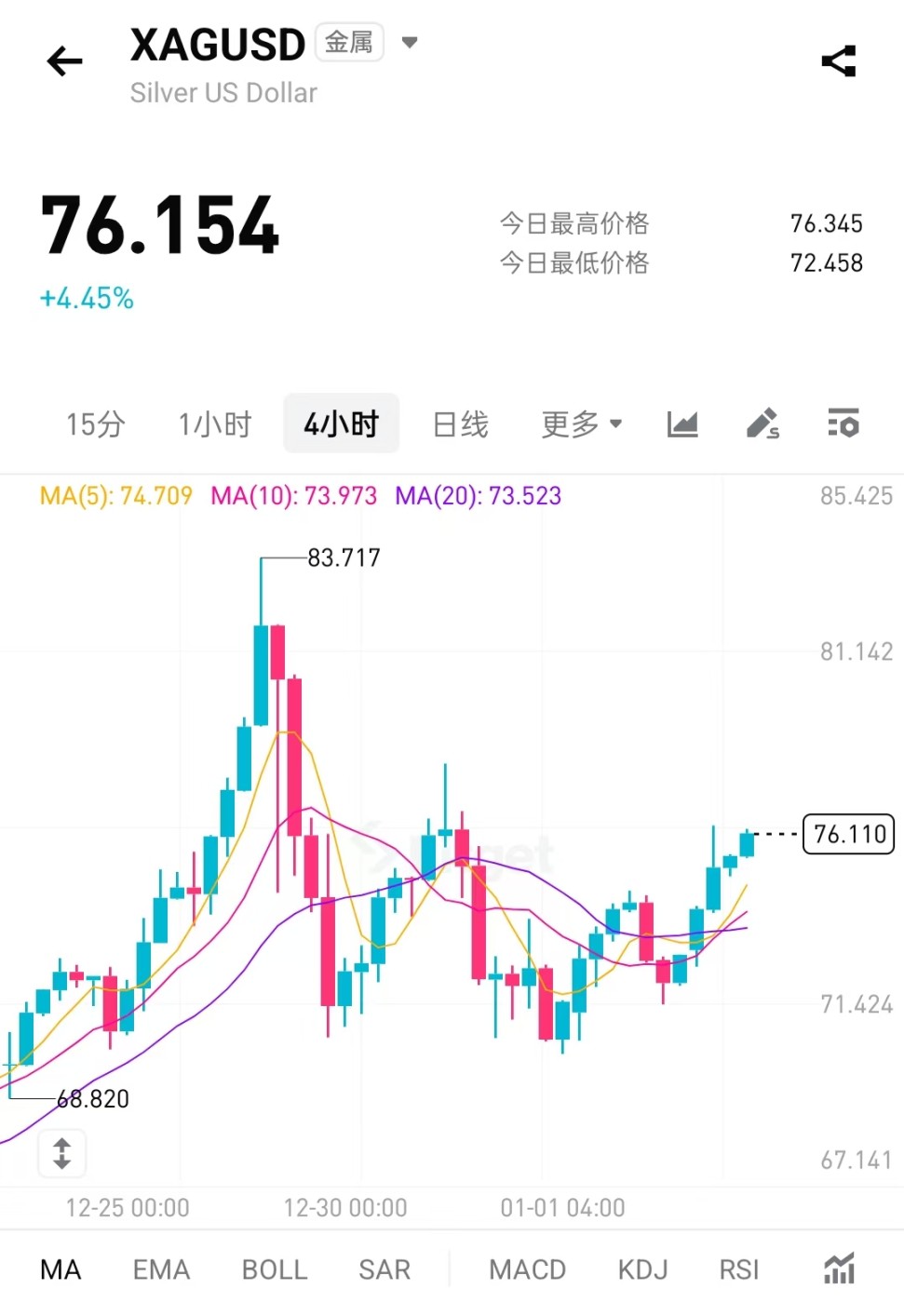
Trade execution: Place a market order, and the system displays potential profit/loss and margin requirements. Stop-loss/take-profit settings are simple. The experience was smooth during testing.
When the market is closed, investors cannot conduct buying or selling operations, including placing orders.
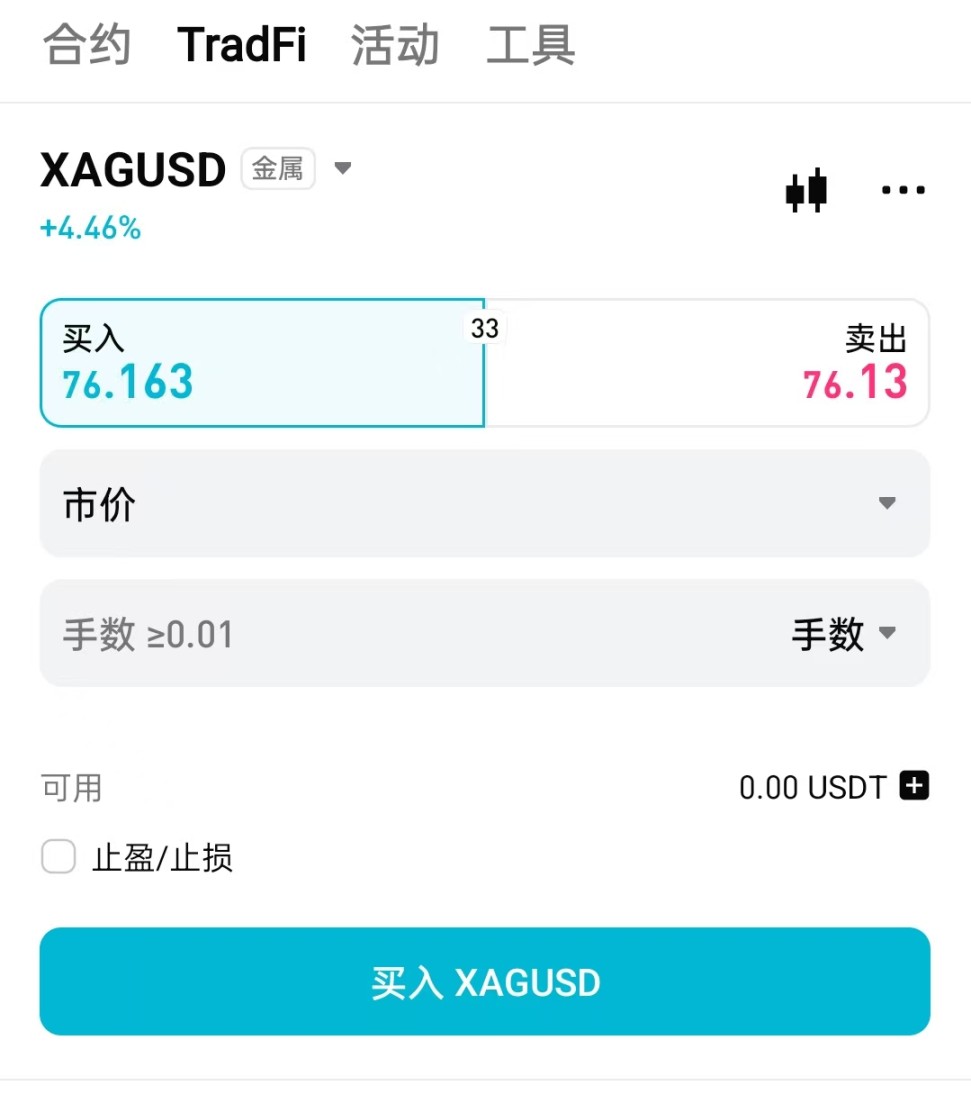
Transferring funds from MT5 back to your spot account and then withdrawing them to your wallet is free and seamless. Overall, the user experience exceeded expectations, but it's steep for beginners—MT5 has a steep learning curve. Some minor potential issues include liquidity reliance on third parties and the possibility of disruptions due to extreme events like black swan events. Compared to traditional platforms, Bitget is more flexible, but its stability may be slightly inferior.
Bitget TradFi is suitable for crypto users to scale, but they need to be more aware of the risks. In actual trading, combining it with DeFi tools can improve efficiency.
On the eve of global blockchain finance, basic infrastructure is being built in advance for all investors.
U.S. SEC Chairman Paul Atkins predicts that the entire U.S. financial market may migrate to blockchain technology, which underpins cryptocurrencies, within the next two years. "This will not only be a trend over the next 10 years, but could also become a reality in just two years. The next step will come with digital assets, market digitization, and tokenization, which will bring 'huge benefits' to transparency and risk management."
Correspondingly, Brian Armstrong, CEO of the US exchange Coinbase, recently stated that the platform's top priority for 2026 is to develop a full-fledged trading platform covering cryptocurrencies, stocks, prediction markets, commodities—including spot, futures, and options.
The tide is surging.
Before traditional finance migrates to the blockchain on a large scale, Bitget TradFi is not just about letting crypto users play with gold and silver, but about building the infrastructure in advance for all investors (regardless of their background).
The launch of Bitget TradFi may signify a shift from a pure crypto platform to a comprehensive financial services provider.
First, it expands its user base. Bitget already has 120 million users, primarily retail crypto investors. Through TradeFi, it attracts TradeFi investors into the crypto market, targeting the multi-trillion dollar forex market by integrating crypto, stocks, and on-chain assets to form a closed-loop ecosystem, increasing user stickiness. Second, it diversifies income streams. The crypto market is highly cyclical; trading volume declines during bear markets, and with altcoins generally lacking wealth effects in this cycle, market enthusiasm has plummeted. TradeFi can provide a stable source of income, reducing reliance on spot/futures trading.
As Bitget CEO Gracy Chen stated, "A wise bird chooses a good tree to perch on, and capital seeks profit. Today's traders are no longer limited to a single investment track. The mission of a trading platform is to break down boundaries and make the crossing and flow of assets safer and more efficient. The launch of TradeFi is an important part of Bitget UEX (Panorama Exchange) plan, giving users flexibility on a single platform and eliminating obstacles to cross-market trading."
Overall, Bitget TradFi is not just a product, but also one of its key strategic initiatives, and a new generation of global financial investment platform is rapidly moving forward.


