
The first week of November saw a very poor sentiment in the cryptocurrency market.
Bitcoin has fallen to even lower levels than during the "10.11" crash, failing to hold the $100,000 mark and even dropping below $99,000, a new low in the past six months. Ethereum touched a low of $3,000.
The total amount of liquidations across the network in 24 hours exceeded $2 billion, with long positions losing $1.63 billion and short positions losing $400 million.
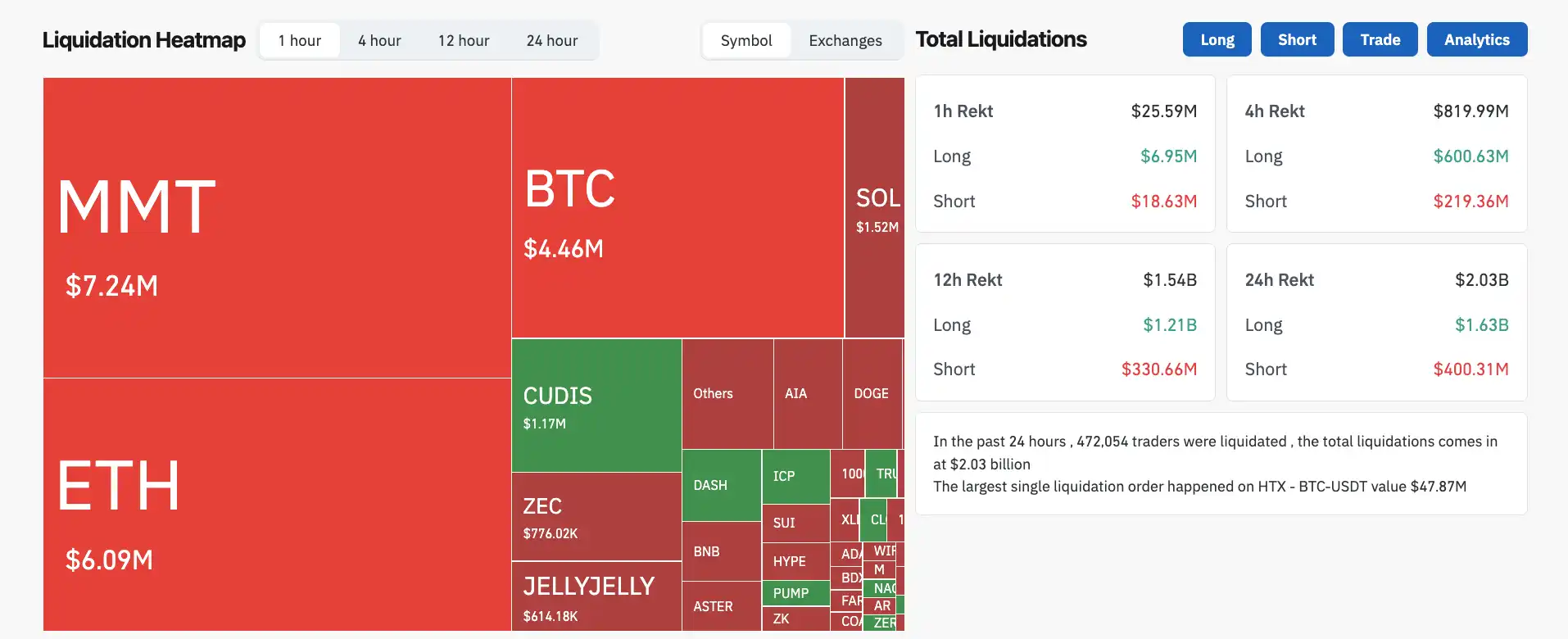
Data source: CoinGlass
The worst case was a BTC-USDT long position on the HTX trading platform, which was liquidated for a single trade of $47.87 million, directly topping the entire network's liquidation list.
There must have been some reasons for the decline, but we'll see in hindsight.
Industry insider
Two projects have run into trouble in the past two days. On November 3rd, Balancer, a well-established and renowned DeFi project, suffered a $116 million theft due to a code error. Balancer is part of DeFi infrastructure and is even older than Uniswap, so this kind of code problem has a significant impact on the industry.
On November 4, a wealth management platform called Stream Finance collapsed, with the company stating that it lost $93 million. However, the reason for the loss is unknown, and the company has not explained it. The community speculates that it happened on the day of the "October 11" stock market crash.
There's only so much money in the crypto world, and another 200 million has disappeared in the last two days.
From a macro perspective
In fact, if you look at the global capital markets, everything was falling on November 4th. Even Japanese and South Korean stocks, which had hit new highs, fell, and US stocks also fell in pre-market trading.
First, there's the interest rate cut. Last Wednesday, the Federal Reserve's speech made it seem certain that a rate cut would occur in December, suggesting there was no need to rush into a rate cut.
Then ETFs also saw net outflows. Last week, the US stock ETF for Bitcoin saw a net outflow of $802 million, and on Monday, November 3, it saw another net outflow of $180 million.
Another event on November 5th is the oral arguments of the U.S. Supreme Court's "tariff trial," which will examine the legality of Trump's imposition of global tariffs. The uncertainty lies in the fact that if the final ruling is against Trump, the tariffs may be lifted, leading to further policy adjustments.
The US federal government shutdown has entered its 35th day, tying the record for the longest shutdown in US history. The government shutdown has led institutions to hedge against high-risk assets, triggering a sell-off. This is likely one of the core reasons for the recent sharp decline.
As previously reported by Wall Street Insights, the shutdown forced the U.S. Treasury to surge its General Account (TGA) balance at the Federal Reserve from approximately $300 billion to over $1 trillion in the past three months, reaching a near five-year high. This process is equivalent to withdrawing more than $700 billion in cash from the market.
This massive liquidity withdrawal has a tightening effect comparable to several interest rate hikes. Key funding rate indicators are all in a state of emergency. According to Bloomberg, the Secured Overnight Financing Rate (SOFR) surged by 22 basis points on October 31, well above the Federal Reserve's target range, indicating that the actual cost of financing in the market has not decreased with the Fed's rate cuts. Meanwhile, the use of the Fed's Standing Repurchase Facility (SRF) is also approaching historical highs.
Spot ETFs continue to lose funds
The bleeding of funds in ETFs is actually more severe than imagined.
From October 29 to November 3, BlackRock's IBIT, the world's largest Bitcoin spot ETF with a 45% market share, saw a net outflow of $715 million over four trading days, accounting for more than half of the total outflow of $1.34 billion in the US Bitcoin ETF market.
Looking at the whole week, from October 28 to November 3, IBIT saw a net outflow of $403 million, accounting for 50.4% of the total outflow of $799 million in the entire market. On October 31, the outflow reached $149 million, setting a new record for the highest single-day outflow in the entire industry.
On November 4, BlackRock's Coinbase Prime escrow address also conducted an on-chain rebalancing of 2,043 BTC and 22,681 ETH, leading to market speculation that ETF holders are still continuously selling crypto assets.
Although IBIT's current asset size is still between $95 billion and $100 billion, holding about 800,000 Bitcoins (accounting for 3.8% of the total circulating supply), the outflow over four days corresponds to about 5,800 BTC, which also accounts for 0.7% of its holdings.
Although the proportion is not large, it is an industry leader and has a significant demonstration effect.
Looking at other major Bitcoin spot ETFs, the top five are BlackRock's IBIT, Fidelity's FBTC, Grayscale's GBTC, Bitwise's BITB, and ARKB, a collaboration between ARK and 21Shares.
Fidelity's FBTC saw a net outflow of $180 million during the same period, representing 0.7% of its size, which is considered moderate; Grayscale's GBTC saw a slowdown in redemptions after the reduction in its fee rate, with an outflow of $97 million this week; the relatively smaller BITB and ARKB both saw weekly changes of around $50 million.
This wave of redemptions is essentially a sharp drop in investor risk appetite, which coincides with expectations of high macroeconomic interest rates and a technical breakdown in Bitcoin.
Long-term holders on the blockchain are also cashing out aggressively.
Even more formidable than ETFs are the established players on the blockchain.
Over the past 30 days (October 5 to November 4), wallet addresses that held Bitcoin for more than 155 days, commonly known as "long-term holders" (LTH), net sold approximately 405,000 BTC, representing 2% of the circulating supply. Based on an average price of $105,000 during this period, this equates to cashing out more than $42 billion.
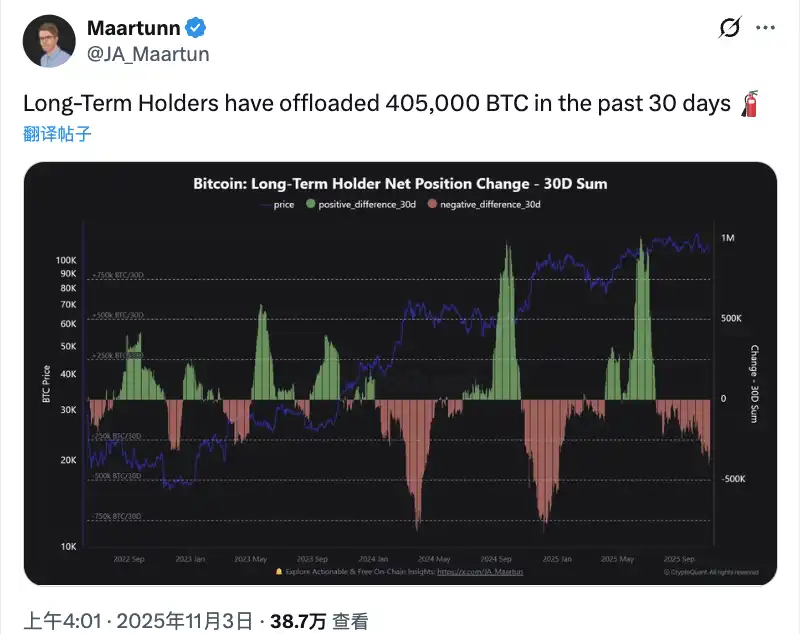
This group still holds approximately 14.4 million to 14.6 million BTC, accounting for 74% of the total circulating supply, making them the largest supplier in the market. The problem is that their selling pace perfectly matches the price movement: after Bitcoin hit a record high of $126,000 on October 6, profit-taking accelerated significantly; on the day of the "10.11" flash crash, 52,000 BTC flowed out in a single day; from the end of October to the beginning of November, coupled with four consecutive days of net outflows from ETFs, the average daily sales exceeded 18,000 BTC.
Looking at the on-chain data, the main sellers are "mid-generation" wallets holding 10 to 1000 coins—those who bought in 6 months to 1 year ago and are now seeing a paper profit of around 150%. Meanwhile, whales holding more than 1000 coins are actually slightly increasing their holdings, indicating that top players are not bearish; it's just that medium-sized profit-takers are cashing in.
In comparison to historical data, LTH saw a 5.05% sell-off in March 2024, coinciding with a 16% drop in Bitcoin's price; and a 5.2% sell-off in December of last year, resulting in a 21% drop. This October's sell-off of 2.2%, a mere 4% decrease, is actually considered relatively mild.
However, the market couldn't withstand the simultaneous outflow of funds from both ETFs and on-chain transactions; the combined effect of these two forces caused the market to collapse.
Judging the bottom of the decline
Glassnode commented that the market continues to struggle above the short-term holding cost price (approximately $113,000), a key battleground between bulls and bears. Failure to regain this level could lead to a further decline towards the active investor's actual price (approximately $88,000).
CryptoQuant CEO Ki Young Ju released a series of on-chain data last night, stating that the average cost of Bitcoin wallets is $55,900, meaning holders have made an average profit of approximately 93%. On-chain fund inflows remain strong. The price is unable to rise due to weak demand.
Markus Thielen, CEO of 10x Research, stated after the market decline that Bitcoin is approaching the support line established since the crash on October 10th. A break below $107,000 could see it fall to $100,000.
Chinese crypto KOL Banmuxia publicly stated today that "the traditional four-year bull market cycle has ended, and Bitcoin will gradually fall to $84,000, then experience several months of complex fluctuations, before surging to $240,000 by the end of next year or the beginning of next year, following the bubble burst in the US stock market."
The only good news at present is that Bitcoin has historically risen in November on average.