1. Introduction: Breaking the threshold of Wall Street, US stocks are no longer far away
For a long time, investing in U.S. stocks has always been a complicated and difficult thing for ordinary people. The high account opening funds, cumbersome account opening procedures, and restrictions on regions and trading hours have made it difficult for many ordinary investors to truly enter the U.S. stock market.
With the rise of US stock tokenization (RWA US stocks), this situation is changing. Through Web3 technology, US stock investment is becoming simple and easy. Anyone can easily invest in Tesla, Apple and other top global companies with a small amount of money.
The tokenization of US stocks is changing the way ordinary people participate in global investment. This article will help you sort out its gameplay, thresholds and potential risks, so that you can avoid pitfalls and stay one step ahead.

2. What new opportunities does the tokenization of U.S. stocks bring to ordinary people?
24-hour non-stop trading, seize market opportunities at any time
Traditional US stock trading is only conducted during specific hours when the US stock market is open, which is not friendly to non-US investors and can easily lead to missed investment opportunities. US stock tokenization provides a 24-hour trading environment through on-chain trading, allowing investors to capture market opportunities at any time.
The threshold has been greatly lowered, and everyone can invest in top companies
In the past, it took a large amount of capital to buy well-known stocks such as Tesla, Apple, and Amazon. However, tokenized U.S. stocks cut high-priced stocks into small shares, and people can participate in the investment with just a few dozen dollars, making it truly accessible to everyone.
More investment channels and more opportunities for asset appreciation
The returns from traditional stock investments mainly come from stock price increases and dividends, while tokenized assets can also participate in the DeFi ecosystem, such as lending and yield farming, so that investors can obtain more diversified and more efficient sources of income.
Eliminate various restrictions on cross-border investment and make global asset allocation more convenient
For example, mainland investors who want to invest in U.S. stocks need to apply for a foreign currency bank card, but it is increasingly difficult to open an overseas bank account, and there are many restrictions on the inflow and outflow of funds. In addition, even if you successfully apply for a Hong Kong bank card, the capital threshold for opening an account with a local brokerage firm is high (such as a minimum deposit of HK$100,000) or requires specific conditions (such as having an account with other foreign brokerage firms), and the process is cumbersome and complicated.
The tokenization of U.S. stocks does not require any foreign currency bank cards. You only need a digital wallet to invest in the world's top companies. This truly breaks the limitations of geography and capital, making global asset allocation extremely simple.
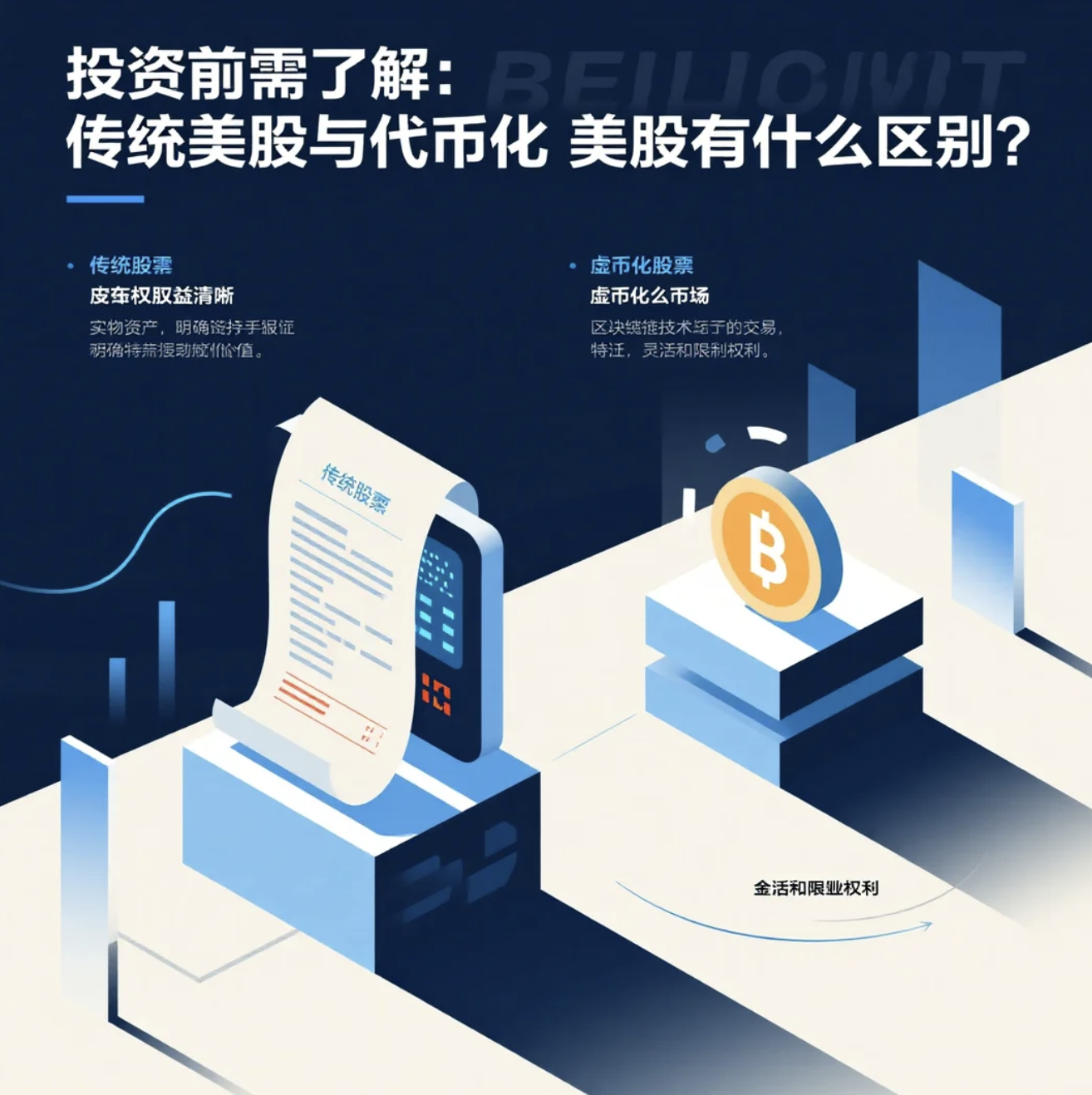
3. What you need to know before investing: What is the difference between traditional US stocks and tokenized US stocks?
Traditional US stocks: clear shareholder rights
Traditional U.S. stock investment means directly owning a company's shares, with clear voting rights and shareholder dividend rights, and investors enjoy mature supervision and legal protection.
Tokenized US stocks: flexible but limited rights
Investors in tokenized U.S. stocks usually do not have shareholder voting rights, and dividends may be distributed in the form of tokens, focusing more on the gains brought by price fluctuations. Investors need to pay more attention to the security, reputation and regulatory compliance of the platform.
4. Beginner’s guide: How to avoid the pitfalls of tokenized U.S. stock investment?
Clarify the true rights of investing in tokens
Before investing in tokenized U.S. stocks for the first time, you must be clear about the asset custodian behind the token, the nature of the assets, whether there are dividends, voting rights and other specific rights.
Focus on platform security and compliance
Choose a platform with good reputation and strong compliance to avoid the risk of fraud or platform running away. Refer to community reputation, compliance documents and regulatory information.
Pay attention to liquidity risk
Some token markets are small, trading volume is insufficient, and the bid-ask spread may be large. It is recommended to choose a platform with a large user base and good liquidity.
Be careful with leverage trading
Investors who are new to tokenized assets should avoid blindly using high leverage to prevent investment risks from being magnified and causing unnecessary losses.
5. Conclusion: Invest rationally and obtain long-term returns steadily
So how can ordinary people participate in the tokenization of US stocks? At present, many platforms have launched related products, such as Robinhood (EU users only), Synthetix, Mirror Protocol, Backed Finance, and the recently popular Mountain Protocol (packaging US bond returns in the form of tokens), Swarm, DeVol, etc. on Solana. They differ in compliance, trading experience, and participation threshold.
for example:
Robinhood EU version: supports tokenized stocks of popular private companies such as OpenAI and SpaceX, but only for EU users.
Synthetix: Focusing on the synthetic asset model, you trade on-chain price exposure rather than custody of real stocks.
Backed Finance (BDE, bNVDA): These are real custody securities assets, aimed at qualified investors, and have strong compliance.
Swarm: operates under the EU licensing framework, and some products are also open to retail users.
If you are a beginner, it is recommended to start with a platform that has a friendlier trading experience and more transparent information disclosure, and focus on:
Does this platform actually custody the underlying shares?
Is there a statutory mandate or filing in a specific jurisdiction?
Does it support small transactions?
Are there any withdrawal restrictions or lock-up mechanisms?
The product structure and risk exposure of different platforms are different. Don’t assume that just because you see the words “OpenAI” or “NVDA” they are exactly the same as real stocks.
Choosing an entry point that suits you and starting with small, experiential products is a safer way to get started.
The tokenization of US stocks has opened a door to the global capital market for ordinary people. Although investment is more convenient, investors still need to participate rationally, fully understand the risk and return characteristics of investment, and do a good job of risk management.
Seize the opportunity, enter the market cautiously, and make the tokenization of U.S. stocks an important step in your stable investment.