Written by: TechFlow
On May 27, an unknown little stock created a huge wave in the Nasdaq trading hall.
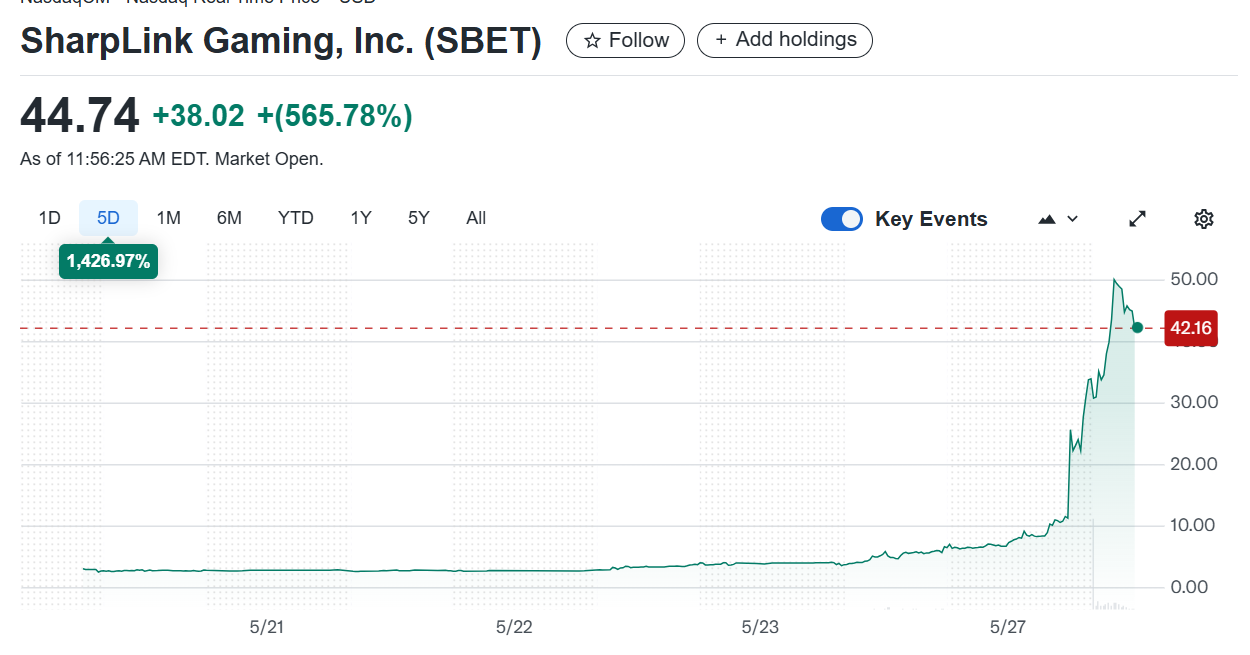
SharpLink Gaming (SBET), a small gaming company with a market cap of just $10 million, announced that it has purchased approximately 163,000 Ethereum (ETH) through a $425 million private equity investment.
As soon as the news came out, SharpLink's stock price skyrocketed, with the increase exceeding 500% at one point.
Buying coins may be becoming the new wealth code for U.S. listed companies to increase their stock prices.
The source of the story is naturally MicroStrategy (now renamed Strategy, stock code MSTR), the company that first ignited the war and made a bold bet on Bitcoin as early as 2020.
In five years, it has transformed from an ordinary technology company into a "Bitcoin investment pioneer." In 2020, MicroStrategy's stock price was just over $10; by 2025, the stock had soared to $370, with a market value of over $100 billion.
Buying coins not only inflated MicroStrategy's balance sheet, but also made it a darling of the capital market.
In 2025, the craze intensified.
From technology companies to retail giants to small gaming businesses, U.S.-listed companies are using cryptocurrencies to ignite a new valuation engine.
What is the secret to increasing the market value of wealth by buying coins?
MicroStrategy, a textbook on how to combine cryptocurrencies and stocks
It all started with MicroStrategy.
The enterprise software company pioneered the U.S. stock-buying craze in 2020, with CEO Michael Saylor saying Bitcoin is a “more reliable store of value than the U.S. dollar”;
Recharging faith is exciting, but what really makes this company stand out is the way it plays in the capital market.
MicroStrategy's approach can be summarized as a combination of "convertible bonds + Bitcoin":
First, the company raised funds by issuing low-interest convertible bonds.
Since 2020, MicroStrategy has issued such bonds several times, with interest rates as low as 0%, far below the market average. For example, in November 2024, it issued $2.6 billion in convertible bonds with almost zero financing costs.
These bonds allow investors to convert them into company shares at a fixed price in the future, giving investors a call option while allowing the company to obtain cash at a very low cost.
Secondly, MicroStrategy invested all the funds raised in Bitcoin. Through multiple rounds of financing, it continued to increase its holdings of Bitcoin, making Bitcoin a core component of the company's balance sheet.
Finally, MicroStrategy took advantage of the premium effect brought about by the rising price of Bitcoin to start a set of "flywheel effects."
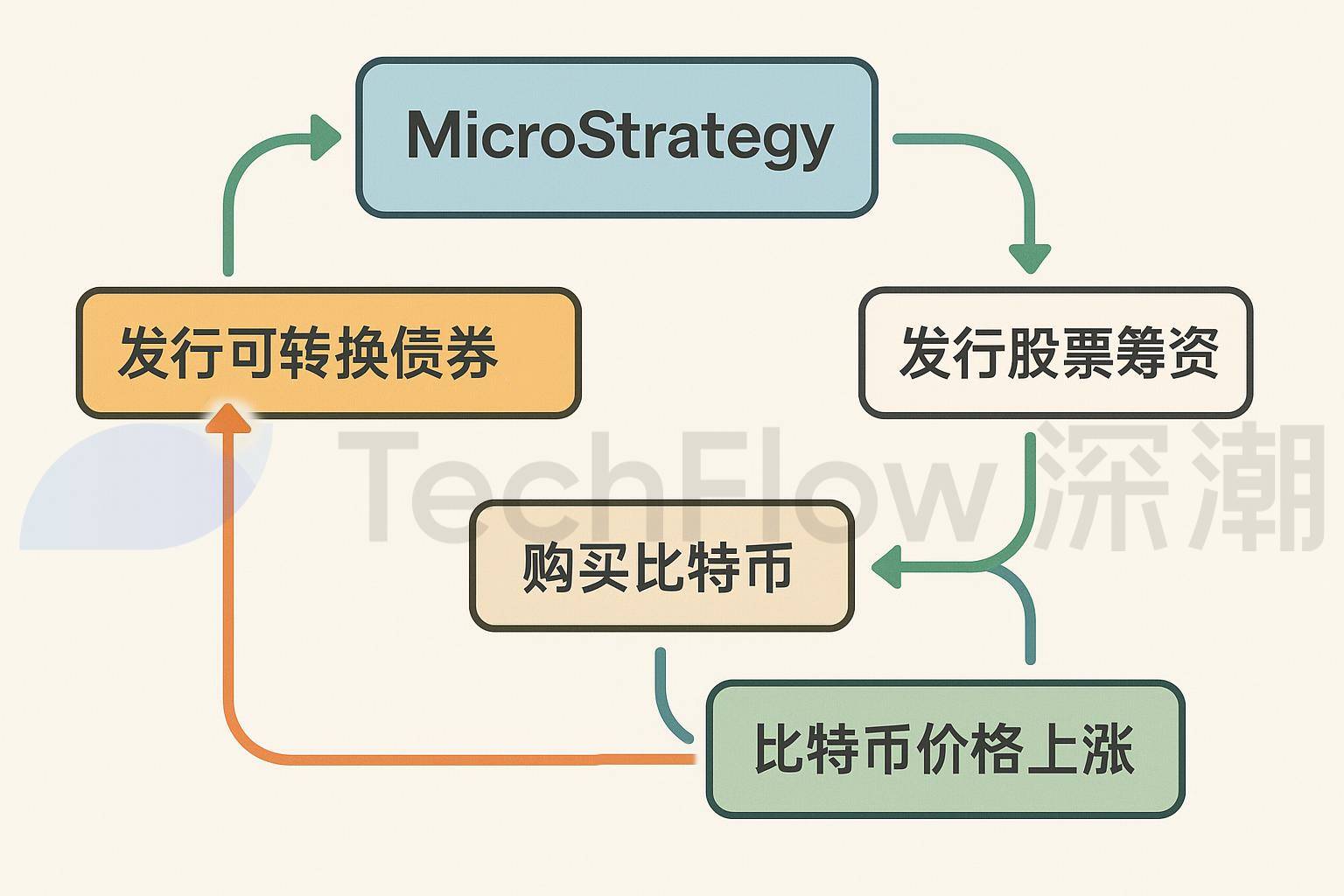
When the price of Bitcoin rises from $10,000 in 2020 to $100,000 in 2025, the value of the company's assets increases significantly, attracting more investors to buy stocks. The rise in stock prices allows MicroStrategy to issue bonds or stocks again at a higher valuation, raise more funds, and continue to purchase Bitcoin, thus forming a self-reinforcing capital cycle.
The core of this model is the combination of low-cost financing and high-return assets. Borrow money at almost zero cost through convertible bonds, buy Bitcoin, which is highly volatile but bullish in the long term, and then use the market's enthusiasm for cryptocurrencies to amplify valuations.
This approach not only changed MicroStrategy's asset structure, but also provided a textbook example for other US stock companies.
SharpLink, backdoor listing is not for wine
SharpLink Gaming (SBET) has optimized the above gameplay by using Ethereum (ETH) instead of Bitcoin.
But behind this is the ingenious combination of the power of the cryptocurrency circle and the capital market.
Its gameplay can also be summarized as "shelling". The core is to use the "shell" of listed companies and encrypted narratives to quickly amplify the valuation bubble.
SharpLink was originally a small company struggling on the brink of delisting from NASDAQ. Its stock price was once less than $1, and its shareholders' equity was less than $2.5 million, facing enormous compliance pressure.
But it has a killer feature - its Nasdaq listing status.
This "shell" attracted the attention of a giant in the cryptocurrency world: ConsenSys, led by Ethereum co-founder Joe Lubin.
In May 2025, ConsenSys, together with several crypto venture capital firms (such as ParaFi Capital and Pantera Capital), led the acquisition of SharpLink through a $425 million PIPE (private equity financing).
They issued 69.1 million new shares at $6.15 per share, quickly taking over 90% of SharpLink, eliminating the cumbersome process of an IPO or SPAC. Joe Lubin was appointed chairman of the board, and ConsenSys made it clear that it would work with SharpLink to explore the "Ethereum Treasury Strategy."
Some people say this is the ETH version of MicroStrategy, but in fact the gameplay is more sophisticated.
The real purpose of this transaction is not to improve SharpLink's gambling business, but to make it a bridgehead for the cryptocurrency circle to enter the capital market.
ConsenSys plans to use the $425 million to purchase approximately 163,000 ETH, package it as the "Ethereum version of MicroStrategy", and claim that ETH is a "digital reserve asset."
The capital market is about "story premium". This narrative not only attracts speculative funds, but also provides a "public ETH proxy" for institutional investors who cannot directly hold ETH.
Buying coins is just the first step. The real "magic" of SharpLink lies in the flywheel effect. Its operation can be broken down into a three-step cycle:
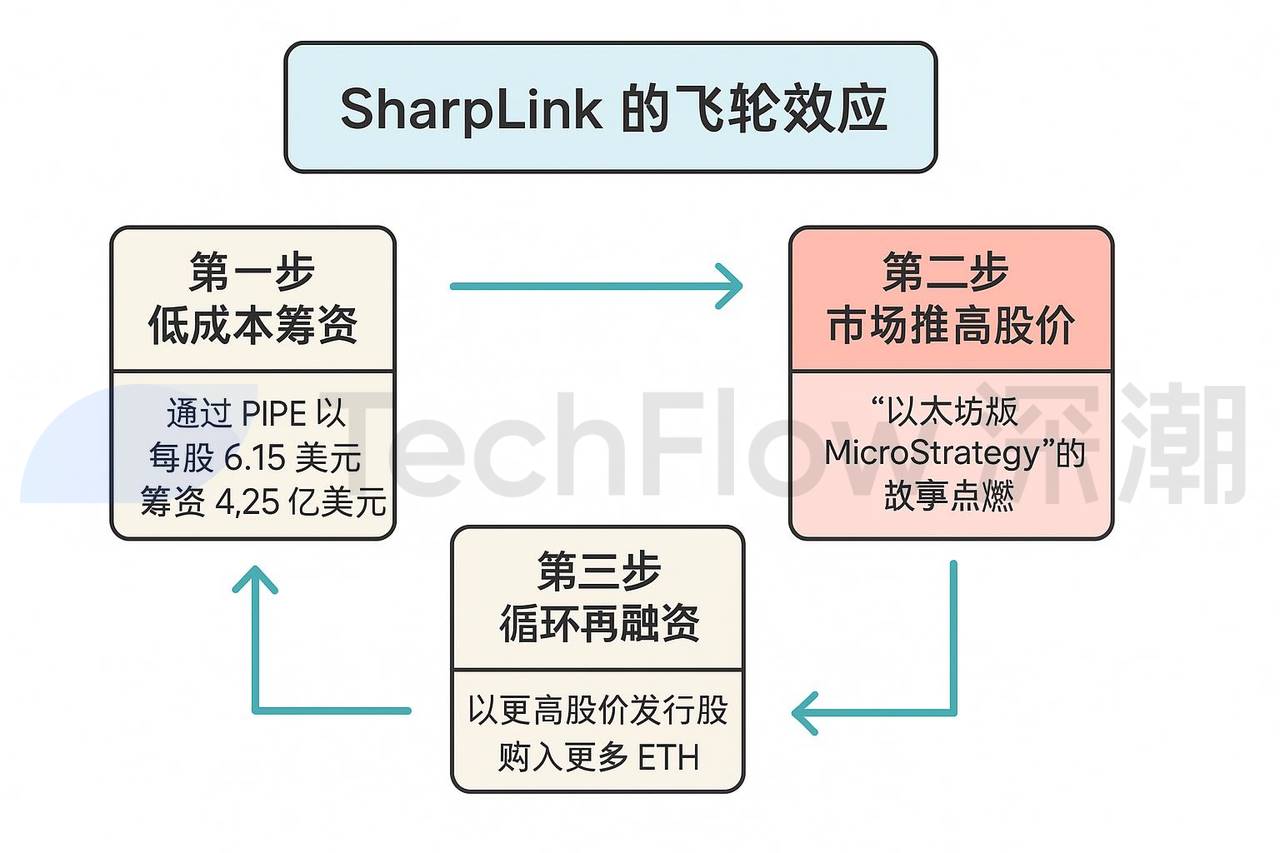
The first step is to raise funds at low cost.
SharpLink raised $425 million at $6.15 per share through PIPE, which is less expensive than an IPO or SPAC because it does not require cumbersome roadshows and regulatory processes.
In the second step, market enthusiasm pushes up stock prices.
Investors were ignited by the story of "MicroStrategy of Ethereum", and the stock price soared rapidly. The market's enthusiasm for SharpLink's stock far exceeded its asset value, and investors were willing to pay a price far higher than the net value of their ETH holdings. This "psychological premium" caused SharpLink's market value to expand rapidly.
SharpLink also plans to stake these ETH tokens, lock them in the Ethereum network, and earn an annualized return of 3%-5%.
The third step is circular refinancing. By issuing shares again at a higher share price, SharpLink can theoretically raise more funds and buy more ETH, and the cycle will continue, with the valuation snowballing.
Behind this "capital magic" lies the shadow of bubbles.
SharpLink’s core business — gambling marketing — is almost ignored, and its $425 million ETH investment plan is completely disconnected from its fundamentals. Its stock price has skyrocketed, driven more by speculative funds and crypto narratives.
The truth is, cryptocurrency capital can also use the "shell + coin buying" model to quickly inflate valuation bubbles by using the shells of some small and medium-sized listed companies.
The real purpose lies elsewhere. It would be good if the business of the listed company itself is related, but it doesn’t really matter if there is no connection.
Imitation is not a panacea
The coin buying strategy seems to be the "wealth code" of U.S. listed companies, but it is not always effective.
The road of imitation is crowded with latecomers.
On May 28, GameStop, a gaming retail giant that once became famous for its retail investors’ collective battle against Wall Street, announced that it had purchased 4,710 bitcoins for $512.6 million in an attempt to replicate MicroStrategy’s success. However, the market reaction was cold: after the announcement, GameStop’s stock price fell 10.9%, and investors were not buying it.
On May 15, Addentax Group Corp (stock code ATXG, Chinese name Yingxi Group), a Chinese textile and apparel company, announced plans to purchase 8,000 bitcoins and Trump's TRUMP coin by issuing common stock. At the current bitcoin price of $108,000, the purchase cost will be more than $800 million.
But in contrast, the company's total stock market value is only about 4.5 million US dollars, which means that its theoretical coin purchase cost is more than 100 times the company's market value.
Almost at the same time, another Chinese US-listed company Jiuzi Holdings (stock code JZXN, Chinese name Jiuzi Holdings) also joined the coin buying craze.
The company announced plans to purchase 1,000 bitcoins over the next year at a cost of more than $100 million.
Public information shows that Jiuzi Holdings is a Chinese company focusing on new energy vehicle retail, founded in 2019. The company's retail stores are mainly distributed in China's third-tier and fourth-tier cities.
The total market value of this company's stock on Nasdaq is only about 50 million US dollars.
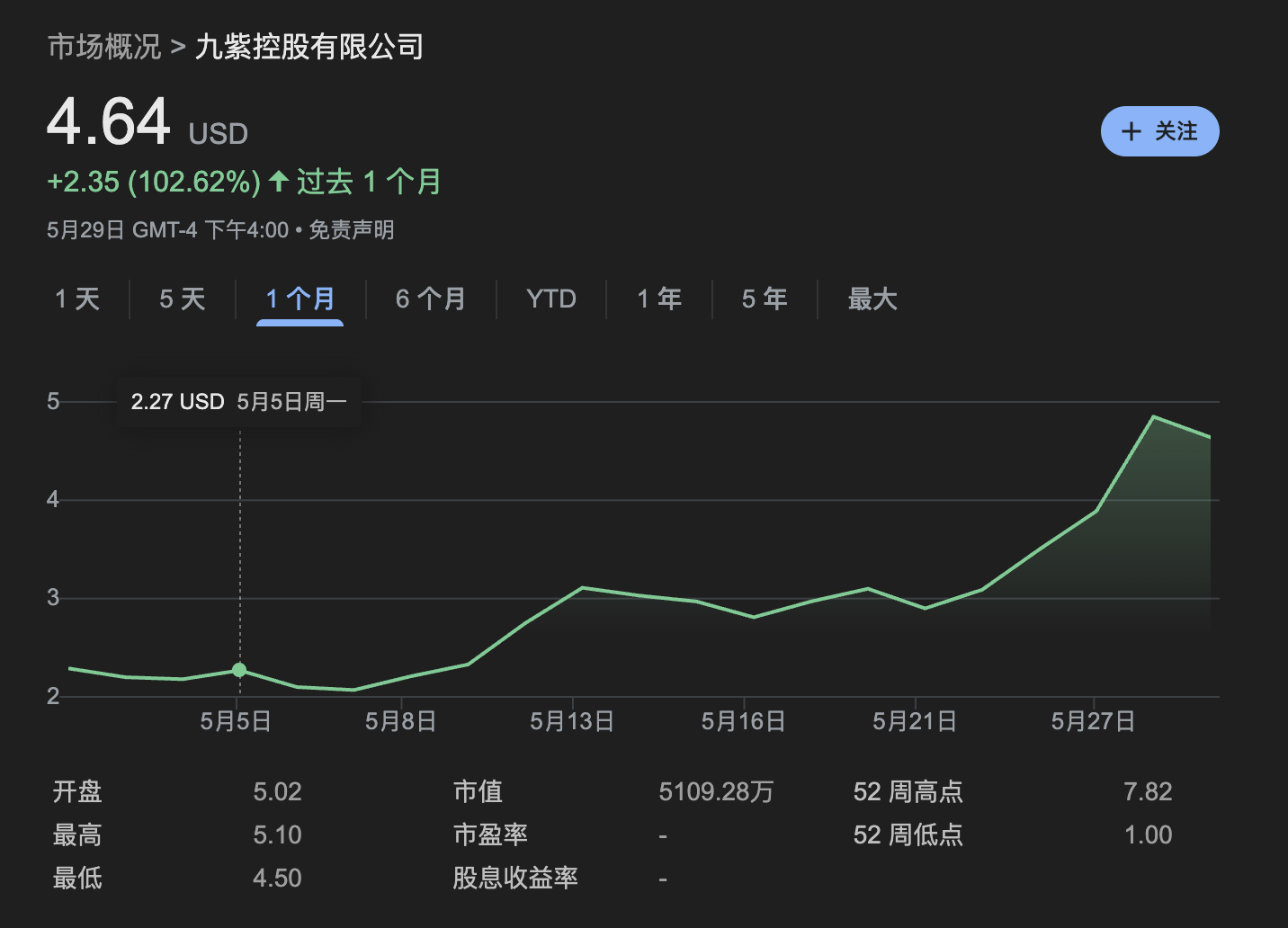
The stock price is indeed rising, but the match between the company's market value and the cost of buying coins is the key.
For more latecomers, if the price of Bitcoin falls, if they really buy it, their balance sheets will face tremendous pressure.
The strategy of buying coins is not a universal code for wealth. Buying coins without fundamental support and excessive leverage may just be a risk leading to a bubble burst.
Another way out
Despite the risks, the cryptocurrency buying craze could become the new normal.
In 2025, global inflationary pressure and expectations of dollar depreciation will continue, and more and more companies will begin to view Bitcoin and Ethereum as "anti-inflation assets." Japan's Metaplanet has increased its market value through the Bitcoin treasury strategy, and more US listed companies are also following MicroStrategy's path faster and faster.
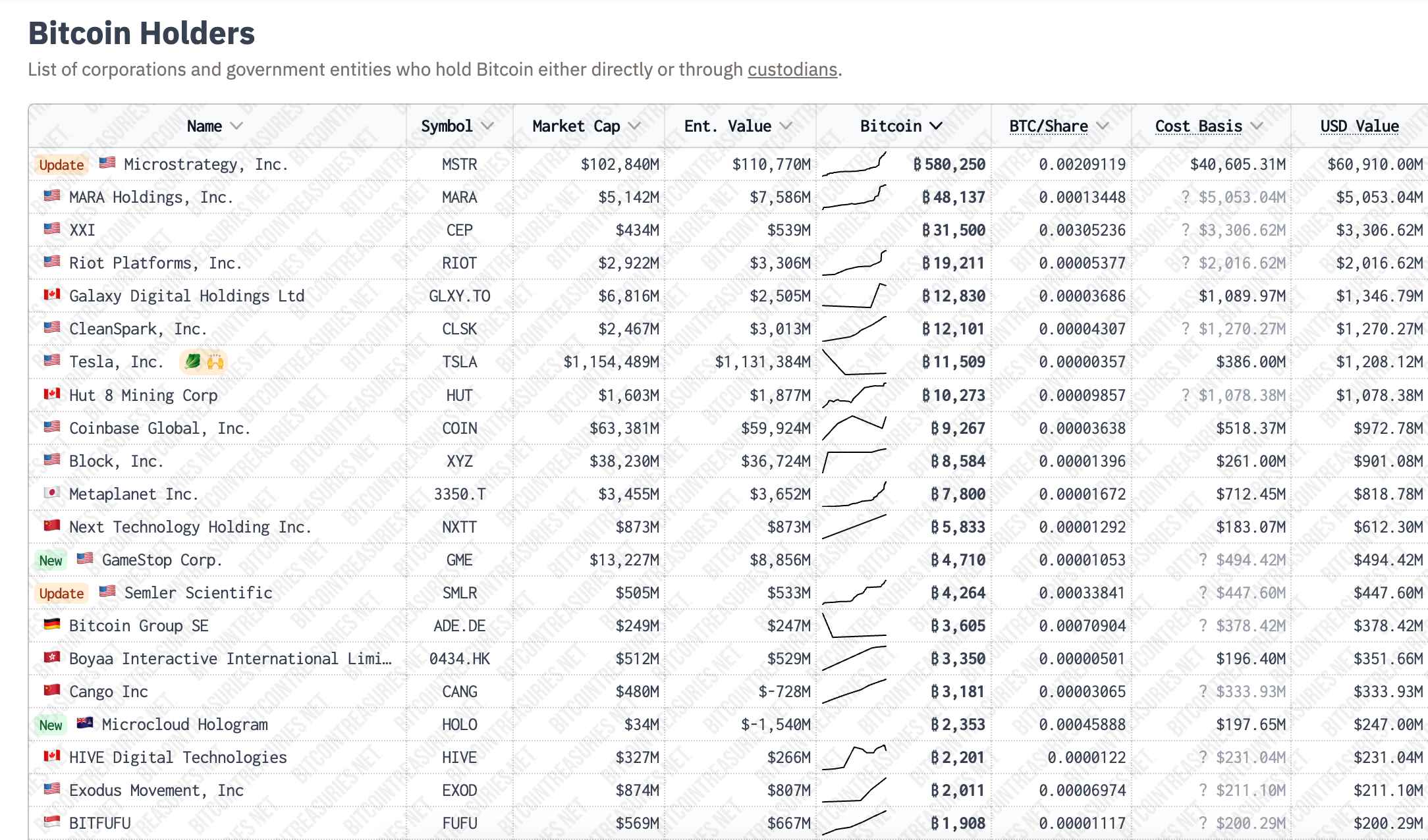
Under the general trend, cryptocurrencies are increasingly appearing in the global political and economic fields.
Is this a kind of “out-of-circle” that people in the cryptocurrency circle often talk about?
Looking at the current trends, there are two main paths for cryptocurrencies to go mainstream: the rise of stablecoins and crypto reserves in corporate balance sheets.
On the surface, stablecoins provide a stable medium for payment, savings and remittance in the crypto market, reduce volatility and promote the widespread use of cryptocurrencies. But in essence, they are an extension of the hegemony of the US dollar.
Taking USDC as an example, its issuer Circle has close ties with the US government and holds a large amount of US debt as reserve assets. This not only strengthens the US dollar's status as a global reserve currency, but also further penetrates the influence of the US financial system into the global crypto market through the circulation of stablecoins.
Another way out of the circle is for listed companies to buy coins as mentioned above.
Coin-buying companies attract speculative funds and push up stock prices through encryption narratives, but apart from a few leading companies, it remains a mystery as to how much the fundamentals of their main businesses can be improved by later imitators, other than increasing market valuations.
Whether it is stablecoins or crypto assets entering the balance sheets of listed companies, crypto assets look more like a tool to continue or strengthen the previous financial structure.
Whether it is about harvesting leeks or financial innovation, it is more like looking at the two sides of a coin, depending on which side of the table you sit at.