
The Merrill Lynch Investment Clock is an asset allocation framework based on the economic cycle. It divides the economic cycle into four stages (recovery, overheating, stagflation, and recession) by analyzing the trends of economic growth and inflation, and recommends corresponding investment asset categories for each stage.
In the field of cryptocurrency, due to the significant differences between its market characteristics and traditional financial markets (such as high volatility, decentralization, policy impact, etc.), we need to redefine a "Crypto Merrill Lynch Clock" exclusively for the cryptocurrency field, combining the unique attributes and driving factors of the crypto market.
1. The Four Phases of the Crypto-Merrill Lynch Clock
1. Crypto Recovery
Market characteristics:
On-chain activity is recovering: On-chain transaction volume, active addresses, and decentralized finance (DeFi) total locked value (TVL) are starting to pick up.
Investor Sentiment: Fear is fading (Fear & Greed Index turned from Extreme Fear to Neutral).
Macro environment: Global liquidity is loose, the US dollar index is weakening, and the preference for risky assets is rising.
Policy environment: Regulatory expectations are clear or relaxed, and institutions are beginning to re-enter the market.
Technical indicators: The prices of major cryptocurrencies such as Bitcoin have broken through key resistance levels (such as the 200-day moving average), and technological innovations (such as Layer 2 expansion and protocol upgrades) have driven market confidence.
Recommended assets:
Core assets: Blue-chip cryptocurrencies such as Bitcoin (BTC) and Ethereum (ETH) are suitable as the first choice for market recovery because of their strong risk resistance.
Growth assets: Layer 1 public chain tokens (such as SOL, ADA, AVAX), because of their great potential for ecological expansion.
Stablecoin hedging: holding some stablecoins (such as USDT, USDC) to cope with fluctuations.
Investment strategy:
Build positions in core assets when prices are low, and pay attention to early opportunities in emerging public chains and DeFi projects.
Participate in staking or liquidity mining to earn extra income.
Pay attention to on-chain data (such as growth in active addresses and rising gas fees) to confirm the recovery trend.
2. Crypto Overheating
Market characteristics:
On-chain activity is high: Transaction volumes in areas such as DeFi, NFT, and GameFi have surged, and on-chain gas fees have soared.
Investor Sentiment: Greedy sentiment dominates (the Fear and Greed Index enters the extreme greed range).
Macro environment: Global risk asset boom, and high FOMO (Fear of Missing Out) sentiment among retail and institutional investors.
Policy environment: Regulatory risks lurk, but the market temporarily ignores negative news.
Technical indicators: RSI (Relative Strength Index) is overbought, the prices of altcoins are rising rapidly, and an "Altseason" has emerged.
Recommended assets:
High-risk, high-return assets: small and medium-cap altcoins, DeFi tokens, NFT-related projects, Metaverse/GameFi tokens.
Leveraged tools: perpetual contracts, options and other derivatives (suitable for those with high risk appetite).
Meme coins: such as DOGE, SHIB, etc., may experience a short-term surge due to retail investor enthusiasm.
Investment strategy:
Chase hot sectors (such as NFT, GameFi, AI+ blockchain), but set a stop-profit point.
Reduce core asset holdings and increase allocations to small and medium-sized market capitalization tokens.
Be wary of market bubbles and pay attention to capital flows (such as whale wallet movements and net inflows into exchanges).
3. Crypto Stagflation
Market characteristics:
On-chain activity slowed down: transaction volumes declined, DeFi TVL growth stagnated, and NFT trading volumes shrank.
Investor sentiment: The market is in a wait-and-see state, and the Fear and Greed Index tends to be neutral with a slight bias towards fear.
Macroeconomic environment: Global economic uncertainty increased, liquidity tightened, and the US dollar index strengthened.
Policy environment: Regulatory pressure has intensified (such as tax policies and anti-money laundering regulations), and market confidence has been dampened.
Technical indicators: Prices are moving sideways or slightly down, volatility is decreasing, and the market lacks a clear direction.
Recommended assets:
Defensive assets: Stablecoins (USDT, USDC, DAI) to avoid volatility risks.
Core assets: Bitcoin and Ethereum, due to their market dominance and relative stability.
Yield-generating assets: Participate in low-risk DeFi protocols (such as Curve, Aave) to obtain stable returns.
Investment strategy:
Reduce leverage and reduce exposure to high-risk assets.
Hold stablecoins or participate in stablecoin mining to preserve value.
Pay attention to policy trends and on-chain data, and look for market bottom signals.
4. Crypto Recession
Market characteristics:
On-chain activity is sluggish: transaction volume and TVL have dropped significantly, and the NFT and altcoin markets are close to freezing point.
Investor sentiment: Extreme fear, huge selling pressure, and the fear and greed index is at a low level.
Macroeconomic environment: Global economic recession, risk assets falling across the board, and liquidity extremely tight.
Policy environment: high regulatory pressure (such as crypto bans, exchange restrictions), and institutional withdrawal from the market.
Technical indicators: Bitcoin fell below key support levels, altcoins generally plummeted, and market liquidations were frequent.
Recommended assets:
Safe-haven assets: Stablecoins (USDT, USDC) may completely exit the crypto market.
Core assets: Hold a small amount of Bitcoin and Ethereum, waiting for the market to reverse.
Cash equivalents: Fiat currency or other low-risk assets (such as gold).
Investment strategy:
Cash is king, reduce crypto exposure.
Focus on long-term value projects (such as Ethereum ecosystem and cross-chain protocols) to build positions at low prices.
Monitor on-chain data and macro indicators (such as Federal Reserve policy, on-chain liquidation data) to determine the bottom.
2. Driving Factors of Crypto-Merrill Lynch Clock
Unlike the traditional Merrill Lynch clock, which relies on economic growth and inflation, the Crypto Merrill Lynch clock's cycle estimates are driven by the following factors:
On-chain data: number of active addresses, transaction volume, TVL, Gas fees, etc. reflect market activity.
Investor sentiment: Fear and Greed Index, social media sentiment, Google Trends, etc.
Macroeconomics: US dollar index, interest rate policy, and global liquidity.
Regulatory policies: regulatory attitudes of various countries towards cryptocurrencies (such as the US SEC and the EU MiCA regulations).
Technological innovation: such as Ethereum upgrades (such as mergers, Dencun upgrades), Layer 2 expansion, cross-chain technology, etc.
Market structure: BTC Dominance, altcoin rotation, and institutional participation.
↓Illustration of the Crypto-Merrill Lynch Clock↓
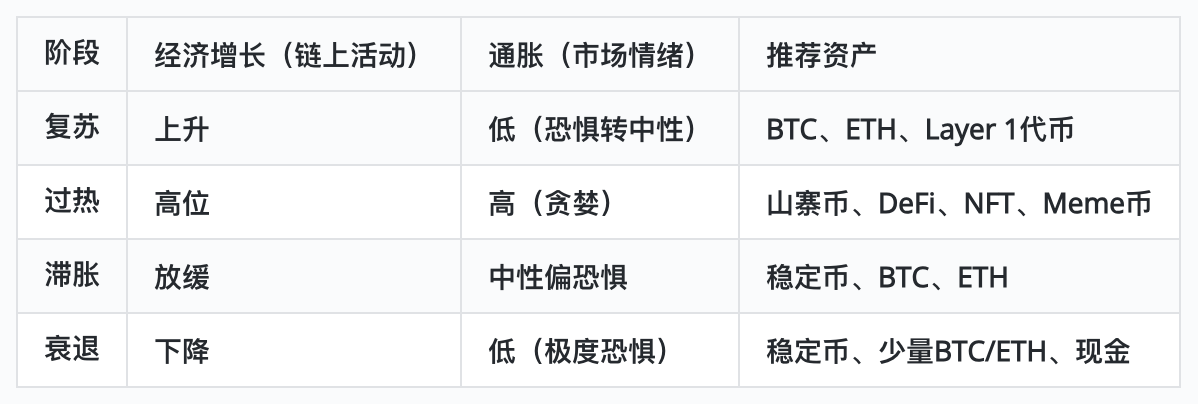
3. Precautions and usage
High volatility: The volatility of the crypto market far exceeds that of the traditional market, and the cycle switching may be faster, so it is necessary to pay close attention to on-chain and market data.
Regulatory risk: Policy changes could lead to a cycle jump (e.g., directly from overheating to recession).
Technology-driven: Major technological upgrades (such as Ethereum sharding and Bitcoin Taproot) may trigger unexpected cyclical turns.
Data tools: It is recommended to use tools such as Dune Analytics, Glassnode, CryptoQuant, etc. to monitor on-chain indicators and use the Fear and Greed Index to judge market sentiment.
Different market participants use the CryptoMerrill Lynch clock in different ways:
Investors: Adjust asset allocation according to the current market stage to balance risks and returns.
Traders: Use windows of cycle switching (such as recovery to overheating) to capture short-term opportunities.
Long-term holders: accumulate core assets at low prices during recession and recovery phases, ignoring short-term fluctuations.
DeFi participants: Participate in high-yield protocols during the recovery and overheating phases, and switch to low-risk strategies during the stagflation and recession phases.
Currently, according to market data in May 2025, the crypto market is in the "recovery" stage. On-chain activities (such as BTC transaction volume and number of active addresses) increased by more than 12%, DeFi TVL stabilized, investor sentiment shifted from fear to neutral, and the fear and greed index was neutral. Trump's coming to power and SEC's loosening of regulations boosted confidence, but the macro economy (such as the US Q1 GDP contracted by 0.3%) and tariff policies brought volatility risks.
For the recent strategy, it is recommended to prioritize the allocation of core assets such as Bitcoin and Ethereum, and pay attention to the high-performance public chain (SOL). Build positions on dips, participate in DeFi staking to gain returns, and set stop losses to cope with fluctuations. Use tools such as Glassnode to monitor on-chain data and be wary of regulatory and macro risks. At the same time, use crypto options (Long Put) to prevent the risk of falling.