
Recently, when Lawyer Mankiw was surfing the Internet, he saw the following news: A Hong Kong court issued a tokenized legal notice to two illegal wallets on the Tron network. According to reports, the case was an online fraud involving approximately 2.65 million USDT. In this way, the Hong Kong court tokenized the judicial notice and "airdropped" it to the wallet involved, while warning that any subsequent transactions may violate criminal law.
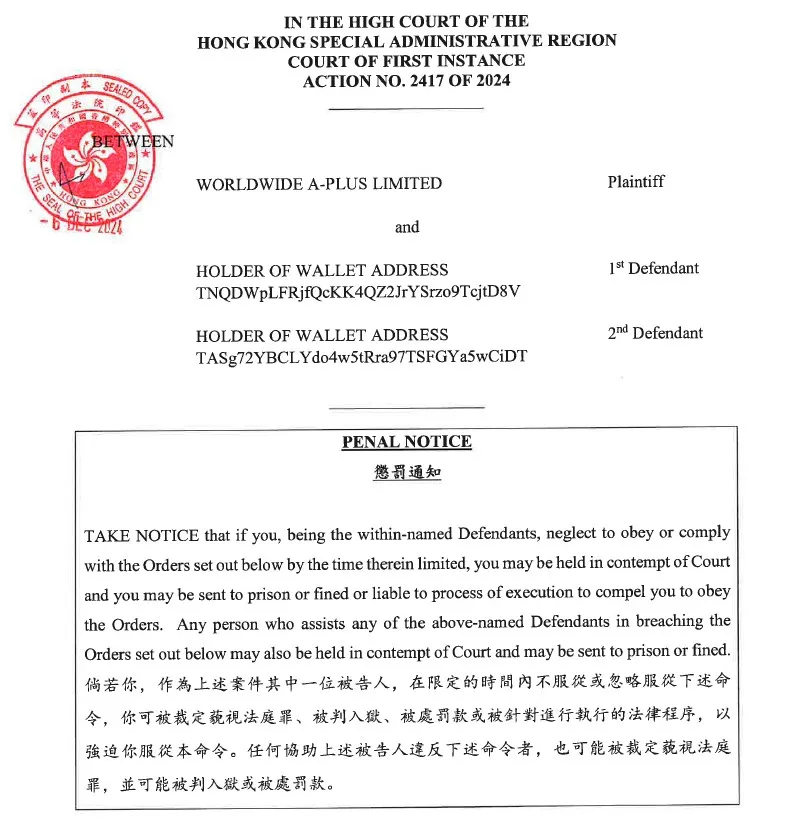
In fact, this method is not the first in Hong Kong. As early as 2022, RBB Lab, a technology development company in the Republic of San Marino, used NFT technology to issue court summonses to a former employee and a contractor. In addition, the United Kingdom and the United States have also used blockchain technology to airdrop legal documents to anonymous wallets.
However, what is certain is that Hong Kong's use of this technology to send judicial documents has undoubtedly opened up a new judicial landscape.
Document tokenization, a new judicial landscape
Whether it is delivered face-to-face, delivered by mail or published in public notices, traditional judicial notices require knowing who the person notifying is, where he lives and how to contact him. However, the decentralization and anonymity of the blockchain network allow everyone to hide behind the wallet address, and no other information is known except what was done.
This poses a dilemma for judicial authorities: the person behind the address cannot be directly located, and the effectiveness of traditional notification methods is naturally out of the question.
In this context, tokenized legal documents came into being. By converting judicial notices into NFTs or tokens and "airdropping" them to the target wallet address, judicial institutions can bypass the difficulty of identity recognition and achieve direct delivery on the chain. This not only solves the problem that traditional methods cannot cover the space on the chain, but also further provides a legal basis and technical support for the freezing and recovery of illegal assets on the chain.
Here, most people will probably raise a key question: Isn’t the tokenization notification just a useless notification? Can it also achieve freezing and recovery?
"Chicken ribs" or a judicial weapon?
Before answering this question, let us first look at previous related cases and understand their underlying judicial logic.
In the UK Osbourne case, the court clarified the legal protection of NFT assets through NFT notifications, and provided a legal basis for asset freezing and subsequent accountability; in the US LCX case, the court further ensured that the defendant could obtain legal information in a timely manner through NFT notifications with links, and successfully froze some assets with the cooperation of the exchange; in this Hong Kong case, legal liability was also directly imposed on anonymous blockchain addresses through tokenized legal documents. This method not only achieves direct constraints on address holders, but also effectively informs third-party exchanges and other relevant institutions, further strengthening the enforcement of the law.
It can be found that the core judicial logic of the three cases is that the court sends legal notices through NFTs and directly binds legal constraints to blockchain addresses. You must know that anyone who plays in Web3 must use a wallet address, which means that the wallet address is the best identity on the chain. Therefore, the court adopted a reverse logic: no longer clinging to the real identity, but directly applying legal constraints to the identity on the chain. This method ensures that even if it is impossible to determine who is behind the address, the legal effect can still be traced back to its behavior.
In the cases of the United States and Hong Kong, the coordinated operation of on-chain and off-chain is enabled. For example, the tokenized documents in Hong Kong are not only for the address holders, but also inform third parties such as exchanges: If you insist on playing with this address, you may touch my legal red line; if you identify this address, then please cooperate with me to freeze assets and restrict transactions - this also makes exchanges and other institutions an important part of judicial execution. If this mechanism can proceed smoothly, it can not only effectively prevent the transfer and spread of illegal assets, but also may help victims to protect their rights and realize potential losses.
In addition, tokenized documents also technically realize the openness and transparency of judicial procedures. The entire process of document generation, sending and receiving is recorded on the chain and has the characteristics of being tamper-proof. This not only provides a reliable chain of evidence, but also strengthens the credibility of judicial actions. At the same time, unlike traditional notification methods, tokenized documents are not limited to the boundaries of jurisdictions. Their transmission utility can directly cover global activities on the chain, providing more possibilities for cross-border cases.
Real limitations and challenges
However, ideals are full, but is reality also full? Lawyer Mankiw believes that although tokenized legal documents show great potential for the combination of judicial and blockchain technology, there are still many challenges to be solved in actual operation.
First, the existence of coin mixers, non-compliant centralized exchanges, and decentralized exchanges provide a convenient path for asset transfer. Coin mixers conceal the source and destination of funds by mixing assets of different users and then distributing them. Decentralized exchanges do not have a centralized management mechanism and cannot cooperate with law enforcement actions, while non-compliant exchanges may adopt a "turn a blind eye" attitude towards illegal activities. The existence of these tools and platforms has greatly increased the difficulty of tracking assets, and even if the documents have been issued, it may not be possible to prevent assets from being further dispersed.
The second issue is the rapid transfer of assets on the chain. The execution of tokenized documents takes time, while the speed of blockchain transactions is measured in seconds. Before the document is successfully "airdropped" to the target wallet, the offender may have completed the transfer operation. For example, in this Hong Kong case, millions of USDT had been transferred before the document was issued. How to find a balance between notification delays and rapid asset transfer is one of the core issues facing this technology. In addition, for assets that have been transferred, whether losses can be recovered through legal procedures and the specific execution path still require clearer mechanism design.
At the same time, although wallets can be used as on-chain identities, most Web3 players have multiple wallets. Therefore, freezing a single address is unlikely to affect its entire asset network, nor can it impose a very "fatal" constraint on its subsequent on-chain activities. To make matters more complicated, offenders may also use new wallet addresses or wallets on other chains to cooperate with mixers to hide or disperse assets, thereby evading judicial tracking. This decentralization makes it difficult for the effectiveness of the document to cover the complete chain of illegal activities behind the address.
In addition, the issue of connecting technology with the judicial system cannot be ignored. At present, the judicial system has different levels of acceptance of blockchain technology and the depth of technical understanding, which may lead to a limited scope of application of tokenized instruments. At the same time, different jurisdictions have different definitions of blockchain assets and the degree of recognition of tokenized instruments. Cross-border cases are particularly prone to difficulties due to issues of applicable law. For example, in some jurisdictions, the legal effect of on-chain notifications may not be recognized at all, which makes cross-border execution more complicated. Therefore, how to seamlessly connect on-chain legal actions with traditional judicial procedures still requires more technical support and mechanism improvement.
Attorney Mankiw's Summary
Tokenized legal documents have undoubtedly opened up a new path for the combination of justice and blockchain technology, and also provided a feasible solution to the legal problems caused by anonymous wallets, and also marked the gradual acceptance of the judicial community to Web3. However, as mentioned above, in order to truly achieve comprehensive and effective law enforcement, many challenges from reality need to be addressed.
From the perspective of current technology and actual judicial application, Attorney Mankiw suggests starting from the following directions:
1. Promote in-depth collaboration between the judiciary and the blockchain ecosystem
Judicial authorities should actively cooperate with blockchain technology providers, compliant exchanges and industry associations to establish a stronger on-chain law enforcement support system. For example, by introducing compliant nodes or cooperating with on-chain validators, they can strengthen real-time tracking and asset freezing of illegal activities. At the same time, they should promote the formulation of industry standards, set clear compliance guidelines for on-chain service providers such as exchanges and mixers, and form a complete collaborative network.
2. Improve the legal and technical framework for tokenized instruments
The existing tokenized instrument mechanism needs to further enhance its legal authority and technical credibility. Judicial authorities should work with technology developers to explore more efficient tokenization solutions, such as introducing more authentication information in documents or adopting mandatory technical means (such as anti-transfer labels). At the same time, global legal recognition and technical standards should be established to solve the problem of effectiveness across jurisdictions.
3. Strengthen asset control mechanisms after notification
In response to the problem of rapid asset transfer, it is recommended to add real-time monitoring and early warning mechanisms based on on-chain notifications. Once illegal assets are transferred, the freezing process should be triggered immediately through cooperation with exchanges and on-chain protocols to minimize the possibility of asset transfer and laundering. In addition, it is necessary to explore tracking technologies for cross-chain bridges and decentralized wallets to provide more feasible execution paths for victims to recover losses.
4. Strengthen user education and optimize response process
Judicial authorities and industry organizations should promote victim education, for example, through media or public relations activities, to inform the public that once fraud or asset loss occurs, they should report the case immediately and provide information such as wallet addresses and transaction records. The sooner the victim reports the case, the quicker the judicial authorities can act and reduce the risk of asset transfer or loss.
The significance of tokenized legal documents is not only technological innovation, but also an important practice of the judicial system actively embracing blockchain, showing greater potential through integration. At the same time, this trend also shows that blockchain technology can not only serve innovation and business, but also become an important cornerstone of a rule of law society.
This is also the ultimate goal of Attorney Mankiw: to promote the implementation and application of Web3-related laws. With the continuous advancement of technology and justice, we believe that the transparency and immutability of blockchain will play a greater role in judicial practice, providing a reliable solution for the protection of on-chain assets worldwide, and building a more solid bridge for fairness and justice on and off the chain.