
Although it is based on the first-generation public chain architecture and has long lacked smart contracts and DeFi support, it still ranks among the top four in market capitalization, and its current fundamentals look stronger than ever:
The long-running lawsuit with the US SEC has officially come to an end
Institutional adoption continues to rise
Support for it is increasingly evident in the US political circles
A variety of financial products have been launched based on XRP
The technology ecosystem is constantly upgrading and expanding
However, XRP has always faced a core problem: lack of programmability. XRP Ledger does not natively support smart contracts, which means that DeFi operations, liquidity mining, or complex asset structure design are not possible. This technical defect has long restricted the release of its potential.
That all changed with the advent of Firelight.
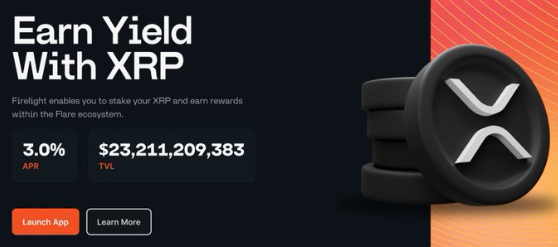
How Firelight Unleashes XRP’s True Potential?
Firelight was originally a staking protocol running on Flare Networks, allowing $FXRP holders to earn returns through proxy staking. Today, Firelight pushes XRP into the heart of the DeFi world, unlocking XRP's dynamic financial capabilities through a full set of mechanisms.
The core process is as follows:
Users lock native $XRP on XRP Ledger
Flare Networks mints $FXRP after verification
Users stake $FXRP to Firelight
Firelight mints stXRP (liquidity staking token)
Users can use stXRP to participate in various DeFi opportunities (lending, liquidity mining, derivatives, etc.)
The security and stability of the system are based on the following mechanisms:
All F-assets use a 2x overcollateralization mechanism
Collateral includes XRP, FLR and stablecoins, which greatly alleviates volatility and de-anchor risks
Each stXRP is backed 1:1 by real native XRP
Revenue mechanism and ecological expansion
Firelight's revenue source is similar to Ethereum's restaking model. Users' stXRP can be used to support decentralized services such as cross-chain bridges and oracle networks, and the fees generated are the returns to coin holders.
Additionally, users will earn Firelight Points, which can be used in future incentives, which may include airdrops of its native token (although this has not yet been officially confirmed).
Compared with other staking systems, Firelight has obvious advantages:
Fast release period (<2 days)
No Slashing
Already supported in multiple Flare ecosystem protocols, such as SparkDexAI and Kinetic Markets
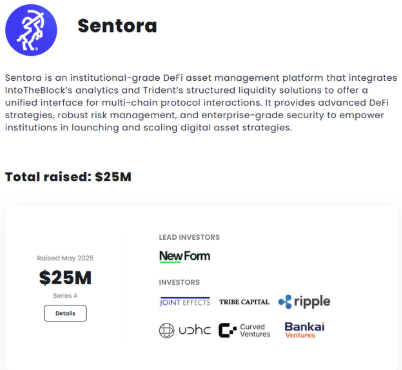
Behind Firelight is the Sentora team, which was formed by the merger of IntoTheBlock and Trident Digital and received $25 million in Series A financing.
in conclusion:
XRP did have structural shortcomings in the past, especially the lack of DeFi and programmability, but with the implementation of the Firelight protocol, it is evolving from a payment-oriented public chain to a universal asset with multi-level financial attributes.
Combined with the current support of US political forces, the continuous increase in institutional holdings, and continuous innovation in the technical layer, XRP is transforming from an "old generation public chain" to one of the most promising DeFi basic assets in the new cycle.
If the biggest problem of XRP in the past was "what was missing", now it has finally ushered in the key step of "completing the puzzle". In the long run, its value reassessment has just begun.

