
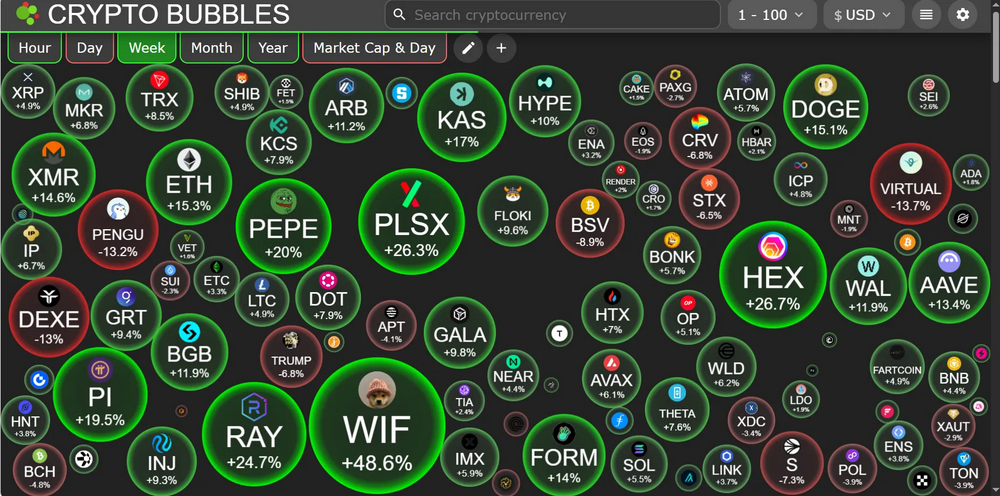
This week, the crypto market has seen a good momentum rise with the cooling of Sino-US trade on Monday and the CPI data meeting expectations. Although there was a flash crash on Thursday night, it was subsequently repaired. As of the time of writing, the price of Bitcoin remains above 10.4w. The market is still mixed. Coinbase opened high and closed low. It first joined the S&P 500 index and rose sharply, but then suffered a double blow from the SEC investigation + user data theft, and its stock price fell by 7.2%; FTX is about to start a 5 billion compensation on the 30th, but the Wisconsin Investment Committee has sold its Bitcoin ETF holdings. At the same time, Russia has sent 640,000 soldiers to Ukraine, and the overall wait-and-see sentiment has intensified.
The meme coin market is in a white-hot stage, with three major platforms, Pump.fun, Believe and LetsBONK.fun, competing fiercely, and engaging in a "meme Three Kingdoms" battle around token launch, liquidity and community influence. At the same time, the chairman of the SEC delivered a major speech on asset tokenization, providing a clearer regulatory framework for the issuance, custody and trading of crypto assets, heralding the advent of a new era of compliance and mainstreaming.
1. The meme war heats up
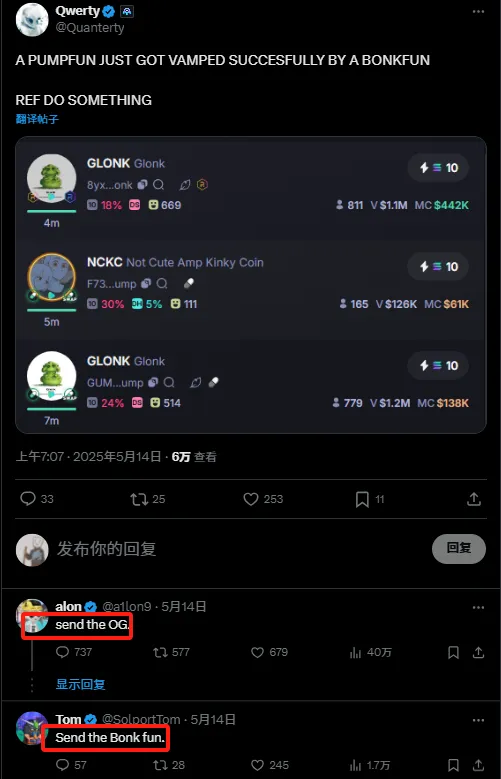
With Believe joining the ranks of the anti-Pump.fun army, the competition in the meme market this week has become more intense in the "Romance of the Three Kingdoms" between Pump.Fun, Believe and LetsBONK.fun. In particular, Pump.Fun, Believe and LetsBONK.fun launched a crazy battle to compete for Glonk's Ticker. Among them, Tom, the founder of LetsBONK.fun, and Alon, the cofounder of Pump.Fun, both shouted orders to each other on Twitter, bringing this meme craze to its peak.
1. Why Pump.Fun became the target of public criticism
- Since Pump.fun has strong cash flow, it does not need to issue coins. The regular sale of Solana suppresses the price of the local currency.
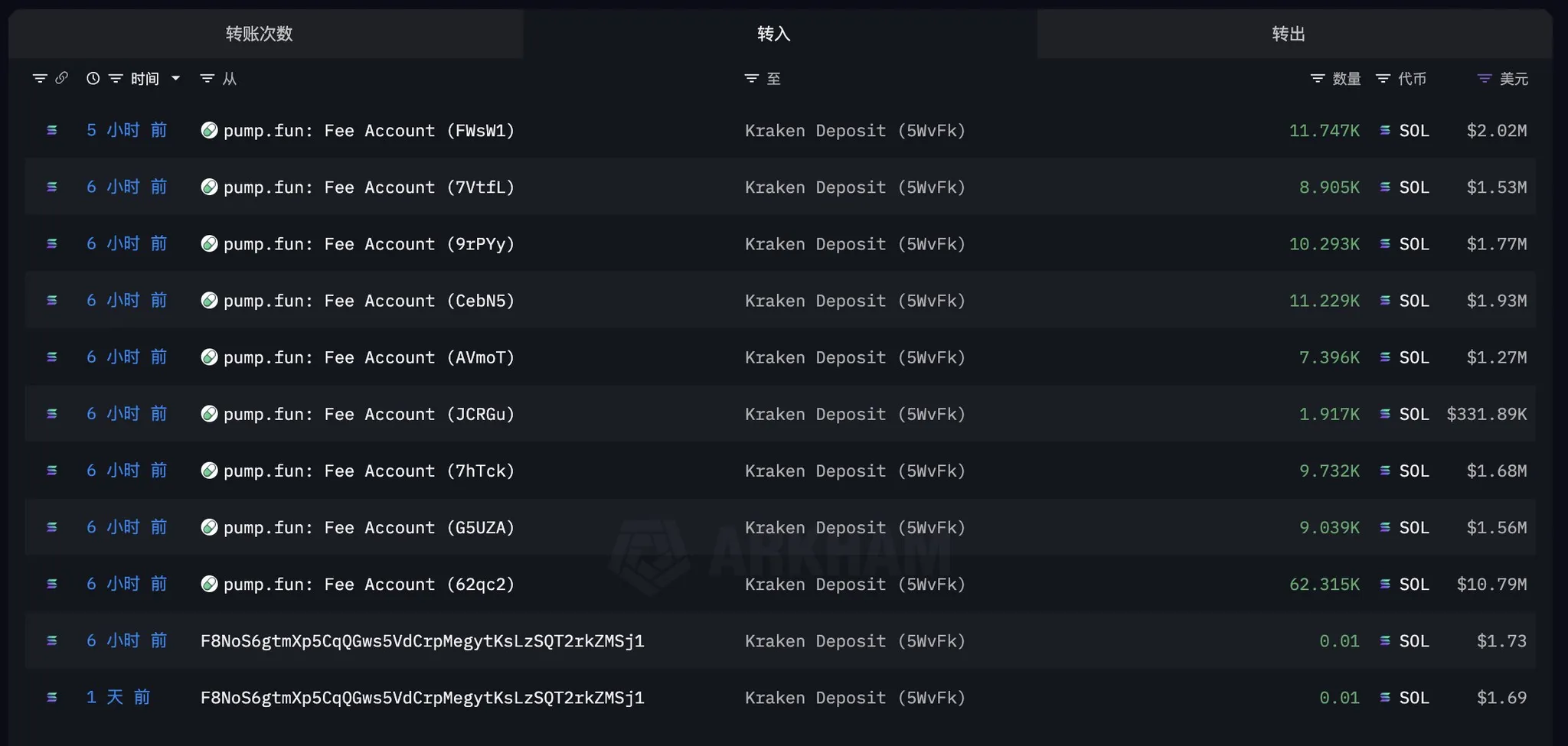
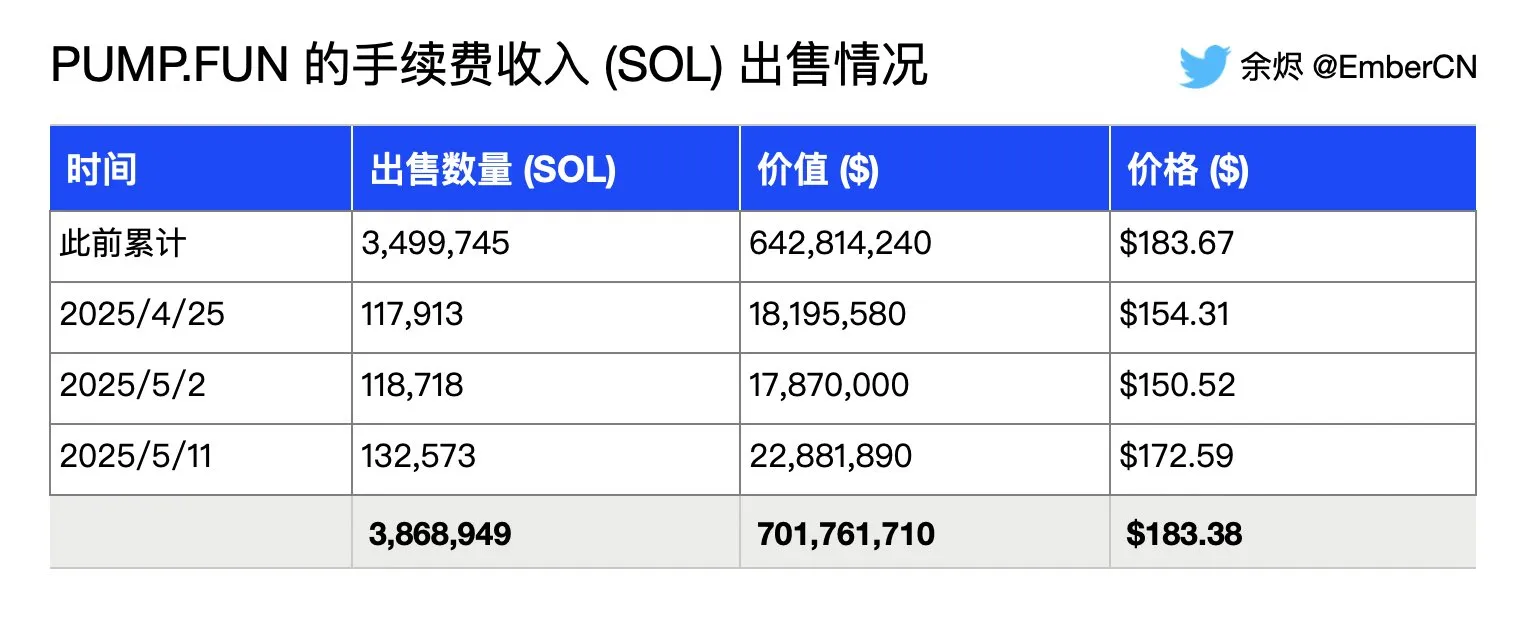
According to statistics from the on-chain blogger Yu Jin, pump. fun will transfer these SOLs to Kraken after accumulating one to two weeks of transaction fee income. In more than a year, they have sold a total of about 3.868 million SOLs ($701.76M) at an average price of $183.3.
- Pump.fun is the only one in the Solana ecosystem, and there is no competition, which is not conducive to the development of the ecosystem.
Pump.Fun accounts for 71% of Solana's daily token issuance, especially the launch of PumpSwap in March 2025, which directly competes with DEXs such as Raydium and further consolidates its market share. Its goal is to dominate Solana DeFi transactions and weaken the market position of other AMMs. This dominance may inhibit innovation, and the lack of competition may lead to a single ecosystem, which will harm its long-term development. Although Raydium (the purple part in the figure below) still occupies the top position in market share, it is obviously also under pressure from the new force Pumpswap (the green part in the figure below).
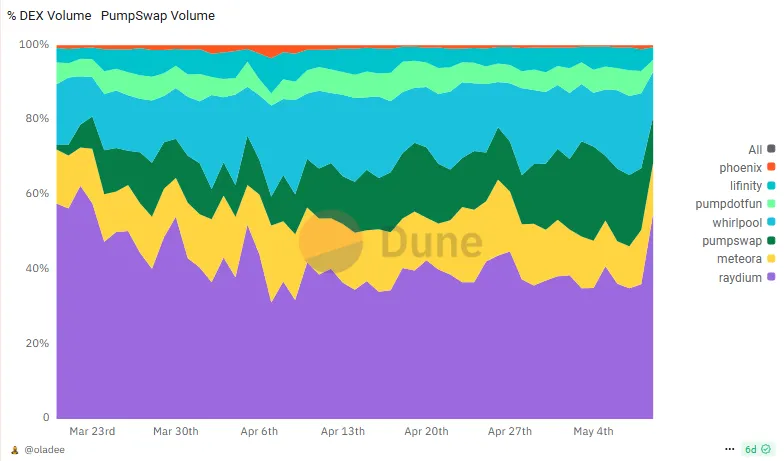
Later, under pressure from competition, pump.fun announced on May 13 that it would launch a creator revenue sharing plan. 50% of PumpSwap's revenue is now shared with token creators, spitting out the entire pie.
2. Believe’s Web2 gameplay
The founder of Believe is Ben Pasternak, a 26-year-old Australian entrepreneur who developed the game Impossible Rush at the age of 14, with over 500,000 downloads. He dropped out of school at the age of 15 and moved to New York, where he founded the social trading app Flogg and received $2 million in funding, becoming one of the youngest entrepreneurs to receive venture capital from Silicon Valley.
In January this year, Ben Pasternak created a Web3 project Clout on Solana. The first token launched by the Clout platform was Pasternak, which has the same name as the founder. After the launch, Pasternak once reached a market value of 80 million US dollars, but then fell all the way, and the lowest point fell below 180,000 US dollars. On April 28, Clout announced that it would be renamed Believe, and the Pasternak token was renamed LaunchCoin and became the new platform coin. After that, the coin price began to rise all the way. The platform attracted the attention of the market by launching multiple memes with a market value of over 10 million.
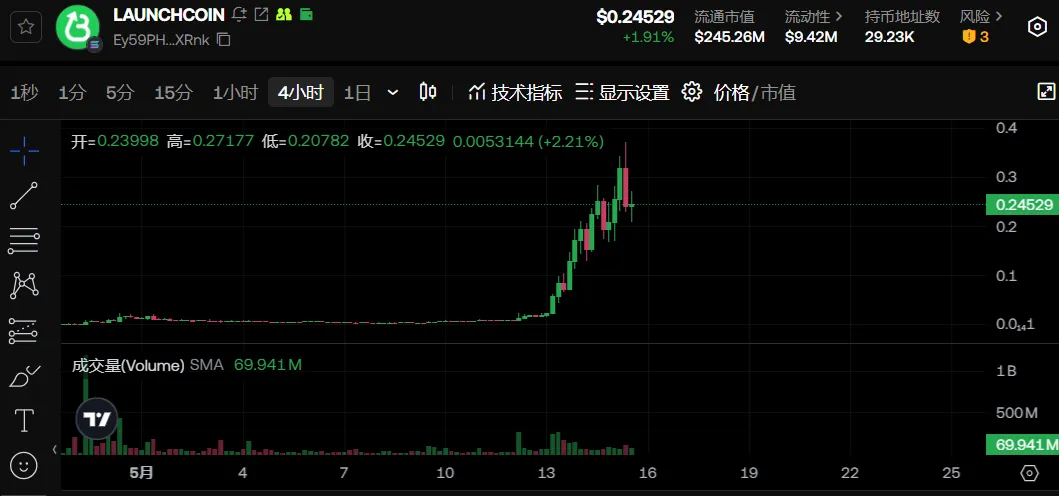
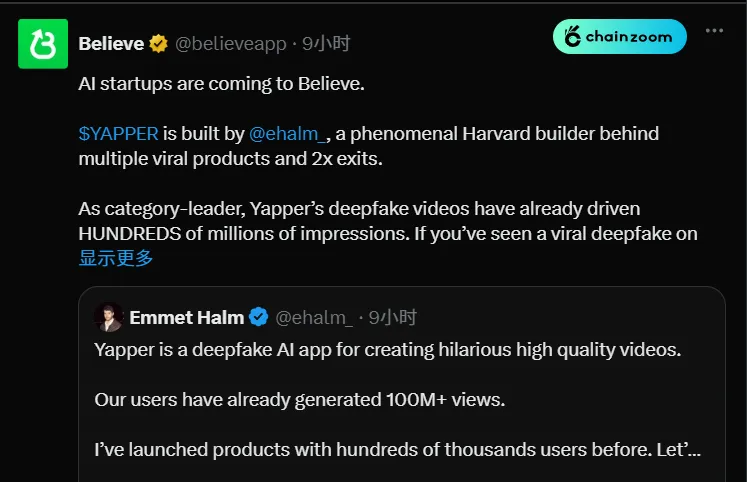
In particular, Believe has developed a new strategy, which is to attract people from Web2 to enter Web3. For example, the Yapper project, which was launched in the early morning of May 15, was launched by Emmet Halm from Harvard. In the traditional Web2, he has launched many popular products and successfully exited twice. Ordinary people basically have no chance to get on board this meme coin, and its market value has climbed to tens of millions in a short period of time. In fact, the entire Believe has done several similar quick pass projects in the past period of time by attracting people from Web2 and letting them issue coins in Web3. Believe's model should continue in the short term, and because of the wealth-creating effect of Yapper, more Web2 teams will be willing to join.
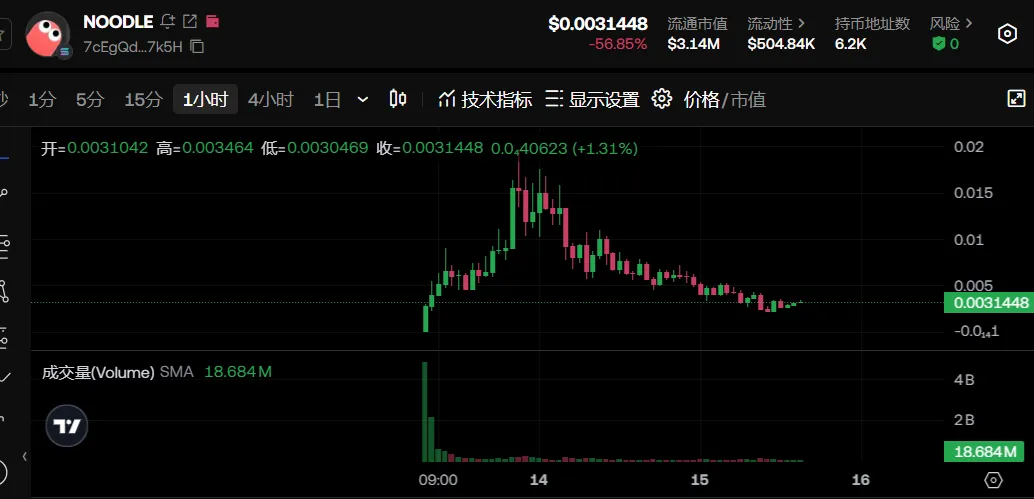
For example: Noodle: A snake game, it is a meme launched by Web2 entrepreneur Alex Leiman, who previously released applications such as RizzGPT and Astra with a total download volume of more than 10 million times.
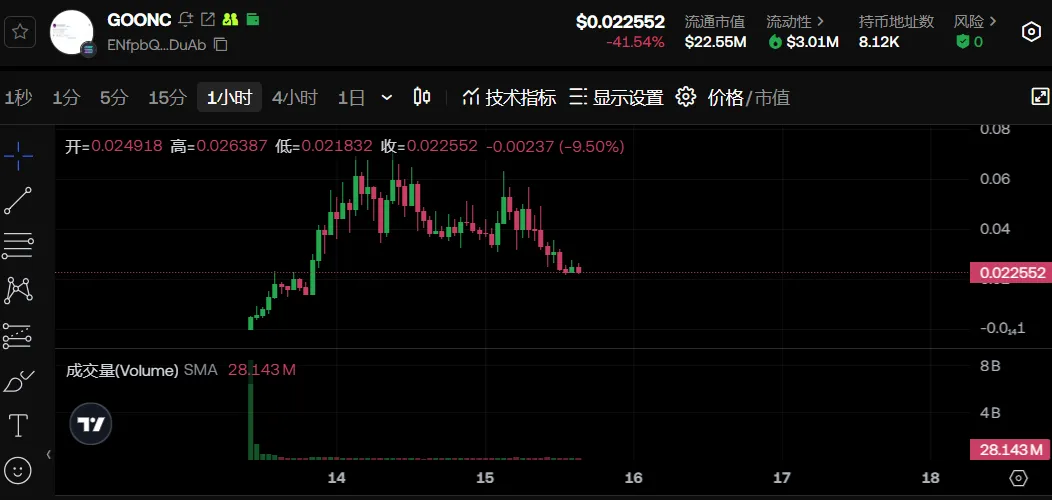
GOONC: A token issued by OpenAI employee Pata van Goon
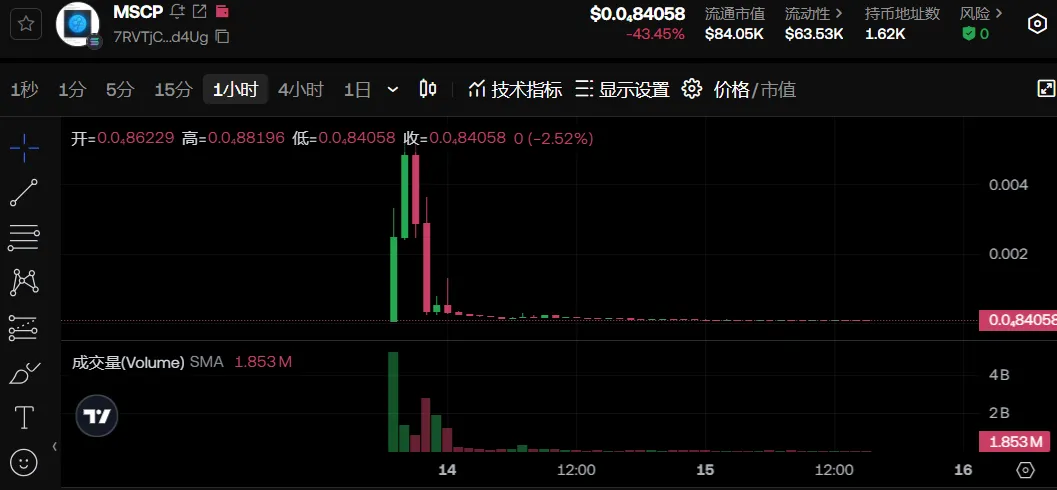
MSCP: DEV was suspected to be a Meta software engineer, but was later debunked
However, founder Ben recently said that he will no longer recommend new tokens, but will focus on existing tokens. The opportunity lies in seeing if a second-stage entry can be made for the current projects run by Believe.
3. LetsBONK.fun
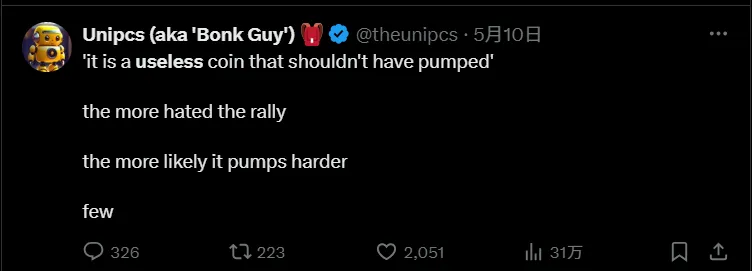
LetsBONK.fun is supported by many OGs in the Solana ecosystem, and has produced some of the most popular tokens, such as Useless, Hosico, and Ikun. If you want to participate in the recommendation, follow the founder Tom and the ecosystem supporter Bonk Guy, who often publicly shout orders on Twitter. For example, Useless was triggered by Bonk Guy's tweet.
4. Robot Wars
The Believe platform allows users to launch new tokens by replying to any post on X, mentioning @launchcoin and adding the token name (such as $TICKER). This process is simple and fast, and the smart contract is deployed immediately, lowering the barrier to launch. This mechanism has led to a large number of bots monitoring new launches on X and quickly buying in to take advantage of the initial price increase, causing the meme battlefield to evolve from the original PVP to BVB.
Ordinary people basically have no chance to get on board this meme coin, and its market value has climbed to tens of millions in a short period of time. If you rely solely on manual chain scanning, the difficulty may rise sharply. In this mode, when the Believe official and its founder directly push a certain meme, the early interest groups have already ambushed in advance, and it seems extremely risky for retail investors to enter the market.
5. Competition in the meme market
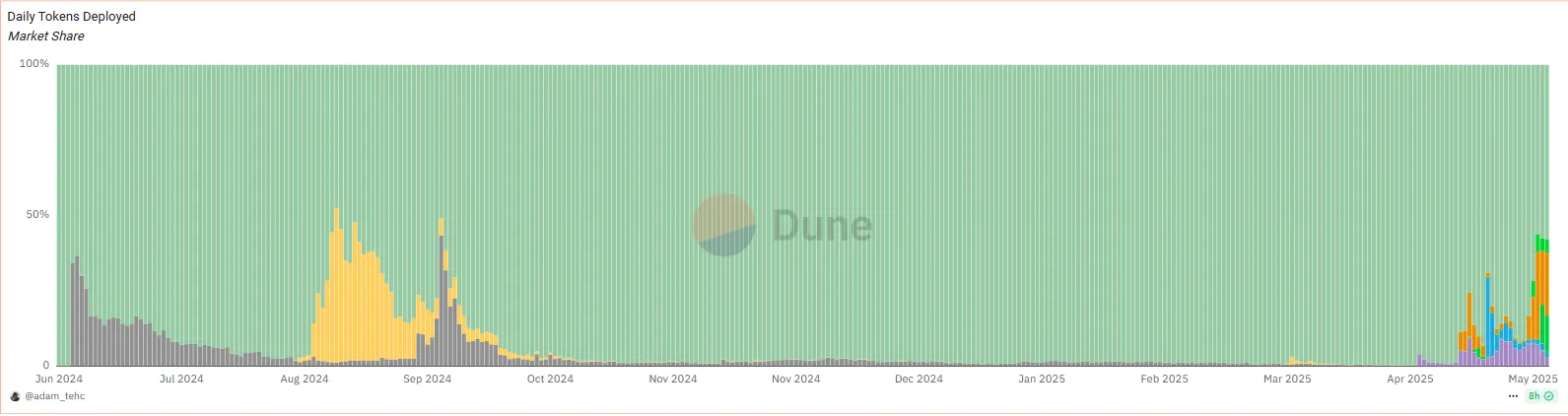
Although Pump.Fun still occupies an absolute leading position in the meme market, its market share is being eroded by these new launch platforms. The green part of the figure below is the market share of Pump.Fun's token deployment volume. It can be clearly seen that its position has been seriously threatened from almost controlling the entire Sol meme market. It is still unknown who will be the final winner of this meme war, but for retail investors, when the three platforms attract traffic and compete with each other, it may be the golden age of meme gold dogs.
2. SEC Chairman’s Keynote Speech on Asset Tokenization
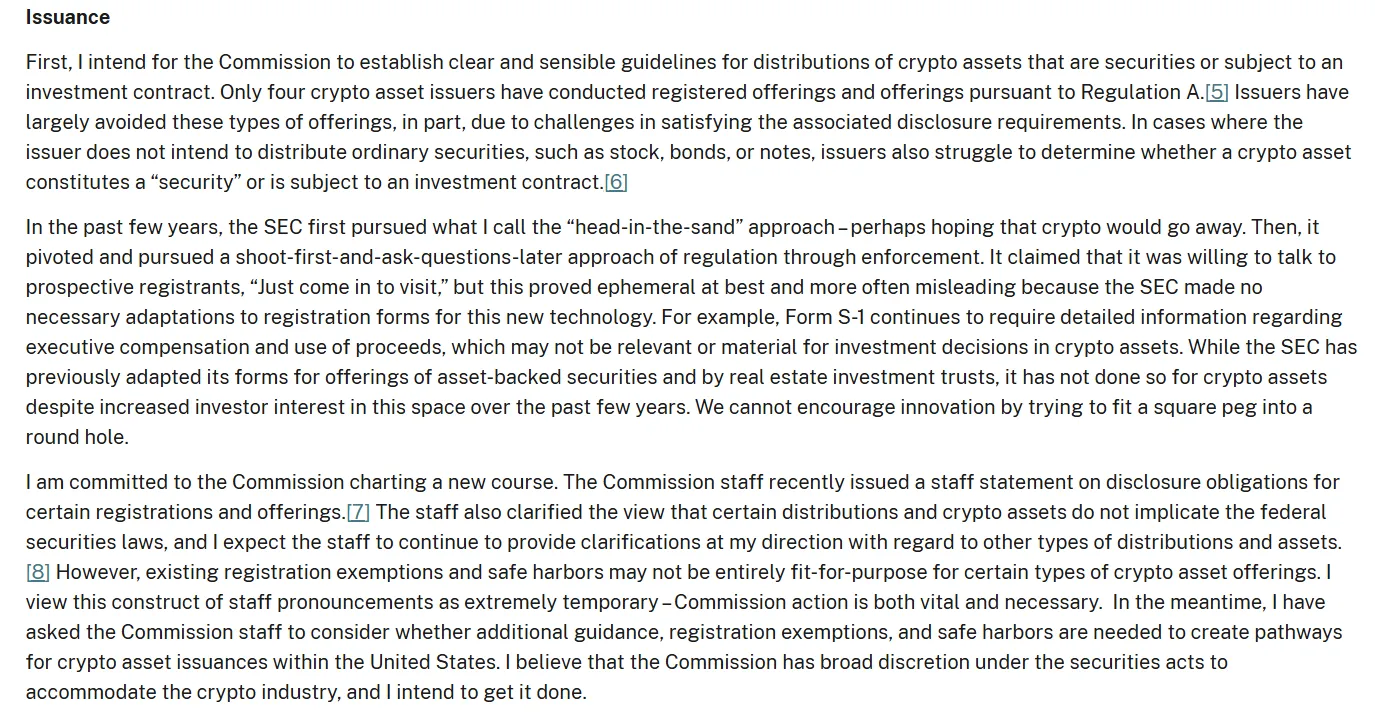
1. Asset issuance
- Current situation and challenges: Atkins pointed out that only four crypto asset issuers have completed legal issuance through registered issuance or Regulation A. For example, existing forms such as Form S-1 require information such as executive compensation and use of proceeds, which may be irrelevant or unimportant to investment decisions in crypto assets. After all, most projects do not have companies and their revenue is mainly in tokens. Although the SEC has adjusted the forms for asset-backed securities and real estate investment trusts, the adjustment of crypto assets has not kept up with the growth of investor interest.
- Regulatory objectives: The SEC plans to develop clear and reasonable guidelines for the distribution of crypto assets that are securities or subject to investment contracts to address the uncertainty of issuers in determining whether an asset constitutes a security. Atkins criticized the SEC's past regulatory approach of "burying its head in the sand" or "shooting first and asking questions later", emphasizing the need to provide legal certainty for the crypto industry. Since the adjustment of regulations is temporary, the SEC will still provide registration exemptions or safe harbors for non-compliant projects that have already issued coins as long as they can be corrected.
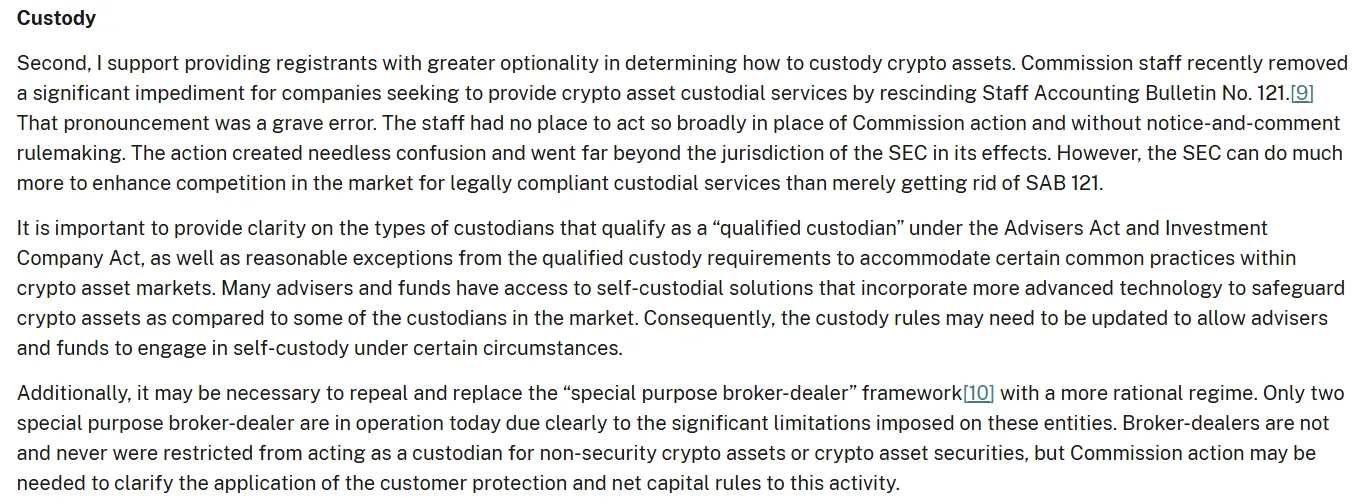
2. Hosting
- In the past, the SEC had two major difficulties in managing custodians:
(1) Identity restrictions: Atkins is mainly relaxing the identity restrictions on custodians. Previously, only large asset companies or banks were eligible, but later it will be gradually relaxed to include securities firms, financial institutions, etc. In the subsequent tokenization process, traditional banks face the risk of being eliminated.
(2) Custody restrictions: Previously, as long as users deposited a certain amount of crypto assets, the custodian had to provide equivalent liabilities and security assets, which occupied a large amount of the custodian's funds. The corresponding bill SAB 121 was revoked in January this year.
- Regulatory objectives: The SEC plans to provide registrants with greater choice in deciding how to custody crypto assets, clarify the types of custodians that qualify as “qualified custodians” under the Advisers Act and the Investment Company Act, and consider reasonable exemptions for self-custody to accommodate common practices in the crypto asset market. For example, many advisors and funds may prefer to use self-custody solutions that incorporate advanced technology. Therefore, the custody rules may need to be updated to allow advisors and funds to engage in self-custody in certain circumstances.
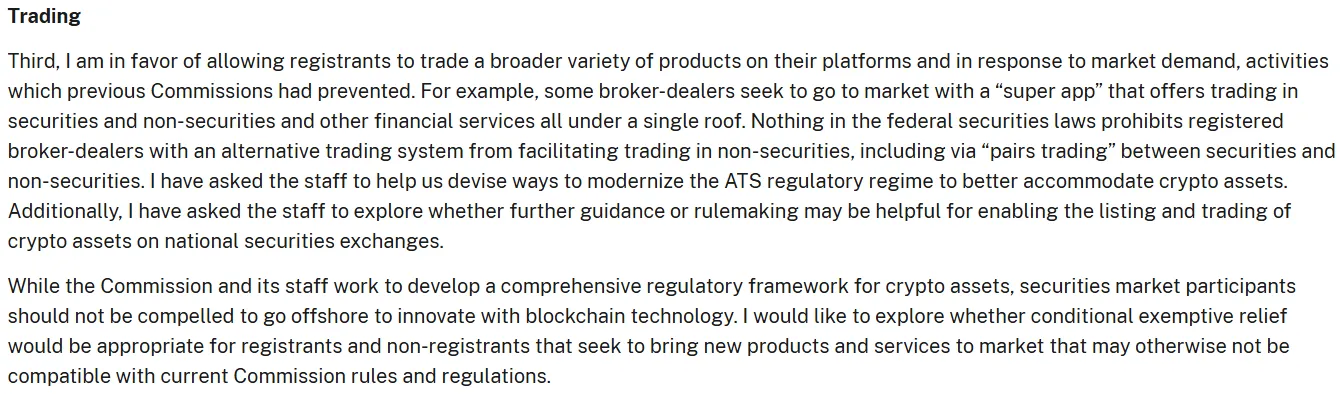
3. Trading
- Status and Innovation: Atkins supports allowing registrants to trade a wider range of products on their platforms, responding to market demand, such as providing securities and non-securities trading through "super applications" [which may mean that the cryptocurrency and stocks should be connected as a whole, and the application provides securities and non-securities and other financial services under the same roof] . He pointed out that federal securities laws do not prohibit registered broker-dealers with ATSs from facilitating non-securities transactions, including "paired transactions" between securities and non-securities.
- Regulatory goals: The SEC plans to modernize the ATS regulatory regime to better accommodate crypto assets and explore further guidance or rulemaking to enable the listing and trading of crypto assets on national securities exchanges. Atkins emphasized that market participants should not be forced to move innovation overseas due to regulatory incompatibility.
in conclusion
1. Strong regulation curbs fraud and makes the market more standardized. The SEC's strict supervision, enforcement actions and penalty mechanism will significantly reduce fraudulent projects. Through clear compliance paths and investor protection measures, the crypto market will be more standardized and transparent, enhancing confidence in long-term development.
2. Tokenization becomes mainstream, with both efficiency and compliance. Asset tokenization is becoming an efficient, transparent and liquid way of issuing assets. The United States has occupied the high ground of global asset issuance through the SEC's regulatory framework (such as issuance guidance, registration exemptions and safe harbor rules). In the future, the SEC may further control the right to issue assets through clear rules, attracting global project parties to register and issue coins in compliance in the United States, and enjoy regulatory protection and market trust.
3. Liquidity has been significantly improved and the market scale has expanded. Tokenization has opened up the traditional US stock market and the crypto market, significantly enhancing overall liquidity. The market value ceiling of a single token will be further broken, driving the rapid expansion of the crypto market and attracting more institutional investors to participate.
Special thanks
Creation is not easy. If you need to reprint or quote, please contact the author in advance for authorization or indicate the source. Thank you again for your support.
Written by: Nora / WolfDAO
Editorial review: Mat / Nora
Thanks to the above partners for their outstanding contributions to this weekly report. This weekly report is published by WolfDAO for learning, research or appreciation only.
Attached is a recruitment information:
🔥 Cryptocurrency traders, build the future of Web3 with us!
Job responsibilities: Develop, execute and optimize trading strategies, monitor market trends and on-chain data, increase returns and control risks.
Job requirements: Finance/mathematics/computer related background, familiar with the mainstream digital asset market, practical trading experience, strong data analysis ability, and passion for the crypto market.
We offer:
Industry-leading salary (base salary + performance + project commission + year-end bonus)
Clear promotion path (Strategist → Senior Trader → Head of Asset Management)
Core teamwork and rapid growth
Get in touch with the latest Web3 projects
If you are passionate about cryptocurrency and eager to realize your personal value in a rapidly growing industry, welcome to join us!
Resume delivery: kelly@wolfdao.com