
Introduction
Bittensor was founded in 2019 by former Google AI engineer Jacob Robert Steeves with the vision of building a democratized artificial intelligence development platform . The protocol enables global peer-to-peer collaboration through an incentive-driven architecture , allowing participants to contribute and evaluate AI models in a decentralized manner.
The core of Bittensor lies in its dedicated subnets, each dedicated to a specific AI function, such as decentralized inference or model training. In these subnets: miners provide computing resources to perform tasks, and validators evaluate the quality and utility of the output through Bittensor's unique Yuma consensus algorithm. The Yuma consensus algorithm dictates how TAO tokens are distributed between validators and miners, rewarding participants based on the accuracy and value of their contributions. Validators who consistently provide reliable, timely and honest assessments will gain greater consensus influence. Conversely, if a validator's assessment is significantly biased (such as overestimating a miner's performance), their staked deposit may be forfeited. Accordingly, miners are incentivized to produce high-quality work in order to obtain favorable evaluations and more token rewards. This incentive mechanism has spawned 113+ subnets, with a total market value of Bittensor of $3.6 billion (market value is used instead of FDV , because the maximum supply of the PoW system is different from the common pre-mining total amount of the protocol). At its peak in December 2024, the overall market value of Bittensor exceeded $5 billion.
This article will explore in depth: key milestones in Bittensor’s development, an overview of major subnet contributors, an analysis of the token economic model, and a forward-looking analysis of future prospects.
Key Ecosystem Evolution: Bittensor EVM and dTAO
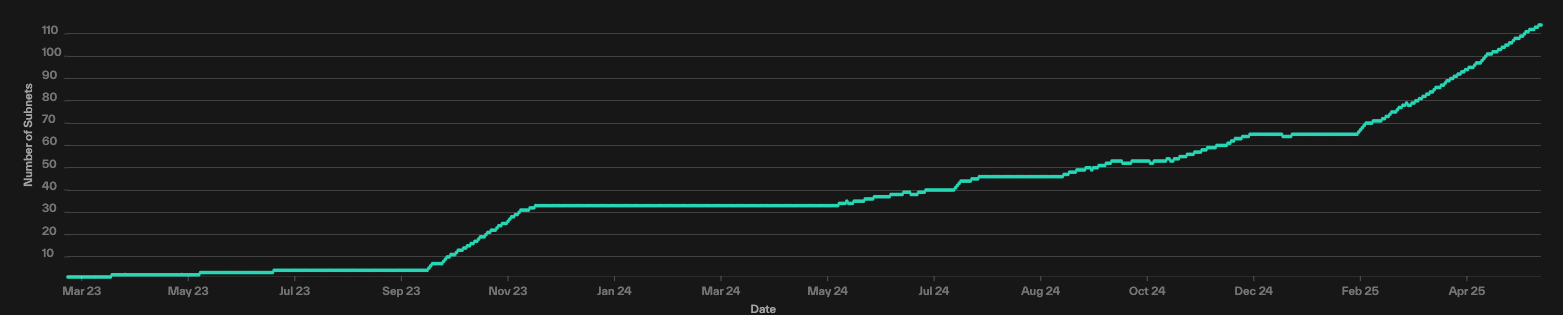
Number of subnetworks in Bittensor
Since its mainnet launch in January 2021, Bittensor has faced a series of challenges, including misaligned incentives leading to low-quality output, centralization issues in the root subnet, duplication of validator weights, abuse of meme subnets, malicious PyPI package attacks, and the "runaway batch call" overload incident in May 2025.
The network and its core teams have gradually addressed these issues. For example, the problem of low-quality output has been naturally alleviated with the emergence of professional miner teams such as Tensora . These teams have an incentive to maintain high standards because poor performance will result in reduced weight distribution, and validators who exaggerate miner performance will be punished through Bittensor's clipping mechanism.
In response to the problem of validator weight duplication (i.e., validators do not conduct independent assessments but directly copy the verification weight of others), the team released Bittensor v7.3.0 in July 2024. This upgrade introduced a commit-reveal mechanism to delay and encrypt the validator's submission data, ensuring that the replicator can only obtain outdated weight information, thereby maintaining the fairness of the evaluation and verification process.
Bittensor has also suffered direct security attacks. In July 2024, a malicious version of the Bittensor software package was uploaded to the PyPI repository, causing unsuspecting users to have their wallets stolen after installation, resulting in a loss of approximately $8 million. For this reason, on-chain transactions were suspended for 10 days to prevent further losses and remove the affected software packages. In May 2025, the network suffered a " runaway batch call " attack, and the system entered a two-day "safe mode" due to overload until core functions were restored.
In order to address the long-standing root subnet centralization problem and optimize the incentive system, Bittensor launched the dTAO protocol upgrade in February 2025. This improvement introduces exclusive alpha tokens for each subnet, allowing market participants to directly stake their favorite subnets. Today, the proportion of TAO token distributions received by each subnet is entirely determined by the market demand for its alpha token. This mechanism not only realizes the decentralization of TAO distribution decisions, but also reduces the reliance on the root subnet verification node to judge the subnet TAO distribution. The scheme also promotes the rapid expansion of the network scale, with the number of subnets surging from 65 to 113 in just 14 weeks .
However, this market-based mechanism also exposes new loopholes. SN281, known as the " LOL subnet", openly encouraged holders to buy its alpha tokens to drive up prices in order to grab a disproportionate share of TAO distribution rewards without providing real computing power contributions or functions. The emergence of such speculative non-AI subnets eventually forced the Opentensor Foundation to intervene and stop the subnet's token distribution to maintain the health of the ecosystem.
The launch of Bittensor EVM , another milestone upgrade, enhances the scalability of its network. By being compatible with EVM, the protocol opens up new possibilities for decentralized applications and DeFi scenarios. We will analyze this evolution in depth in the following chapters of this article.
Subnet: Bittensor Ecosystem Core
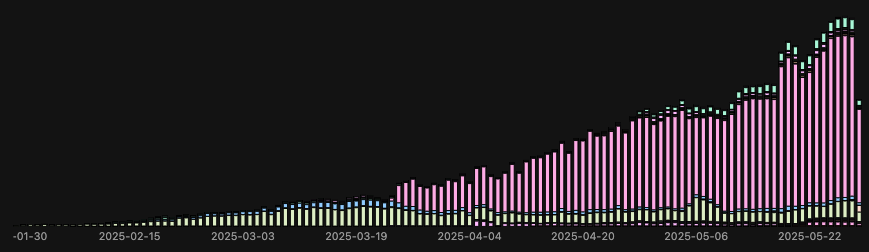
The total amount of AI reasoning tokens generated daily on the Chutes platform
Subnets are the foundation of the Bittensor ecosystem, and over time, some prominent projects, sometimes called "subnet giants", have emerged. Thanks to the dTAO mechanism, we can easily identify the subnets that the market considers to be the most valuable by filtering the subnets with the largest market capitalization, and these subnets also receive a higher proportion of TAO emissions.
Top 10 subnetworks by TAO emissions (as of May 2025)
SN64: Chutes — 14.39% emission | Development team: Rayon Labs | Serverless AI computing
Chutes provides developers with an efficient and economical way to deploy AI models through a serverless platform or API, which is said to cost 85% less than traditional cloud service providers such as AWS. As a decentralized system, it eliminates single points of failure and plans to integrate TEEs to enable private queries. In the past three months, its daily AI reasoning token generation has surged from 6.6 billion to 101 billion . The platform's revenue (in the form of TAO or fiat currency) will flow into the automatic staking mechanism for the repurchase of the subnet's Alpha token. Chutes' development team, Rayon Labs, also manages SN56 (Gradients) and SN19 (Nineteen), which together account for 23.71% of TAO's total emissions.
SN14: TAOHash — 8.2% Emission | Development Team: Latent Holdings | Decentralized PoW Mining
TAOHash supports the decentralization of the mining pool by rewarding Bitcoin miners with Alpha tokens to allocate computing power to subnet validators. The team is exploring expansion to other PoW assets such as Kaspa and Dogecoin . In May, Latent Holdings reinvested 4.4 BTC from validator earnings into TAO and pledged it back to the subnet, which could form a virtuous growth flywheel.
SN56: Gradients — 6.66% emission | Rayon Labs | Decentralized AI model training
Gradients provides a decentralized environment that supports AI model training methods such as supervised learning, RLHF (human feedback reinforced learning), and alignment tuning. It uses distributed GPUs to reduce training costs. Similar to Chutes, its platform revenue will also be used to automatically stake its Alpha tokens.
SN4: Targon — 5.73% emission | Development team: Manifold Labs | Decentralized AI computing
Targon provides fast and cost-effective AI reasoning services (up to 4 times faster than centralized platforms) and GPU computing services. Its supported applications include Dippy (an AI character chat platform with more than 4 million users), TAOBOT, and AI-enhanced search tool Sybil.
SN3: Templar — 5.62% emission | Development team: Rao Foundation | Large-scale AI model training
Templar has similar goals to Gradients, focusing on the pre-training and fine-tuning of large AI models with more than 70 billion parameters, aiming to lower the threshold for using advanced model training infrastructure.
SN51: Celium — 4.44% emission | Development team: Datura | Decentralized GPU rental
Celium provides decentralized GPU rental services similar to IO.net, with more advantageous prices, and provides developers with friendly templates for frameworks such as PyTorch and TensorFlow. Although its off-chain revenue performance is strong , transparency still needs to be improved.
SN8: Proprietary Trading Network — 3.45% Emission | Development Team: Taoshi | Democratizing Quantitative Strategies
The subnet aggregates risk-adjusted trading strategies of professional traders and supports decentralized AI and machine learning models to integrate these strategy data. Although Alpha tokens currently have no practical use, the team will use them as trading competition rewards to distribute to winners.
SN5: Kaito — 3.13% emission | Development team: Kaito AI | Decentralized web search and indexing
OpenKaito crawls data from platforms such as X and Discord and builds the Web3 knowledge graph . Miners are responsible for data crawling, index maintenance, and query response. Although the subnet Alpha token is a completely different token from the KAITO token on the Basechain, the community expects that the subnet will be monetized through validator APIs and embedded services in the future.
SN19: Nineteen — 2.71% emission | Development team: Rayon Labs | High-frequency AI reasoning
Nineteen focuses on real-time, low-latency AI reasoning services , which are particularly suitable for scenarios with high timeliness requirements such as smart assistants, autonomous agents, and industrial AI. Its goal is to surpass centralized giants such as Mistral and OpenAI in specific real-time computing tasks. The platform revenue will be used to repurchase Alpha tokens.
SN9: Pretrain — 2.13% emission | Development team: Macrocosmos | Basic model training
Operated by another industry giant Macrocosmos (the team also manages SN1: Apex, SN13: Data Universe, SN25: Mainframe, and SN37: Finetuning), Pretrain incentivizes the development of large-scale basic models through datasets such as Falcon Refined Web. The network uses a benchmark training mode, and rewards are calculated based on the model loss score. At present, its Alpha token has not yet played a practical role.
These ten subnets currently account for 56.46% of TAO's total emissions. But in addition to these head projects, there are also a large number of experimental and vertical subnets in the Bittensor ecosystem, such as:
SN59: AI Agent Competition Simulation
SN44: Athlete Performance Analysis
SN10: DeFi Strategy Modeling
SN25: Protein folding calculations
SN93: Inspiring content creation
Most of these subnets are still in the exploratory phase , and many Alpha tokens do not yet have immediate utility or direct value capture capabilities. However, as these subnets mature, we expect to see sustainable profit models, greater transparency, and a significant increase in the total market value of Alpha tokens, especially as TAO weight continues to decline and Alpha token emissions gradually surpass root subnet emissions .
As of May 2025, emission of subnet Alpha tokens has exceeded root subnet emission. This shift will gradually alleviate the sell-off from root subnet validators (who have historically automatically sold their allocated Alpha tokens). This dynamic change may mark the beginning of a new era of bottom-up growth for the Bittensor ecosystem.
dTAO upgraded token economic model
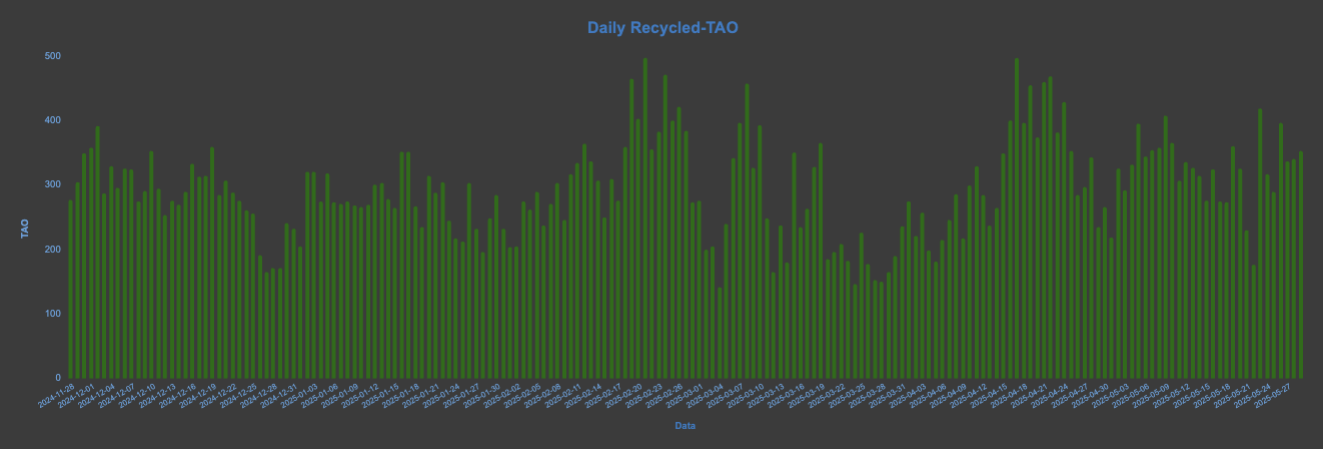
Daily TAO circulation
The Bittensor protocol was officially launched in 2021. Its issuance mechanism is similar to Bitcoin, with no pre-mining or ICO, a total supply of 21 million TAOs, and the same halving cycle. However, with the launch of the dTAO upgrade, the economic model of the protocol has undergone major changes.
Under the dTAO mechanism, subnet creators need to pay a registration fee of at least 100 TAO (the specific amount fluctuates with network demand). When registering, the system will allocate up to 100 TAO to the subnet liquidity pool, and the remaining part will be directly burned (in early designs, this part can be refunded when the subnet is launched). This adjustment stems from the design feature that subnets under the dTAO framework no longer support cancellation for the time being. It is worth noting that the registration fee of the root subnet validator now adopts a full circulation mechanism, while the registration fees of miners and validators of each subnet must be paid in TAO and automatically redeemed for the Alpha tokens of the corresponding subnet. These Alpha tokens will realize the circulation of tokens within the subnet .
The dTAO upgrade further expands its use cases by establishing TAO as the liquidity foundation for subnet Alpha tokens. When a user stakes TAO to a specific subnet, the staked amount is automatically converted to that subnet's Alpha token, allowing the user to receive emission rewards based on the subnet allocation ratio. As of now, 7.72% of the total TAO supply is staked in various subnets.
This change in network design will significantly increase the market demand for TAO due to the rapid growth of the number of subnets, the gradual popularization of sustainable profit models, and the increasing activity of Alpha token trading. It is worth noting that due to the continuous circulation of TAO tokens in the system, its halving cycle has been extended. According to the latest forecast, the next halving will be postponed to January 25, 2026 .
TAO’s DeFi layer and enterprise adoption
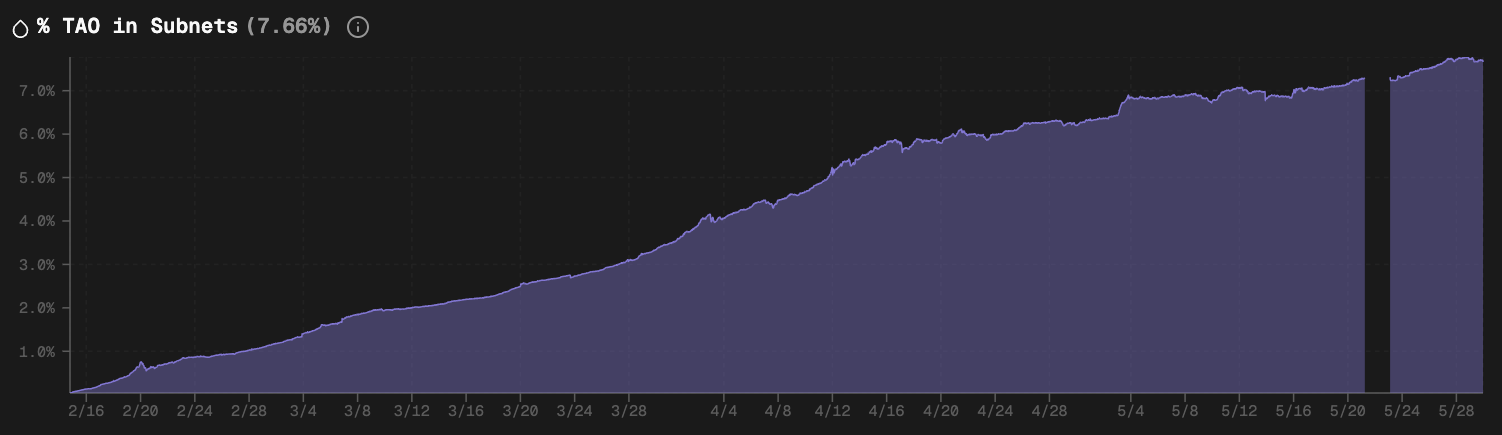
TAO Subnet Staking Ratio
In 2025, Bittensor achieved EVM compatibility, a major upgrade that significantly lowered the threshold for developers to directly deploy smart contracts and build DeFi applications in the network. This technological breakthrough has spawned a number of innovative application scenarios, including: liquidity pledge, dTAO trading market, lending protocols, and cross-chain interoperability solutions.
Emerging DeFi applications in the Bittensor ecosystem
TaoFi: Supports the cross-chain bridge of USDC from Ethereum to Bittensor EVM and converts it to taoUSD . The team also revealed that they are developing a cross-chain purchase mechanism, and in the future users can directly purchase Alpha tokens through mainstream ecosystems such as Ethereum and Solana .
Tensorplex: Provides TAO liquidity staking services on Ethereum and Bittensor EVM, and launches Alpha token trading platform Backprop Financé . As an important contributor to the ecosystem, the team received an undisclosed amount of investment from YZi Labs in March 2025.
Taofu: Innovatively tokenizes subnet owner keys and Alpha emission rights , supports launching subnets through public fundraising, and significantly lowers the threshold for subnet creation.
Tao.app and Taostats: It combines the functions of blockchain browser and Alpha token trading platform , providing users with in-depth data analysis of subnet performance indicators and token liquidity.
TAO.bot and Hotkey: Alpha token buying and selling interface built based on USDT or TAO transactions, effectively enhancing the liquidity infrastructure of Bittensor EVM.
TaoYield: Real-time aggregation and display of TAO staking APY of the root subnet and each subnet, significantly improving staking transparency.
LayerZero and Hyperlane: Now support cross-chain interaction with Bittensor EVM, paving the way for broader blockchain ecosystem integration.
Despite the progress, Bittensor EVM currently lacks standardized wrapped TAO or dTAO tokens , which limits seamless integration with DeFi smart contracts. The team has confirmed in the weekly OpenDev developer meeting that it is actively advancing the deployment plan of standardized wrapped TAO.
TAO's institutionalization process
TAO is gradually gaining favor among institutional investors, a trend that was only seen in the early stages of Bitcoin development:
xTAO announced its merger with Adrianna Ventures and plans to list on the Toronto Stock Exchange Venture Market (TSXV) through a reverse takeover (RTO). The core business of the project is to operate Bittensor verification nodes , and it is currently raising $10 million in funds to expand infrastructure and technology stack construction. This capital operation marks the recognition of decentralized AI computing power assets by the traditional financial market.
Safello, a leading Nordic cryptocurrency exchange, has made its first foray into the decentralized AI space, adjusting its financial resource management strategy by reducing its holdings of 1 BTC and replacing it with 239.8 TAO. The move was interpreted by the market as an endorsement of Bittensor's long-term development prospects, and its CEO emphasized in the statement: "This is our first step in incorporating crypto-native AI protocols into strategic asset allocation."
Summary
Bittensor is rapidly evolving from a single-coin protocol to a large network of specialized AI subnets , each with its own token, community, and economic model. The ecosystem is becoming increasingly active, with upcoming updates such as Uniswap V3 integration and Yuma 3 , which aims to further optimize the validation process. At the same time, the community is actively discussing innovative technical proposals such as Proof of Weights to enhance validator accountability and performance. Most TAO holders are now actively staking, and as TAO emissions shift to subnet-specific alpha tokens increase day by day, stakers will turn to seek higher returns in more promising subnets. This market-driven competition has brought a few clear frontrunners into the spotlight, including Chutes, TAOHash, and Targon, but dominance is far from guaranteed. In this rapidly changing environment, today’s top subnets could easily be surpassed by tomorrow’s innovations. Many of these leading subnets were virtually unknown just a few months ago, and now they offer credible, investable narratives. The early stages of dTAO already show great potential . The next few months will be critical in determining which projects can turn this potential into sustainable value, and these are the ones to watch closely.