
Recently, some users posted on social media that their OUYI accounts were frozen, withdrawals were restricted, or even blocked. When users apply for unblocking, the exchange requires users to provide proof of "source of income" and other evidence.
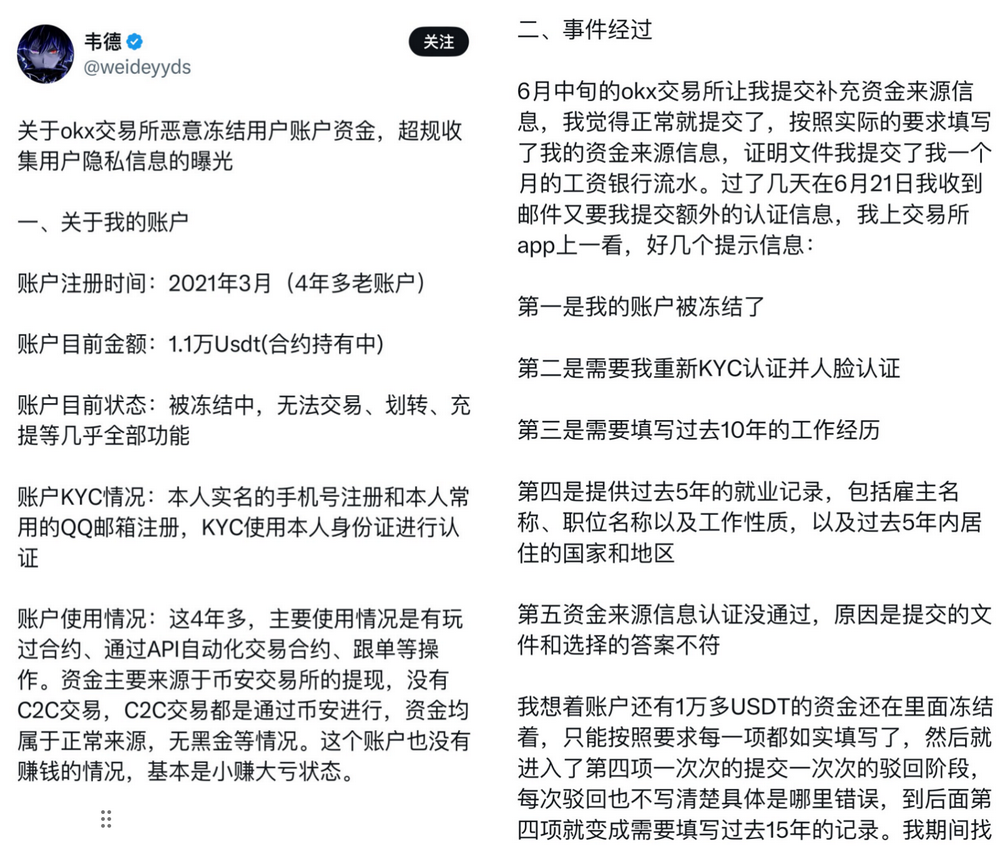
Some users also shared their experiences in Ouyi in the comment section, speculating that the blogger might have been permanently blocked, and said that they had spent a lot of energy trying to solve the problem of unfreezing their account, but ultimately failed the review.
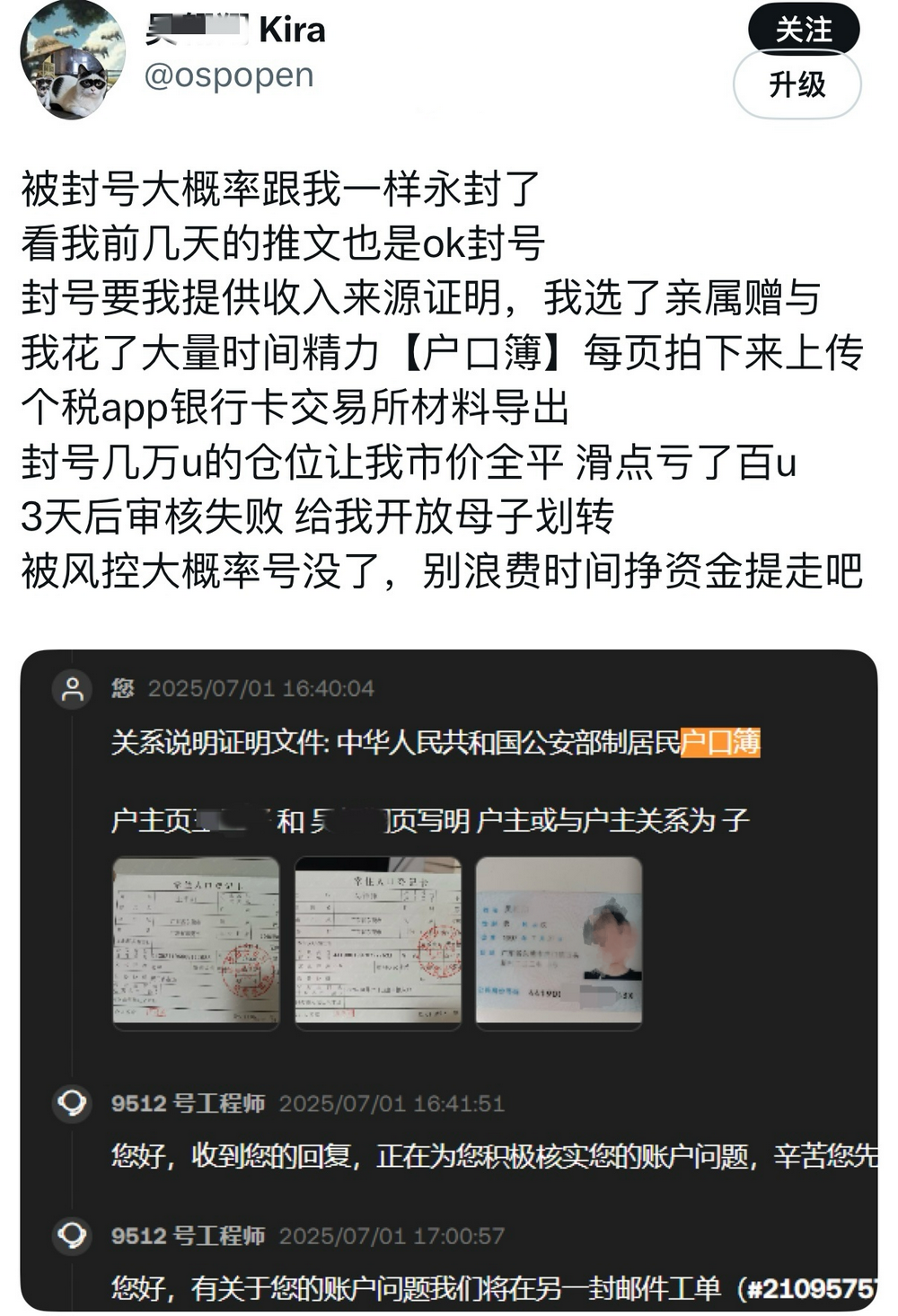
As a web3 lawyer, Lawyer Liu tried his best to make a legal analysis of this incident and the fund security issues encountered by mainland residents when using all centralized exchanges from an objective and neutral perspective, and deeply interpreted the real risks faced by mainland Chinese residents in the field of virtual currency.
1. How does the exchange respond?
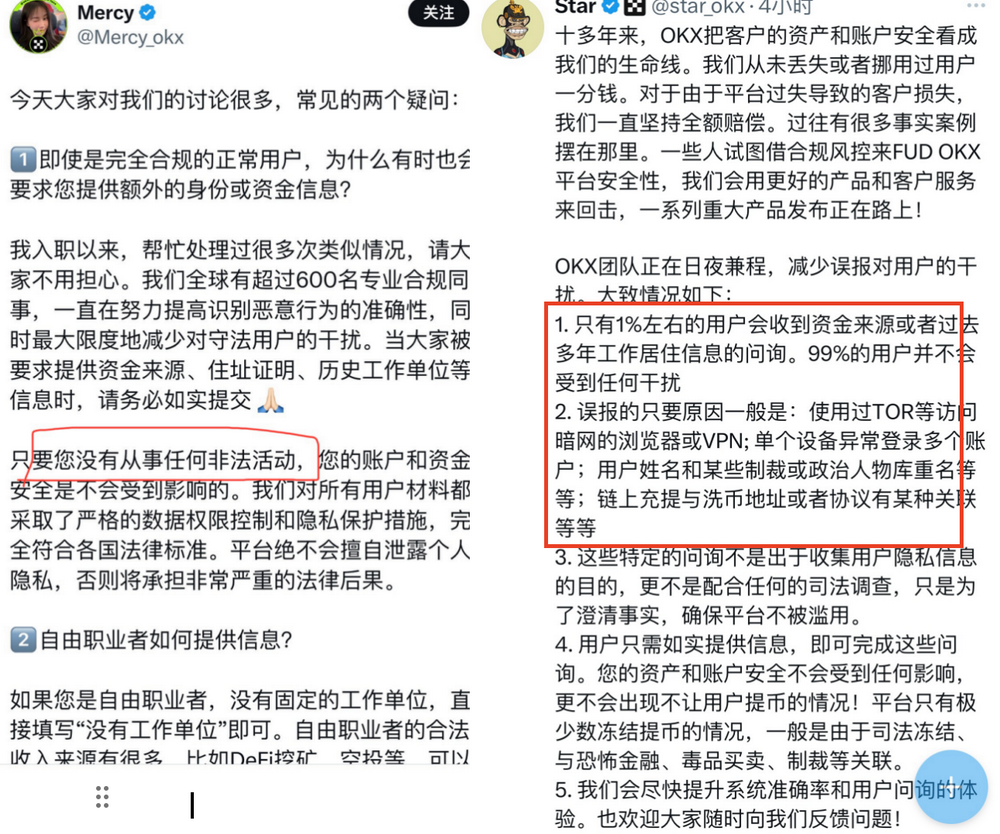
Euro-Yit Exchange also responded publicly to the online public opinion in a timely manner. For example, Mercy, an employee of Euro-Yit Exchange, said that fully compliant and normal users may be accidentally injured when encountering the system's "identification of malicious behavior", so Euro-Yit Exchange is improving the accuracy of identifying malicious behavior; at the same time, the employee said, "As long as you do not engage in any illegal activities, the security of your account and funds will not be affected."
And OuYi's CEO Xu Mingxing said in a statement that due to false alarms, about 1% of users will receive "inquiries about the source of funds or past work and residence information"; the main reasons for false alarms are that users use VPN to access, use TOR browser to access the dark web, a single device abnormally logs into multiple accounts, and user names are the same as certain sanctioned or political figures.
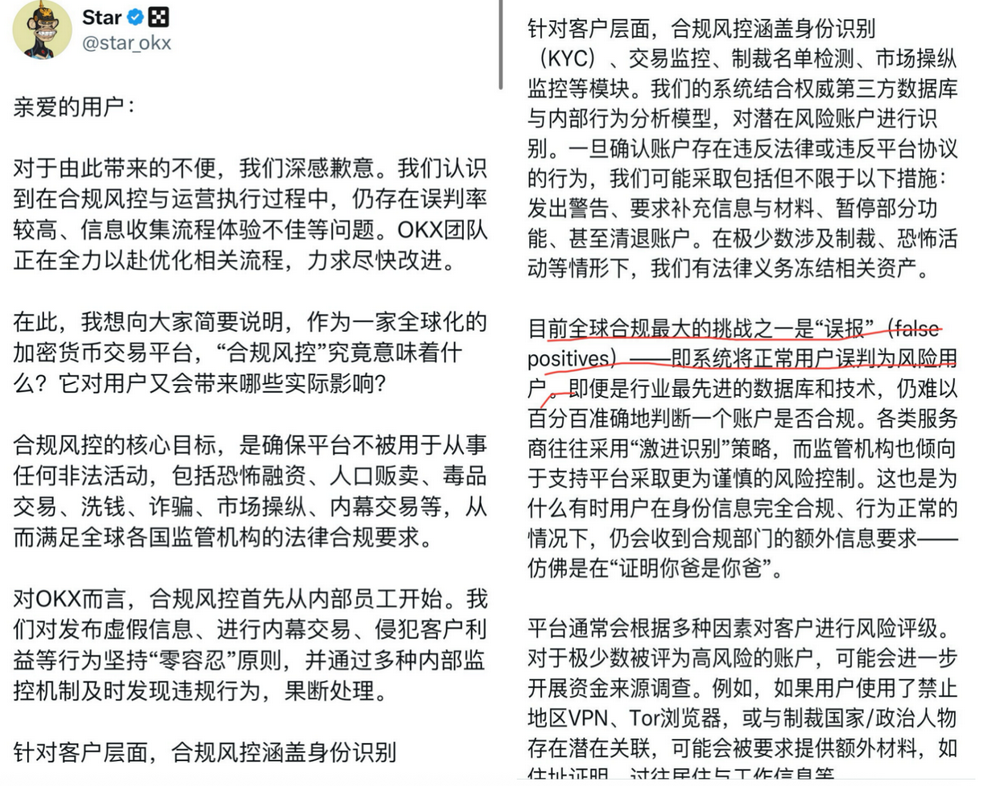
Afterwards, the CEO of Ouyi issued another statement, apologizing to users and explaining the significance and impact of "compliance and risk control" of virtual currency exchanges, but also clarified the following:
“Once we confirm that an account has violated the law or the platform agreement, we (Ouyi) may take measures including but not limited to the following:
Issue warnings, request additional information and materials, suspend some functions, or even clear accounts. In rare cases involving sanctions, terrorist activities, etc., we have a legal obligation to freeze relevant assets. "
At the same time, it also explains the reasons for the occurrence of "false positives" (i.e. the system mistakenly identifies normal users as risky users).
II. Legal risks of Chinese residents using overseas virtual currency exchanges
Some time ago, it was rumored that Ouyi was going to conduct an IPO on the US stock market. Although the truth of this news cannot be fully confirmed at present, if it is true, then it seems easy to understand why Ouyi has a strict KYC policy.
Of course, it is also possible that the IPO is fake news. Then we need to interpret and analyze from a higher level the legal risks of mainland Chinese users registering for virtual currency exchanges, especially for speculating in cryptocurrencies.
There are many virtual currency regulatory policies currently applicable to mainland China (see: " Summary of Regulatory Documents on the Web3.0 Industry in Mainland China "). Among them, after the "9.4 Announcement" in 2017 "drove mainland virtual currency exchanges out of the sea", the most powerful one at present is the "9.24 Notice" (" Notice on Further Preventing and Dealing with the Risks of Virtual Currency Trading Speculation ").
The “9.24 Notice” systematically and comprehensively regulates the business operations of overseas virtual currency exchanges:
(1) Overseas virtual currency exchanges providing services to residents in China through the Internet constitute illegal financial activities ;
(2) Domestic staff of overseas virtual currency exchanges, as well as legal persons, non-legal organizations and natural persons who knowingly or should have known that they are engaged in virtual currency-related businesses and still provide them with marketing, payment settlement, technical support and other services, shall be held accountable in accordance with the law.
In other words, from the perspective of mainland China's regulators, the services provided by overseas virtual currency exchanges to mainland residents are all illegal financial activities. However, since mainland China's law enforcement agencies do not have extraterritorial law enforcement powers, there is no way to force overseas virtual currency exchanges to shut down their servers, or even to provide services to mainland residents through the Internet.
From the perspective of mainland residents, there are currently no regulations prohibiting them from using overseas virtual currency exchanges. The "9.24 Notice" only prohibits exchanges from operating in the mainland, but does not prohibit mainland residents from using exchanges.
Therefore, the current situation is that even if the exchange knows that mainland China prohibits exchanges from operating, the mainland is too large and no one will give up this big market, so the exchange will continue to provide services to the mainland. Users registered in the mainland can pass KYC even if they use a "+86" phone number, a mainland resident ID card or a Chinese passport to register.
Of course, licensed exchanges in Hong Kong (such as OSL, HashKey, etc.) and exchanges in other countries (such as Coinbase in the United States, and even Kraken, etc.) still follow China's regulatory policies and do not support people with mainland identities, residences, and work to open accounts.
Therefore, the risk for mainland Chinese residents is that even if you can use virtual currency exchanges such as Binance and OY, you need to know that according to mainland China's regulatory regulations, the services provided by exchanges to mainland residents are illegal financial activities . Some friends may wonder, if that's the case, why haven't I been "in trouble"? Don't worry, let's take a look at the analysis below by Lawyer Liu.
3. What lessons can we learn from the FTX exchange bankruptcy case to the EU-Italy incident?
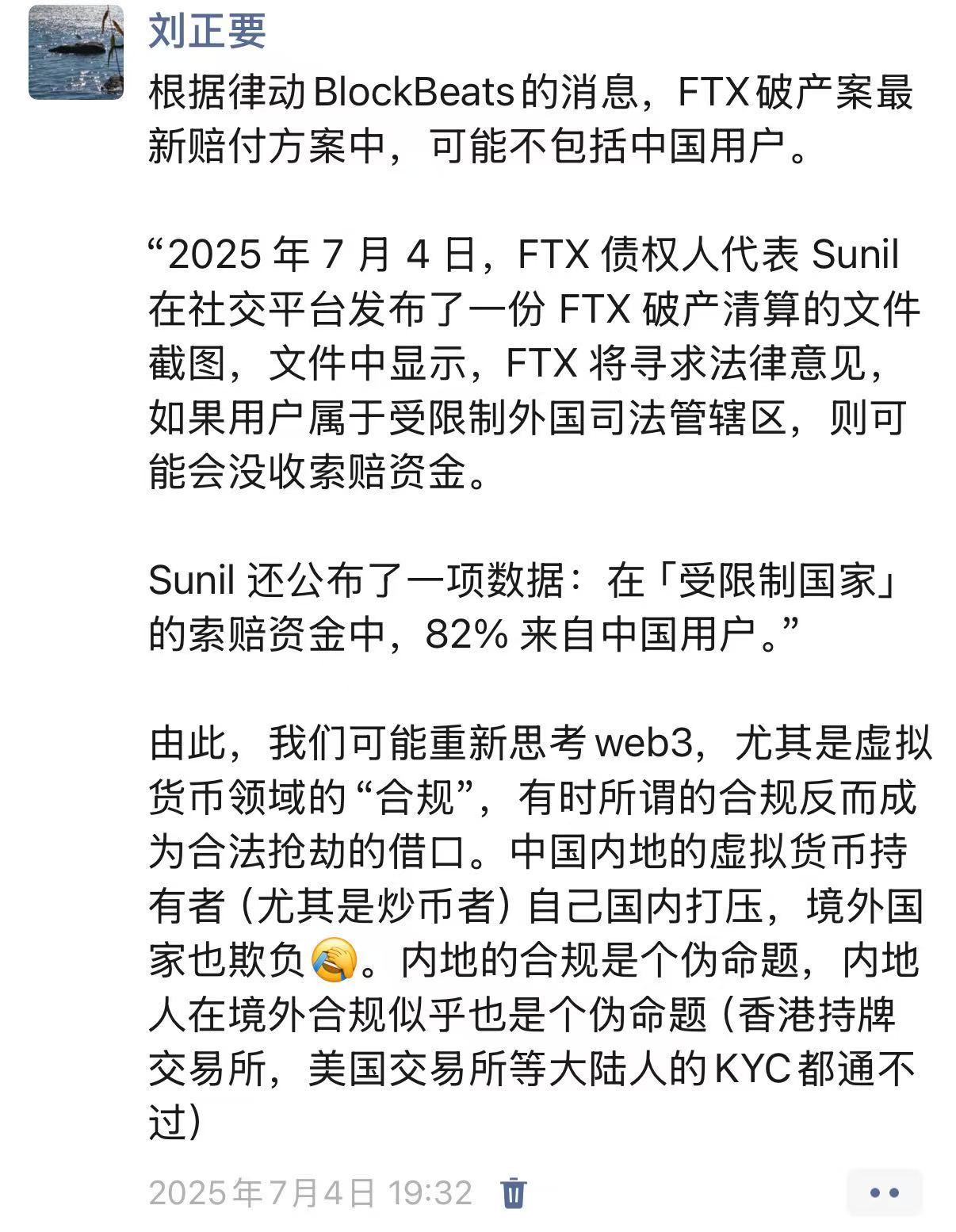
On July 4, one of the opinions in the FTX exchange bankruptcy plan was that if the user belongs to a restricted foreign jurisdiction, the claimed funds may be confiscated. Of all the funds involved in the "restricted countries", 82% came from China.
In other words, if your own country does not protect the investment behavior of virtual currency, it is a bit wishful thinking to expect other countries or exchanges to protect it. Therefore, web3 nomads in mainland China, especially those who play with coins, are really "Asian orphans in the cryptocurrency circle."
Finally, Lawyer Liu would like to say that for Chinese mainland resident users of centralized exchanges, if their accounts are frozen, there is little other way to "harden" their accounts except to cooperate with the exchange to unfreeze them according to the exchange's requirements. According to the legal dispute jurisdiction agreement on the official website of EURITA, if you want to "sue" EURITA, you need to go to the Hong Kong International Arbitration Center, which is too costly for many ordinary users (travel, work delays, lawyer fees, etc.)
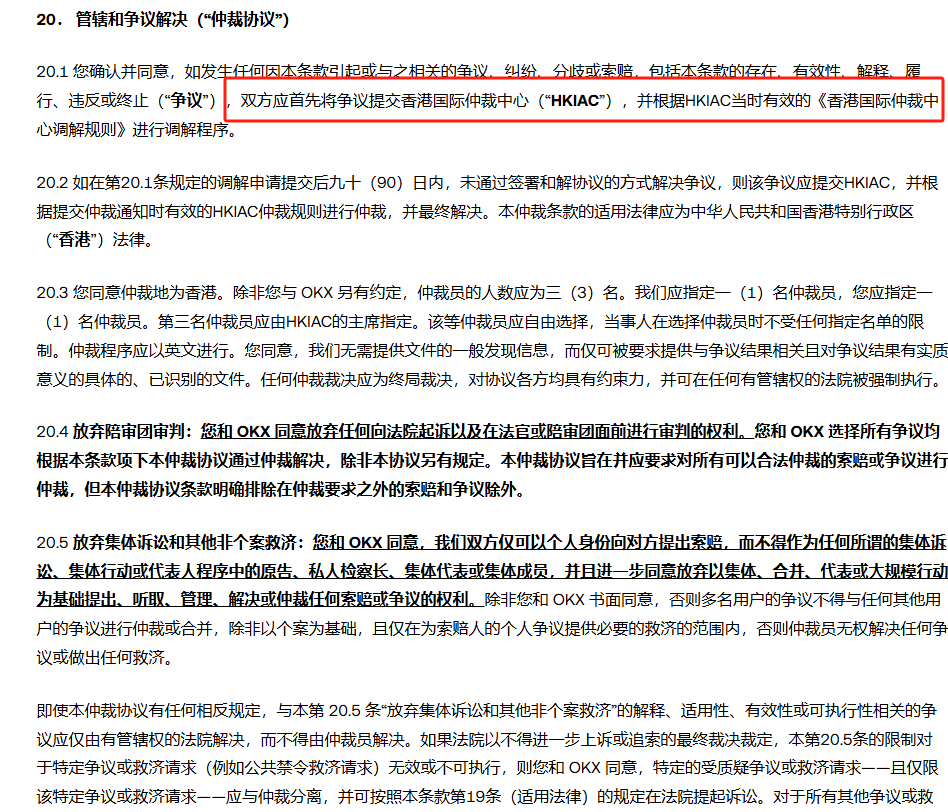
(Source: OUYI official website)