

Author: Route 2 FI
Compiled by: Vernacular Blockchain
Trading Psychology reveals the hidden mind games behind successful cryptocurrency trading. As a trader, your mind can be your most powerful tool - or your greatest weakness.
Your personal biases, like confirmation bias and overconfidence, can quietly sabotage your financial decisions without you even realizing it.
The most successful traders are not necessarily the smartest, but rather those who understand their own psychological patterns, control their emotions, and can make rational choices under pressure.
By recognizing how your brain naturally reacts, you can develop discipline, manage risk more effectively, and transform trading from an emotional roller coaster into a strategic, precision-focused operation.
Let’s dive in!
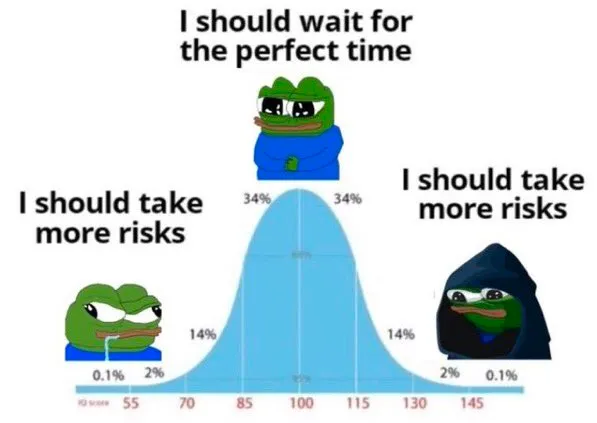
Where are you in the IQ curve above? Which Pepe type do you belong to?
Trading psychology reveals how traders react to market events and various factors that influence trading.
A trader's mental state not only determines their trading decisions, but also greatly affects the development of their trading career.
You may already know that the key to success is not high IQ, but psychological factors such as patience, perseverance, self-discipline and a healthy mental state.
Different traders may react very differently to the same market conditions.
1. Transaction Type
For example, when the price of Bitcoin ($BTC) drops sharply, some people will panic sell, while others will choose to buy on dips, believing that the price will rebound. Therefore, based on psychological characteristics, traders can be roughly divided into the following categories:
1) Impulsive Trader
These traders do not have a thorough plan, make quick decisions, and often ignore the consequences. They are easily influenced by emotions, which can lead to potentially huge losses.
2) Cautious Trader
This type of trader will fully analyze the market situation and their own financial situation before trading, usually emotionally stable, and have good self-management skills. However, they are sometimes too conservative and lack the spirit of adventure, while appropriate risk-taking can often bring higher returns.
3) Practical Trader
Pragmatic traders are both adventurous and analytical. They manage risk and trade with confidence. They are the ideal type of trader: they are not overly analytical, but they can reasonably assess whether each trade has a positive expected value (+EV).
You may already recognize some of yourself in these types and be able to reflect on how your own psychological traits may affect your trading results.
There is no doubt that trading psychology is an integral part of trading success.
2. Trading Bias
Trading biases are cognitive errors that traders may make during their decision-making process, which often significantly affect trading performance and final results.
Here are some common trading biases:
1) Confirmation Bias
Traders tend to seek out information that supports their existing views while ignoring evidence that contradicts their views. This bias can lead to poor decisions or overtrading.
For example, let’s say you hold a lot of Ethereum ($ETH). Typically, you might look for information on platforms like Crypto Twitter that supports the idea that Ethereum is a good asset, rather than researching the reasons why Ethereum might not be the best choice. As a result, you tend to be more exposed to content that agrees with your existing views rather than conducting a comprehensive and objective assessment.
Trading psychology not only helps you better understand the market, but also allows you to understand your own behavioral patterns, helping to improve your trading performance.
2) Availability bias
In cryptocurrency trading, availability bias refers to investors making decisions based on easily recalled or recently acquired information rather than thorough analysis. A typical example is when traders rush to buy a cryptocurrency because it is frequently mentioned on social media or news platforms, without considering its fundamentals.
For example, if a particular altcoin becomes popular on Twitter due to a celebrity endorsement or a viral meme, traders may overestimate its potential and invest heavily in it, even though the coin may lack a solid technical foundation or real-world application scenarios.
This bias can lead to poor investment decisions because readily available information may not accurately reflect the true value or long-term prospects of an asset. Another example is when traders overreact to recent market events. If the price of Bitcoin suddenly surges, the availability bias may lead investors to believe that such quick gains are common and easy to achieve, leading to overly optimistic trades.
This can lead to chasing short-term trends while neglecting more stable, long-term investment strategies.
3) Anchoring bias
A classic example of anchoring bias in cryptocurrency trading is when investors buy Bitcoin at $100,000 at the market peak. Even when market conditions change and the price drops significantly, they still stick to the anchor price of "$100,000". This psychology can lead to the following wrong decisions:
Holding on to the position when it was obvious that selling was needed, hoping that the price would return to $100,000.
Ignore new market information or analysis and only believe in your obsession with the $100,000 price.
Anchoring bias can lead to huge financial losses as traders fail to adapt to market changes and miss opportunities to stop losses or take profits at lower prices.
Another common anchoring bias is related to the net worth number. As a trader, you are exposed to profit and loss (PnL) fluctuations every day. Let's say your crypto net worth is $100,000. If you lose $20,000, it's easy for you to get stuck on the fact that your account is "down" and find it difficult to get back to the original level. This mentality may cause you to take an overly defensive approach to the market, and even if there seems to be a potential trading opportunity, you cut risk for fear of losing again.
4) Loss Aversion Bias
Traders often feel the pain of losses more intensely than the pleasure of profits, which often causes them to hold on to losing positions too long or close profitable positions too early.
Loss aversion is particularly evident in crypto trading. Suppose a trader buys Bitcoin at $100,000, expecting the price to rise, but the price falls to $80,000. Although market indicators indicate that the price may continue to fall, the trader is reluctant to sell his position, hoping that the price will return to his purchase point.
This reluctance to cut losses stems from the psychological pain of realizing losses, even when the trend is clearly unfavorable.
Another manifestation is that when a coin rises by 10%, traders will quickly sell it to lock in gains, fearing profit taking; but when a coin falls by 20%, they are reluctant to sell it, clinging to the illusion of a price rebound.
This behavior reflects that traders feel the pain of losses much more than the pleasure of equivalent gains. In the volatile crypto market, loss aversion can lead to:
Holding underperforming assets for a long period of time.
Missing out on other potential profit opportunities.
Increased emotional stress and irrational decision making.
To be honest, this is one of the classic traps I fall into every day. For example, right now I am shorting some weak altcoins. If I am currently making $10,000 in profit, but the price slightly corrects and my profit drops to $5,000, I tend to fall into the mentality of "never closing the position until it reaches more than $10,000". Because it makes me feel like I lost $5,000, even though the trade is still profitable overall. I believe many people can relate to this.
5) Overconfidence bias

6) Overconfidence bias Traders often overestimate their knowledge and abilities, which may lead to excessive risk-taking and frequent trading.
A typical example occurred during the Bitcoin bull run in 2021. Many traders were overconfident that they could predict market trends, so they increased leverage significantly, believing that Bitcoin prices would continue to rise.
When the price of Bitcoin surpassed $60,000 in early 2021, many investors became overly optimistic due to the recent upward trend, convinced that the price would continue to climb. They ignored the potential risks and the possibility of market volatility.
However, when the market eventually corrected and the price of Bitcoin fell below $30,000 a few months later, these overconfident traders suffered significant losses.
7) Fear and Greed
Fear and greed can cause traders to exit trades too early due to fear of losing money, or hold on to positions too long in an attempt to maximize profits.
Needless to say, this is intuitive and self-explanatory.
8) Recent news bias
Traders tend to give more weight to recent events or information and ignore longer-term trends or historical data.
For example, you may overreact to short-term price fluctuations and make irrational decisions. Suppose that after a sharp drop in the price of Ethereum ($ETH), traders may think that the downward trend will continue, so they rush to sell their positions and miss the opportunity for the market to rebound. Think about Crypto Twitter (CT). After a few days of decline, everyone will say that the trend is over and you should have sold it long ago, but in the end the market often reverses.
9) Herd bias
Traders follow the crowd and do not make decisions based on their own analysis, which is very common in the crypto market and is also a classic CT behavior pattern.
A prime example is Ethereum’s price performance between 2020 and 2021. From around $130 at the beginning of 2020 to its all-time high of $4,859 in November 2021, Ethereum prices rose by a staggering 3,756%.
This price surge reflects multiple types of herd behavior:
FOMO (Fear of Missing Out): As the price of Ethereum continues to rise in 2020 and 2021, more and more investors are flocking in, not wanting to miss out on potential gains.
Market Sentiment: Bitcoin’s performance and institutional adoption have driven positive sentiment across the crypto market, spreading to Ethereum as well.
Technological Progress: Ethereum’s transition to Ethereum 2.0 and the implementation of EIP-1559 in August 2021 (which introduced a burning fee mechanism) further stimulated market interest.
DeFi boom: As the leading platform for decentralized finance (DeFi) applications, Ethereum has seen a significant increase in demand and usage.
Institutional Interest: Growth in institutional adoption, coupled with the launch of Ethereum futures by the Chicago Mercantile Exchange (CME) in February 2021, brings more credibility to the asset.
It is important to note that after Ethereum reached its peak in November 2021, it experienced a significant pullback in 2022, with prices falling to around $900 in June, catching many investors off guard.
10) Framing Effect

11) Framing Effect
The way information is presented can affect trading decisions, and traders may make different choices depending on whether the data is presented positively or negatively.
Taking Solana as an example, the following is a typical example of the framing effect in crypto trading:
“Solana is up 10% in the last 24 hours, highlighting its strong ecosystem growth.”
“Despite a 10% gain, Solana has failed to reclaim its all-time highs.”
These two sentences describe the same 10% gain, but they present it in very different ways. The first piece of news highlights the positives, which may encourage traders to buy or hold Solana, while the second piece of news highlights potential drawbacks, which may make investors hesitate or even choose to sell.
This different framework can have a significant impact on traders’ decisions. For example, after reading the first piece of news, a trader may believe that the Solana network is growing strongly and be inclined to invest. However, after reading the second piece of news, a trader may hesitate to invest or even choose to exit the market if the price rises.
12) Illusion of Control
Traders overestimate their influence on market outcomes, leading to excessive risk taking.
For example, a trader may spend hours studying the price action of a token called “Fartcoin” and think they have discovered a perfect market timing strategy. Based on this “insight”, they may bet a large portion of their portfolio, mistakenly believing that they can control the outcome of their trades.
This illusion of control is particularly evident during bull markets. When the overall crypto market is in an upward trend, most tokens will grow with it. Traders may attribute their success to their own abilities rather than the overall trend of the market. For example, they may confidently say, "I knew this altcoin would rise 30% today because of my technical analysis," but in reality, this growth may just be the result of the overall trend of the market.
Personally, I don’t believe in technical analysis at all because it has been proven time and time again that the real driver of the market is the news, not that “invisible line” you draw.
13) Clustering Illusion
Traders see patterns in random market data that don’t exist and develop faulty strategies as a result.
A typical example is a crypto trader who notices that the price of a particular coin has been rising for five consecutive days. Based on this short-term pattern, he believes that a bullish trend has formed and decides to invest heavily in the asset. However, the five-day rise may be completely random and not represent any real trend.
This example reveals the core of the clustering illusion:
Traders see a pattern in the small sample data (five days of price action).
They assign meaning to the pattern without considering the broader market context or long-term data.
Investment decisions are based on the assumption that this pattern will continue, without considering that market fluctuations can be random.
In the highly volatile environment of crypto trading, prices fluctuate wildly due to a variety of factors. Mistaking short-term random price movements for meaningful trends can lead to poor investment decisions.
Let’s be honest, we’ve all been there. But after all, our analysis has to be based on something, right?
14) Negativity Bias
Traders tend to focus more on the negative aspects of a trade or strategy, which can cause them to miss out on great opportunities.
For example: Let’s say a trader has been doing very well over the past few months, with most trades making positive gains. However, one day, they experience a significant loss due to a market crash caused by negative regulatory news.
Despite the overall success, the trader began to dwell on this negative experience and:
Becoming overly cautious can lead to missing out on potential profit opportunities even if market conditions improve.
Continuously anticipating similar negative events and thereby selling positions prematurely or overusing stop-loss orders.
Ignore positive market indicators or good news and focus only on potential threats or negative factors.
This bias is also seen when some traders sell an asset they were previously bullish on. They may start spreading fear mongering (FUD) in an attempt to justify their decision and hope that the asset doesn’t continue to rise (after all, they already sold it).
15) Self-Attribution Bias

Traders attribute successful trades to their own abilities and attribute failed trades to external factors, thus hindering learning and improvement.
A classic example is a trader who bought Bitcoin at $80,000 and sold it at $105,000, making a nice profit. He attributes this success to his excellent market analysis and trading skills. However, when the same trader bought Ethereum at $3,500 and the price dropped to $3,000, he attributed the loss to market manipulation, unexpected regulatory news, or “whale” selling.
We see this phenomenon on Crypto Twitter (CT) almost every day (hint: it’s a daily occurrence!).
16) Hindsight Bias
Traders believe that past events are more predictable than they actually are, which can lead them to be overconfident in future forecasts.
For example, a trader bought Solana (SOL) at $200 in early January 2025. By mid-January, the price had risen to $250. Looking back, the trader thought, “I knew Solana would go up 25%. The sentiment and technical indicators were so clear.”
This reflects several characteristics of hindsight bias:
Traders overestimate their ability to predict Solana price action.
Ignoring the inherent volatility of the crypto markets, especially altcoins like Solana.
Ignore external factors that influence price increases, such as overall market conditions or specific news events.
This bias may lead to the following consequences:
Overconfidence in future trades
Ignoring potential risks or contrary indicators
Failure to effectively diversify its crypto portfolio
3. Problems I experienced in trading
These biases often occur in my trading process. By being aware of the existence of these biases, we can better reflect on our trading behavior and improve our strategies.
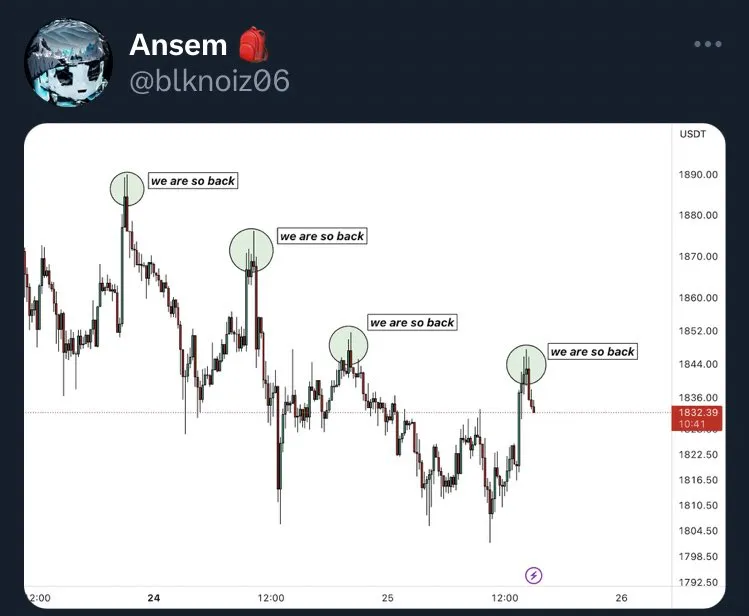
1) Random Reinforcement
Sometimes amateur traders (like myself) may go on a winning streak while experienced traders go on a losing streak. Although this is essentially a game of luck, traders may mistake this for their own ability, or conversely, may seriously doubt their ability and fall into the psychological trap of random reinforcement.
Random overtrading is a destructive psychological phenomenon that is very common among traders. It can cause traders to misunderstand their own abilities, cloud their judgment, and lead to overconfidence or extreme lack of confidence. The problem is that novices may mistakenly believe that they have found a way to make easy profits, while experienced traders may begin to doubt their skills, trading plans, and even their entire trading knowledge system.
An example of a mistake I often make:
Let’s say my trading day starts with a big gain on $TIA. This can happen with any asset, but generally speaking, if there is a big gain at the beginning, I will become overconfident and more likely to start trading frequently without a clear logic.
My thinking was this: "I've made a lot of money, so I can now risk more. Even if I lose, it doesn't matter, because I'm betting with my 'free money'."
Can you see the flaw in this thinking?
Random reinforcement makes traders ignore the randomness of the market and mistakenly believe that short-term success is entirely due to their own ability, resulting in more high-risk decisions in the absence of a rigorous strategy. This mentality will lead to:
Ignore market risks and trade frequently.
Overestimating your own skills and ignoring potential warning signs.
Suffering significant losses when markets turn.
2) Fear of Missing Out (FOMO)
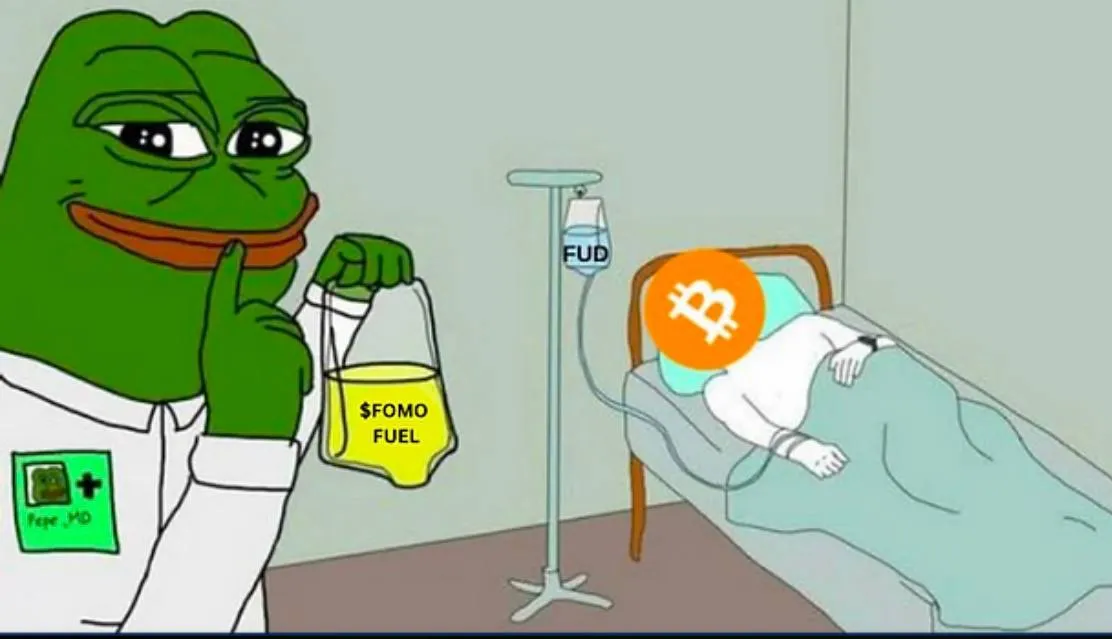
Everyone is familiar with FOMO. Social media, news, and herd mentality have us hooked on the idea that we can make a lot of money if we just act now, which is when panic trading begins. Trading because of FOMO eliminates rationality and reason.
Frankly, I feel this sentiment on Crypto Twitter (CT) almost every day. There is always a token that may be about to "fly to the moon".
A reader once wrote to me:
“I haven’t taken a vacation since 2019 because I feel like if I leave for a week, the market will skyrocket while I’m away. I’m sure a lot of people feel the same way, unable to fully enjoy life because of FOMO.”
It sounds sad, but I understand it, especially when I was not fully invested in the market, or when I was liquidating a position in a bear market.
If you feel FOMO on a green day… then you may be out of ammunition when the market turns red. If you must feel FOMO, choose a red day.
3) Revenge Trading
This style of trading is very detrimental to the trader's financial situation and often exacerbates losses.
Suppose you trade well during the week and make a steady profit. However, at the weekend, you suddenly lose all your profits, or even more.
The next reaction is a kind of "revenge psychology".
The target of revenge is the market itself. So you try to make up for your losses as quickly as possible, frantically trading junk coins, and often making some unforgivable mistakes.
I define revenge trading as attempting to recover a loss on one trade by making multiple, lower-quality trades.
suggestion:
Prioritize quality and don't rush for success. Finding good trading opportunities takes time, don't rush into it because of emotions.
Pause trading and reevaluate your strategy. After a loss, stop and reflect on what went wrong. Analyze your trades and find out where you went wrong. This will help you avoid making the same mistakes in the future. Tools like CoinMarketMan and TradeStream can help you record and analyze your trading data.
Get help. If you find yourself struggling to break out of a cycle of losing and revenge trading, consider finding a mentor or coach. They can provide valuable guidance and help you develop a more effective trading strategy.
4) Gambling Psychology
First, let’s acknowledge that we all have a gambler’s mentality to some degree.
The essence of trading is planning, strict discipline and continuous learning, but some traders see it as gambling. Traders with a gambling mentality usually do not consider building a proper trading strategy, but trade on impulse and rely on luck. They are driven by the adrenaline rush of winning the "bet" and completely ignore systematic operations.
This gambling mentality is common among novice traders as well as some professional traders who are eager to get something for nothing.
The gambling mentality causes traders to make impulsive decisions without careful consideration, which ultimately leads to inevitable losses and emotional breakdown.
5) Herd Instinct
Herd mentality is an important issue in the field of psychology. In trading, herd mentality is often based on the fear of failure. Therefore, traders often rely on group decisions instead of conducting comprehensive market analysis. This reliance can lead to panic trading, irrational operations, and ultimately losses.
To be a successful trader, you always need to pay attention to your psychology. This simple formula should be your guiding light in your trading journey: rational analysis > herd behavior.
An example of herd mentality:
Let’s say Ansem tweets a message about a new coin. Immediately, the price of the token starts to soar. Soon, other crypto opinion leaders start discussing the token. Because the whole group is rushing in, you feel safe and follow the crowd. However, if you are not vigilant enough, you are likely to suffer losses when the market is finally “dumped”. This is always the case.



