
Author: Monchi | Editor: Monchi
1. Bitcoin Market
From May 24 to May 30, 2025, the specific trend of Bitcoin is as follows:
May 24: Bitcoin showed a structural fluctuation of falling first and then rising. After opening, it quickly dropped to $108,650, and then rebounded for a short time, rising to $109,787. However, during the Asian session, the price weakened again, falling sharply to the lowest point of the day at $107,028. After that, the market started a corrective rebound, reaching $108,517, $107,615 (short-term correction), and $109,350 respectively. The volatility gradually converged to around $109,000 in the evening.
May 25: Continuing the narrow range of the previous day, the intraday high was recorded at $109,016, followed by a significant rapid decline to $107,378. After a brief rebound to $108,269, the price fell again to $106,877, stabilized in late trading, and slightly rebounded to $107,650.
May 26: Bitcoin prices continued to be weak in the previous period, falling to a weekly low of $106,725. But then the market sentiment changed significantly, and the bulls pushed the price up sharply. Bitcoin quickly rose to $109,188 in a short period of time. Although it fell back slightly, it immediately rose again and broke through to $109,702. The market continued to fluctuate upward in the afternoon, reaching a high of $110,120. The price at the end of the trading day was around $109,740, and finally rose to $110,117, forming a tentative breakthrough.
May 27: The overall trend of Bitcoin fell first and then rose. It fluctuated and fell back to $108,977 in the early trading, and then gradually rebounded to $109,755, but then encountered selling pressure and quickly fell back to $108,306. The market then entered a fluctuating upward rhythm, breaking through $109,242, $109,860 and $110,455, showing that bullish sentiment has warmed up. Although it once fell back to $109,415 before closing, it quickly resumed its upward trend and returned to $110,182.
May 28: Bitcoin continued its upward trend of the previous day, reaching an intraday high of $110,410. It encountered significant resistance at the $110,000 mark, and then the price fell technically, gradually falling back to the $109,000 level and maintaining a volatile consolidation. As the market closed, the selling pressure intensified, and the price of Bitcoin fell rapidly to $107,221, with obvious signs of short-term pressure.
May 29: Bitcoin started to fluctuate upward on that day, with prices rising in a step-by-step manner, breaking through $107,845, $108,446 and the intraday high of $108,882. The market then fell under pressure and entered a downward channel, falling back to $105,712 in the late trading, showing an overall "high-rise and fall" pattern during the day.
May 30: Bitcoin rebounded slightly to $106,434 in the morning, then quickly dropped to $104,802, then quickly rebounded, showing a certain buying support. As of writing, the current price is temporarily reported at $105,374, and the short-term range remains volatile.
Summarize
This week, Bitcoin as a whole showed a downward consolidation trend in a wide range of fluctuations. From May 24 to 28, the price ran in the range of US$107,000 to US$110,500, and tested the US$107,000 support level many times, showing a certain buying capacity. However, since the evening of the 29th, the market started a new round of downward correction, and the US$105,000 level has become an important short-term support at the current stage.
Overall, the market has entered a relatively healthy technical consolidation phase, and is expected to maintain a range-bound pattern in the short term, accumulating momentum for the next round of trends. It is worth noting that the combined effects of continued inflows of ETF funds, spot market premiums, and low volatility are building a more solid market bottom structure. Once the macroeconomic environment becomes clearer, market sentiment is expected to pick up, driving Bitcoin to strengthen again, laying the foundation for a medium- and long-term upward trend.
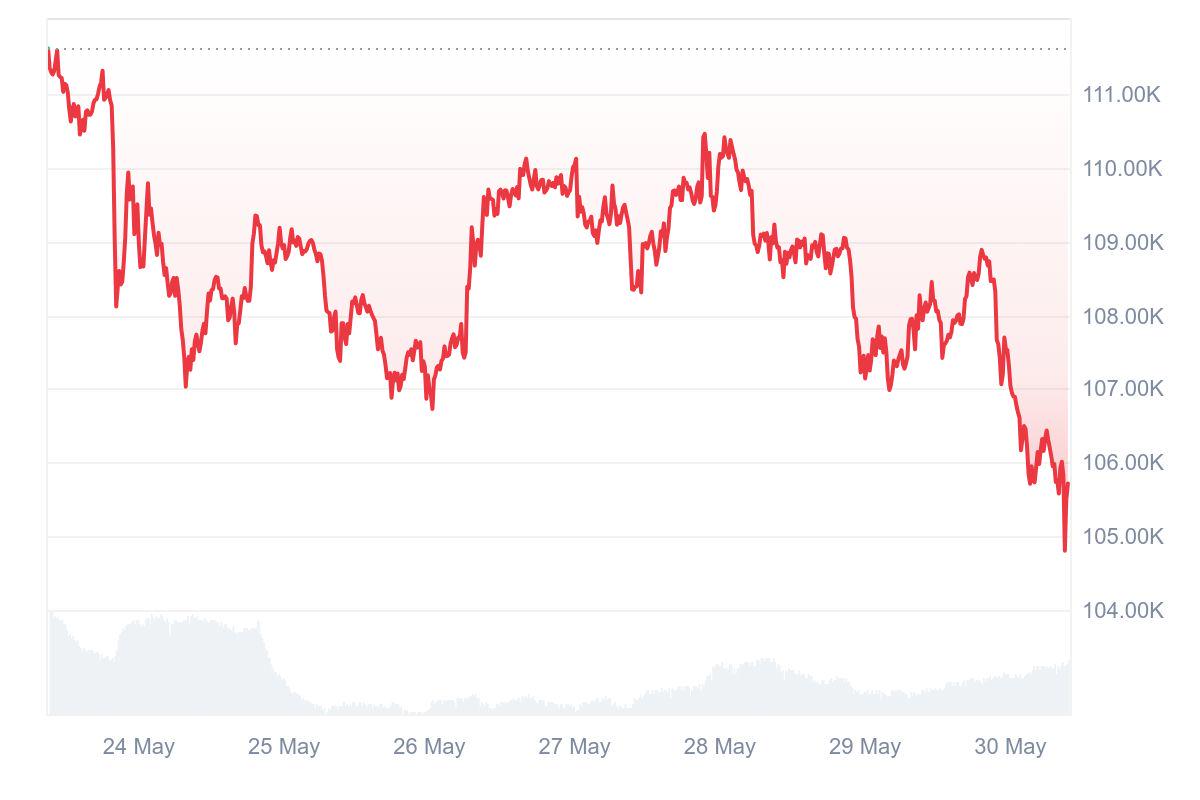
Bitcoin price trend (2025/05/24-2025/05/30)
2. Market dynamics and macro background
Fund Flows
1. Net outflow from exchanges continues to expand, and funds are steadily flowing into Bitcoin
Under the dominance of spot trading, the scale of net outflow from centralized exchanges continues to expand. According to Glassnode data, from May 25 to 28, the cumulative net outflow from centralized exchanges was about 18,400 BTC, reflecting the continuous accumulation trend of long-term holders and institutional funds.
Large outflow from Coinbase: On May 26, Coinbase had a single-day net outflow of 7,883 BTC, the third largest single-day outflow in the past month, which may be related to institutional or ETF fund allocation.
Binance Outflows: On May 27, Binance saw a net outflow of 2,190 BTC (about $243 million), indicating that market sentiment is becoming cautious as Bitcoin approaches the key resistance level of $114,000.
Fund differentiation among exchanges: Data on May 24 showed that Bitfinex, Binance and Bitstamp had a total outflow of nearly 5,600 BTC, while Kraken recorded a net inflow of 1,810 BTC, reflecting the liquidity differentiation among different trading platforms.
Overall, the trend of net outflow from exchanges is becoming increasingly obvious, with funds more inclined to "leave exchanges and turn to long-term holdings or allocate alternative tools." It also reflects that some funds are shifting to channels such as ETFs.
2. Daily average capital inflows are strong, close to the peak of the last bull market
According to CryptoQuant analyst Axel Adler Jr, the current average daily new capital inflow into the Bitcoin market is approximately US$1.8 billion, which is close to the bull market high in November 2021 (Bitcoin price was approximately US$64,000).
The scale of capital inflows at key high points: At $73,000, the peak inflow reached $3.6 billion; at $92,000, the peak inflow reached $4.5 billion
This data shows that despite the continuous record high prices, the market still maintains strong capital supply and active willingness to enter the market, providing solid support for the subsequent trend of Bitcoin.
3. Leverage game and whale dynamics: high-risk operations trigger short-term fluctuations, and the options market tends to be rational
The market has recently shown polarized leverage behavior: some big whales have adopted high-leverage aggressive operations, resulting in sharp fluctuations and greater risks; while the overall market leverage level is moderate, investors rely more on options for risk hedging, and the structure tends to be rational.
James Wynn Case
Between May 24 and 25, his long and short positions fluctuated greatly, with the amount of his positions falling from $1.2 billion to $1 billion in the short term, and he ultimately lost tens of millions of dollars in two days. Starting from May 27, he added to his long positions again, holding $500 million to $600 million on the 28th, and maintained his leveraged position by selling PEPE coins to add margin.
From May 29 to 30, during the Bitcoin pullback, its 40x leveraged long positions were on the verge of liquidation. After stop loss reduction, the position dropped from $760 million to $177 million. A total of 949 BTC were liquidated, with a loss of more than $99 million. The current margin is not enough to maintain the original position. The market has seen reverse copy orders targeting its strategy, with a floating profit of more than $5.6 million, indicating that some investors took advantage of the volatility of large investors to conduct reverse operations.
The overall leverage level tends to be cautious
As of May 29, the open interest of BTC futures on mainstream platforms has dropped by 10%-15% from the high point in December 2023, and the open interest on Binance has dropped from $13.7 billion to $12.5 billion. The current market is mainly driven by spot buying, with less leveraged speculation.
Options market expands rapidly
Glassnode data shows that the open interest of Bitcoin options reached US$46.2 billion, a record high, up US$25.8 billion from the low, an increase that exceeded the futures market, reflecting the growing demand for advanced hedging tools among investors and the increasingly mature and rational market structure.
4. Spot Bitcoin ETF: Funds continue to flow in, and the scale of inflows hits a record high
This week's daily ETF fund inflow/outflow details:
May 27: +$385.4 million in net inflows
May 28: +$432.7 million in net inflows
May 29: -$471.9 million net outflow
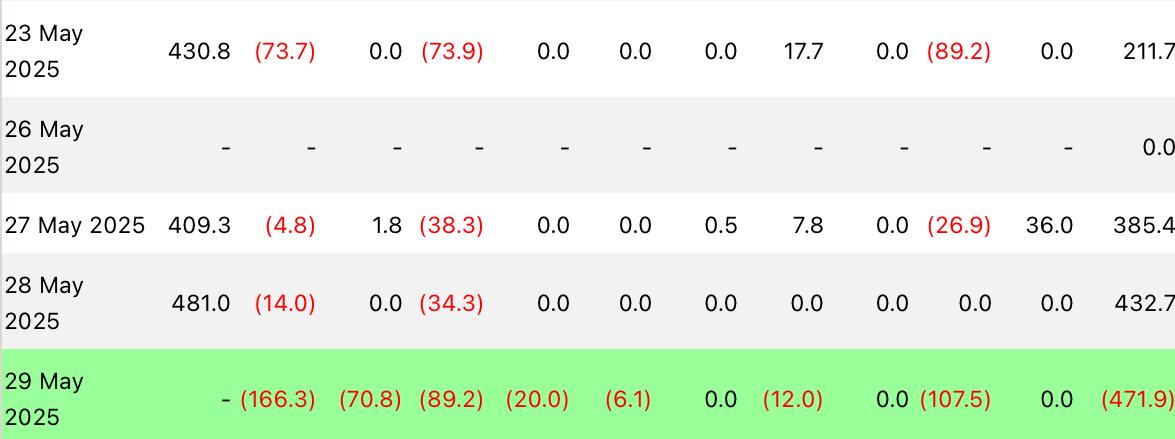
ETF Inflow/Outflow Data Image
Despite a small net outflow over the weekend, overall funding momentum remains strong.
Weekly trading volume hit a new high: As of the week ending May 24, total spot ETF trading volume reached US$25 billion, with net inflows of US$2.75 billion, setting the second-highest single-week inflow record since its listing in 2024.
Monthly net inflows set a new record: cumulative net inflows in May were US$3.294 billion, the highest level since 2025.
In the past five weeks, US Bitcoin ETFs (represented by IBIT under BlackRock) have attracted a total of more than US$9 billion, while gold ETFs have seen outflows of more than US$2.8 billion, highlighting Bitcoin's role as an alternative to traditional safe-haven assets.
Against the backdrop of changing global risk aversion patterns and increasing uncertainty in the U.S. fiscal outlook, Bitcoin’s status as a store of value continues to rise. Continuous capital injections have compressed the supply of Bitcoin available for circulation on exchanges, laying a solid foundation for the medium- and long-term price structure.
5. Analysis of miners’ behavior: Miners took small profits, but still optimistic overall
As the price of Bitcoin rises, the amount of money transferred by miners to exchanges has increased from an average of 25 BTC per day to 50 BTC, which is still far below the 100 BTC/day level at the peak of the bull market. This shows that some miners are choosing to cash out on a small scale, but overall they still prefer to hold for the long term, reflecting an optimistic attitude towards the future market. Miners are not under concentrated selling pressure for the time being, and the impact on market selling pressure in the short term is limited.
Technical indicator analysis
1. Relative Strength Index (RSI 14)
According to Investing.com data, as of May 30, Bitcoin’s (BTC) 14-day relative strength index (RSI) was 40.883.
The value is near the 40 range, which is a weak area (the common reference range is 30–70), indicating that the short-term market momentum is weakening and sellers have a slight advantage. The RSI value has not reached the oversold zone (below 30), indicating that the market has not yet entered an extreme panic, but is in a cautious wait-and-see stage. If the RSI continues to fall and falls below 30, it may trigger a technical rebound; if it can stand above 50 again, it is expected to regain upward momentum.
2. Moving Average (MA) Analysis
5-day moving average (MA5): $107,738.88
20-day moving average (MA20): $104,405.74
50-day moving average (MA20): $94,115.63
100-day moving average (MA100): $93,961.22
200-day moving average (MA200): $86,160.28
Current market price: $106,022.15

MA5, MA20, MA20, MA100, MA200 data pictures
The current price is slightly lower than MA5, indicating that the short-term pressure is heavy and the market is in a short-term adjustment phase. However, the price is still higher than MA20 and MA50, and the medium-term trend structure maintains a healthy upward channel. At the same time, MA100 and MA200 show a continuous upward trend, forming a solid long-term support area, indicating that the long-term bull market trend is still continuous.
3. Key support and resistance levels
Support level : Bitcoin's current short-term support is mainly concentrated at three key technical levels: $107,000, $108,000 and $105,000, forming an effective support belt. $107,000: After multiple tests on May 24, 26 and 29, the price rebounded, indicating that this position has strong buying capacity; $108,000: After the correction on May 27, the price stopped falling and stabilized, further confirming its effectiveness; $105,000: After the price fell to this level on May 30, it rebounded quickly, indicating that this is a short-term strong support at the current stage. If it falls below, it may trigger a new round of decline.
Resistance : Short-term upper resistance is concentrated at $106,500, and the medium-term key resistance is $110,500. $106,500: The rebound on May 30 was blocked here, indicating that the short-term rebound momentum is limited; $110,500: The two upward probes on May 26 and 28 failed, verifying that this position is a medium-term suppression level. If it can effectively break through and stabilize above it in the future, it may open up a new round of upside space and challenge a higher target level.
Currently, Bitcoin is in a structure with strong short-term support and medium-term suppression, and the probability of short-term fluctuations is high. In the future, we need to pay attention to the effectiveness of the $105,000 support and whether the $110,500 area is broken, as key technical signals for judging the direction of the market.
Market sentiment analysis
1. Optimistic but rational: Market sentiment returns to stability from extreme greed
Currently, Bitcoin is in a high-level consolidation cycle. Although the price has fallen back to the $105,000 area in the short term, it has remained above the technical support as a whole, and the market's resilience remains. Judging from the K-line structure and transaction characteristics, although the shorts continue to exert pressure, the longs have not completely withdrawn, and the key support levels have been effectively defended many times, reflecting that the market has not yet entered a systematic decline. Investor sentiment has also shown a transitional state from the previous "extreme optimism" to "cautiously optimistic", entering a typical technical consolidation range.
It is worth noting that on-chain data shows that during the short-term price correction, long-term investors' confidence in holding positions has increased rather than decreased. According to CryptoQuant analysis cited by CoinTelegraph, around May 26, a large number of high-leverage short-term traders were liquidated. At the same time, long-term holders took the opportunity to increase their positions, pushing Bitcoin's realized market value to more than $28 billion, a record high since April. This "weak hands out, strong hands take over" behavior shows that Bitcoin's market structure is concentrating on medium- and long-term bullish funds, which will help build a more solid chip foundation in the future.
At the same time, some short-term funds chose to cash in when the price failed to effectively break through $110,000, which also exacerbated short-term volatility and consolidation needs. However, from an emotional perspective, mainstream investors did not show obvious panic, and the overall market continued to operate in an optimistic expectation.
2. Key Sentiment Indicators (Fear and Greed Index)
The Fear & Greed Index is an important indicator for measuring market sentiment. As of May 30, the index was at 61, in the "greed" zone, indicating that investor sentiment is still optimistic. This week, the daily index remained in the range of 61 to 69: from May 24 to 29, it was 67, 67, 69, 68, 68, and 65, respectively. Although it fell slightly from last week, it was still at a high level, indicating that the market risk appetite is still strong and has not yet turned to a defensive configuration.
The current market sentiment is gradually cooling down from overheating, showing the characteristics of rational optimism. Although Bitcoin has experienced a short-term shock correction, investors have not panicked and sold, and the greed index remains in a high range, showing that the market still has positive expectations for the future market. The continued increase in positions by long-term holders highlights their recognition of the current price level, while the gradual exit of short-term speculators has eased the pressure of floating chips and helped to repair market sentiment. Overall, Bitcoin is currently in a stage of parallel adjustment of sentiment and reorganization of chips, investor confidence remains, and market expectations are still positive.
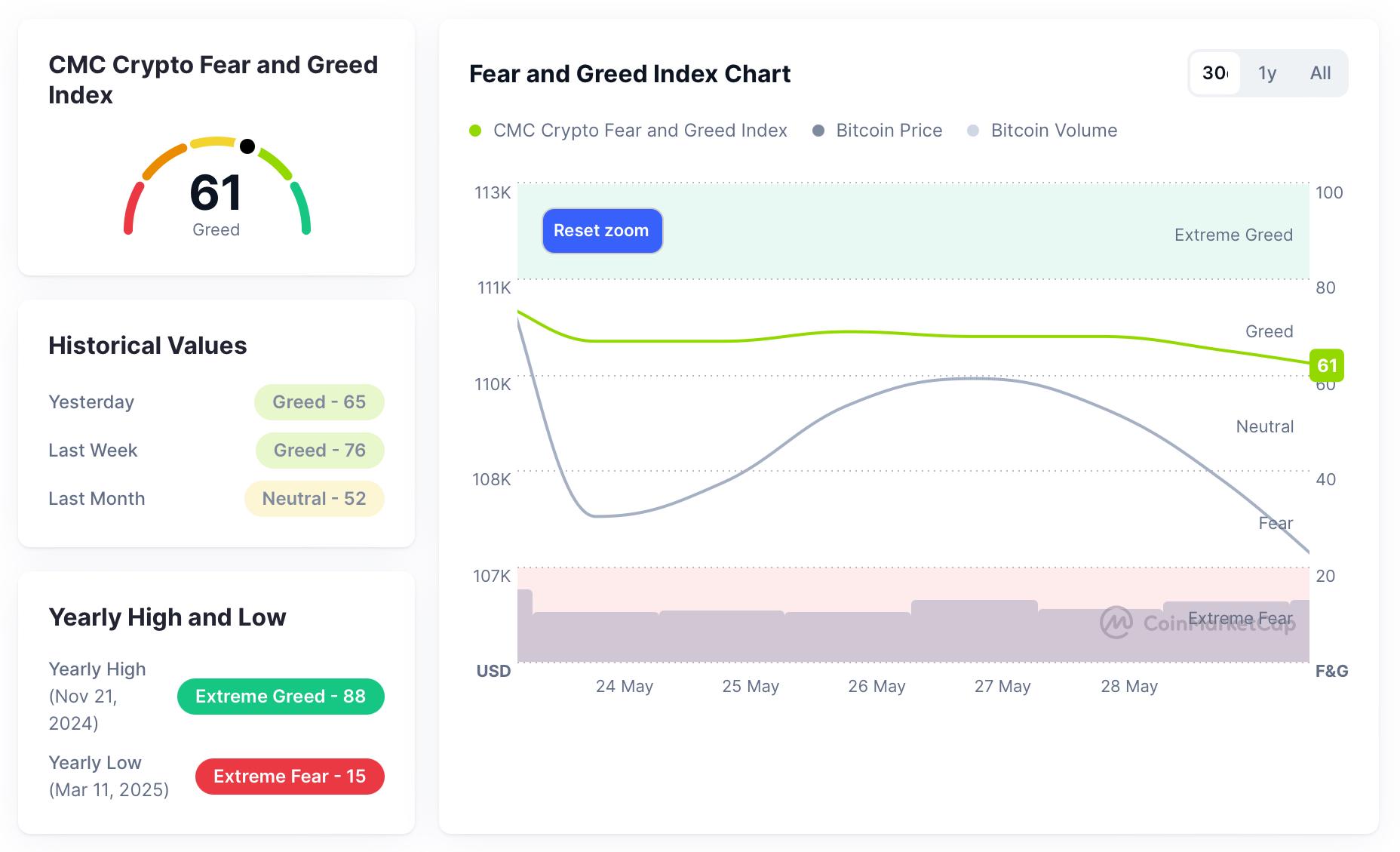
Fear and Greed Index Data Picture
Macroeconomic Background
Trump Media and Technology Group plans to invest $3 billion in cryptocurrency
On May 26, 2025, Trump's "Trump Media and Technology Group (TMTG)" announced plans to raise about $3 billion, and intends to invest most of the funds in cryptocurrency assets such as Bitcoin. The financing method includes issuing $2 billion in new shares and $1 billion in convertible bonds. This move is interpreted as the Trump camp continuing to strengthen its emphasis on the digital asset market and further consolidate its "crypto-friendly" image. This news will help boost market confidence in the long-term value of crypto assets.
In addition, on May 28, 2025, Trump's son Eric and Donald Trump Jr. announced at the Bitcoin conference that after being blocked from traditional bank financing, they turned to the cryptocurrency field and launched a cryptocurrency mining business.
U.S. Department of Labor lifts restrictions on cryptocurrency investments in 401(k) plans
On May 27, 2025, the U.S. Department of Labor under the Trump administration officially revoked the "extremely cautious" regulatory guidance on investing in cryptocurrencies in 401(k) retirement accounts during the Biden administration. This policy shift means that U.S. employers will face less legal resistance in offering crypto asset options such as Bitcoin in retirement plans, which is expected to drive a large amount of compliant funds into the market, which will be beneficial to Bitcoin in the medium and long term.
Trump administration delays imposing high tariffs on EU
On May 25, 2025, the Trump administration originally planned to impose a 50% tariff on EU goods in early June, but ultimately decided to postpone the implementation of the policy in order to buy more time for trade negotiations between the US and Europe. This move was interpreted by the market as a signal of easing trade tensions, leading to a rise in European stock markets, a stronger dollar, and an increase in market risk appetite.
US court halts 'Liberation Day' tariff policy
On May 28, 2025, the U.S. International Trade Court ruled that the "Liberation Day" tariff plan launched by the Trump administration in early May based on the International Emergency Economic Powers Act (IEEPA) was an act of overstepping authority and declared it invalid. The plan was intended to impose high tariffs on major trading countries (especially China). After the ruling was announced, major U.S. stock index futures rose sharply, with the Dow futures rising 550 points. This news eased market concerns about macro uncertainties and indirectly benefited the performance of risky assets including Bitcoin.
Vice President JD Vance Gives Pro-Crypto Speech at Bitcoin Conference
On May 28, 2025, at the Bitcoin 2025 conference in Las Vegas, U.S. Vice President JD Vance said that the Trump administration will continue to support cryptocurrency policies, emphasizing that cryptocurrency is a tool to fight inflation and bad policies. He also called for the passage of the GENIUS Act to establish a regulatory framework for stablecoins.
Major U.S. Bank Considers Getting Into Cryptocurrency
On May 28, 2025, Reuters reported that large U.S. banks are internally discussing expanding their involvement in cryptocurrencies, considering gradually entering the field through pilot projects, partnerships, or limited cryptocurrency transactions. This trend shows that with the support of regulators, traditional financial institutions are becoming more accepting of cryptocurrencies.
Latest developments in exchange regulation
On May 30, 2025, the U.S. Securities and Exchange Commission (SEC) voluntarily withdrew its lawsuit against Binance, demonstrating a shift in regulatory policy and boosting market confidence. On the same day, the Thai Securities and Exchange Commission announced that it would ban five unlicensed cryptocurrency trading platforms, namely Bybit, 1000X, CoinEx, OKX and XT.COM, from June 28, 2025 to protect investors' rights and interests and prevent money laundering risks. The Thai Ministry of Digital Economy and Society will be responsible for implementing the relevant ban measures and remind users to properly handle relevant assets in advance.
3. Hash rate changes
Between May 24 and May 30, 2025, the Bitcoin network hash rate fluctuated as follows:
On May 24, the overall hash rate of the Bitcoin network showed a trend of first decline and then rise. It initially fell from 941.28 EH/s, and then fell to 880.07 EH/s and 811.35 EH/s, and hit the low of the day at 787.37 EH/s in the evening. The computing power then rebounded rapidly, breaking through the previous high and rising to 1061.34 EH/s, indicating that the computing power on the miner side was back online or adjusted. On May 25, the hash rate continued to be strong, climbing to 1067.75 EH/s, but the computing power gradually declined in the second half of the day, and fell back to 890.50 EH/s at the end of the day, reflecting that some computing power may temporarily withdraw after high load. On May 26, the hash rate initially fell rapidly to 821.22 EH/s, rose slightly to 895.33 EH/s, and then fell further to 807.03 EH/s. In the evening, the hash rate rebounded significantly, reaching a maximum of 989.19 EH/s, and fell to 934.75 EH/s at the end of the day. The overall fluctuation range is large, indicating that the supply of computing power is disturbed by multiple external factors, including power stability and mining farm scheduling. On May 27, the hash rate rose rapidly from 913.89 EH/s to an intraday high of 1024.41 EH/s, reflecting the centralized access of some high-performance computing nodes. However, it gradually weakened afterwards, first falling back to 964.52 EH/s, and then falling sharply in the afternoon and evening, and finally falling to 818.40 EH/s. On May 28, the hash rate of the entire Bitcoin network once dropped to 762.76 EH/s during the day, and the short-term computing power fell back. However, it rebounded quickly afterwards, showing strong network recovery ability, climbing to 847.22 EH/s, 956.93 EH/s, and reaching an intraday high of 995.74 EH/s, indicating that miner activity has picked up and the overall computing power of the network is in a strong state of repair. On May 29, the Bitcoin network hash rate experienced fluctuations, first falling from 994.19 EH/s to 921.20 EH/s, then rebounding to 1028.37 EH/s, then falling to 896.67 EH/s, and rising to 1021.12 EH/s at the end. On May 30, as of the time of writing, the hash rate stabilized at around 1000 EH/s, a slight decline from the previous day.
Overall, despite the large fluctuations in the short term, the overall computing power of the Bitcoin network remains at a high level, reflecting the flexible response of miners to the current market environment and the resilience of the network. In the future, as the power supply situation and market prices become clearer, the hash rate is expected to stabilize and gradually recover.
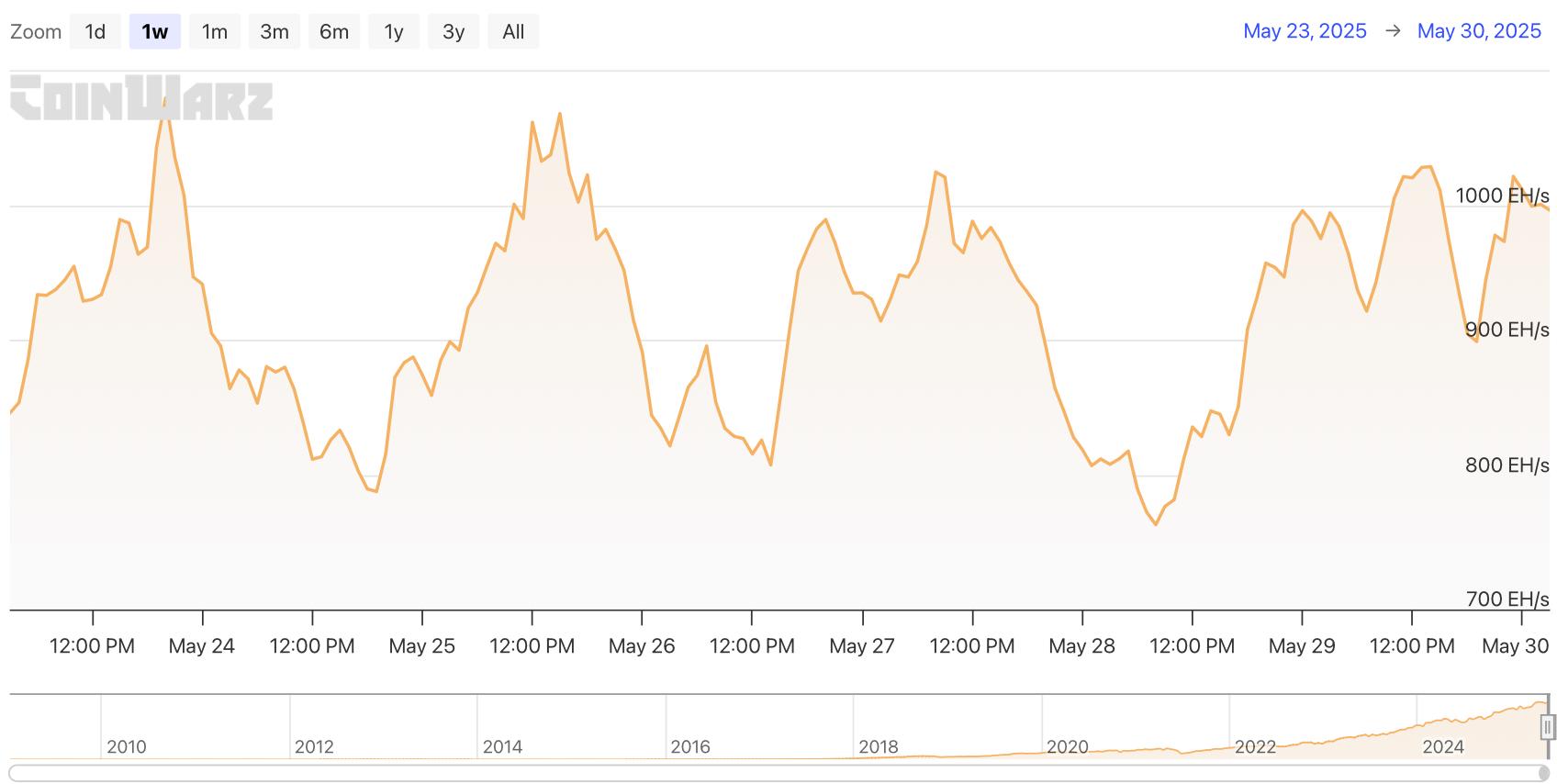
Bitcoin network hash rate data
4. Mining income
According to YCharts data, the total daily income of Bitcoin miners this week (including block rewards and transaction fees) is as follows: May 24: $48.28 million; May 25: $55.81 million; May 26: $52.92 million; May 27: $49.49 million; May 28: $56.30 million; May 29: $53.95 million. Overall, the average daily total income of miners this week remained roughly in the range of $48 million to $56 million, with little overall fluctuation, indicating that mining revenue has shown a relatively stable high-level fluctuation trend in this cycle.
From the perspective of output value per unit of computing power, as of May 30, the hash price of the Bitcoin network was $55.43/PH/s/day, which was in the upper-middle range this month.
From the trend of the past 7 days, the Bitcoin hash price (Hashprice) showed a trend of rising first and then falling: it fell back to $55.74/PH/s/day on May 26, and then rose to this week's high of $57.66/PH/s/day on May 28, and then gradually fell back to $55.14/PH/s/day on May 30. Overall, although the network difficulty remained high, the transaction fee income increased this week. At the same time, the withdrawal of some phased computing power reduced network competition, prompting Hashprice to remain relatively strong this week, and the overall performance was better than the mid-May level. From the monthly trend, the current Hashprice is still at a relatively high level in the past month, reflecting that the current Bitcoin mining network still has a certain income resilience under a high difficulty environment.
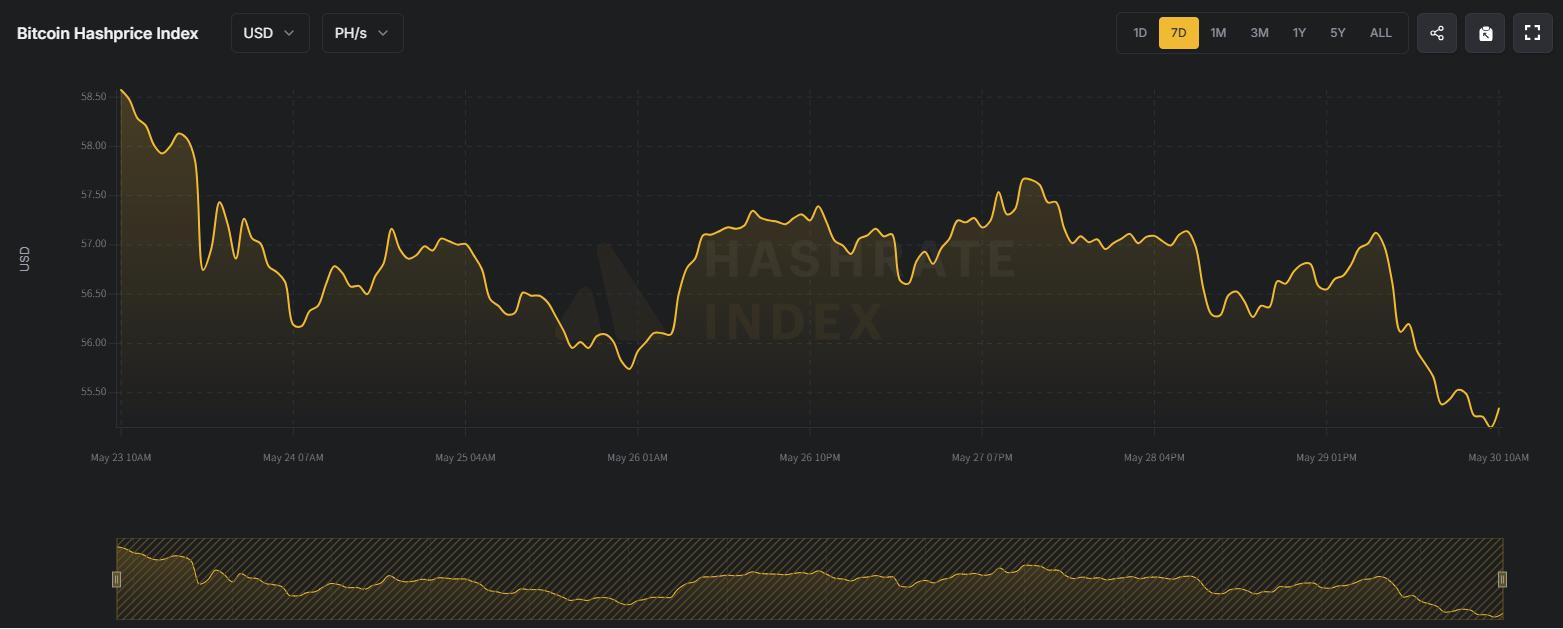
Hashprice data
5. Energy costs and mining efficiency
According to CloverPool data, as of the time of writing on May 30, the total network hashrate of Bitcoin was 925.74 EH/s, and the current network mining difficulty was 121.66 T. The next round of difficulty adjustment is expected to be carried out on May 31, with an estimated increase of 3.87%, and the difficulty will rise to 126.36 T. This trend shows that although the price of Bitcoin has been in a high-level oscillation phase recently, the total network hashrate continues to grow, reflecting that miners as a whole still have strong profit momentum, and more miners continue to put equipment online to participate in mining. This trend usually means that the market still holds an optimistic expectation for the medium- and long-term Bitcoin price, and the energy supply and hardware efficiency of the mining industry are steadily improving, supporting the continuous increase in hashrate.
From the perspective of mining costs, according to the latest model calculation results of MacroMicro, as of May 28, 2025, the unit production cost of Bitcoin is approximately US$91,321.19, while the spot price during the same period is US$107,802.32, and the corresponding mining cost-to-price ratio is 0.85. Currently, Bitcoin mining activities are generally in a profitable range, and miners can obtain an average profit margin of about 18.08% per Bitcoin. Although the ratio is not in an extremely low range (for example, when it is lower than 0.6, it usually indicates that miners are extremely profitable, which may be accompanied by stronger computing power growth and increased pressure to sell coins), it still shows that the current market has not yet entered a high-pressure reshuffle period.
Overall, Bitcoin mining is currently in a stage of "high profitability + high competition". As the difficulty increase in June approaches and many parts of the world enter the peak of summer electricity consumption, the marginal cost of some high-energy-consuming mining farms will be further compressed, which may trigger a new round of computing power optimization and equipment replacement. At the same time, the Bitcoin mining industry will further concentrate on the top miners with large-scale operation capabilities, low electricity price resources and efficient mining machine configurations, and the industry concentration is expected to continue to increase.
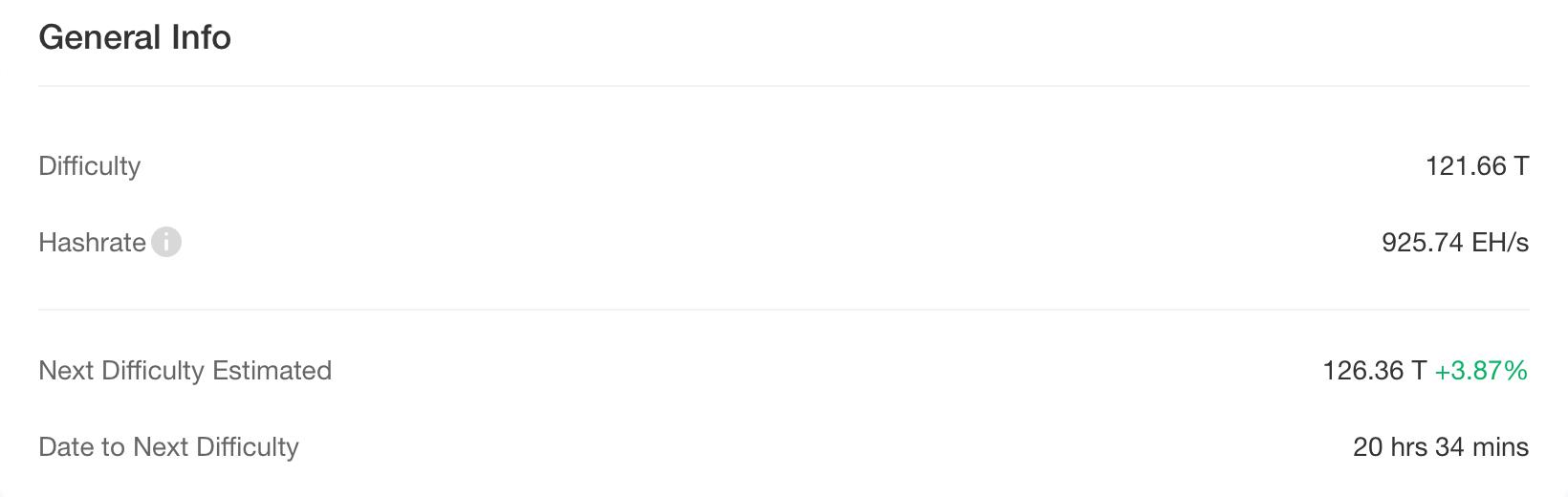
Bitcoin mining difficulty data
6. Policy and regulatory news
IMF: Will "continue efforts" to ensure El Salvador no longer accumulates Bitcoin
On May 28, the International Monetary Fund (IMF) said on Tuesday that it would "continue to work" to ensure that the total amount of Bitcoin held by the Salvadoran government remains unchanged. In March, El Salvador reached a $3.5 billion loan agreement with the IMF, one of the conditions of which was "prohibiting the public sector from voluntarily accumulating Bitcoin", while Bitcoin was delisted from its legal tender status and merchants were no longer forced to accept it. However, El Salvador's Bitcoin holdings increased from 6,101.15 to 6,189.18, worth about $678 million. President Bukele said: "It will not stop. If we did not stop when the world rejected us and most 'Bitcoiners' abandoned us, we will not stop now and in the future." Although El Salvador's increase in Bitcoin holdings seems to violate the loan agreement, the IMF report still believes that the overall implementation of the loan program "performed well" and key fiscal and reserve goals have been achieved.
Texas Bitcoin Reserve Act Coordinating Committee submits final report, awaiting vote by both houses
According to Bitcoin Laws, on May 27, the Texas Senate did not accept the House's amendment to the Bitcoin Reserve Act SB21. The disagreement between the two parties led the state legislature to set up a coordination committee composed of members from both houses for consultation. Later on May 28, it was reported that the coordination committee had reached an agreement on the content of the bill and submitted a final report. It is now waiting for the Texas Senate and House of Representatives to vote on it, and then it will be submitted to the governor's office for signature. The bill aims to promote Texas to include Bitcoin in the state's fiscal reserves.
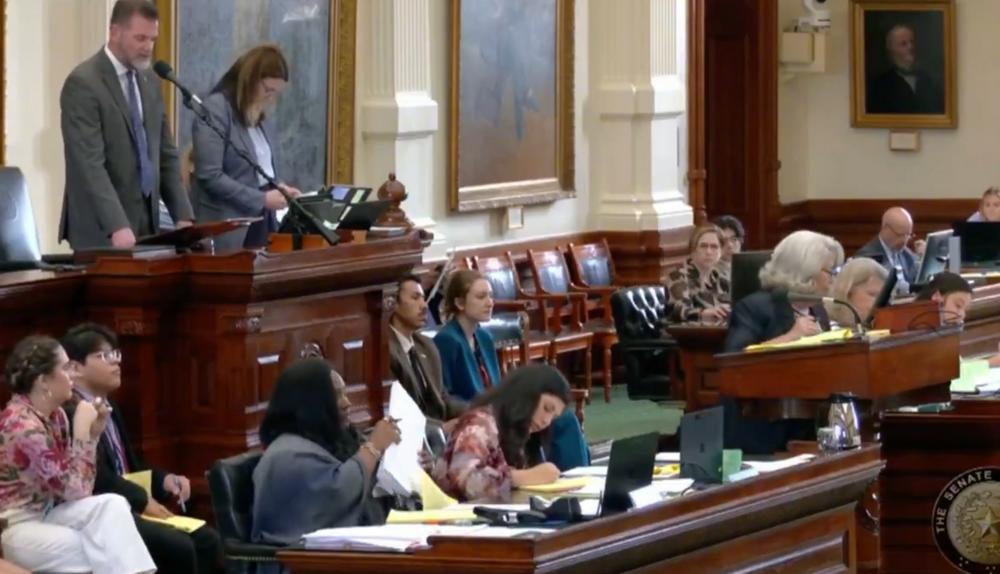
Related images
Pakistan is planning to establish a strategic Bitcoin reserve
On May 29, a cryptocurrency adviser to the Pakistani government announced on Wednesday that the country will launch a strategic Bitcoin reserve. Bilal Bin Saqib, the new special assistant to the prime minister on blockchain and cryptocurrency, said at the Bitcoin 2025 conference in Las Vegas that the Pakistani government is planning to establish its own strategic Bitcoin reserve.
“We were inspired by the (US government),” one official added. Earlier this year, President Donald Trump signed an executive order paving the way for the US to establish a strategic bitcoin reserve. “We will hold these bitcoins and will never sell them,” he added.
Panama Considers Building Strategic Bitcoin Reserves and Accepting Bitcoin Payments
On May 30, Panama was considering establishing a strategic Bitcoin reserve, as well as possibly paying in Bitcoin, including fees for passing through the Panama Canal.
Previously, Panama passed a bill allowing the use of Bitcoin to pay taxes, parking tickets, licenses and other fees.
7. Mining News
Russia's Bitcoin mining industry ranks first in the world in terms of growth rate and second in mining volume
According to news on May 24, Russia's Bitcoin mining industry currently ranks first in the world in terms of growth rate and second in the world in terms of mining volume. Russia's largest Bitcoin mining companies BitRiver and Intelion control more than 50% of the country's market share, and the two companies will generate a total of US$200 million in revenue in fiscal year 2024.
Pakistan appoints crypto advisor, plans to invest 2,000 megawatts of electricity in Bitcoin mining
On May 25, the Pakistani government allocated 2,000 megawatts of installed power capacity to support related industries in its first phase of plans to promote the development of Bitcoin mining and artificial intelligence data centers. The plan, led by the Pakistan Cryptocurrency Commission, aims to monetize the country's surplus energy, transform coal-fired power plants that operate at only 15% (such as Sahiwal, China Hub, Port Qasim) and create high-tech jobs.
On May 27, the Pakistani government appointed Bilal Bin Saqib as the Prime Minister's Special Assistant on Blockchain and Cryptocurrency. He is also the Chief Advisor and CEO of the Pakistan Crypto Commission. This move indicates that Pakistan is accelerating its efforts to build itself into a crypto-friendly economy, attracting the attention of global investors.

Related images
8. Bitcoin related news
Bitcoin holdings of global companies and countries (statistics for this week)
1. DDC Enterprise: DDC Enterprise (NYSE: DDC) announced on May 24 that it had completed the acquisition of the first 21 bitcoins as part of its bitcoin reserve strategy, with a market value of approximately $2.28 million. The company issued 254,333 common shares in exchange for bitcoins, and expects to complete the purchase of the remaining 79 in the next few days, with a total target holding of 100 BTC.
2. Semler Scientific: On May 24, Semler Scientific, a Nasdaq-listed medical technology company, announced that it had purchased another $50 million worth of Bitcoin. Its total Bitcoin holdings currently stand at 4,264, with a total value of approximately $466 million based on the price at the time.
3. Monochrome ETF: The Australian Monochrome Spot Bitcoin ETF (IBTC) officially disclosed that as of May 29, its Bitcoin holdings had increased to 666, an increase of 116 from the previous period. Based on the current price of the currency, the market value of the holdings has reached approximately A$111 million.
4. El Salvador: According to data from May 26 and May 27, the Salvadoran government increased its holdings by 7 bitcoins in the past week and increased its holdings by 1 more on May 27. The total holdings are currently 6,189.18 bitcoins, with a total value of approximately US$667 million.
5. Captor Capital: On May 28, Canadian investment company Captor Capital announced the launch of its Bitcoin treasury strategy and completed its first BTC purchase worth $500,000. At the same time, it raised funds from European investors by issuing convertible bonds, with a financing limit of up to $10 million.
6. KindlyMD: On May 28, Nasdaq-listed KindlyMD purchased 21 bitcoins for the first time, with a total value of approximately US$2.3 million, at an average price of US$109,027 per bitcoin, with funds coming from the exercise of warrants. The company is currently promoting a merger with Trump-related Bitcoin company Nakamoto, which is expected to be completed in the third quarter of 2025.
Corporate Bitcoin purchases in 2025: 205,507, 3 times more than new supply
On May 24, according to statistics from asset management company Bitwise, corporate Bitcoin purchases in 2025 have exceeded three times the new supply of Bitcoin. Companies have increased their holdings by 205,507 Bitcoins in total, and Bitcoin has increased its supply by 64,556. This only includes purchases disclosed by listed companies, not private companies.
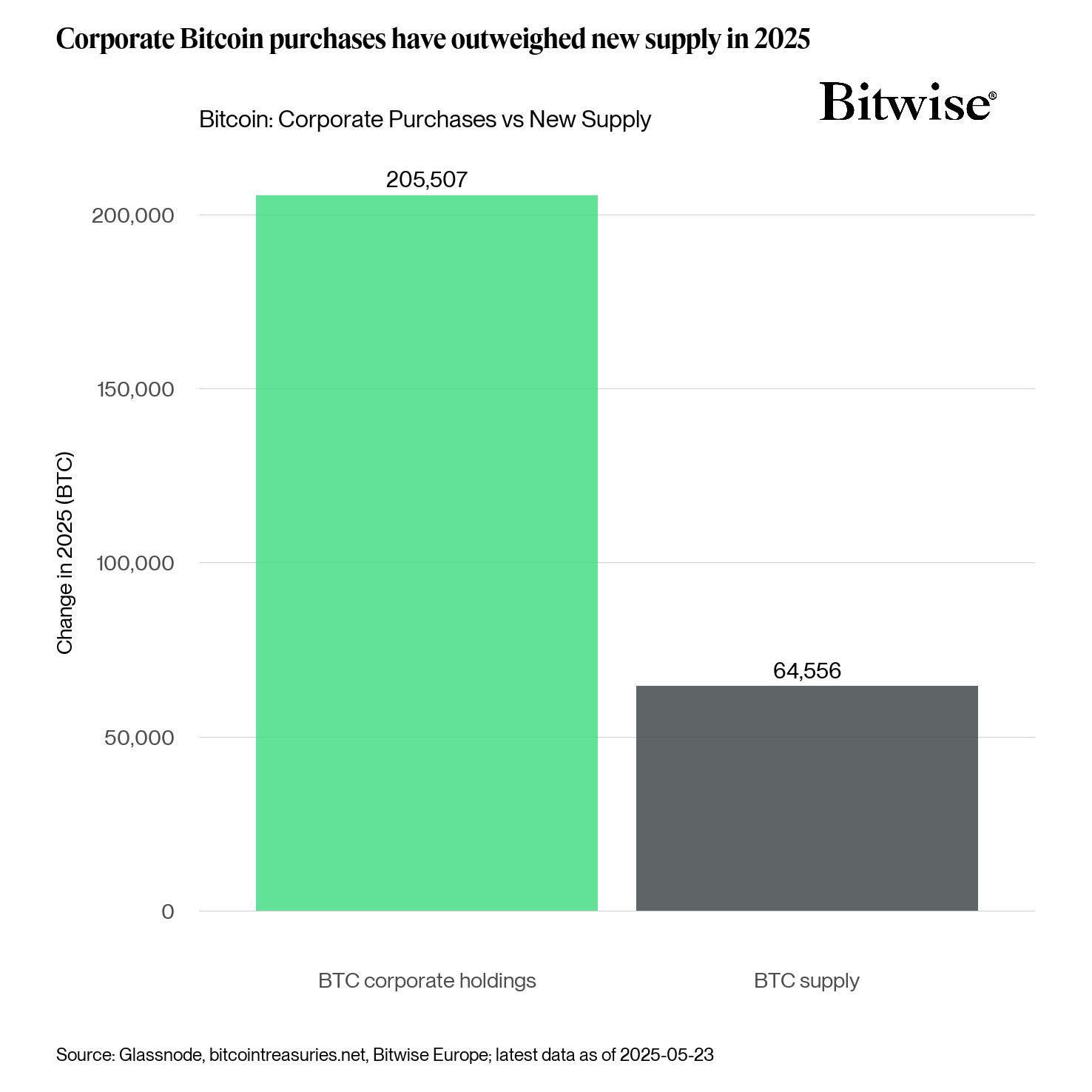
Related images
Trump Media & Technology Group (DJT.O) announces approximately $2.5 billion in Bitcoin funding transaction
On May 27, Trump Media & Technology Group (DJT.O) announced that it had reached a Bitcoin funding transaction of approximately US$2.5 billion and planned to use the raised funds to establish a Bitcoin reserve.
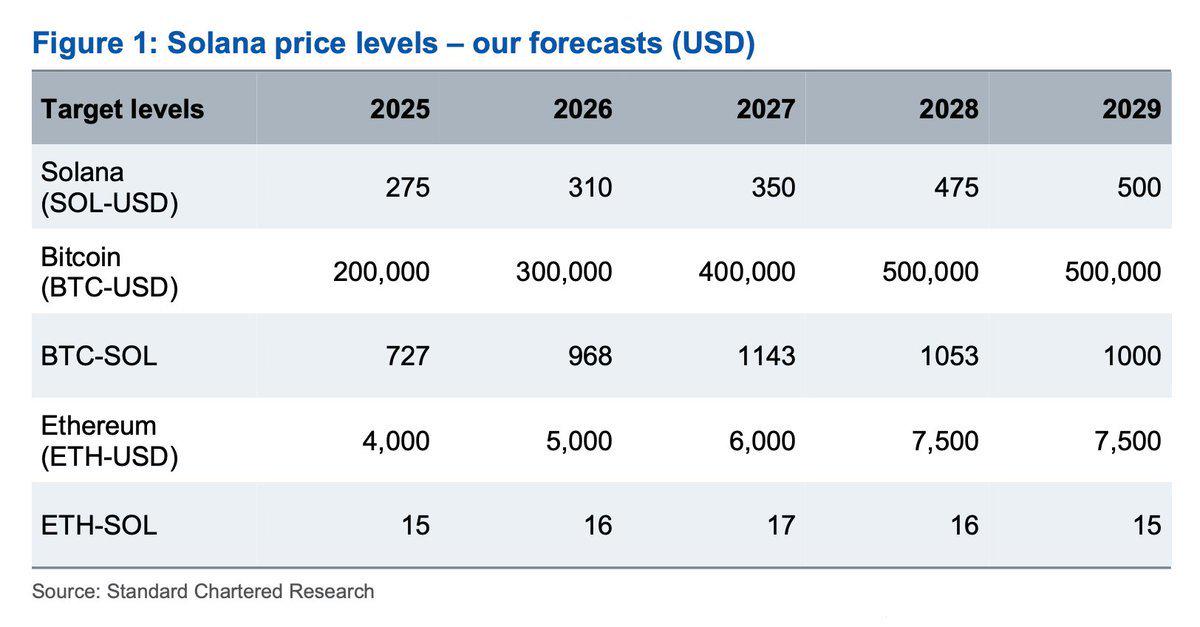
Standard Chartered Bank predicts Bitcoin will outperform Ethereum and Solana by 2025
On May 27, Standard Chartered Bank's recent report predicted that Bitcoin will reach a major milestone by the end of 2025, outperforming Ethereum and Solana. The study, released on May 27, provides a comprehensive five-year price forecast for Bitcoin (BTC), Ethereum (ETH), and Solana (SOL). The analysis focuses on expected price trends and relative valuations from 2025 to 2029. The study predicts that BTC will reach $200,000 by the end of 2025, $300,000 in 2026, $400,000 in 2027, and peak at $500,000 in 2028. The $500,000 level is expected to remain stable until 2029.
Related images
U.S. Congressman Lummis: Trump and senior U.S. military officials support the establishment of a strategic Bitcoin reserve
On May 28, 2025, at the "Bitcoin 2025" conference held in Las Vegas, U.S. Senator Cynthia Lummis of Wyoming said that Trump supports her proposed Bitcoin bill and has set up a special team in the White House to study digital asset policies, covering stablecoins, market structure and Bitcoin strategic reserves. The draft bill recommends that the U.S. government purchase up to 1 million Bitcoins to establish a strategic reserve. Lummis also revealed that the top U.S. military "strongly supports" this plan, believing that it will enhance the country's economic resilience and security.
Trump administration officials say Bitcoin is the gold standard and will not sell government-held Bitcoin
On May 28, at the ongoing "Bitcoin 2025" conference, President Trump's executive director said: "Bitcoin is the gold standard." He also emphasized: "We will not sell any Bitcoin that the US government may hold."
BlackRock executive: Bitcoin has much more room to rise than gold
On May 28, at the ongoing "Bitcoin 2025" conference, the managing director of BlackRock said, "Bitcoin has much more room for growth than gold.
US Vice President Vance predicts US Bitcoin holders will double, promises friendly regulatory framework
On May 29, US Vice President Vance said that about 50 million Americans hold Bitcoin, and I believe this number will soon increase to 100 million.
U.S. Vice President Cyrus Vance has welcomed the "mainstream" entry of cryptocurrencies into the U.S. economy, vowing to create "pro-innovation" rules for digital assets and praising a crypto billionaire who endorsed Trump's bid for the presidency last year. Speaking to thousands of orange-clad Bitcoin investors in Las Vegas on Wednesday, Vance touted the rise of cryptocurrencies and predicted that the number of Americans holding Bitcoin would soon double. "This is a movement — and I'm proud to stand with you today," Vance said on a stage named after Satoshi Nakamoto, the anonymous creator of Bitcoin. "We want our fellow Americans to know that cryptocurrencies and digital assets, especially Bitcoin, are part of the mainstream economy and are here to stay." Vance said the Trump administration would quickly develop a regulatory framework for tokens pegged to the U.S. dollar. The next priority will be to create a "transparent and tailored regulatory framework for digital assets — one that supports innovation and fully integrates cryptocurrencies into the mainstream economy."

Related images
Trump's son: Bitcoin may exceed $170,000 by the end of 2026
On May 29, Donald Trump Jr., the eldest son of Trump, and Eric Trump, the second son, predicted at the Bitcoin 2025 conference that the price of Bitcoin may exceed $170,000 by the end of 2026. Eric revealed that Michael Saylor, the founder of MicroStrategy, had suggested that the Trump family mortgage Mar-a-Lago to invest in Bitcoin and guided them to establish a crypto asset reserve strategy.
Many of the Trump family's businesses have recently entered the crypto space: the parent company of its Truth Social plans to raise $2.5 billion to establish Bitcoin reserves; its joint venture mining company American Bitcoin plans to go public through a SPAC; and the World Liberty project will launch the stablecoin USD1.
Michael Saylor explains the guiding principles of "21 Ways to Get Rich" at Bitcoin 2025
On May 30, Strategy founder Michael Saylor delivered a keynote speech at the Bitcoin 2025 Conference in Las Vegas on Thursday, poetically praising Bitcoin and explaining to the audience and participants the guiding principles of what he called "21 Ways to Get Rich."
Michael Saylor said, "Satoshi Nakamoto lit a fire in cyberspace. The timid will flee from it, the ignorant will dance around it, and the loyal will add fuel to the fire, embrace the dream of a better world, and bathe in the warmth of the light of the Internet. Many people will be afraid of Bitcoin. They will never touch it, never benefit from it, and eventually be left behind by the times. But those who truly understand it will add fuel to the fire. Buying Bitcoin is adding fuel to the fire."
Michael Saylor said, "Take out your fiat currency and exchange it for Bitcoin. Take out your long-term capital and exchange it for Bitcoin. Sell your bonds and exchange them for Bitcoin. Sell your bad stocks, sell your bad real estate, and buy Bitcoin." This is the third way to get rich: courage. In addition to courage, Michael Saylor also advised the audience to have confidence in the potential of Bitcoin.