Author: Nancy, PANews
Traditional financial institutions are accelerating their entry into the crypto market. On June 24, payment giant Mastercard announced that it would provide on-chain cryptocurrency purchase services, further promoting the mainstreaming of crypto payments.
In fact, in recent years, Mastercard has been continuously deepening its encryption strategic layout, and has moved from experimental exploration to the actual implementation stage, becoming a key part of its global financial map.
Can you buy coins by swiping your card? Mastercard opens up a deposit channel on the blockchain
Yesterday, Chainlink and Mastercard officially announced a strategic partnership that will allow more than 3 billion cardholders worldwide to purchase cryptocurrencies directly on the blockchain through credit cards. This is not only another major layout of Mastercard in the field of encryption, but also realizes the deep integration of traditional financial networks and DeFi core components in the path of legal currency deposit, which may open a new channel for the large-scale popularization of on-chain finance.
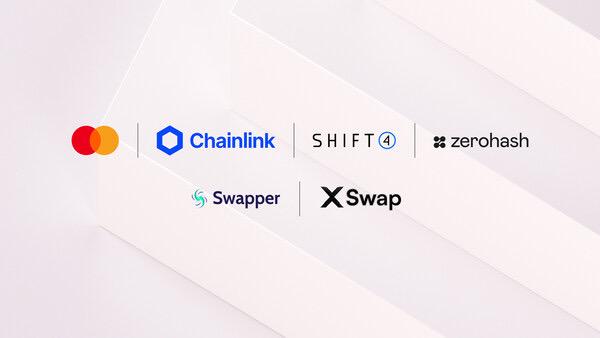
It is reported that in this service system, users do not need to register a centralized exchange (CEX) account or operate complicated on-chain bridging processes. They only need to initiate a transaction request through DEX Swapper Finance, which has integrated this function, to use Mastercard to purchase crypto assets.
Among them, Swapper Finance serves as the user's front-end entrance and supports the initiation of credit card payment instructions; traditional payment gateway service provider Shift4 Payments provides seamless card payment processing, verifies and processes users' legal currency payments (such as US dollars, euros, etc.); ZeroHash, as a cryptocurrency and stablecoin infrastructure provider, is responsible for converting users' legal currencies into cryptocurrencies (such as BTC, ETH, etc.), and ensuring compliance, providing liquidity and on-chain services; Chainlink's decentralized oracle network and interoperability standards (CCIP) ensure the security of on-chain transactions and the reliability of data, and its ecological DEX XSwap uses protocols such as Uniswap to obtain liquidity and complete on-chain exchanges of cryptocurrencies.
Ultimately, the encrypted assets will be sent directly to the user's on-chain wallet address through smart contracts. The entire process does not require understanding trading pairs, gas fees or slippage parameters, nor does it require switching to a centralized trading platform.
You should know that in the past few years, whether it is traditional payment companies such as Visa or Mastercard, their cooperation in cryptocurrency has mostly focused on the consumer end, that is, allowing users to swipe coins for consumption through encrypted debit cards, and the background will automatically convert the digital assets held into legal currency for daily payments, such as the encrypted debit cards launched by Uphold and Worldcoin.
However, the cooperation between Mastercard and Chainlink is no longer about using on-chain assets for real-world consumption, but about directly opening up a channel from fiat currency deposits to on-chain assets, allowing non-crypto native users to obtain on-chain assets by swiping their cards like shopping on Amazon, without having to understand any DeFi concepts, and in a compliant and transparent manner. This not only breaks the long-standing barrier of DeFi users to deposit funds, but also provides a compliant, secure, and controllable on-chain channel for the traditional financial system.
In this regard, Raj Dhamodharan, Executive Vice President of Blockchain and Digital Assets at Mastercard, said: “People want to be able to easily connect to the digital asset ecosystem and vice versa. This is why we continue to use our global payment network and mature experience to bridge the gap between on-chain commerce and off-chain transactions. By working together with Chainlink, we are opening up a secure and innovative way to revolutionize on-chain commerce and promote the wider adoption of crypto assets.”
“This is a classic example of the integration of traditional finance and decentralized finance. I am very excited that Chainlink can promote this key connection from traditional payment networks to on-chain DEX trading environments. This is a complex and multi-layered collaboration, and I am very pleased to be able to leverage the power of the Chainlink community to make it happen.” Chainlink co-founder Sergey Nazarov also pointed out.
In order to stimulate new business models through encryption, this year we will focus on three areas
"The key issue that prevents cryptocurrency from going mainstream is that it is difficult for users to identify and transfer money to each other through methods they are familiar with. Mastercard's goal is to become a connector between traditional finance and blockchain networks, inspiring new business models while ensuring compliance." Raj Dhamodharan, head of Mastercard's encryption and blockchain business, recently pointed out that Mastercard has now moved from the experimental stage to providing actual encryption solutions.
In fact, unlike many traditional financial institutions that still view crypto as a fringe area or regulatory risk, Mastercard is deepening its layout in the crypto field and gradually integrating crypto assets, stablecoins and tokenized assets into daily payment experiences.
According to a report submitted by Mastercard to the U.S. SEC in February this year, the company has made significant progress in achieving its goal of "innovating the payment ecosystem", including tokenizing transactions, creating solutions to unlock blockchain-based business models, and simplifying access to digital assets. At the same time, in this document, Mastercard clearly pointed out that digital currencies have the potential to subvert traditional financial markets and may directly challenge its existing products. Due to the accessibility, immutability and efficiency of digital assets, stablecoins and cryptocurrencies may become more popular as they are regulated and are becoming competitors in the payment industry.
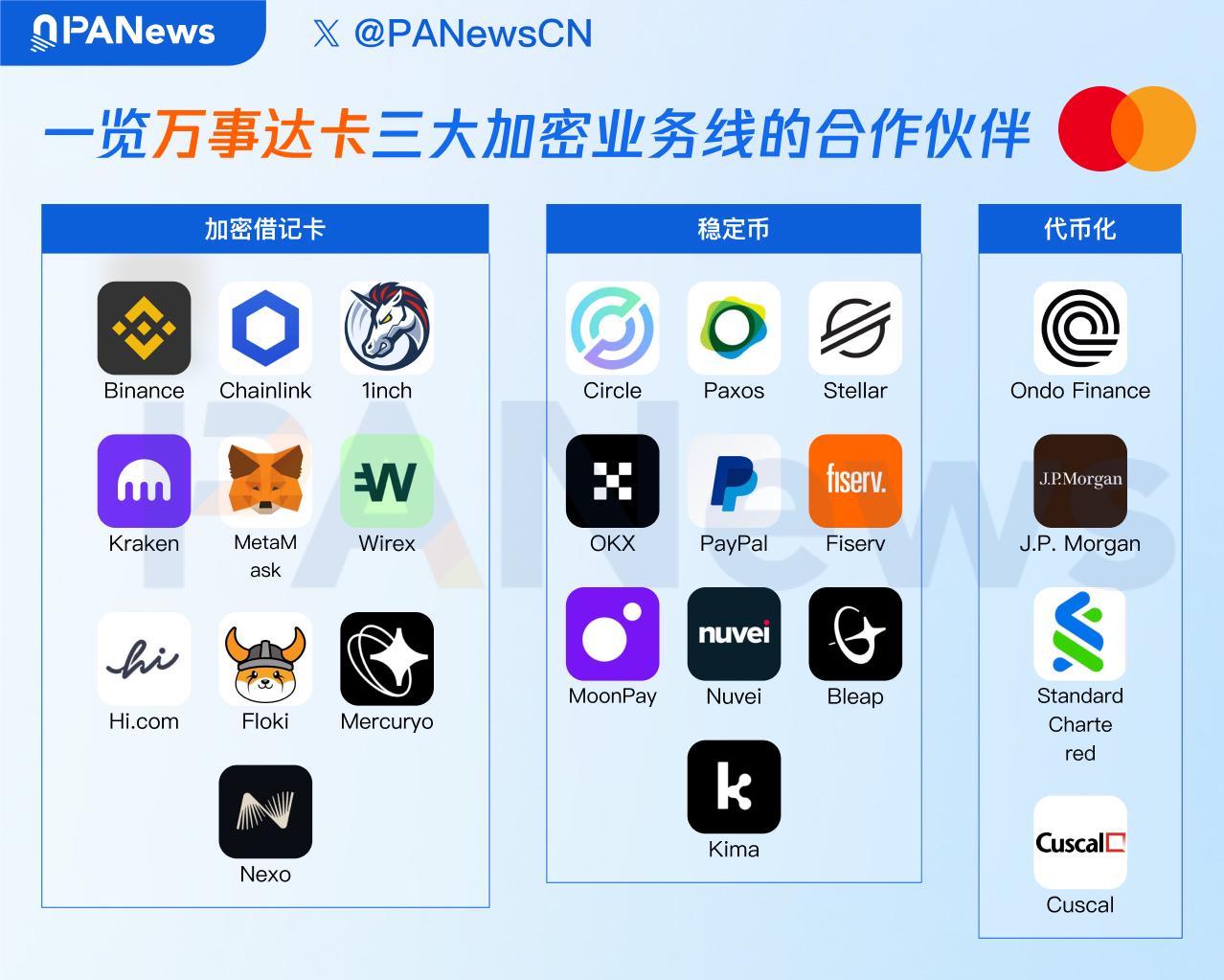
In fact, before swiping cards to buy coins became a reality, Mastercard has been promoting the commercialization of crypto payments, including cooperating with crypto companies such as Binance, Kraken, MetaMask, 1inch and Floki to launch co-branded crypto debit cards, allowing cardholders to make purchases directly with cryptocurrencies and automatically complete the fiat currency exchange in the background.
Not only that, in the process of deploying encrypted payments, stablecoins are also becoming the strategic center of Mastercard's on-chain settlement.
Not long ago, Mastercard joined the Global Dollar Network, a stablecoin alliance initiated by Paxos and other institutions, to jointly mint and share the interest income of the stablecoin USDG linked to US bonds. At the same time, Mastercard will also support PayPal's PYUSD and Fiserv's FIUSD stablecoins, and integrate them into the Mastercard Move cross-border payment network; in May, Mastercard announced that it would join hands with the crypto payment company MoonPay to launch a new stablecoin payment card, which supports users to make stablecoin payments at more than 150 million merchants worldwide, and transactions will be automatically converted to legal currency; in April, Mastercard announced that it will cooperate with Nuvei, Circle and Paxos to launch a full range of stablecoin payment solutions, and merchants will soon be able to directly use stablecoins including USDC to complete transaction settlement. In the same month, Mastercard cooperated with OKX to launch OKX Card, supporting stablecoin payments in its huge merchant network, and reached a strategic cooperation with Bleap, founded by former Revolut employees, aiming to integrate stablecoin payments more deeply into traditional financial infrastructure, etc.....
These intensive actions show that Mastercard is incorporating stablecoins into users' daily consumption, settlement and transfer behaviors. In order to improve the security and user-friendliness of crypto asset transactions, Mastercard has previously launched Crypto Credential, which reduces the possibility of errors in the cryptocurrency transfer process by replacing complex wallet addresses with easy-to-use aliases.
In addition to stablecoins, Mastercard is also vigorously promoting the construction of asset tokenization. In April this year, Mastercard revealed that it was developing a multi-token network Multi-Token Network, with the goal of replicating its traditional payment network to provide digital asset trading infrastructure for consumers, merchants and financial institutions. The system will integrate on-chain and off-chain asset flows to ensure compliance and optimize user experience. Mastercard has cooperated with JPMorgan Chase, Standard Chartered and others to explore scenarios such as cross-border payments and carbon credit tokenization, and has applied for more than 250 blockchain-related patents since 2015. In February, Ondo Finance joined the Mastercard network to improve cross-border payments, and its short-term U.S. government bond fund (OUSG) investment products will be open to companies on the Mastercard Multi-Token Network (MTN), enabling them to earn returns through tokenized assets. Last November, Mastercard has partnered with JPMorgan Chase's digital asset business Kinexys, its blockchain-based tokenized asset transfer system Multi-Token Network (MTN), to strengthen B2B cross-border payments, provide greater transparency and faster settlement speeds, and reduce time zone friction. In August of the same year, in order to combat the endless stream of online fraud, Mastercard is planning to cancel credit card numbers and expand tokenization plans using biometric data such as fingerprints or facial scans as security measures. In May 2024, Mastercard completed the tokenized deposit proof-of-concept test through the Hong Kong Monetary Authority's regulatory sandbox. According to Mastercard, it has achieved tokenization of 30% of its transactions by 2024.
"We believe that the future financial system will include both bank deposits and stablecoins. Deposits are the basis of funds, and stablecoins provide efficient settlement capabilities on the chain. If there is more regulatory clarity in the future, allowing deposits to be represented in some form on the public chain, this will be the key to the large-scale expansion of tokenization." In an interview a few months ago, Dhamodharan revealed that Mastercard has set three strategic priorities for 2025: on-chain/off-chain deposits and withdrawals, Crypto Credential promotion, and stablecoin applications. Currently, Mastercard has supported financial institutions to use stablecoins for transaction settlement, and plans to announce more partnerships and application scenarios this year to continue to advance the process of crypto integration.
Amid the accelerating integration of traditional financial institutions and the crypto world, Mastercard is breaking through in three major areas to build its own crypto business empire.