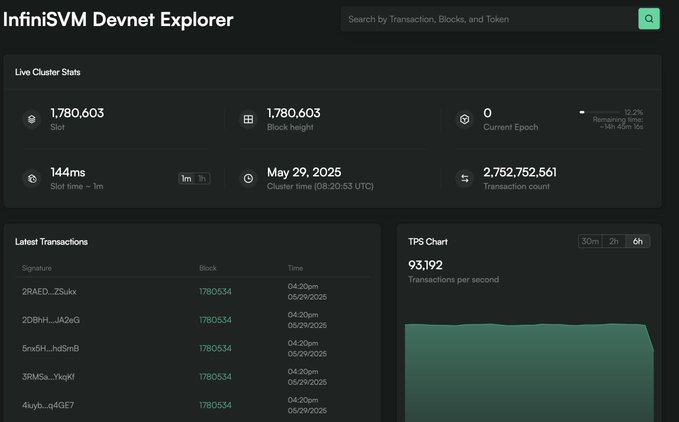
I heard that Solayer launched InfiniSVM Devnet, and immediately released a usable test environment with a peak of 340,000+ TPS? To be honest, when the Solana ecosystem was still at 4,000 TPS and PumpFun users were still suffering from transaction failures, Solayer's solution was not a gradual optimization, but a direct leap in magnitude.
What is the confidence behind this?
1) The confidence of InfiniSVM comes first from an industry reality: the pure software optimization route has reached its limit, and hardware acceleration is just in time.
In the past few years, the performance improvement of blockchain has mainly relied on architectural innovation - from Bitcoin's UTXO to Ethereum's account model, from PoW to PoS, from single chain to L1+Layer2 modular stacking, these are all breakthroughs at the software level. But now this road is getting narrower and narrower.
This is why most high-performance chains are stuck at the 10,000-level TPS threshold.
The 160,000 TPS claimed by Aptos is mostly a theoretical value, and Sui is also difficult to run at full capacity continuously in actual applications. The fundamental reason is the physical bottleneck under the general hardware architecture.
Traditional CPU serial processing, network I/O latency, and memory access overhead, these hardware-level limitations are becoming the biggest obstacles to performance improvement.
The RDMA (remote direct memory access) hardware acceleration technology route chosen by InfiniSVM essentially bypasses the CPU bottleneck and allows nodes to communicate directly at the memory level. In addition, InfiniSVM also introduces a multi-executor parallel processing model and cooperates with SDN (software defined network) for real-time traffic optimization. These are all possibilities for finding new breakthroughs at the hardware level, and are also an important shift in the development of the industry.
2) InfiniSVM is fully compatible with the Solana virtual machine, which means that for developers who have already worked in the Solana ecosystem, migrating to InfiniSVM is basically a matter of "changing the RPC endpoint". The commercial value of this compatibility design is self-evident. Traditional blockchains are limited by the TPS ceiling, and many application scenarios can only remain in the conceptual stage. For example, high-frequency algorithmic trading, real-time game state synchronization, etc. The confirmation finality of InfiniSVM (0.01 second confirmation time) is a breakthrough indicator in many application scenarios: real-time interaction in blockchain games, millisecond settlement of DEX, high-frequency automated trading of AI Agent, etc. This is critical to breaking through the current limitations of Solana's application scenarios.
3) InfiniSVM adopts a hybrid POAS consensus model that attempts to find a balance between performance and decentralization. Daily transactions are quickly processed through the validator network, and the Solana mainnet is used as the final arbitration when disputes or abnormal situations occur. This "fast track + insurance mechanism" design idea is quite pragmatic.
In fact, this design idea is not new - the early design of Polygon and various side chain solutions have similar logic. The problem is that hardware acceleration solutions will naturally increase the threshold for node operation. Although RDMA and InfiniBand technologies have strong performance, the cost and technical complexity are also increased accordingly. Like most high-performance chains, there is bound to be the problem of "centralization" of the verification node network.
This logic is very realistic: since the hardware acceleration route will inevitably lead to the centralization of the validator network, a mature decentralized network should be used as the ultimate security guarantee. This is equivalent to layering the two requirements of "performance" and "security" - InfiniSVM is responsible for extreme performance, and Solana is responsible for ultimate security.
Above. It should be noted that Devnet is still in the internal testing stage at this stage. The blockchain status will be reset from time to time, and the network data may be intermittently unstable. These all indicate that there is still a lot of engineering work to be done before it is ready for production. Especially when facing the extreme pressure of 1 million+ TPS.
In general, InfiniSVM represents an important directional shift in blockchain infra - from software optimization to hardware acceleration, from theoretical innovation to engineering implementation. In simple terms, Solayer's confidence is the forward-looking choice of "technical path". (As shown in the figure below, the real-time TPS is nearly 100,000)