
Ethereum’s recent decline has really hurt many investors.
A recent report from Matrixport pointed out that the global search popularity of Ethereum has approached its historical low, which in the past often foreshadowed a further sharp drop in prices. The reduction in ETH on-chain activities, the decline in total locked value (TVL), and the market's speculation about the potential strategic digital asset reserves of the United States have led to a significant weakening of demand for Ethereum's native token ETH. The current market environment shows that weak demand for ETH has become an indisputable fact.
However, there are still many staunch supporters of the Ethereum ecosystem in the industry. Du Jun, founder of ABCDE, publicly stated on March 3 that despite the book loss of more than $20 million due to the increase in Ethereum holdings in the past year, he still firmly believes in the value of Ethereum and even considers selling other assets to lower the cost of ETH holdings.

Nick Tomaino, founder of the well-known investment institution 1confirmation, bluntly stated on social media that they will "double down on ETH" because in his opinion, Ethereum is one of the only two "trusted, neutral and sufficiently decentralized" ecosystems in the crypto world and has unique long-term "social scalability."

Faced with continued sluggish market sentiment and the "counter-force support" of industry leaders, what will be the future of Ethereum?
Comparison of historical cycles: Is the script repeating itself?
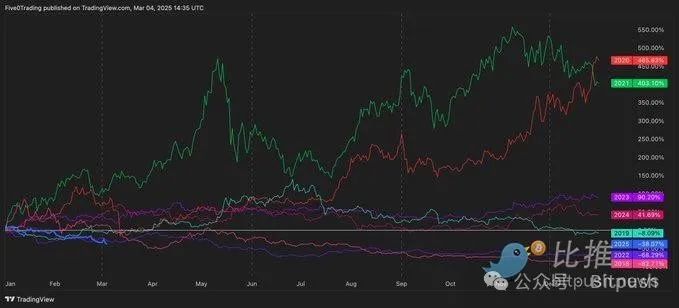
Some market observers have pointed out that Ethereum's recent performance is similar to the bear markets of 2018 and 2022. Anonymous trader 5.0 Inverted said that Ethereum is "following the price trend of the 2018 and 2022 bear markets." The data in the figure below shows that Ethereum fell 82.71% and 68.29% in 2018 and 2022, respectively, and continued to fall in the second half of the year.
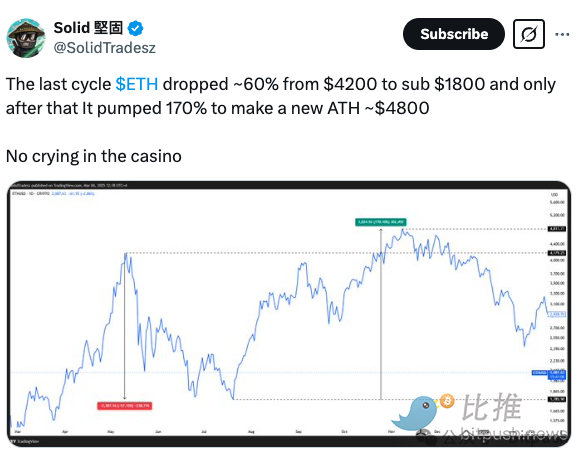
Another trader pointed out that Ethereum fell 60% from $4,200 to $1,800 in the last cycle, and then rebounded 170% in the following months, eventually hitting a record high of $4,800. Drawing on the experience of 2021, Ethereum may continue to maintain its current weak trend before rebounding at the end of the year.
Technical analysis: long and short signals intertwined
As of writing, Ethereum has rebounded from lows below $2,000 to around $2,240, finding strong support around the $2,000 mark, a level that coincides with the key ICT Best Trade Entry (OTE) level closely watched by traders and has temporarily halted the downward momentum of the price.
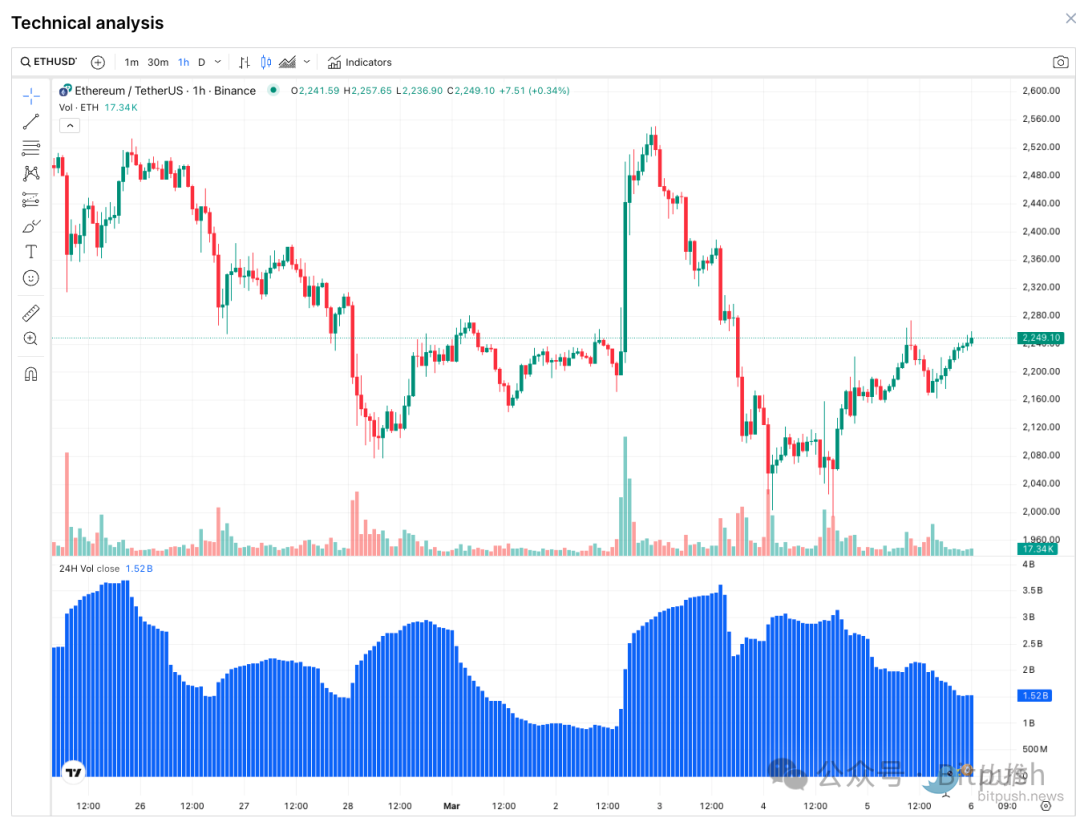
Looking at the hourly chart, ETH price shows mixed signals. After briefly breaking through the local resistance at $2,262, the price has started to fall back, and bears may further push the price down in the short term.
The daily chart is more positive. Ethereum price started to recover after rebounding from the $2,076 support level. In the medium term, there is no clear reversal signal. Traders should focus on the key area of $2,000. If this level is broken, the price may soon test the $1,750 area.
Market analysts expect Ethereum to consolidate in a wide range between $2,000 and $2,500, and this range-bound movement may continue until a breakout signal appears, heralding the next major rally. Both bulls and bears are closely watching these key levels.
If Ethereum can maintain above $2,000 and accumulate momentum, the current stage may evolve into a new bullish wave. Chart analyst Ali Martinez believes that Ethereum's most critical resistance level is at the $2,400 mark, where more than 2.41 million investors have purchased 62.68 million ETH. For analysts, breaking through this level could "pave the way for a rally to $3,000."
CryptoQuant analyst MACD believes that the Ethereum MVRV ratio has fallen below 1, putting Ethereum in an undervalued area. Historically, this level has seen significant price increases in previous bull cycles. In addition, MACD points out that Ethereum accumulation addresses (addresses that continue to receive ETH but never withdraw it) have increased sharply, indicating that institutional investors are building their positions during the current market downturn.
However, MACD also acknowledges that broader economic conditions, such as liquidity policy and monetary policy in the United States, may continue to exert downward pressure on asset prices. Market sentiment has not yet fully turned to optimism, and investors need to remain cautious and wait for more clear signal verification.