
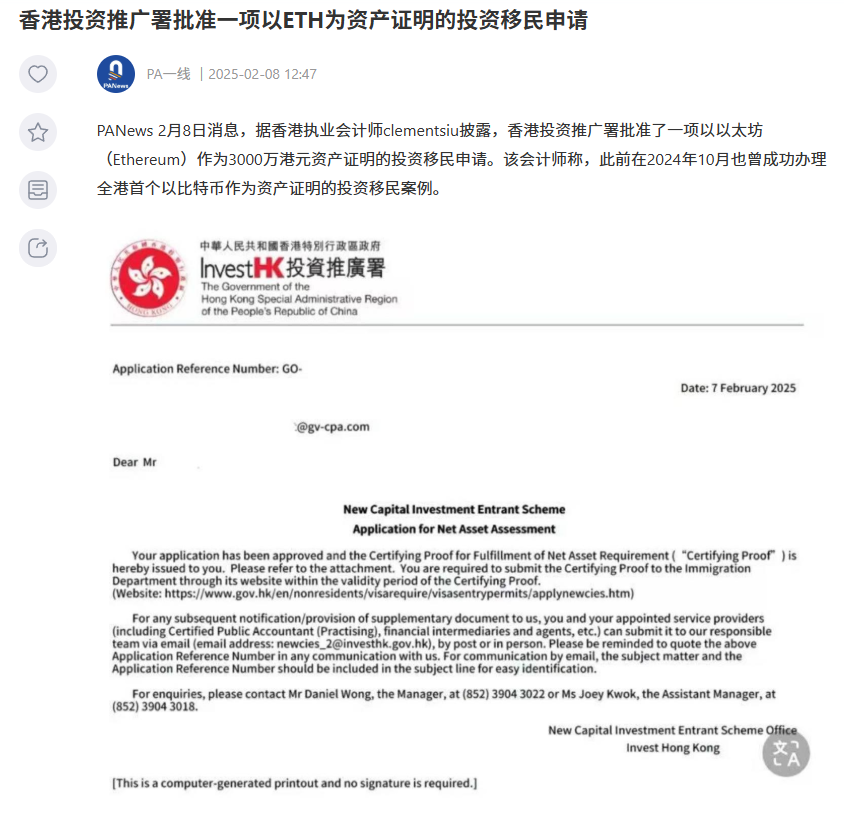
Recently, Invest Hong Kong approved a "new thing": someone used 30 million Hong Kong dollars of Ethereum (ETH) as proof of assets and successfully applied for investment immigration. This is not the first time. Last October, there was a case of "passing customs" with Bitcoin. It sounds like cryptocurrency players have found a "shortcut", but in actual operation, many large holders of coins are stuck in a key link - proof of source of funds (SOF). Today we will talk about what is going on.
1. Why can cryptocurrency be used as “proof of assets”?
According to Hong Kong's "New Capital Investor Entry Scheme", applicants need to prove that they beneficially own (or share with their spouse) at least HK$30 million in assets, including stocks, bonds, deposits, real estate, etc. There are two core logics for the acceptance of cryptocurrencies:
1. The policy does not explicitly prohibit: The Hong Kong government has an open attitude towards asset types. As long as the accountant can issue a report to prove that these assets actually exist and belong to the applicant, in theory they meet the requirements.
2. There are precedents in the market: According to the industry partners I have contacted, they already have many similar cases, from Bitcoin to Ethereum. As long as the process is compliant, there is no essential difference between cryptocurrency and stocks and real estate.
But here comes the problem: "proving that you have money" and "proving where your money comes from" are two different things.
2. The biggest hurdle: Proof of Source of Funds (SOF)
There is a classic contradiction in the cryptocurrency circle: "The coins can be taken out, but the money cannot be explained."
- Early players have many “black histories”: many people obtained coins through mining, over-the-counter transactions, or even “gifts from friends” in their early years, and they cannot produce bank statements or transaction records at all.
- Exchanges are hampered by “collapses”: Platforms such as FTX and Binance have had compliance issues, and some users’ historical data has been lost or not recognized by regulators.
- Anonymity is a double-edged sword: Although blockchain is transparent, it is difficult to directly link wallet addresses to real people’s identities, making it difficult for accountants and immigration authorities to trace the source of funds.
For example, a big investor spent HKD 1 million to buy Bitcoin in 2017, which is now worth HKD 10 million. But the transfer records of that year have long disappeared, or the transaction was made in cash. How can we prove that the HKD 100,000 was legal income? If we cannot prove this, our immigration application will be rejected.
3. Accountants’ Dilemma: Understanding Currency and Complying with Regulations
Hong Kong policy stipulates that proof of assets mainly relies on reports from certified public accountants (CPAs), but accountants also have headaches:
1. Confusion in valuation standards: Cryptocurrencies fluctuate drastically. Should we calculate based on the price at the time of application or the average value over the past six months? Different accountants may have different operations.
2. High pressure on anti-money laundering: If the client’s money comes from unknown channels, the accountant may be blamed for the report.
3. High technical threshold: How to verify the ownership of the wallet address? How to distinguish "own assets" from "temporarily borrowed coins"? All these require professional knowledge.
4. What to do? Three ways to break the deadlock
For large cryptocurrency holders, if you want to apply for immigration using cryptocurrency, you need to make these preparations in advance:
Keep evidence from the first day : transfer records of buying coins, exchange bills, tax payment certificates, even a handwritten receipt is better than nothing.
Find a professional team : The combination of lawyer + accountant + immigration consultant is key, especially an institution familiar with cryptocurrencies and Hong Kong policies, who can help you design a compliance path.
Compliance in batches: If the source of funds in the early years is unclear, you can add WeChat for consultation.
Previously, Aiying also wrote a related article " Hong Kong New Capital Investor Entry Scheme: A Complete Analysis of Virtual Asset Investment and a Guide to Applying for a Hong Kong Virtual Asset Management License ". The following is a summary of some of the content:
The Hong Kong government's policy address announced that the minimum investment threshold for the "New Capital Investor Entrant Scheme" is HK$30 million, of which applicants must invest at least HK$27 million in permitted financial assets and non-residential real estate, and invest HK$3 million in the new "Capital Investor Entrant Scheme Portfolio" to support the development of the innovation and technology industry and other key industries. This means that for those who want to immigrate, they can now obtain Hong Kong residency by investing in these financial assets.
The scope of permitted investment assets is a highlight. According to the published list of "permitted investment assets", ownership interests in limited partnership funds (LPFs) and open-ended fund companies (OFCs) managed by Hong Kong Type 9 licensed companies are recognized as investable assets.



